Despina Petrushevska
Nutrition intake form
A nutrition intake form is a structured questionnaire that records a patientR...

3
Last Updated: Oct 22, 2026
Free PDF 3 pages, print-ready Clinician-reviewed
Download your free bariatric psychological evaluation template Bariatric Psychological Evaluation A ready-to-use bariatric psychological evaluation form covering surgical readiness, weight-loss history, eating-disorder and substance-use screening, mental health status, support systems, and clearance documentation for weight-loss surgery candidates. Download template Bariatric surgery programs almost always require a psychological evaluation before they’ll clear a patient for surgery, […]
A ready-to-use bariatric psychological evaluation form covering surgical readiness, weight-loss history, eating-disorder and substance-use screening, mental health status, support systems, and clearance documentation for weight-loss surgery candidates.
Upload this PDF, or any form you already use, and Pabau's AI Form rebuilds it with tick boxes, text fields and a signature. Attach it to the treatment once, and every patient gets it on time.
AI Form rebuilds the consent, history and aftercare forms you already use. You review each one, then publish.
Patients complete forms on their phone before they arrive, so the front desk stops retyping paper.
Every signed form is versioned and attached to the treatment record, ready when you need it.
Set how long a consent stays valid. Returning patients skip forms they have already signed.
Supports HIPAA and GDPR compliance AES-256 encryption 4.8 on G2 4.7 on Capterra Trusted by 4,000+ practices worldwide

A bariatric psychological evaluation is a pre-surgical psychosocial assessment that screens weight-loss surgery candidates for eating disorders, mental health history, and readiness to sustain lifelong post-op behavior change.
Most bariatric surgery programs and insurers require this evaluation as a condition of surgical approval. That makes it a program and payer requirement rather than a universal legal mandate, and it’s typically completed by a psychologist or psychiatrist.
The evaluation combines a diagnostic interview of roughly 45 to 90 minutes with self-report instruments such as the BDI for depression and the EDE-Q for eating pathology, plus substance-use and support-system screening.
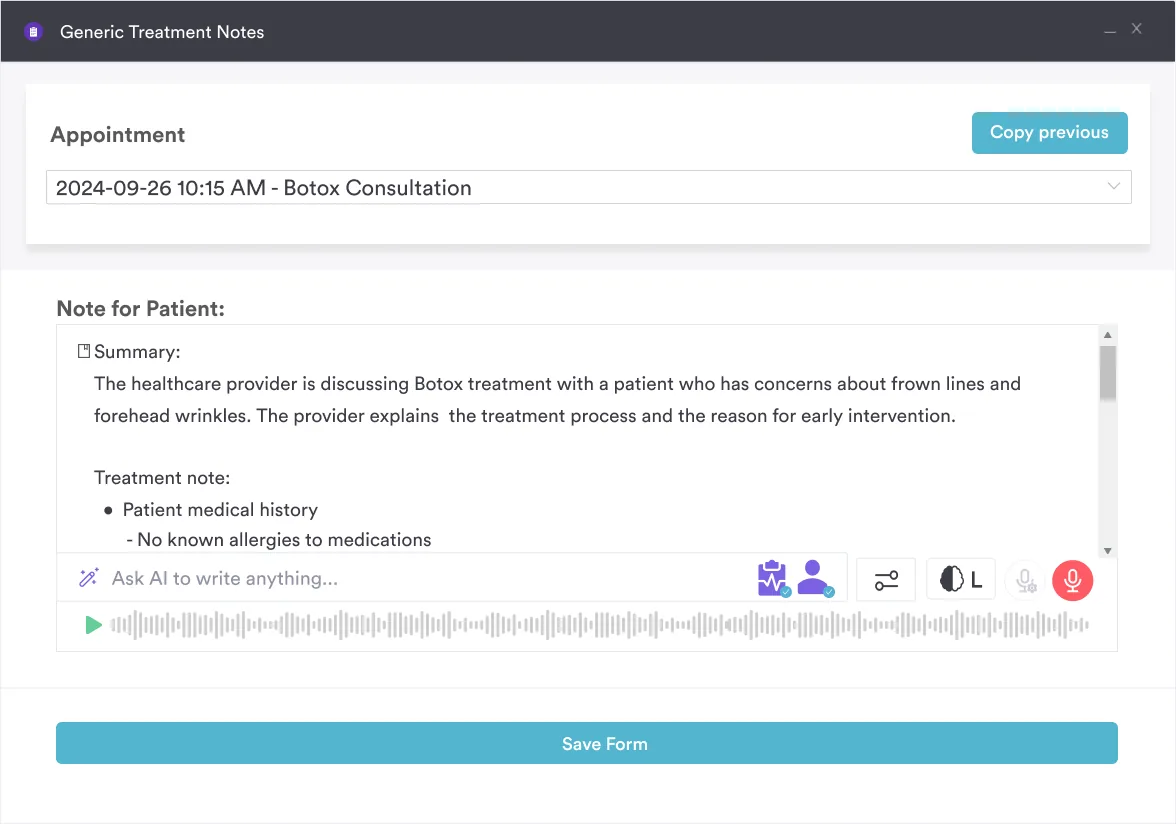
Practice management software like Pabau can capture the intake history through digital forms and speed up note-writing with Pabau Scribe, our AI scribe, while the clinician still owns the clinical judgment behind the clearance decision.
Bariatric surgery programs almost always require a psychological evaluation before they’ll clear a patient for surgery, and payers frequently make it a condition of coverage. For the clinicians handling these referrals, the evaluation needs to do more than confirm a patient looks like a good candidate on paper.
It has to surface eating-disorder history, substance use, coping patterns, and the practical support a patient will have through months of post-op behavior change. This template gives you a structured format built around the sections a bariatric surgery program and its payers expect to see.
A bariatric psychological evaluation is a pre-surgical psychosocial assessment completed before a patient is cleared for weight-loss surgery. It’s typically performed by a licensed psychologist or psychiatrist working alongside the bariatric surgery team, and it focuses specifically on the psychological and behavioral factors that affect surgical candidacy and long-term outcomes.
The evaluation covers the patient’s reasons for seeking surgery, prior weight-loss attempts, and current eating behaviors, including any history of binge eating. It also reviews mental health history and current status, psychotropic medication use, substance use, and the support systems a patient can rely on after surgery. Medication trials belong in that history as well, and a GLP-1 medication list is useful when a patient’s earlier attempts involved semaglutide or tirzepatide.
Sustained weight loss depends heavily on a patient’s ability to follow a lifelong post-operative regimen, which is why support systems get their own section in the evaluation.
For the surgical team, the completed evaluation does three things:
Working through a bariatric psychological evaluation follows the same sequence as the sections in the form itself, from intake through to the final recommendation.
For clinicians handling a steady stream of bariatric referrals. You then review and refine it for clinical accuracy, which cuts down on post-session write-up time without changing the judgment behind the readiness recommendation.
Bariatric psychological evaluation templates serve several roles across a surgical program.
In a psychology practice platform, completed assessments file straight into the client record.
A well-designed template delivers clinical and operational advantages specific to a surgical clearance process.
Consistency: Every candidate gets screened against the same criteria: eating behavior, mental health history, substance use, and support systems. What gets covered no longer depends on which clinician is conducting the interview.
Payer approval: Insurers that require pre-surgical psychological clearance expect documentation of medical necessity, and incomplete evaluations are a common reason surgical authorization gets delayed. Practices that manage this evaluation alongside a broader caseload can use weight-loss clinic software to route a completed template straight into the patient’s record and the surgical team’s file.
Risk identification: Because the evaluation forces systematic screening for binge eating, substance use, and limited social support, it surfaces psychological risk factors while there’s still time to address them with counseling or a delayed surgery date, rather than after complications appear post-op.

Time efficiency: Once a practice adapts this template to its own workflow, clinicians spend less time deciding what to ask and more time on the clinical judgment the evaluation requires. Adding a dedicated weight loss clinic means comparing licensing, costs and technology before committing.
CPT code 90791 (psychiatric diagnostic evaluation without medical services) is the primary billing code for a bariatric psychological evaluation. It covers the integrated biopsychosocial assessment that the clearance interview requires, including the history, mental status exam, and recommendations.
Codes 96130 and 96131 (or the test-administration codes 96136 and 96137) apply only when formal standardized testing, such as the BDI or EDE-Q, is administered and interpreted with a separate report. They aren’t billed alongside 90791 for the interview itself.
Payers frequently deny a body-mass-index or bariatric-candidacy code when it’s billed as the primary diagnosis. Reimbursement usually depends on documenting a covered diagnosis identified during the evaluation, such as a qualifying morbid obesity diagnosis, a mental health condition, or an eating disorder, rather than the screening code alone.
Beyond the template structure, a few documentation habits strengthen the clinical and legal defensibility of a bariatric evaluation.
A pre-surgical psychological evaluation isn’t required by federal law the way informed consent is. It’s recommended by bariatric surgery guidance and required by most bariatric surgery programs and insurers as a condition of surgical approval, which makes it a program and payer requirement rather than a blanket legal one.
The American Society for Metabolic and Bariatric Surgery (ASMBS) has published guidance on this, referencing Sogg, Lauretti, and West-Smith‘s 2016 recommendations for the presurgical psychosocial evaluation of bariatric surgery patients, published in Surgery for Obesity and Related Diseases.
It sets out the domains this kind of evaluation should cover, from eating pathology and mental health history through readiness and support-system assessment. The evaluation is generally performed by a psychologist or psychiatrist rather than a general mental health screener.
From a program standpoint, an incomplete evaluation, one missing a required domain such as binge-eating or substance-use screening, is difficult to defend if a patient struggles after surgery. A template that walks through every domain the guidance describes gives a program documented evidence that it followed a thorough process.
Implementation requires coordination across intake, clinician scheduling, and billing roles.
Practices that use digital intake forms can have patients complete demographic details and self-report instruments like the EDE-Q before the appointment, arriving with scored data ready for review. That leaves more of the visit for the clinical interview and readiness discussion that needs a clinician’s judgment. Weight loss programs outside bariatric surgery can start new patients with a dedicated weight loss intake form covering the same history.

Pabau’s digital forms and clinical documentation features help behavioral health practices standardize bariatric psychological evaluations, keep clearance documentation consistent across every referral, and reduce administrative time.

A completed bariatric psychological evaluation contains distinct sections, each with its own documentation requirements.
Surgical information and reason for seeking surgery: Patient is a 42-year-old man referred for pre-surgical evaluation ahead of a planned sleeve gastrectomy in eight weeks. He reports two prior physician-supervised weight-loss attempts, both regained within a year, and cites hypertension and joint pain as his main reasons for pursuing surgery now.
Eating behavior and psychological testing: EDE-Q results indicate subclinical binge eating, two objectively large episodes per week over the past three months, without compensatory behavior. No evidence of anorexia or bulimia nervosa. BDI score falls in the minimal-depression range.
If a case like this raises concerns beyond depression alone, an anxiety and depression test can help clarify the full picture before you finalize a recommendation.
Support systems and readiness: Patient lives with his spouse, who attends the consultation and confirms willingness to support dietary changes at home. He demonstrates a clear understanding of the procedure, realistic weight-loss expectations, and describes a specific post-op meal-planning routine already discussed with a dietitian.
Recommendation: Cleared for surgery from a psychological standpoint, with a referral to a structured binge-eating support group given the subclinical binge eating identified on the EDE-Q, to be completed before the surgery date. Follow-up recommended at three and 12 months post-op to monitor eating behavior and mood.
A well-structured bariatric psychological evaluation turns pre-surgical clearance from an ad-hoc conversation into a systematic, defensible process that surgical teams and payers can act on.
Whether you handle occasional bariatric referrals or run a behavioral health practice standardizing evaluations across several clinicians, following the same structure every time makes the clearance decision easier to document and easier to defend if a patient’s outcome is ever questioned.
The template above is customizable to the bariatric programs and payers you work with most. Pair it with Pabau Scribe, our AI scribe, to cut down on note-writing time after each evaluation. If you want to see how digital forms and AI-assisted documentation can support your bariatric clearance workflow, book a demo with Pabau.

Managing a patient with high glucose too? hyperglycemia nursing care plan includes NANDA diagnoses, interventions with rationale, and an assessment checklist for charting.
Supporting a patient’s ketogenic diet plan? ketogenic diet plan template lays out macronutrient targets, a 7-day meal breakdown, and a grocery list by category.
Need a standard format for nutrition notes? nutrition SOAP note template structures nutrition consultations into Subjective, Objective, Assessment, and Plan sections.
The diagnostic interview itself typically runs 45 to 90 minutes. Self-report instruments, the BDI for depression and the EDE-Q for eating pathology, are usually completed separately, either before the appointment or right after, rather than during the interview time itself.
There’s no single law requiring it, but most bariatric surgery programs and insurers make a psychological evaluation a condition of surgical approval. It’s a program and payer requirement rather than a universal legal mandate, and it’s generally performed by a psychologist or psychiatrist working with the surgical team.
Document ideation (frequency and duration), intent, plan, access to means, protective factors, and any prior attempts. Record the clinical reasoning behind the risk level assigned and note whether the finding affects the surgical clearance recommendation, since active risk generally needs to be addressed before a patient proceeds to surgery.
Common reasons include untreated or unstable mental health conditions, an active binge eating disorder or other unaddressed eating disorder, ongoing substance misuse, and a demonstrated lack of understanding of or motivation for the post-op lifestyle changes surgery requires. A deferred clearance with a referral to treatment is more common than an outright denial.
Use encrypted, access-controlled systems with audit logs and automatic backups. Restrict access to clinical and billing staff who need it for the surgical referral. Confirm any digital form vendor has a signed Business Associate Agreement, and store paper evaluations in locked, limited-access storage.