Journal prompts for mental health
Journal prompts for mental health are guided questions that help people process ...

2
Last Updated: Oct 13, 2026

The 7 stages of dementia chart is built on the Global Deterioration Scale (GDS), developed by Dr. Barry Reisberg in 1982, and is sometimes called the 7 stages of Alzheimer’s chart.
Stages 1-3 cover normal function to mild decline (often before diagnosis); stages 4-5 are moderate decline needing daily help; stages 6-7 are severe, end-stage decline needing full-time care.
Stage duration is an estimate that varies widely. Survival after diagnosis commonly runs 4-10 years but ranges from under 3 to more than 20, shaped most by age at diagnosis and dementia type.
The FAST scale maps functional loss inside the same stages. FAST 7c (loss of independent walking), with qualifying comorbidities, is a key CMS threshold for hospice eligibility.
A one-page reference that maps the symptoms, functional losses, and typical duration of each GDS stage, from normal cognitive function through severe decline. Print it for the exam room, share it in family meetings, or attach it to a patient’s record for care planning.
Download templateFamilies ask one question more than any other: what comes next? The 7 stages of dementia chart answers it. Based on Dr. Barry Reisberg’s Global Deterioration Scale (GDS), it turns a vague, frightening decline into seven defined stages, each with recognizable symptoms and a rough timeline you can plan around.
The chart below shows all seven dementia stages at a glance, then this guide breaks down the symptoms and duration of each one. It also maps the GDS against the FAST scale, the functional tool that determines hospice eligibility, so clinicians using mental health practice management software like Pabau can stage a patient, document it, and communicate the trajectory in one workflow.
The 7 stages of dementia chart is a clinical staging tool that categorizes dementia progression from normal aging through severe cognitive decline. It comes from the Global Deterioration Scale, which Dr. Barry Reisberg created at New York University in 1982. Because his research focused on Alzheimer’s disease, the same tool is often published as the 7 stages of Alzheimer’s chart.
Its job is to standardize how practitioners describe severity. Instead of relying on impressions, clinicians place a patient in a stage using specific cognitive and functional criteria, so every member of the care team is tracking the same reference point. The chart also gives families a shared vocabulary for what they are seeing at home.
Here is the full 7 stages of dementia chart in one view. Durations are estimates and vary widely by individual, dementia type, age at onset, and overall health.
| Stage | Level of decline | Key symptoms | Typical duration |
|---|---|---|---|
| Stage 1 | No cognitive decline | Normal function. No memory loss or symptoms; used as a baseline. | Not applicable |
| Stage 2 | Very mild decline | Occasional forgetfulness (names, misplaced objects). Not evident to others or on testing. | Can last years |
| Stage 3 | Mild decline | Noticeable memory lapses, trouble finding words, difficulty with complex tasks. Loved ones start to notice. | 2-7 years |
| Stage 4 | Moderate decline | Clear deficits: managing finances, planning, recent events. Social withdrawal and early personality changes. | About 2 years |
| Stage 5 | Moderately severe decline | Major memory gaps (own address, phone number). Needs help choosing clothing; can no longer live independently. | About 1.5 years |
| Stage 6 | Severe decline | Forgets names of close family, incontinence, behavioral symptoms (wandering, sundowning, aggression). Needs help with most daily activities. | About 2.5 years |
| Stage 7 | Very severe decline | Loss of speech and motor skills, unable to eat or walk unaided. Requires 24-hour care. | 1-2.5 years |
The GDS groups the seven stages into three broad phases: stages 1-3 are early decline (usually before a dementia diagnosis), stages 4-5 are the middle phase, and stages 6-7 are late or end-stage. Here is what each looks like in practice.
Use safe documentation practices when recording stage-specific behavioral symptoms. Focus on observable function and safety rather than stigmatizing language.
Flag stage transitions the moment they happen. When a patient moves from Stage 3 to Stage 4, record the date, the triggering observation (a new functional loss or behavior), and any plan change. These transition notes become the evidence for care escalation and the anchor for the next family conversation.
There is no fixed timeline. Survival after diagnosis commonly runs 4 to 10 years, but the range spans from under 3 to more than 20 years. The two biggest factors are age at diagnosis and the type of dementia. Someone diagnosed in their 60s often lives far longer than someone diagnosed at 85.
Within that arc, the early stages (2-3) can stretch across several years, the middle stages (4-5) tend to move faster, and the late stages (6-7) are the most variable.
| Dementia type | Average life expectancy after diagnosis | How progression differs |
|---|---|---|
| Alzheimer’s disease | 8-10 years | Follows the GDS stages most closely; steady, gradual decline. |
| Vascular dementia | About 5 years | Often step-wise, with sudden drops after strokes rather than a smooth curve. |
| Dementia with Lewy bodies | About 5-8 years | Cognition fluctuates day to day; movement and alertness are affected early. |
| Frontotemporal dementia | About 6-8 years | Behavior and language change first; memory can stay intact longer. |
This is why staging matters for family communication. A stage 3 family can be told to expect years of relative stability with a focus on cognitive engagement and safety planning. A stage 6 or stage 7 family, looking at the 7 stages of dementia before death, needs to understand that end-of-life preparations are now appropriate. Honest timelines reduce caregiver shock and support proactive decisions.
Those conversations weigh on the family too. Practices that also treat caregivers reach for tools such as an Internal Family Systems worksheet to work through the guilt and grief that surface.
The GDS measures cognitive decline. The FAST scale (Functional Assessment Staging Tool), also developed by Reisberg, measures functional loss in activities of daily living. They describe the same disease along the same seven stages, but a patient can sit at a different point cognitively than functionally, so clinicians often record both. FAST is the tool the Centers for Medicare & Medicaid Services (CMS) uses to determine hospice eligibility. Pair staging with a scored screen, and use our guide to MoCA score interpretation to read the result.
The cross-reference below lines the two scales up stage by stage, including the FAST substages that split the later stages into finer functional checkpoints.
| GDS stage | FAST stage | Functional milestone | Clinical significance |
|---|---|---|---|
| 1 | 1 | No functional difficulty. | Baseline. |
| 2 | 2 | Subjective difficulty finding words or objects. | Age-associated changes. |
| 3 | 3 | Difficulty with demanding tasks at work. | Mild cognitive impairment. |
| 4 | 4 | Difficulty with complex tasks (finances, meal planning). | Mild dementia. |
| 5 | 5 | Needs help selecting appropriate clothing. | Moderate dementia; independent living ends. |
| 6 | 6a-6e | Progressive loss of dressing, bathing, and toileting; incontinence. | Moderately severe dementia. |
| 7 | 7a-7f | Speech narrows to a few words, then one word; loss of walking (7c), sitting up, smiling, and holding the head up. | Severe dementia; hospice threshold. |
The hospice trigger sits inside stage 7. When a patient reaches FAST stage 7c, the loss of independent walking, and has qualifying comorbidities, CMS considers them eligible for hospice, where life expectancy is typically under six months. Accurate FAST documentation is what turns a clinical observation into approved palliative coverage, so missing or vague staging records can delay care and lead to denied claims.
The chart fits Alzheimer’s disease best, because that is what Reisberg studied. Other types of dementia move through recognizable decline, but not always along this smooth seven-stage curve, and forcing every patient onto the GDS can be misleading. Adjust your expectations by type:
For these patients, use the chart as a framework rather than a strict rulebook, and document the specific functional losses you observe. Note that dedicated tools exist too, such as the 7 stages of vascular dementia chart, when a condition-specific reference fits the case better.
Staging is only useful if it is recorded consistently. Most practices fold it into the initial comprehensive geriatric assessment, then re-assess annually or whenever function changes. That assessment usually includes family history, which a family genogram template records across generations. Strong dementia charting rests on four habits.
Doing this on paper means four places to check before a follow-up. In organized client records, it is one screen a practitioner opens mid-appointment, with the staging assessment, cognitive scores, and progression timeline tied to a single patient timeline.
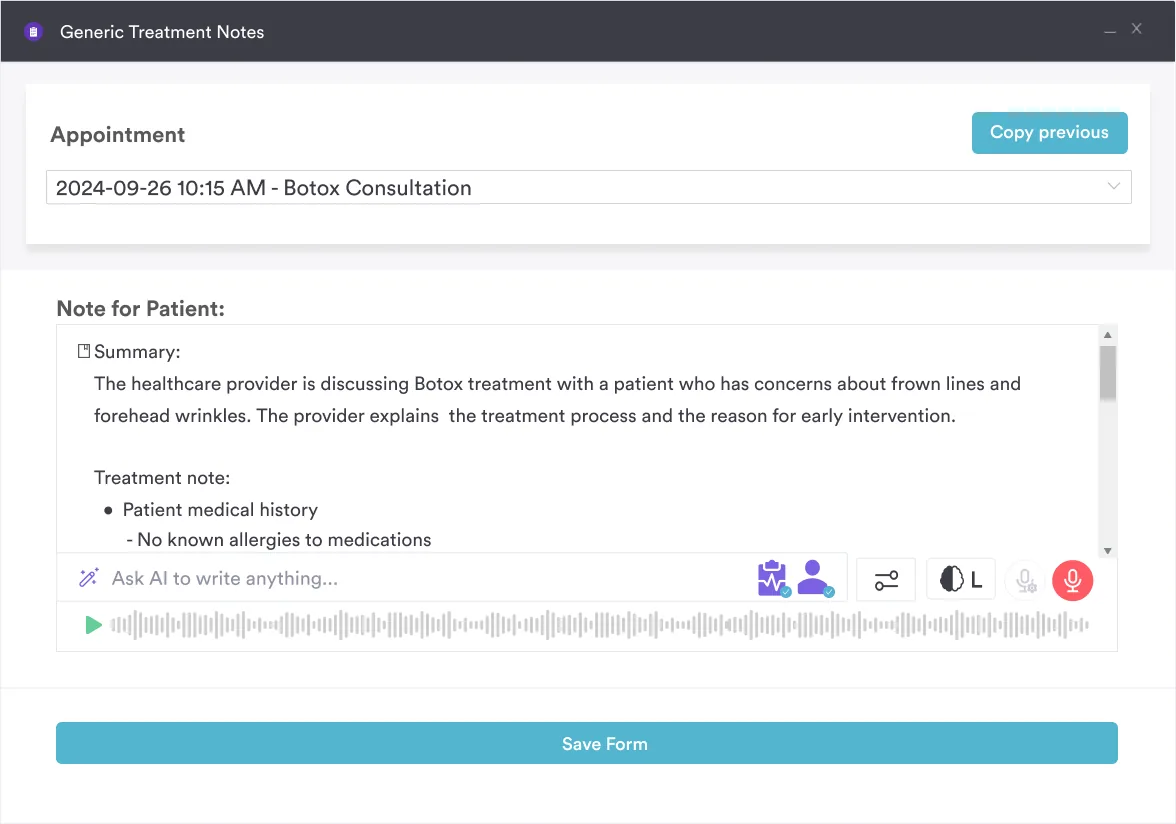
Because CMS ties hospice coverage to FAST staging, these records also protect reimbursement. Clear documentation of the stage is what qualifies a patient for palliative services and keeps compliance tracking intact. Book a demo to see how Pabau ties dementia staging, clinical notes, and care planning into one workflow for your team.
It is a clinical staging tool based on Dr. Barry Reisberg’s Global Deterioration Scale. It categorizes dementia progression from no cognitive impairment (Stage 1) through very severe decline (Stage 7), helping clinicians track severity, plan care, and explain what to expect to patients and families.
Essentially yes. The Global Deterioration Scale was developed from Alzheimer’s research, so the 7 stages of Alzheimer’s chart and the dementia version describe the same seven stages. The framework fits Alzheimer’s most precisely; other dementia types can progress differently.
End stage dementia (Stage 7) involves loss of speech, loss of the ability to walk or sit up unaided, and the inability to eat or drink safely. The person depends on others for all care and needs round-the-clock support. It is the point at which hospice care is usually appropriate.
The 7 stages of dementia before death run from Stage 1 (no impairment) through Stage 7 (very severe decline). Death usually occurs during Stage 7, once a person has lost speech, the ability to walk, and the ability to eat or drink safely. Reaching FAST stage 7c is the point at which hospice care, with a prognosis of around six months, becomes appropriate.
Incontinence typically appears in Stage 6. On the FAST scale it is captured in the substages, with urinary incontinence around 6d and fecal incontinence around 6e. It is one of the markers that a patient has moved from moderate into severe decline.
Sundowning, increased confusion and agitation in the late afternoon and evening, most often emerges in the middle-to-late stages, particularly Stage 6. It can appear earlier and varies by individual, so document the pattern and triggers rather than assuming a fixed stage.
The Global Deterioration Scale (GDS) grades cognitive decline; the FAST scale grades functional loss in daily activities. They track the same progression but from different angles. FAST adds substages for the later stages and is the tool CMS uses to determine hospice eligibility.
FAST stage 7c marks the loss of independent walking. Together with qualifying comorbidities, CMS uses it as a threshold for hospice eligibility, where life expectancy is typically under six months. Documenting FAST 7c justifies a palliative focus and opens the end-of-life conversation with families.