







ICD-10 code T86.42: Liver transplant failure
ICD-10 code T86.42 is the billable ICD-10-CM diagnosis code for liver transplant...

Last Updated: Sep 16, 2026

ICD-10 code V47.1XXA is the billable diagnosis code for a car passenger injured in a nontraffic collision with a fixed or stationary object, initial encounter. It has been effective since October 1, 2015, when ICD-10-CM replaced ICD-9-CM. It remains valid under the current FY2026 edition and is accepted on HIPAA-covered transactions.
The code covers the active treatment phase, meaning it applies the first time the patient receives care for this injury, not follow-up visits. This reference covers the full code breakdown, 7th character extensions, related codes, documentation requirements, and the ICD-9-CM crosswalk.

V47.1XXA is a valid billable ICD-10-CM code for a car passenger, not a driver, injured in a nontraffic collision with a fixed or stationary object.
The 7th character A designates initial encounter (active treatment); use V47.1XXD for subsequent encounters and V47.1XXS for sequela.
Nontraffic accidents occur off public roadways, including parking lots, driveways, and private property, per CDC/NCHS official guidelines.
Accurate documentation must confirm the patient’s role as passenger, the nontraffic accident type, and the collision mechanism to support this code.
Pabau’s claims management software supports ICD-10 code selection and electronic claim submission to reduce denials on external cause codes.
ICD-10 code V47.1XXA is a specific, billable ICD-10-CM diagnosis code. It describes a car passenger injured in a nontraffic collision with a fixed or stationary object, at the initial encounter.
Per the CDC/NCHS ICD-10-CM official tool, it is an original ICD-10-CM code that took effect on October 1, 2015. It remains valid in the FY2026 edition, which runs from October 1, 2025 through September 30, 2026. Because it carries a full 7-character structure, it is reportable as-is and needs no further refinement on a HIPAA-covered claim.
The code is classified under the external cause of morbidity section (V00-Y99). It records the mechanism and circumstances of the injury rather than the resulting diagnosis. Clinicians typically pair V47.1XXA with a separate injury code describing the patient’s physical condition, such as a cervical strain or fracture, on the same claim.
The 7th character in V47.1XXA signals the encounter type and is required for the code to be billable. The ICD-10-CM system uses A, D, and S to distinguish active treatment from follow-up care and late effects. Selecting the wrong character is one of the most common reasons these external cause codes are queried on audit.
A common misconception is that “A” applies only to emergency department visits. Per ICD-10-CM Official Guidelines Section I.C.20, the initial encounter character covers the whole active treatment phase. That includes specialist consultations, imaging, and physical therapy ordered as part of initial injury management. Switch to “D” only once the patient moves to routine monitoring or healing follow-up.
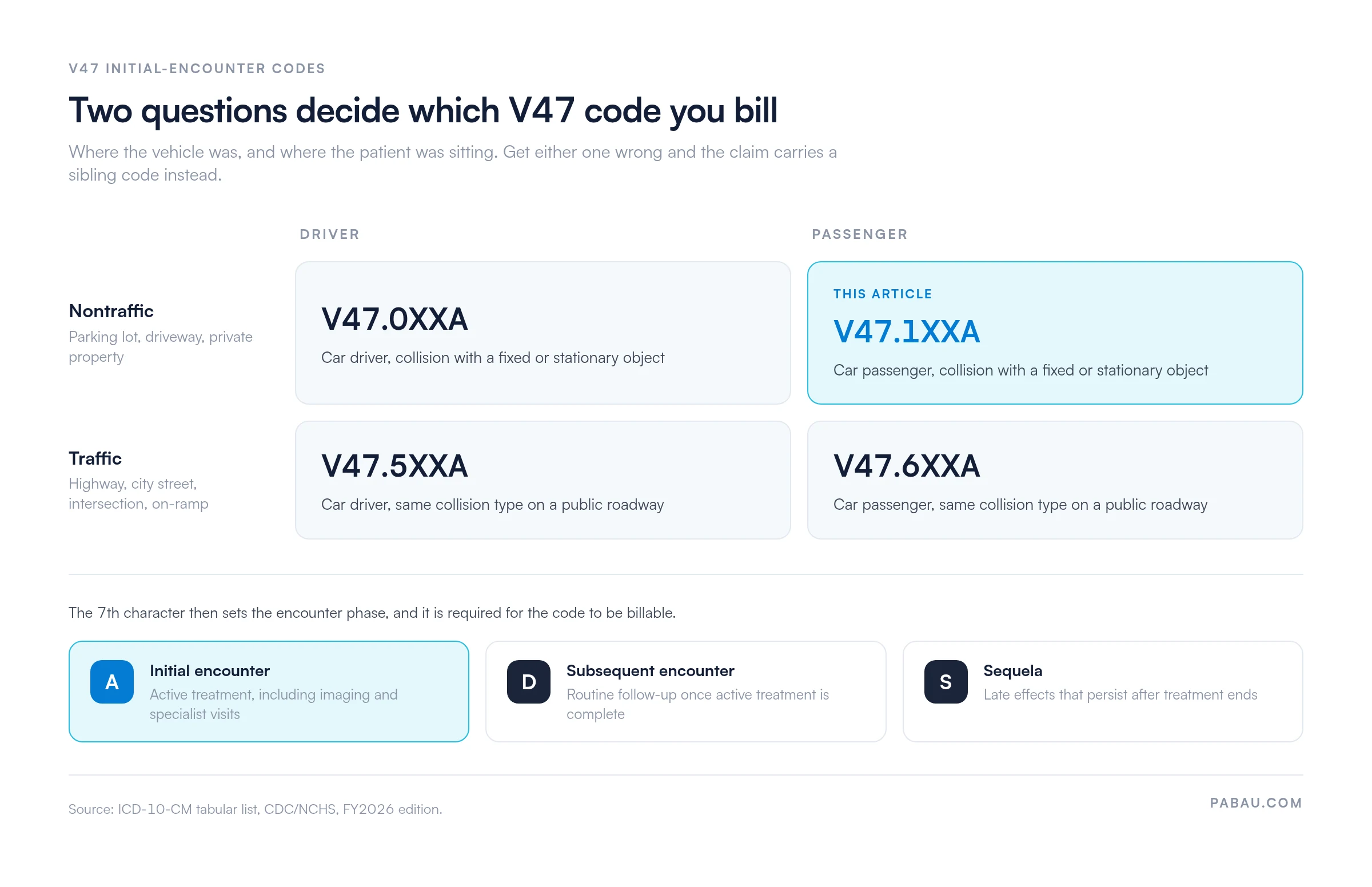
V47.1XXA sits within the V47 code group, which covers car occupants injured in collisions with fixed or stationary objects. The key distinction across V47 sibling codes is the occupant type (driver vs. passenger) and the accident classification (nontraffic vs. traffic). Coders working on motor vehicle accident claims for orthopedic or emergency practices meet these codes often. Any injury the patient sustained, from a cervical strain to a head injury, still needs its own diagnosis code alongside V47.1XXA.
The grid below reduces that table to the two questions a coder has to answer: Where the vehicle was, and where the patient was sitting.
ICD-10-CM inclusion and exclusion notes define the precise boundaries of what V47.1XXA covers. Coders must review these before using the code to avoid pairing it with an incompatible diagnosis. Excludes1 and Excludes2 notes carry different billing implications, so the distinction matters here. Both behave the same way in every ICD-10-CM category, so the logic below transfers to any other code you look up.
ICD-10 code V47.1XXA sits at the most specific level of a clear parent-code hierarchy. Reading the chain from the top helps coders verify that V47.1XXA is the correct endpoint for a given scenario. Our ICD-10-CM codes library lists the neighboring categories a motor vehicle claim usually needs alongside it.
The CMS ICD-10-CM coding page publishes the annual tabular update files that confirm the hierarchy and billable status of every code in this chain. Practices should verify against the current fiscal year file when coding any V47 code on claims submitted after October 1 each year.
V47.1XXA applies to car passengers only. If the injured person was the driver, V47.0XXA is the correct nontraffic initial encounter code. This is one of the most common coding errors on motor vehicle accident claims. Emergency documentation often records the collision without naming the patient’s seating position. Query the clinical notes or operative records where the occupant role is ambiguous.
Documentation that reads “occupant” without specifying the role is insufficient to support V47.1XXA. The clinician’s note must identify the patient as the passenger for this code to stand on audit.
A nontraffic accident, per the ICD-10-CM Official Guidelines maintained by the CDC/NCHS, is any vehicle accident that does not occur on a public roadway. This is the defining modifier for V47.1XXA. Many coders default to traffic-accident codes based on the word “collision,” but the location of the incident determines the correct code family.
When the clinical record notes the accident occurred in a supermarket parking lot or a private driveway, V47.1XXA is appropriate. If it occurred on a public street, the traffic codes apply instead. The AAPC ICD-10-CM code lookup cross-references both code families alongside each other, which can help coders visually compare the accident-type distinctions.
Payers query or deny claims carrying V47.1XXA when the documentation does not establish each element of the code. Five elements must be present in the medical record for the code to hold up on audit.
Practices that bill external cause codes regularly find it easier to build these five elements into the note template than to chase them afterwards.
Practices that keep historical records or handle long-running workers’ compensation claims sometimes need the ICD-9 equivalent of V47.1XXA. The closest ICD-9-CM match is E823.1. Crosswalks between the two systems are approximate rather than exact, and ICD-9 had no encounter-type distinction at all. Review medical billing compliance requirements when legacy and current codes appear on the same multi-period claim.
Both directions of that mapping are documented in the CMS General Equivalence Mappings, published with the annual code files. Treat any single mapping as a shortlist rather than a one-to-one answer.
Reviewing a patient’s pre-2015 records? The GEMs show that E823.1 maps to several ICD-10 codes, depending on occupant type and accident class. Confirm that the record says ‘passenger’ and ‘nontraffic’ before you settle on V47.1XXA.
External cause codes like ICD-10 code V47.1XXA sit among the most denial-prone in the V00-Y99 section. Payers want the occupant role, the accident type, and the encounter phase to agree before they pay. The note usually describes the visit correctly, but it describes it in prose that no coder can map cleanly onto a code.
Practice management software like Pabau keeps ICD-10 code selection inside the clinical note workflow. The clinician documents the encounter in the same place the code is picked. That lets the two be checked against each other before the claim leaves the practice.
Pabau’s claims management software connects documentation to submission in one workflow. Claims route through a clearinghouse, where eligibility checks and claim scrubbing catch code-level errors before a payer sees them. Pabau submits through Claim.MD, which supports CMS-1500 and 837P formats.
Without a clearinghouse connection, a correctly coded V47.1XXA claim can still sit in a manual review queue for weeks. The code being right is only half of what gets it paid.

Pabau’s claims management workflows support accurate code selection, documentation capture, and electronic claim submission, so external cause codes like V47.1XXA clear on first submission.

V47.1XXA rests on three confirmed facts: The patient was a passenger, the accident happened off a public roadway, and the visit was active treatment. Miss any one of them and the claim carries a sibling V47 code, which is how these denials start.
The practical move is to build those three facts into the note template, rather than reconstructing them from an ED narrative weeks later.
Book a demo to see how Pabau keeps external cause codes and their supporting documentation in one record.

Need to understand how claim denials are managed? Denial management in healthcare explains how to track, categorise, and appeal rejected external cause code claims.
Want to see how clean claims reduce rework? What is a clean claim covers the requirements a claim must meet before it reaches a payer without edit flags.
Looking for guidance on insurance eligibility checks? Insurance eligibility verification outlines how real-time checks reduce downstream coding and billing issues.
ICD-10 code V47.1XXA is a billable diagnosis code for a car passenger injured in a nontraffic collision with a fixed or stationary object. The 7th character A marks the initial encounter. The code has been effective since October 1, 2015, and remains valid in the current FY2026 edition.
Yes. V47.1XXA is a specific, billable ICD-10-CM code with a complete 7-character structure. It can be submitted on claims without further refinement, and it appears as valid in the FY2026 ICD-10-CM tabular list maintained by the CDC/NCHS.
V47.1XXA is the initial encounter code for a car passenger injured in this type of nontraffic collision, used during the active treatment phase. V47.1XXD is the subsequent encounter code, used once active treatment is complete and the patient is in the healing or routine follow-up phase.
The 7th character A designates the initial encounter, meaning the patient is receiving active treatment for the injury at that visit. It is not limited to emergency department visits. Any encounter that delivers active care qualifies, including a specialist consultation or imaging ordered for the injury.
A nontraffic accident, per CDC/NCHS ICD-10-CM Official Guidelines, is any vehicle accident that occurs off a public roadway. Common examples include collisions in parking lots, private driveways, and on private property. Accidents on public streets, highways, or roads are classified as traffic accidents and use different code families.
Use V47.1XXA when the injured person was a passenger in the vehicle. Use V47.0XXA when the injured person was the driver. Both codes apply to nontraffic accidents and initial encounters, but differ solely on the occupant’s role. The clinical record must clearly confirm the patient’s seating position to support either code.