







ICD-10 code T86.42: Liver transplant failure
ICD-10 code T86.42 is the billable ICD-10-CM diagnosis code for liver transplant...

Last Updated: Sep 16, 2026

ICD-10 code W18.49XA is the billable ICD-10-CM diagnosis code for other slipping, tripping and stumbling without falling, initial encounter. It is valid for fiscal year 2026, which runs October 1, 2025 through September 30, 2026. The code captures near-fall events where a patient slipped, tripped, or stumbled without reaching the ground.
As an external cause code in the V00-Y99 block, W18.49XA is always sequenced after the principal diagnosis. It is never reported on its own. This reference covers the full code description, the 7th character extensions, the code hierarchy, the applicable and excludes notes, and correct sequencing on the claim.

ICD-10 code W18.49XA is a billable diagnosis code for slipping, tripping, or stumbling without a fall, which separates it from the W19 unspecified fall codes.
The 7th character ‘A’ designates initial encounter, ‘D’ covers subsequent encounters, and ‘S’ covers sequela.
W18.49XA is an external cause code, so it must always be sequenced after the principal injury or condition diagnosis on the claim.
Practice management software like Pabau carries a built-in ICD-10 code lookup, so coders can apply W18.49XA inside the billing workflow.
ICD-10 code W18.49XA describes a patient encounter where the individual slipped, tripped, or stumbled but did not fall to the ground. The “other” qualifier separates this code from the more specific slipping and tripping scenarios that have their own codes within the W18.4 subcategory. Clinicians document these near-fall events because the mechanism can still cause strain, soft-tissue damage, or musculoskeletal stress.
The code sits in block W00-W19 (Slipping, tripping, stumbling and falls), which is nested inside the broader external cause chapter V00-Y99. According to the CDC/NCHS ICD-10-CM web tool, W18.49XA became effective on October 1, 2015. It has remained valid through every subsequent fiscal year, including FY2026.
The table below summarizes the reference fields coders need when working a claim or submitting a HIPAA-covered transaction.
The 7th character in W18.49XA signals the type of encounter being documented. Choosing the wrong one is a common source of denials on external cause codes, so it is worth confirming before the claim goes out.
The placeholder “X” in the 6th position is a dummy character required by ICD-10-CM to allow for the mandatory 7th character. It carries no clinical meaning. Coders sometimes omit it, which produces an invalid code. W18.49A does not exist, so the full seven-character string W18.49XA is required.
Understanding where ICD-10 code W18.49XA sits in the external cause hierarchy helps coders select the right level of specificity. The breadcrumb below shows the full classification path from chapter to specific code. Neighboring codes are indexed in our diagnostic code library if you need to compare one.
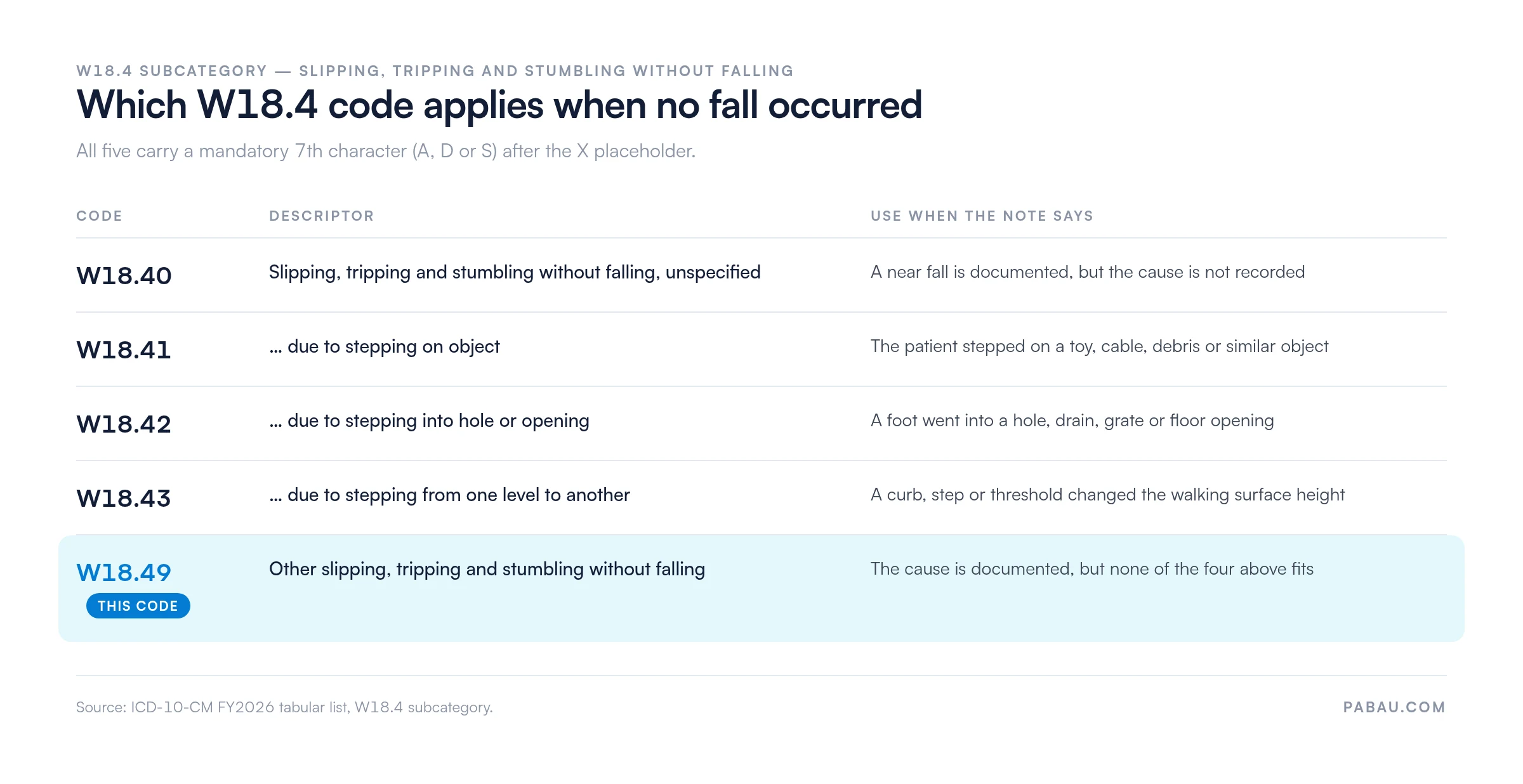
W18.4 is the parent subcategory, and it holds five code stems rather than two. W18.40 covers an unspecified near fall, and W18.41 covers stepping on an object. W18.42 covers stepping into a hole or opening, and W18.43 covers stepping from one level to another. W18.49 is the residual option. Use W18.49XA when the documented cause does not match any of the four more specific scenarios.
The ICD-10-CM tabular list attaches coding notes at the category level, and those notes are reviewed each fiscal year. For W18.49XA, the following ones apply.
The W18 category’s “Applicable To” notes confirm that codes in this block cover slipping and tripping as an external cause, without implying a complete fall. This includes situations where a patient catches themselves, grabs a surface for balance, or recovers before ground contact occurs.
Excludes1 notes indicate codes that cannot be used together because the two conditions cannot occur at the same time. For the W18 category, fall-related codes (W00-W17) are Excludes1. If the patient did fall, you cannot also report W18.49XA on the same claim. Choose one or the other based on the documented outcome.
Excludes2 notes mean the excluded condition is not part of this code but may coexist with it. Assault-related falls (Y93 activity codes) and fall injuries occurring during transport accidents (V-codes) are Excludes2. They can be coded alongside W18.49XA when both conditions are separately documented.
Always read both the Excludes1 and Excludes2 notes at the category level (W18), not just the code level. The most common denial trigger is a coder applying W18.49XA alongside a fall code when the documentation states the patient fell. If the clinical note is ambiguous, query the provider before coding.
The deciding question is whether the patient reached the ground. Use the table below to select the correct code for slipping, tripping, and stumbling scenarios. Getting this right at submission costs far less than claim denial management after the fact.
The clinical note must explicitly support the absence of a fall for W18.49XA to hold up on audit. Phrases such as “near fall”, “almost fell”, “stumbled but maintained balance”, or “tripped without ground contact” all support this code. A note that simply reads “fall” should route to a W00-W17 or W18.30-W19 code.
External cause codes in the V00-Y99 block are supplementary by design, and ICD-10 code W18.49XA is one of them. The CMS ICD-10-CM coding guidelines are unambiguous on this point. An external cause code cannot serve as the principal diagnosis. It explains the cause of an injury, but a code describing the injury itself must appear first on the claim.
The principal diagnosis answers what is wrong with the patient, such as a sprained ankle (S93.401A), a contusion (S80.00XA), or a soft-tissue strain. W18.49XA then answers how it happened, which was a slipping or stumbling event without a fall. Both codes are needed for a defensible claim, but the injury code leads.
Medicare and most payers accept external cause codes but do not require them on every claim. Hospital inpatient settings and some outpatient settings carry facility-specific reporting policies that do mandate them. Check the payer’s coding guidelines before assuming the code is optional.
Apply the same 7th character extension across the principal diagnosis and W18.49XA on every claim. If the injury is coded as ‘initial encounter’ (character A), the external cause code must also use ‘A’. Mismatched encounter types between the principal code and W18.49XA are a denial trigger that is easy to overlook and equally easy to fix.
Legacy billing systems and crosswalk tools sometimes ask for the ICD-9-CM equivalent when reviewing historical claims or comparing pre-2015 encounter data. The AAPC ICD-10-CM code library maps W18.49XA to the ICD-9-CM reference below.
The ICD-9-CM system had no specific code for stumbling or tripping without a fall outcome. E885.9 was the closest available code, but it covered a broader concept. The ICD-10-CM expansion improved clinical specificity for this type of near-fall event.
Reviewing code history is a routine part of annual coding preparation. W18.49XA has been stable since its introduction and carries no revisions through FY2026. The ICD List code database confirms the effective date history below.
Coders should verify code validity at the start of each fiscal year using the CDC/NCHS ICD-10-CM web tool, which publishes the official tabular list. W18.49XA has remained unchanged, but codes in adjacent subcategories can be revised or split without affecting their neighbors.
Most coding teams work W18.49XA across two screens. A tabular list or a lookup site sits in one browser tab, and the claim form sits in another. The code gets retyped, and the sequencing is checked by eye before submission.
Pabau is practice management software that carries the ICD-10-CM lookup inside the patient record. A coder searches the near-fall descriptor, applies W18.49XA to the encounter, and orders it behind the injury diagnosis without leaving the chart. Claims then go out through Claim.MD, our US clearinghouse partner, which validates the codes before the payer receives them.
Sequencing errors surface at claim creation instead of arriving back as a denial three weeks later. Superbills and remittance records stay attached to the same encounter, so an audit of W18.49XA has one place to look. Pabau’s built-in claims management removes the retyping step that produces most of these errors.

Pabau includes a built-in ICD-10-CM code lookup and billing workflow so coders can apply codes like W18.49XA directly within the patient record. No tab-switching, no manual entry errors.

A near fall and a fall to the ground are separate events for coding purposes, and W18.49XA is the code that keeps them apart. Where claims for this code fail, the cause is usually sequencing. W18.49XA follows a principal injury diagnosis and never leads it.
So read the clinical note before you reach for this code. If it says the patient fell, a W00-W17 or W18.30-W19 code applies instead, and the two can never sit on one claim. Book a demo to see how Pabau applies and sequences external cause codes inside a live claim workflow.

List Item #1
List Item #2
ICD-10 code W18.49XA is the billable ICD-10-CM diagnosis code for other slipping, tripping and stumbling without falling, initial encounter. It is an external cause code in Chapter 20 (V00-Y99). Coders use it for near-fall events where a patient slipped, tripped, or stumbled without reaching the ground.
Yes. W18.49XA is a billable ICD-10-CM code for fiscal year 2026, which runs October 1, 2025 through September 30, 2026. It is accepted on HIPAA-covered transactions, but it must always be sequenced after the principal injury diagnosis.
The three codes describe the same near-fall event at different encounter stages. W18.49XA is the initial encounter, used at the first active treatment visit. W18.49XD is the subsequent encounter, used for routine follow-up after the active phase. W18.49XS is the sequela code, used for late effects or complications from the original event.
Use W18.49XA when the clinical documentation confirms the patient did not fall to the ground. Phrases such as “near fall”, “stumbled but maintained balance”, or “tripped without ground contact” support this code. If the patient did fall, use the appropriate W00-W17 or W18.30-W19 code instead. You cannot report both W18.49XA and a fall code on the same claim (Excludes1).
The W18 category carries an Excludes1 note for fall codes (W00-W17). A fall and a near fall are mutually exclusive events, so W18.49XA and a fall code cannot appear on the same claim. Assault-related falls and transport-accident falls are Excludes2, so they may coexist with W18.49XA when both are separately documented.
Yes, W18.49XA is valid for both FY2025 and FY2026. For FY2026, the code is effective from October 1, 2025 through September 30, 2026. Its description and coding notes have not changed since FY2016.