







ICD-10 code W18.49XA: Slipping, tripping and stumbling without falling
ICD-10 code W18.49XA is the billable ICD-10-CM diagnosis code for other slipping...

Last Updated: Sep 16, 2026

ICD-10 code T86.42 is the billable ICD-10-CM diagnosis code for liver transplant failure. It is valid for HIPAA-covered transactions in the FY2026 edition, effective October 1, 2025. Medical coders use it to document cases where a transplanted liver has ceased to function adequately, distinct from immune-mediated rejection.
It sits under parent code T86.4 alongside four sibling codes for rejection, infection, unspecified complications, and other complications. Assign T86.42 only when the record documents graft failure rather than rejection.

ICD-10 code T86.42 is a billable, specific ICD-10-CM code for liver transplant failure, valid for FY2026 HIPAA-covered transactions.
T86.42 sits under parent code T86.4, one of five billable fifth-character codes covering liver transplant complications.
Documentation must support graft failure rather than rejection, since rejection is coded separately as T86.41.
Primary graft non-function is diagnosed within the first 7 days after transplant, while late failure can follow months or years later.
Pabau’s claims management software integrates with Claim.MD to support accurate submission and eligibility checks for transplant-related claims.
ICD-10 code T86.42 is a billable, specific ICD-10-CM diagnosis code that describes liver transplant failure. It is valid for use in the FY2026 edition of ICD-10-CM, which became effective on October 1, 2025, and is accepted on HIPAA-covered transactions. The CDC/NCHS ICD-10-CM web tool places the code in the chapter for injury, poisoning, and certain other consequences of external causes (S00-T88). Within that chapter it falls under complications of surgical and medical care (T80-T88).
T86.42 is a leaf-level code, so no additional character is appended. It can be sequenced as a principal or secondary diagnosis, depending on why the patient presented. When liver transplant failure is the principal reason for admission, T86.42 leads the diagnosis list.
The table below summarizes the key reference data for ICD-10 code T86.42 as published in the FY2026 ICD-10-CM tabular list.
Liver transplant failure refers to the inability of a transplanted hepatic graft to sustain adequate liver function. The result is organ dysfunction or the need for retransplantation. ICD-10-CM codes it as T86.42, within the broader T86 category for complications of transplanted organs and tissues. The record must explicitly support graft failure rather than rejection before the code is assigned.
Primary graft non-function (PNF) is diagnosed within the first 7 days after transplant, and some centers extend the window to 10 to 14 days. It is the most severe form of early failure. Late graft failure follows chronic hepatic dysfunction, biliary complications, disease recurrence, or vascular events months or years after transplantation.
Causes of liver transplant failure commonly include:
T86.42 applies to documented graft failure, not to every post-transplant complication. When the clinical picture includes both failure and rejection, coders review the physician’s documentation to establish which condition is the primary reason for the encounter.
T86.42 belongs to a defined hierarchy within the T86 category for complications of transplanted organs and tissues. Correct selection depends on knowing the parent code and the four sibling codes that share it. The wider ICD-10-CM code reference shows how the T86 subcategories divide by transplanted organ.
Neither T86 nor T86.4 is billable on its own. Coders select from the five fifth-character codes: T86.40, T86.41, T86.42, T86.43, and T86.49. T86.40 covers a complication the physician records without naming it, and T86.43 covers infection of the transplanted liver. T86.49 is the catch-all for complications that are neither rejection, failure, nor infection, such as post-transplant lymphoproliferative disorder. The map below shows which documented finding sends the claim to each of the five codes.
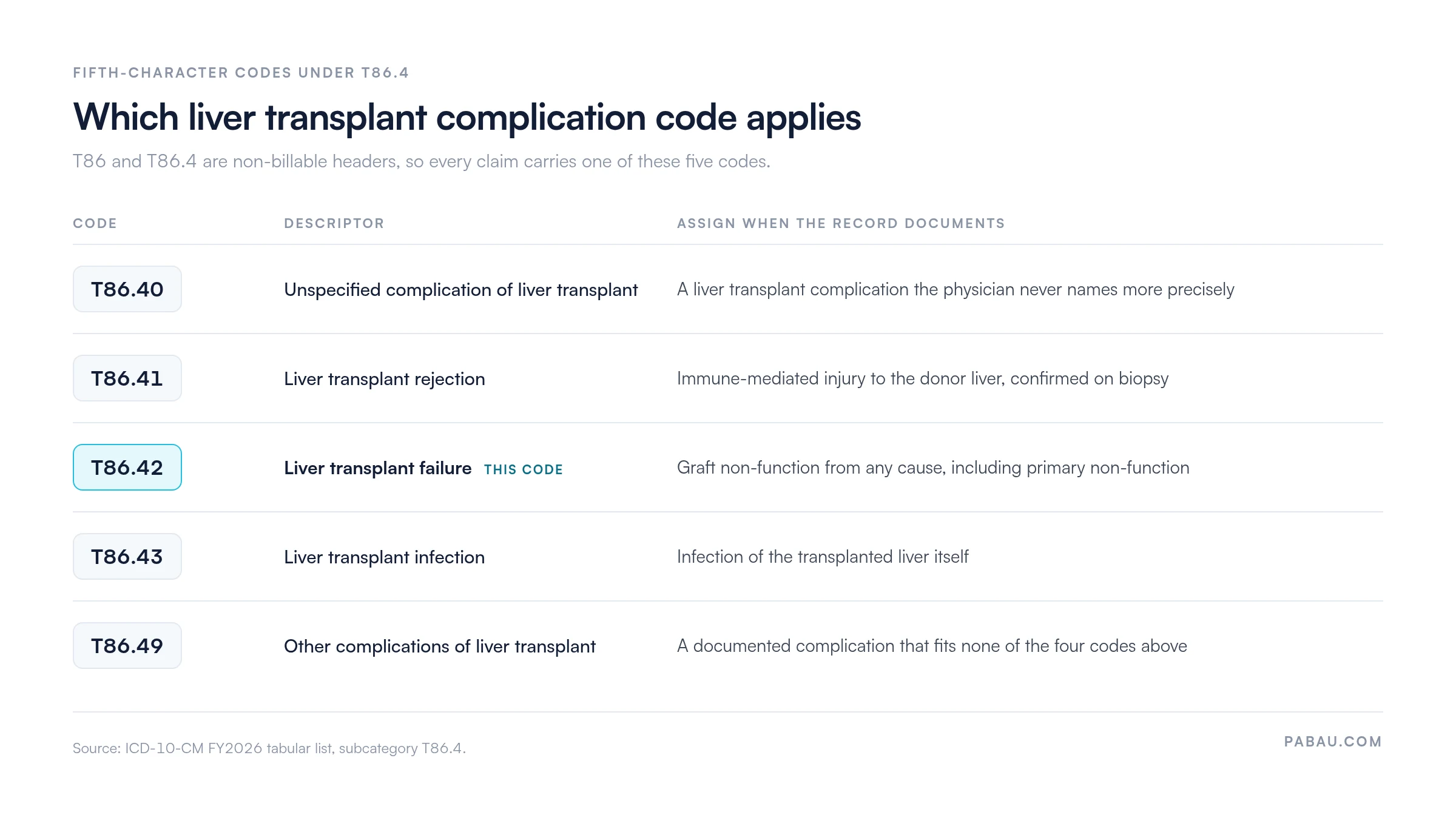
Liver transplant rejection (T86.41) is an immune-mediated process in which the recipient’s immune system attacks the donor hepatocytes. Liver transplant failure (T86.42) describes functional graft non-viability, whatever the mechanism behind it. That distinction drives both clinical management and code assignment. Coders working from AAPC’s ICD-10-CM reference will find the two mutually exclusive in most encounters, though complex cases can carry both.
When the physician documents “liver transplant failure due to chronic rejection,” rejection is the underlying cause (T86.41) and failure is the end-stage result (T86.42). Query the physician or review the ICD-10-CM Official Guidelines before assigning both codes in that scenario. Unresolved dual-coding is a common audit flag in transplant billing.
The ICD-10-CM Official Guidelines for Coding and Reporting govern how T86.42 is sequenced, combined with additional codes, and documented. Transplant admissions carry high dollar values, so payers examine the diagnosis sequence and the supporting documentation closely.
Use T86.42 when the physician has explicitly documented liver transplant failure as a current condition. Documentation phrases that support this code include “hepatic graft failure,” “failed liver transplant,” “primary non-function of hepatic allograft,” and “liver allograft dysfunction requiring retransplantation.”
T86.42 rarely stands alone. The codes below are the ones most often reported with it, and which of them apply depends on what the physician documented:
Three errors account for most transplant coding denials related to T86.42:
Run a chart query for your facility’s liver transplant admissions each quarter. Filter for T86.42 records that carry no Z94.4, because a missing transplant status code invites medical review. Flag those encounters for a coder query before the claim bills.
When T86.42 appears on an inpatient claim, CMS’s MS-DRG grouper assigns the case to a reimbursement group that sets the Medicare base payment rate. Liver transplant failure generally groups under DRGs for liver transplant complications or hepatobiliary conditions. A procedure code for retransplantation or transplant evaluation changes which group the case lands in.
MS-DRG assignment for T86.42 encounters depends on several factors:
Specific MS-DRG numbers for liver transplant failure encounters change annually with the CMS IPPS final rule update. Verify current DRG assignments against the CMS IPPS grouper for the applicable fiscal year before finalizing facility billing. The CMS ICD-10 codes page provides access to the current mapping files.
Transplant billing teams often track submitted claims on a spreadsheet, then reconcile remittance files against them by hand. On a DRG worth five figures, one missing Z94.4 or one unmatched remittance line can sit unexamined for weeks.
Practice management software like Pabau keeps the claim and the clinical record in one system. Pabau supports cleaner claims management by submitting electronically through Claim.MD, our US clearinghouse partner, which reaches thousands of US payers. Eligibility checks, 837P submission, and electronic remittance advice processing all run from the same record.

Denial tracking then shows which payers question transplant claims and what they ask for. Our guide to denial management in healthcare covers how billing teams turn those patterns into documentation fixes before the next claim goes out.

Pabau integrates with Claim.MD to support electronic claim submission, real-time eligibility checks, and denial tracking for complex inpatient encounters including transplant-related diagnoses.

T86.42 earns its place on a claim only when the physician documents graft failure. Pair it with Z94.4 and the codes for the underlying cause, and the MS-DRG assignment holds up under review.
The T86.4 subcategory is where transplant coding most often goes wrong, because rejection, failure, and infection each take their own fifth character. Read the documentation before you choose, and query the physician when it names more than one. Book a demo to see how Pabau keeps transplant claims, codes, and remittance data in one place.

Need guidance on managing claim denials for complex diagnoses? Denial management in healthcare covers the systematic approaches billing teams use to reduce rejection rates on high-value claims.
Want to understand how clearinghouse submission works? Claim.MD clearinghouse explains how electronic claims reach payers and how remittance data flows back to your practice.
Looking for a complete revenue cycle reference? Revenue cycle management provides an end-to-end guide to the billing workflow from eligibility check through payment posting.
ICD-10 code T86.42 is the billable ICD-10-CM diagnosis code for liver transplant failure, valid for FY2026 HIPAA-covered transactions effective October 1, 2025. It sits under parent code T86.4, the subcategory for complications of liver transplant. The code is specific and leaf-level, used when a transplanted liver has ceased to function adequately.
T86.42 is the ICD-10 code for liver transplant failure. It is a billable, specific code within the T86 category for complications of transplanted organs and tissues. T86.41 covers rejection and T86.43 covers infection of the transplanted liver.
Liver transplant rejection (T86.41) is an immune-mediated process confirmed by biopsy. Liver transplant failure (T86.42) describes graft non-function from any cause, including primary non-function, vascular complications, or chronic dysfunction. Rejection leads to failure in some cases, but the two conditions have separate ICD-10-CM codes and require distinct physician documentation.
Yes, T86.42 is a billable, specific ICD-10-CM code valid for submission on HIPAA-covered transactions in the FY2026 edition. Unlike its parent codes T86 and T86.4, which are non-billable headers, T86.42 can be reported directly on claims without further character extension.
The parent code for T86.42 is T86.4, which covers all complications of liver transplant. T86.4 is a non-billable subcategory header. Coders assign one of its five fifth-character codes: T86.40 (unspecified complication), T86.41 (rejection), T86.42 (failure), T86.43 (infection), or T86.49 (other complications).
Coders typically assign Z94.4 (liver transplant status) alongside T86.42 on every transplant-related encounter. Add codes for the underlying cause of failure when the physician documents one. Biliary complication codes and hepatic artery thrombosis codes are the usual additions.