HCPCS Code E0272: Foam rubber mattress billing guide
HCPCS Code E0272: official descriptor and code overview HCPCS Code E0272 is the ...

Last Updated: Nov 6, 2026
HCPCS code V5120 is the Level II code for a binaural, body-worn hearing aid. It reports the device that aids both ears, not batteries, ear molds or other supplies.
The fitting goes on its own line under V5160, the binaural dispensing fee. Traditional Medicare excludes hearing aids by statute, so V5120 carries coverage indicator S and Part B never pays it. Payment comes from Medicaid, Medicare Advantage or commercial plans. Each one sets its own device limits and authorization rules, so confirm the benefit before you order the device.
Let Pabau's smart automation suggest the right codes, reduce claim denials, and keep your practice compliant—effortlessly.
Automate repetitive tasks and focus on what matters most—your patients.
Reduce coding errors and ensure compliance with the latest regulations.
Clean claims, fewer denials, and faster reimbursements.
Powerful insights and reporting to help your practice thrive.
HIPAA compliant SOC 2 certified GDPR-compliant Trusted by 4,000+ clinics worldwide

HCPCS code V5120 reports a binaural, body-worn hearing aid device, not hearing aid supplies or accessories.
Bill the fitting on its own line with V5160, and bill batteries and ear molds under their own supply codes.
Traditional Medicare excludes hearing aids by statute, so V5120 carries coverage indicator S and Part B never pays it.
Medicaid, Medicare Advantage and commercial plans set their own device limits, so verify the benefit before you order.
Record the device make, model, serial number and fitting date, because payers check them against quantity limits.
HCPCS code V5120 is the Level II code for a binaural, body-worn hearing aid. The official long descriptor reads “Binaural, body.” It sits at the start of the Hearing aids range, V5120 to V5267.
In plain terms, V5120 bills the device itself. The patient gets amplification for both ears from a body-worn style of aid. The fitting, the batteries and the ear molds each go on separate claim lines.
Body-worn aids are now uncommon, and the three-word descriptor is easy to read as a supply code. Payment also turns on the plan, because traditional Medicare excludes hearing aids by statute.
V5120 covers the binaural body-worn hearing aid alone. The fitting and each supply around it carry their own codes. Use the two lists below to keep each item on the right line.
V5120 includes:
V5120 excludes:
Keep the device line clean. A V5120 line that also carries supply charges overstates the device and invites a downcode or an audit.
The binaural V5 codes split by how the aid is worn. A pair of in-the-ear aids takes V5130, and a behind-the-ear pair takes V5140. Settle the style first, then match the dispensing fee to the device code.
One check settles most mix-ups. Read the device style on the manufacturer invoice, then confirm it matches the code descriptor word for word.
Every V5120 claim needs an ICD-10-CM code that explains why both ears need amplification. Payers compare that code with the audiogram, so pick the most specific option it supports.
Laterality matters here. If the audiogram shows loss in both ears, code it as bilateral. A unilateral code with unrestricted hearing on the other side contradicts a binaural device.
Traditional Medicare does not cover V5120. Section 1862(a)(7) of the Social Security Act excludes hearing aids and the exams for fitting them. CMS marks the code with coverage indicator S, which means non-covered by statute.
Because the exclusion is in the law, no local coverage determination can change it. There is also no Medicare fee schedule amount to compare against. Each payer that does cover the device sets its own allowance.
An Advance Beneficiary Notice (ABN) is not required for a statutorily excluded item. Many practices still give a voluntary notice, so the patient sees the price in writing. When a secondary payer wants a Medicare denial first, add the GY modifier.
Medicare Advantage plans may add a supplemental hearing benefit. Covered styles, allowances and authorization rules vary by plan and year. Some plans also route hearing aids through a contracted vendor. Confirm the patient can get a body-worn aid through you.
Medicaid hearing aid coverage for adults is optional, so each state decides whether to pay for V5120. For patients under 21, the EPSDT benefit requires states to cover medically necessary hearing aids.
Most Medicaid programs and many commercial plans want approval before you order the device. Send the audiogram, the order and the reason for a body-worn style. Ask whether the V5160 fee line needs its own approval too.
Before you order a V5120 device, pull the patient’s hearing benefit from the payer portal. Confirm that the plan covers a body-worn binaural style, how many devices it allows, and whether it needs authorization. That short check at booking heads off the coverage, limit and authorization denials listed further down.
Audiologists usually bill V5120, under taxonomy code 231H00000X. Licensed hearing aid dispensers may bill it too, where the payer enrolls them for hearing aids. Check enrollment before the first claim, not after a denial.
If the payer does not accept the rendering provider type for this code, it returns CARC 8. That code means the procedure code is inconsistent with the provider type or specialty. Fix it through enrollment or a different rendering provider. Changing the code will not help.
A V5120 claim passes five checkpoints on its way to payment. Each one lines up with a denial reason later in this guide, as the flow below shows.
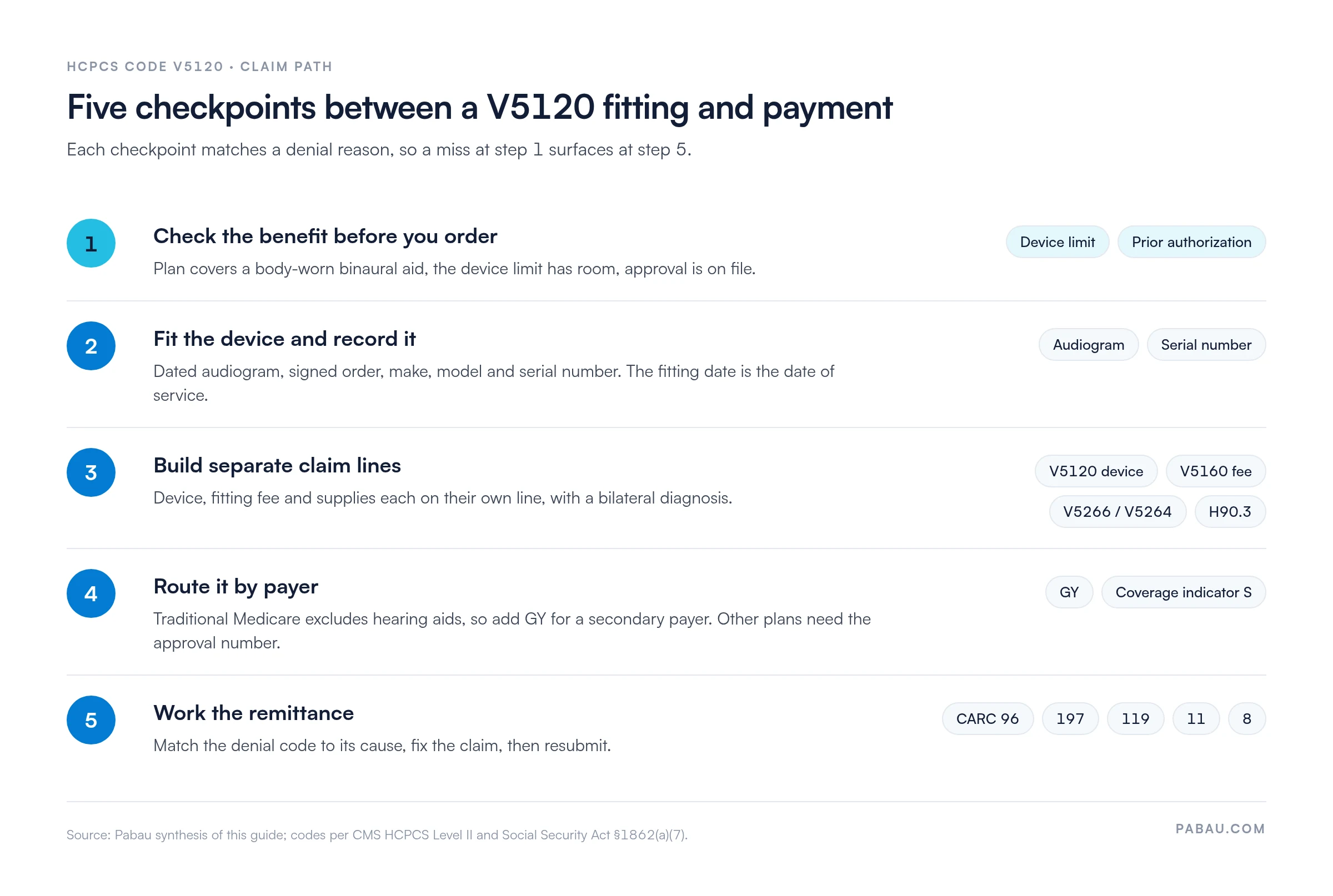
Step one carries the most weight. Skip it, and the device is already ordered by the time the plan says no.
Step three is where coding slips in. Put the device, the fee and each supply on separate lines, and give them one bilateral diagnosis that matches the audiogram.
Payers audit V5120 against device limits, so the record has to prove what was dispensed and when. Keep these eight items where your claims management software can reach them, so no document has to be chased after a denial.
Store these records before you submit. Notes added after a denial rarely survive an appeal. File each document against the claim it supports.
V5120 rarely needs a modifier. Add one only when a payer’s manual calls for it, and leave the line bare otherwise.
The DMEPOS equipment modifiers NU, RR and UE are not standard on V5120. Hearing aids are bought, not rented, and binaural devices are dispensed new. Add one only if a specific payer’s billing manual requires it.
V5120 denials follow a short list of patterns. Match the CARC on the remittance to the row below, then apply the fix before you resubmit.
Log each denial against its row, so repeat causes stand out. For codes outside this list, our guide to medical billing denial codes explains each CARC and RARC.
Many V5120 errors start with treating it like a supply code. Watch for these six.
Run through this list before every clean claim submission. Each item matches a denial pattern above.
Many hearing care practices build a V5120 claim from several places. The audiogram sits in the testing software. The order arrives as a scanned letter, and the serial number lives on a paper fitting sheet.
Pabau, the practice management platform we build, keeps those pieces in one patient record. Intake forms collect the hearing history before the visit. Treatment notes hold the device model, serial number and fitting date against the dispensing appointment.
Pabau’s claims software then works from that record. The device line and the V5160 fee line go out together, built from the same notes. When a payer queries the claim, the answer sits in one place.

Pabau holds the audiogram, device details and diagnosis in one patient record. Your V5120 device line and V5160 fee line go out complete.

V5120 names a device, and most of its claim errors start when it stands in for something else. Supplies, the fitting fee and other binaural styles all have their own codes. A claim that blurs them describes a device the patient never received.
The practices that get paid settle the benefit before they order. They confirm the plan covers a body-worn binaural aid and that the device limit has room. Then the fitting record does the rest. Book a demo to see how Pabau keeps V5120 documentation complete from fitting to claim.

Billing the fitting that goes with V5120? HCPCS code V5160 explains the binaural dispensing fee and how it pairs with each binaural device code.
Fitting in-the-ear aids instead? HCPCS code V5130 covers the binaural in-the-ear device and its documentation.
Fitting behind-the-ear aids instead? HCPCS code V5140 walks through the binaural behind-the-ear device code.
Dispensing batteries with the device? HCPCS code V5266 shows how to bill hearing aid batteries on their own line.
Coding the bilateral body-worn aid instead? HCPCS code V5110 covers the bilateral dispensing fee that pairs with V5100.
HCPCS code V5120 is the Level II code for a binaural, body-worn hearing aid. It reports the device for both ears. Batteries, ear molds and the fitting go on their own lines.
Bill one unit for the binaural device, which serves both ears. Don’t add a second unit or a second line for the other ear. Check each payer’s unit rules, since plans can set their own.
Traditional Medicare does not. The code carries coverage indicator S because Section 1862(a)(7) of the Social Security Act excludes hearing aids. Some Medicare Advantage plans add a hearing benefit, so check the patient’s plan.
No. An Advance Beneficiary Notice isn’t required for an item Medicare excludes by statute. Many practices still give a voluntary written notice, so the patient sees the price before the fitting.
Bill V5160, the binaural dispensing fee, on its own line. V5110 is the fee for V5100, and V5241 covers a single ear.
Yes. V5120 has been part of HCPCS Level II since January 1, 1995, and it remains active for 2026. CMS updates the code set quarterly, so check the current file before you bill.