HCPCS Code Q4185: Cellesta flowable amnion billing guide
HCPCS Code Q4185: definition and official descriptor HCPCS Code Q4185 is the Lev...

Last Updated: Nov 20, 2026
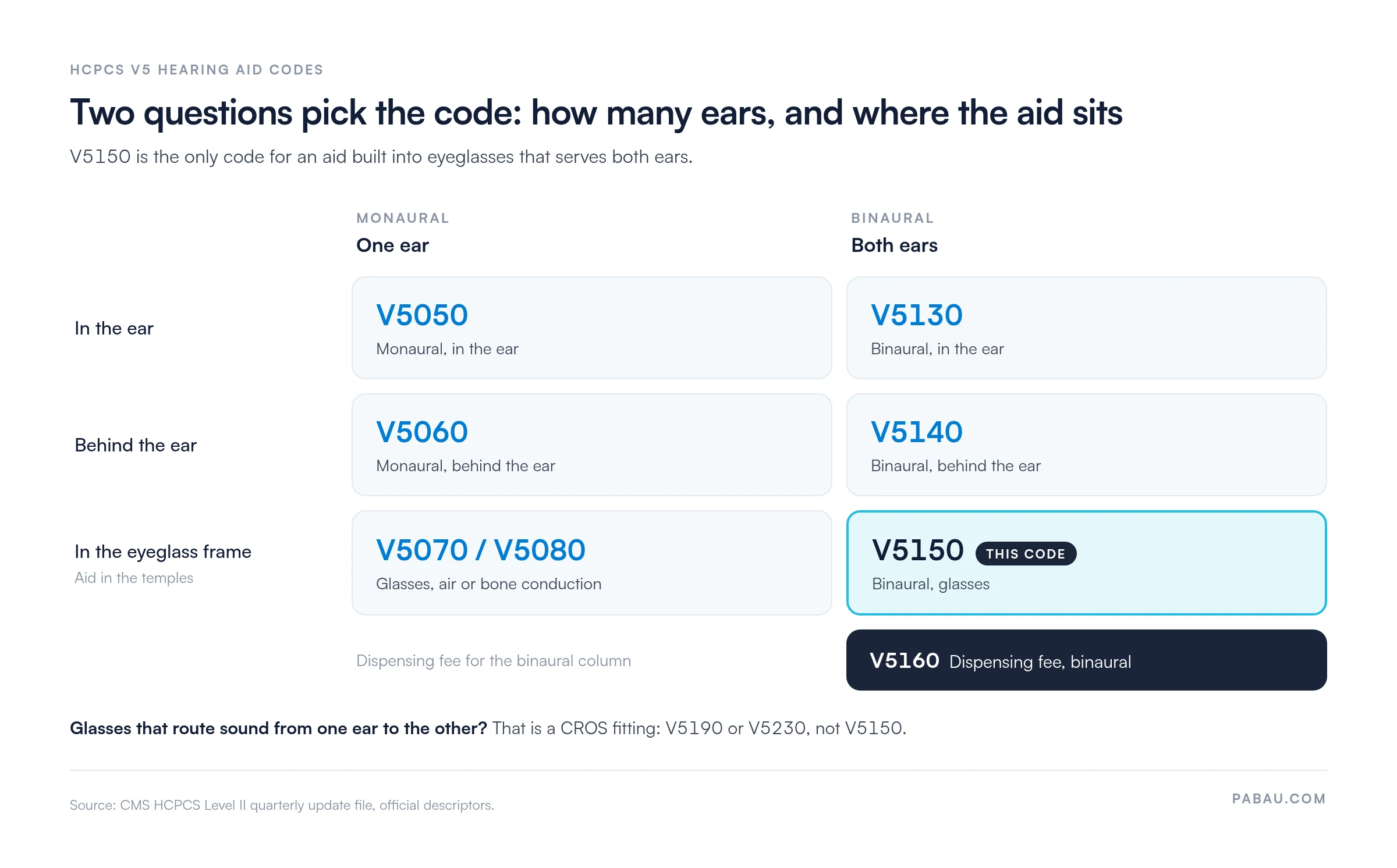
V5150 is the HCPCS Level II code for a binaural hearing aid built into eyeglasses, listed by CMS as "Binaural, glasses." One fitting amplifies both ears through the frame, and the dispensing fee is billed separately with V5160.
V5150 is active, with no termination date since it entered HCPCS on January 1, 1982. Traditional Medicare excludes hearing aids by statute, so V5150 claims go to Medicaid, Medicare Advantage hearing benefits or commercial plans.
Let Pabau's smart automation suggest the right codes, reduce claim denials, and keep your practice compliant—effortlessly.
Automate repetitive tasks and focus on what matters most—your patients.
Reduce coding errors and ensure compliance with the latest regulations.
Clean claims, fewer denials, and faster reimbursements.
Powerful insights and reporting to help your practice thrive.
HIPAA compliant SOC 2 certified GDPR-compliant Trusted by 4,000+ clinics worldwide

HCPCS code V5150 describes a binaural hearing aid built into eyeglasses, listed by CMS as “Binaural, glasses.”
V5150 is an active code with no termination date, so it can still be billed to payers that cover hearing aids.
Bill the dispensing fee with V5160 (binaural), never with a monaural or CROS dispensing code.
Traditional Medicare excludes hearing aids by statute, so V5150 is paid by Medicaid, commercial plans or Medicare Advantage hearing benefits.
Pair V5150 with a bilateral hearing loss diagnosis, such as H90.3, that matches the audiogram.
HCPCS code V5150 is the Level II code for a binaural hearing aid built into a pair of eyeglasses. The CMS HCPCS quarterly update file lists it as “Binaural, glasses,” with the short name “Glasses binaural hearing aid.”
In a glasses-style aid, the amplification sits in the temples of the frame rather than behind or inside the ear. These aids are far less common than behind-the-ear or in-the-ear styles, which makes them easy to confuse with V5140. The table pulls the reference facts together.
Within the HCPCS codes billers use, the older V5 hearing aid codes are sorted by how many ears they serve and where the device sits. V5150 closes the binaural run that starts at V5120, and V5160 is the dispensing fee for that whole run. The table below uses the official CMS descriptors.
Two rows in that table are not V5150’s neighbors in function. V5170 and V5180 were CROS codes, used when sound is routed from a poorer ear to a better one. CMS replaced them in 2019 with V5171, V5172 and V5181.
Two questions settle most fittings: how many ears the aid serves, and where it sits. The grid maps each answer to its code.
With the code confirmed, the claim follows a familiar path. Each step below closes off a different reason for a denial.
Units and ear modifiers are where payer manuals differ most. The code already means both ears, so follow the payer’s own instructions on whether it wants RT and LT.
Because V5150 is binaural, the diagnosis should support hearing loss in both ears. Payers compare the code’s laterality with the audiogram, so a unilateral diagnosis on a binaural claim invites review.
Keep laterality consistent from end to end. A bilateral H90.x code should match an audiogram showing loss in both ears and a fitting record for both sides.
Medicaid, Medicare Advantage hearing benefits, commercial plans and the VA can all pay for V5150, but traditional Medicare does not. Section 1862(a)(7) of the Social Security Act excludes hearing aids, so CMS marks V5150 as non-covered by statute.
Payers ask for slightly different paperwork, but these records cover most V5150 reviews.
Take an illustrative adult Medicaid patient with bilateral sensorineural loss who already wears glasses full time. The audiologist recommends a binaural eyeglass aid. The state plan covers adult hearing aids with prior authorization.
The practice submits the audiogram and the authorization request first. Once approved, it fits the aids and bills V5150 for the device and V5160 for dispensing, with H90.3 on both lines. The authorization number goes on the claim, and the remittance is matched when it arrives.
A short checklist like this is the core of clean claim submission, because it catches problems before the payer does.
When a denial does arrive, sort it by cause before you resubmit. Our guide to denial management in healthcare sets out a simple routine for that.
Hearing aid claims often stall between the fitting room and the billing desk. The audiogram sits in one place, the authorization in another, and the remittance arrives weeks later.
Pabau, a practice management platform with built-in billing, keeps those pieces on the patient record. Its claims management software sends US claims through Claim.MD on CMS-1500 or 837P. Your team runs eligibility checks before the fitting and posts ERA remittances when they arrive. Secondary claims go out from the same record.
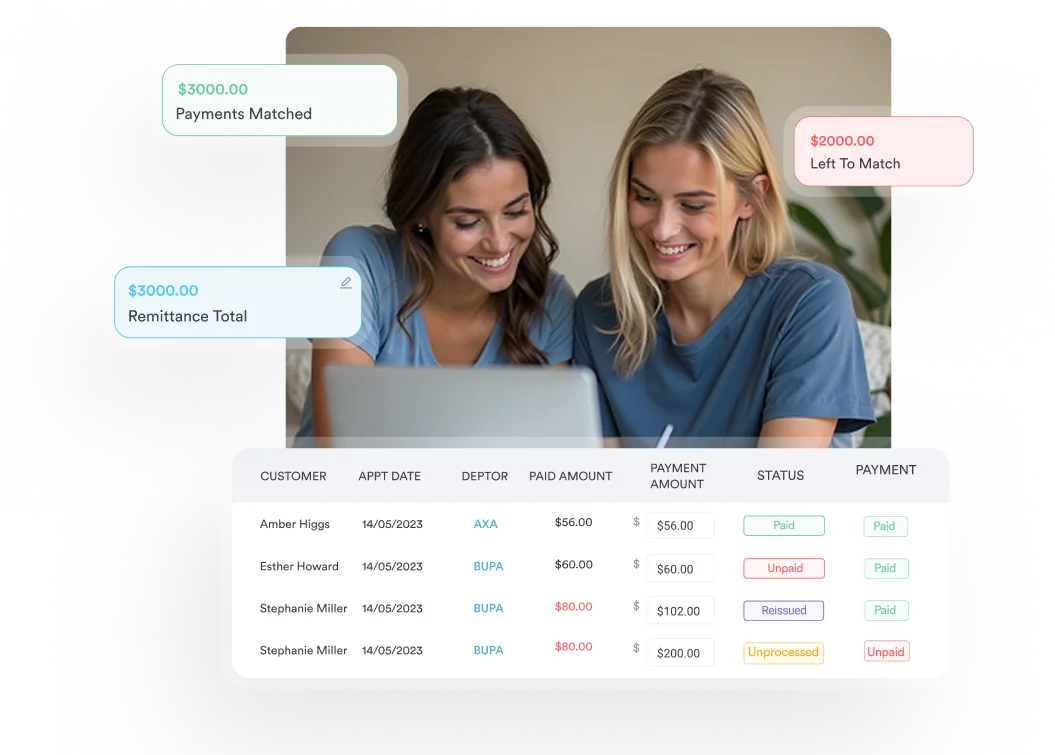

Pabau checks eligibility, sends US claims through Claim.MD and posts ERA remittances, so your team can follow each V5150 claim from fitting to payment.

V5150 is a narrow code with a clear job: a binaural hearing aid in an eyeglass frame. Treat it as active, pair it with V5160 and back it with a bilateral diagnosis.
Most of the remaining work sits with the payer. Confirm the benefit and the authorization before the fitting, and the claim has a much better chance of paying cleanly. Book a demo to see how Pabau checks eligibility and tracks each hearing aid claim through to remittance.

Billing the dispensing fee? HCPCS code V5160 covers the binaural dispensing fee that goes with V5150.
Fitting binaural aids behind the ear instead? HCPCS code V5140 explains the binaural BTE code.
Working with a body-worn binaural aid? HCPCS code V5120 covers the first code in the binaural run.
Billing a CROS fitting in glasses? HCPCS code V5230 covers the binaural contralateral routing system in glasses.
Want fewer denials across every payer? Medical billing compliance sets out the controls that keep claims clean.
V5150 describes a binaural hearing aid built into eyeglasses. The official CMS descriptor is “Binaural, glasses,” and the short name is “Glasses binaural hearing aid.”
V5150 is binaural, so one claim line covers aids for both ears. A monaural glasses aid is billed with V5070 or V5080, depending on air or bone conduction.
Bill V5160, dispensing fee, binaural. It covers the dispensing service for every code in the binaural run from V5120 to V5150.
Yes. V5150 has been in HCPCS since 1982 and has no termination date in the current CMS file.
No. Traditional Medicare excludes hearing aids under Social Security Act §1862(a)(7). Some Medicare Advantage plans add a hearing benefit that may cover it.
No. If the patient is fitted on one side only, use a monaural code that matches the device style.