CPT Code 62284: Injection procedure for myelography
CPT Code 62284: official descriptor and procedure overview The American Medical ...

Last Updated: Oct 19, 2026
V5110 is the HCPCS Level II code for "Dispensing fee, bilateral." It covers fitting and dispensing a bilateral body-worn hearing aid, and it pairs only with that device's code, V5100.
A binaural pair billed with V5120 to V5150 takes V5160 instead, and a single ear takes V5241. Traditional Medicare Part B does not cover hearing aid dispensing fees. Many Medicaid and commercial fee schedules list V5110 as not covered too, so check the payer before you bill it.
Let Pabau's smart automation suggest the right codes, reduce claim denials, and keep your practice compliant—effortlessly.
Automate repetitive tasks and focus on what matters most—your patients.
Reduce coding errors and ensure compliance with the latest regulations.
Clean claims, fewer denials, and faster reimbursements.
Powerful insights and reporting to help your practice thrive.
HIPAA compliant SOC 2 certified GDPR-compliant Trusted by 4,000+ clinics worldwide

V5110 pairs only with V5100, the bilateral body-worn hearing aid. Binaural pairs billed with V5120 to V5150 take V5160.
Many payer and Medicaid fee schedules list V5110 as not covered, so check the payer before billing it.
Traditional Medicare Part B excludes hearing aid dispensing fees, so a V5110 claim to Part B carries the GY modifier. Medicare Advantage coverage varies by plan.
State Medicaid programs differ widely, so verify eligibility and benefit limits before billing V5110.
A wrong device pairing, missing bilateral documentation, or a missing prior authorization causes most V5110 denials.
Pabau’s claims management software checks eligibility and flags a missing authorization code before a V5110 claim goes out.
HCPCS code V5110 is a Level II Healthcare Common Procedure Coding System code with the official descriptor “Dispensing fee, bilateral.” It captures the professional work of fitting and dispensing a bilateral body-worn hearing aid, the device billed with V5100.
The code does not include the cost of the device, which V5100 captures on its own line. HCPCS keeps the bilateral and binaural series apart. Binaural fittings billed with V5120 to V5150 take their own dispensing fee, V5160.
V5110 sits at the end of the V5070-V5110 miscellaneous hearing services and supplies range, as defined by CMS’s HCPCS Level II system. CMS updates HCPCS Level II codes each January. Before submitting claims, confirm that V5110 is still active in the current code year.
V5110 covers the audiology provider’s professional work of evaluating fit, programming, and dispensing a bilateral body-worn hearing aid (V5100) at one visit. Think of it as the fitting service line, separate from the device line.
Body-worn hearing aids are uncommon today, so V5110 is rarely billed. Many payer and Medicaid fee schedules list it as not covered. The Washington State Department of Labor and Industries fee schedule (MARFS Chapter 5), for example, lists V5110 as not covered. Check the payer’s schedule before you bill it.
Knowing what the code leaves out prevents unbundling errors and duplicate billing flags.
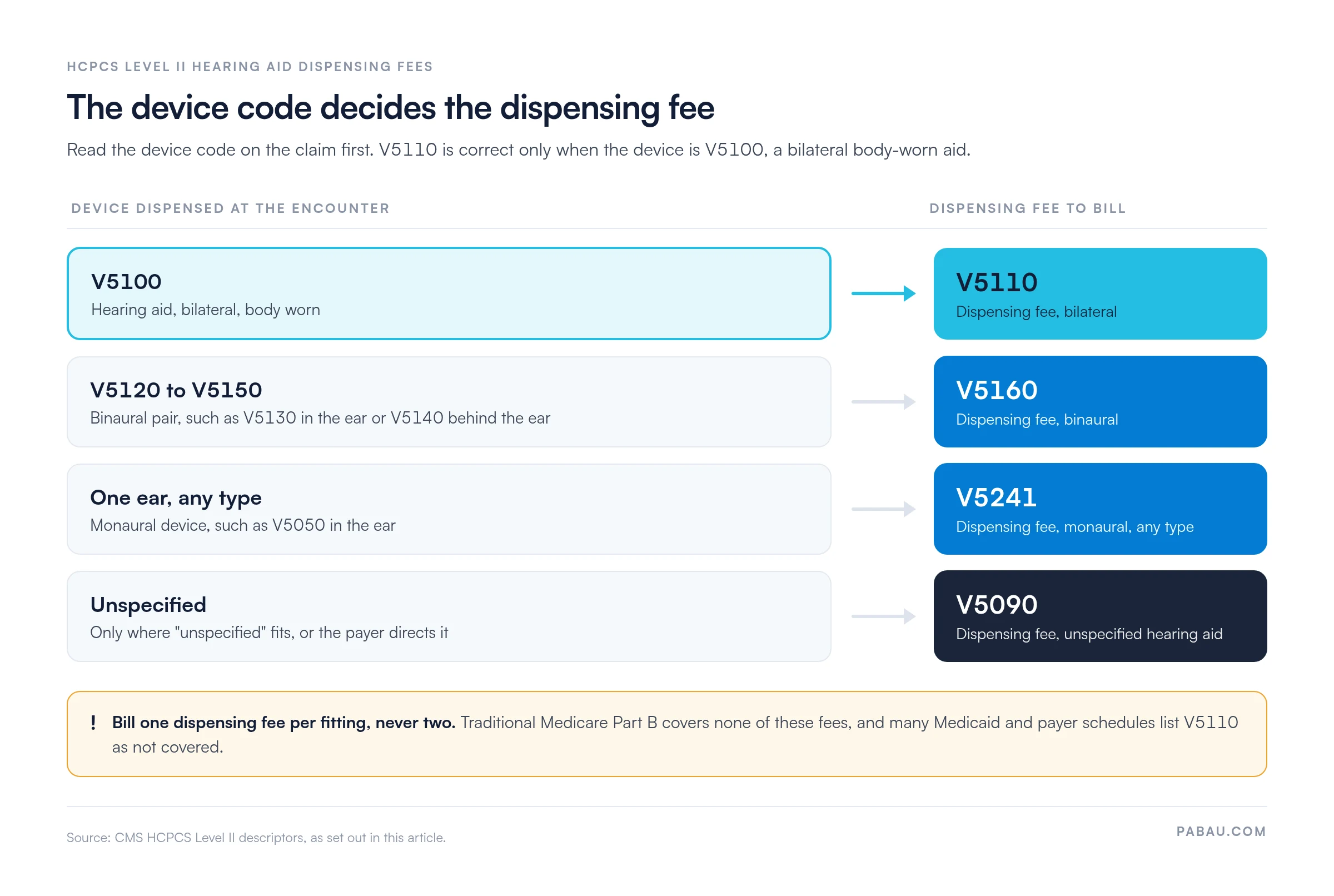
The most common mistake is treating V5110 as the general two-ear fee. If the practice dispensed a binaural pair, such as V5130 or V5140, the dispensing fee is V5160. If only one device was dispensed, V5241 (dispensing fee, monaural hearing aid, any type) is the correct code. V5110 applies only when a V5100 body-worn aid is fitted and documented at the encounter.
Two distinctions cause most coding errors in this range: Bilateral versus binaural, and two ears versus one. HCPCS gives each device series its own dispensing fee. V5110 pairs with V5100, V5160 pairs with the binaural device codes V5120 to V5150, and V5241 covers one ear. Note that V5100 is a device code for a bilateral body-worn hearing aid, not a dispensing fee.
The diagram below shows the pairing at a glance, so you can read the device code first and let it choose the fee.
Search the AAPC HCPCS Level II code range to verify current descriptors before billing. CMS revises the V-code range periodically, and a code that was valid last year may carry a modified descriptor this year. Our HCPCS guides for billers walk through the neighboring V-codes one at a time.
Traditional Medicare Part B does not cover routine hearing aids or hearing aid dispensing fees. The Medicare Benefit Policy Manual (CMS Publication 100-02, Chapter 16, “General Exclusions From Coverage”) sets out the exclusion. Its §100, “Hearing Aids and Auditory Implants,” excludes hearing aids and the examinations for fitting them. Billing HCPCS code V5110 to traditional Medicare results in a denial with a non-covered benefit remark code.
Medicare Advantage (Part C) plans can add hearing benefits as a supplemental benefit, and some of those plans cover hearing aid dispensing fees. Check that the plan lists V5110 itself, not only V5160 or V5241. Coverage rules, copay amounts, and authorization requirements vary by plan. Verify benefits before the service rather than relying on the patient’s Medicare card alone.
State Medicaid programs vary widely. Some states cover hearing aid dispensing fees, but a state that pays V5160 or V5241 may still list V5110 as not covered. Minnesota’s Department of Human Services, for example, covers hearing aid services for eligible adults. Other states exclude hearing aids entirely, limit coverage to children, or cap the annual benefit.
Private commercial insurers and managed care organizations set their own benefit designs. Some cover V5110 at 100% after the deductible. Others require cost-sharing or cap reimbursement at a dollar maximum per benefit period. Before you bill V5110, confirm that the patient’s plan covers V5110 itself for the current benefit year. Your clearinghouse’s eligibility tools can confirm active coverage before each encounter.
Run a real-time eligibility check on the day of service, not just at intake. Medicaid plans can change a patient’s hearing benefit mid-year. An eligibility check from two weeks ago may not reflect a benefit exhaustion or plan change that happened last week.
Many Medicaid programs and Medicare Advantage plans require prior authorization (PA) before a hearing aid fitting. That means the PA must be in hand before the appointment, not after. The insurance eligibility verification step confirms that the benefit exists and whether the plan requires a PA for this patient.
PA requests for V5110 typically require the following clinical information.
Some Medicaid programs require the PA to list each HCPCS code separately, including the V5100 device code and V5110. Submit an incomplete PA and the authorization that comes back may not cover the dispensing fee. That leaves you with an unbillable service line after the fact. Check which codes the authorization lists before you schedule the fitting appointment.
Solid chart documentation is the first line of denial prevention for HCPCS code V5110. Payers audit hearing aid claims because the dollar amounts are material. A missing bilateral fitting note can convert a paid claim into a recoupment demand months after service.
The chart note for the dispensing visit must contain each of the following elements.
The dispensing note is the most important element. It should name the V5100 device and confirm it was dispensed and fitted to both ears. If the note describes a binaural pair, such as two behind-the-ear aids, the fee is V5160. If it describes one ear only, the fee is V5241.
Audiology claims management software with built-in documentation templates cuts these errors. The templates prompt clinicians to confirm the device type and the ears fitted before the encounter is closed.
Denial patterns on V5110 are predictable. Catching them before the claim goes out is the most efficient form of denial management in healthcare. The table below maps each common denial reason to its root cause and the corrective action.
A consistent billing workflow reduces the chance of a V5110 claim being delayed or denied. Here is the sequence audiology billing teams use for clean claim submission.
Many V5110 claims need no modifier, but certain plan types and billing scenarios call for one. Applying the wrong modifier, or omitting a required one, can trigger a denial or edit flag.
Most dispensing fee errors start with information spread across systems. The audiogram sits in one place, the authorization number in an email, and the device code on a paper fitting note. By the time billing staff build the claim, nobody can see whether the fee matches the device.
Pabau, the all-in-one practice software we make, keeps those records on one patient file. Its claims management links each patient to their insurer, and invoice details pre-fill the claim. In the US, a Claim.MD connection runs real-time eligibility checks, so you can confirm the plan covers V5110 before the fitting.
Validation checks run in the background and flag a claim that is missing its authorization code before it leaves. Each claim then shows a live status, from submitted to paid, and ERA remittances post against the right invoice. Your team spends less time reworking denied hearing aid claims and more time with patients.

Pabau checks eligibility in real time and flags a missing authorization code before submission. Your hearing aid claims reach the payer complete, and ERA remittances post automatically.

Treat V5110 as a code you confirm before you use it. Body-worn aids are rare, so an unexpected V5110 line deserves a second look before the claim goes out. Check the device code first, and let it decide the fee.
Then confirm the payer lists V5110 as covered and that the authorization names it. A plan that excludes V5110 means the fee can’t be billed to that plan. Getting those answers at intake takes minutes, while a recoupment demand months later costs the whole fee.
Book a demo to see how Pabau checks eligibility and authorization codes before your next hearing aid claim goes out.

Need a cleaner claim submission process? Claims management software gives audiology teams a structured workflow from code entry to payment posting.
Confused about denial codes on your remittance? Denial codes in medical billing explains the most common CARC and RARC codes and what each one means for your next step.
Want to understand the broader billing picture? What is revenue cycle management covers the end-to-end process from patient registration through final payment collection.
Billing the hearing assessment before the fitting? HCPCS code V5010 covers the hearing aid assessment that usually comes before a fitting.
Fitting a binaural behind-the-ear pair instead? HCPCS code V5140 explains the device code that pairs with the V5160 binaural dispensing fee.
HCPCS code V5110 covers the professional dispensing fee for fitting a bilateral body-worn hearing aid, the device billed with V5100. It does not include the cost of the device itself. Binaural pairs billed with V5120 to V5150, such as V5130 or V5140, take a different dispensing fee, V5160.
No, traditional Medicare Part B does not cover routine hearing aid dispensing fees. V5110 claims billed to Part B will be denied with a non-covered benefit code. Some Medicare Advantage plans include supplemental hearing benefits that cover dispensing fees. Check that the plan lists V5110 itself, because coverage varies by plan and must be verified before each service.
V5110 is the dispensing fee for a bilateral body-worn hearing aid, billed with V5100. V5241 is the monaural dispensing fee for any hearing aid type, used when only one ear is fitted. Using V5110 when only one ear was fitted will result in a denial. A binaural pair, such as two in-the-ear aids, takes V5160 instead of either code. Note that V5100 itself is a device code, not a dispensing fee.
A V5110 claim requires a current audiogram showing hearing loss in both ears and a medical necessity statement supporting bilateral amplification. The chart also needs fitting notes confirming the V5100 device was dispensed and fitted to both ears, with its serial number. Add patient counseling documentation and a prior authorization number if the payer required one.
Medicaid coverage of V5110 varies by state. Some states cover hearing aid dispensing fees for eligible adults, yet many schedules list V5110 itself as not covered. Others restrict coverage to children or exclude hearing aids entirely. Always verify the specific state Medicaid plan’s hearing benefit before scheduling the fitting.
Yes, V5110 is billed alongside its device code, V5100 (hearing aid, bilateral, body worn), on the same claim. It does not pair with the binaural device codes V5120 to V5150, which take V5160, the binaural dispensing fee. Never bill V5110 with V5160 or V5241 for the same encounter. Only one dispensing fee code applies per fitting.