CPT Code 62284: Injection procedure for myelography
CPT Code 62284: official descriptor and procedure overview The American Medical ...

Last Updated: Oct 19, 2026
V5241 is the HCPCS Level II code for dispensing fee, monaural hearing aid, any type. It reports the professional service of fitting and dispensing one hearing aid to one ear.
The hearing aid itself goes on its own claim line under a V5 device code, such as V5257 for a digital monaural behind-the-ear aid. A two-ear fitting takes a binaural fee code such as V5160, and CROS devices have their own dispensing fees.
Let Pabau's smart automation suggest the right codes, reduce claim denials, and keep your practice compliant—effortlessly.
Automate repetitive tasks and focus on what matters most—your patients.
Reduce coding errors and ensure compliance with the latest regulations.
Clean claims, fewer denials, and faster reimbursements.
Powerful insights and reporting to help your practice thrive.
HIPAA compliant SOC 2 certified GDPR-compliant Trusted by 4,000+ clinics worldwide

HCPCS code V5241 is the dispensing fee for fitting one hearing aid to one ear, whatever the device’s style or technology.
V5241 reports the professional service only, so the hearing aid itself goes on a separate line under its own V5 device code.
The ear count must match across the claim. A monaural device code pairs with V5241, while a two-ear fitting takes V5160.
Contralateral routing devices have their own dispensing fees, V5200 for a monaural CROS aid and V5240 for a binaural system.
Traditional Medicare excludes hearing aids and their dispensing fees by statute, so payment depends on Medicare Advantage, Medicaid, or commercial benefits.
HCPCS code V5241 is the Level II code for the fee an audiologist or hearing instrument specialist charges to fit and dispense one hearing aid. Its official descriptor is “Dispensing fee, monaural hearing aid, any type.”
“Monaural” means one ear. “Any type” means the same code applies whatever the device style or technology, from a behind-the-ear aid to a completely-in-canal one.
V5241 never describes the hearing aid itself. The device goes on its own claim line with a V5 hearing aid code, such as V5256 for a digital monaural in-the-ear aid. A behind-the-ear aid with digitally programmable analog circuitry takes V5247 on that device line.
The table below summarizes how the Centers for Medicare & Medicaid Services (CMS) lists V5241 in its October 2026 HCPCS file. Every other V5 hearing aid code is listed in the HCPCS codes directory.
V5241 pays for the professional work around a single device. Payer manuals differ in detail, but the dispensing fee typically covers the steps below.
Some payers fold ear molds or follow-up visits into the dispensing fee. Check the fee schedule before billing any of these on a separate line.
The V5 series has six hearing aid dispensing fee codes. Two questions pick the right one, as the diagram below shows. How many ears were fitted, and does the device route sound from one side to the other?
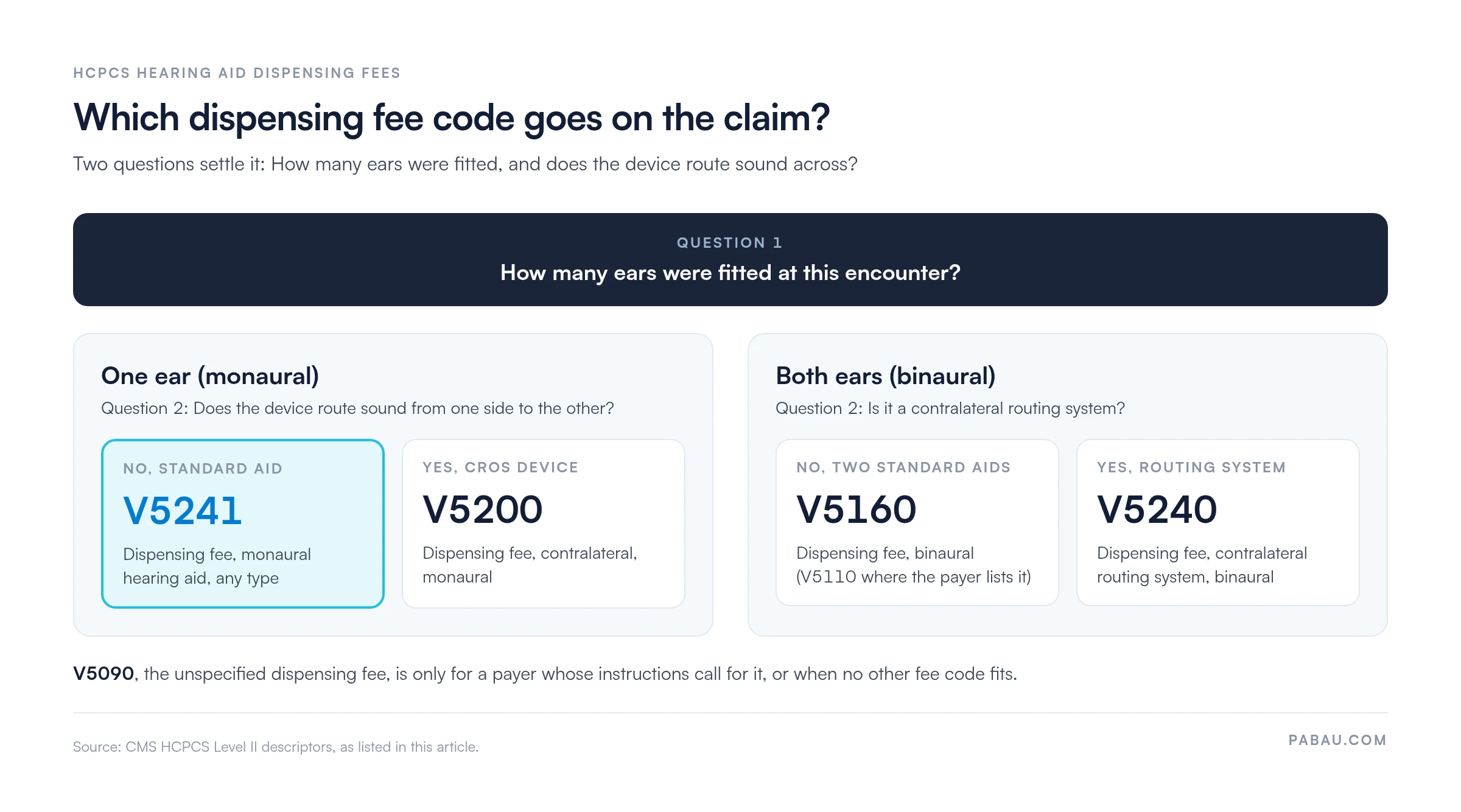
For a two-ear fitting, most payers expect one unit of the binaural code rather than two units of V5241. A few state programs publish their own rule, so read the fee schedule first. Where a schedule lists the bilateral code instead, that two-ear fitting bills as V5110. For the two-ear code in detail, see HCPCS code V5160.
The dispensing fee and the device code must describe the same fitting. The quickest check on any hearing aid claim is the ear count. A monaural device code such as V5257 takes a monaural fee.
A binaural device code next to V5241 tells the payer the claim contradicts itself. So does a CROS device on the same claim as V5241, because a CROS fitting takes V5200. Expect a denial or a request for records in both cases.
The diagnosis must support amplification in the ear being fitted. For a one-ear fitting, a unilateral code with matching laterality is usually the cleanest pairing.
A patient with loss in both ears can still choose a single aid. In that case a bilateral code such as H90.3 is accurate, and the fitting notes should say why only one ear was fitted.
Traditional Medicare does not pay V5241. Whether anyone pays the dispensing fee depends on the patient’s other hearing benefits.
Tell traditional Medicare patients before the fitting that the dispensing fee is theirs to pay. An Advance Beneficiary Notice is not required for a statutory exclusion, but the voluntary version documents the conversation.
Payers reviewing a V5241 claim look for a record that ties the diagnosis to one fitted ear and one device. Keep these items in the patient record:
Record the fitted ear on the dispensing note as its own field, not only in free text. The same value then sets the RT or LT modifier and the diagnosis laterality, so all three agree on the claim.
Many payers want the ear identified on monaural hearing aid lines. Add the side modifier to the device line and the V5241 line alike, so the two lines agree. A clean claim carries the right modifiers from the first submission.
Some Medicaid programs publish their own modifier rules for hearing aid services. Where a payer’s manual differs from the table above, follow the manual.
Most V5241 denials come from a claim that disagrees with itself or with the patient’s benefits. Tracking them by code supports a structured denial management process.
A V5241 error often starts before anyone builds the claim. The dispensing note says one ear, while the charge sheet carries a binaural device code or no side at all.
Pabau, the practice management platform we build for specialist practices, keeps the fitting note, the invoice, and the claim in one patient record. Billing staff work from the encounter that was documented, so the device code, V5241, and the side modifier describe the same fitting.
Pabau’s claims management software also runs validation checks each time a claim is sent. A side modifier that disagrees with the device line gets fixed at the desk, before a payer can deny it.
In the US, Pabau connects to Claim.MD, so staff can run a real-time eligibility check before the fitting appointment. Each claim that clears on the first pass shortens revenue cycle management for an audiology practice.

Pabau keeps the fitting note, device code, and dispensing fee in one patient record. V5241 claims go out with a matching ear, modifier, and diagnosis.

Treat V5241 as one half of a pair. Code the device first, count the ears, and then add the fee that matches. Three of the denials in the table above trace back to skipping one of those steps.
Coverage is the harder part. Traditional Medicare will not pay, so the cost conversation matters as much as the coding. Settle it with the patient before the fitting appointment.
Book a demo to see how Pabau keeps hearing aid dispensing claims consistent from the fitting note to the payer.

Fitting both ears at one visit? HCPCS code V5160 explains the binaural dispensing fee and when it replaces V5241 on a claim.
Need to understand how medical billing denials are managed? Denial management in healthcare covers the end-to-end process for tracking, appealing, and preventing claim rejections across billing codes.
Looking for a full guide to medical billing? What is medical billing? explains the revenue cycle workflow from charge capture through payment posting for practice billing teams.
Want to keep up with audiology billing compliance requirements? Medical billing compliance outlines the key rules, documentation standards, and audit triggers for HCPCS and DME billing.
HCPCS code V5241 is the dispensing fee for one hearing aid fitted to one ear. It covers the professional fitting service for any device type, while the hearing aid itself takes a separate V5 device code.
V5241 is the monaural dispensing fee for one ear, and V5160 is the binaural fee for both ears at one encounter. For a two-ear fitting, most payers expect one unit of V5160 rather than two units of V5241.
No. Traditional Medicare Part B excludes hearing aids and their dispensing fees under Section 1862(a)(7) of the Social Security Act. Some Medicare Advantage plans include a hearing benefit, so check the patient’s plan before the fitting.
No. A monaural CROS device takes V5200, the contralateral monaural dispensing fee. A binaural contralateral routing system takes V5240.
Payers that want the ear identified ask for RT for the right ear or LT for the left. Use the same modifier on the device line and the V5241 line, and follow the payer’s manual where its rules differ.
Yes. V5241 goes on its own line next to the monaural device code, such as V5257 for a digital behind-the-ear aid. Both lines should point to the same diagnosis and carry the same side modifier.