CCSD code H4430: Examination of rectum under anaesthetic
CCSD code H4430 pays for the examination alone CCSD code H4430 is the UK private...

Last Updated: Oct 20, 2026
B0860 is the CCSD code for partial thyroidectomy (not elsewhere classified). It covers partial thyroid resections, such as a partial lobectomy or a nodule excision, that no named thyroid code describes. It sits in section 6.9 of Chapter 6, and insurer fee schedules band it as Major.
Because it is a residual code, B0860 applies only after the named codes are ruled out. Hemithyroidectomy is B0830, bilateral subtotal thyroidectomy is B0820, and isolated isthmectomy is B0850. Total thyroidectomy is B0812, or B0813 with a lymph node block dissection.
Let Pabau's smart automation suggest the right codes, reduce claim denials, and keep your practice compliant—effortlessly.
Automate repetitive tasks and focus on what matters most—your patients.
Reduce coding errors and ensure compliance with the latest regulations.
Clean claims, fewer denials, and faster reimbursements.
Powerful insights and reporting to help your practice thrive.
HIPAA compliant SOC 2 certified GDPR-compliant Trusted by 4,000+ clinics worldwide

CCSD code B0860 covers partial thyroidectomy not elsewhere classified, a residual code for partial resections that no named thyroid code describes.
Hemithyroidectomy is B0830, bilateral subtotal thyroidectomy is B0820, and isolated isthmectomy is B0850, so none of them is billed as B0860.
Total or near-total thyroidectomy is B0812, or B0813 when a lymph node block dissection is added.
The operative note must record the side, the extent of resection, and the thyroid tissue left in place to support a B0860 claim.
Pabau’s practice software keeps pre-authorization numbers, operative notes, and CCSD claims on one patient record.
CCSD code B0860 is the code for partial thyroidectomy (not elsewhere classified). It comes from the schedule kept by the Clinical Coding and Schedule Development (CCSD) Group, which UK private medical insurers use to pay consultant fees. B0860 sits in section 6.9 of Chapter 6, and insurer fee schedules band it as Major.
Not elsewhere classified (NEC) means the code applies only when no named descriptor fits the operation. Section 6.9 gives hemithyroidectomy, bilateral subtotal thyroidectomy, and isolated isthmectomy their own codes. B0860 covers the partial resections left over once those are ruled out.
The thyroid gland has two lobes joined by a narrow bridge of tissue called the isthmus. A partial thyroidectomy removes part of the gland and leaves functioning thyroid tissue in place. Common reasons are a benign nodule, a cyst, or a goiter confined to one area.
B0860 applies once B0812, B0813, B0820, B0830 and B0850 have been ruled out. In practice, that leaves a small set of operations.
Isthmectomy is not on this list. Removal of the isthmus alone has its own code, B0850 (isthmectomy of thyroid gland), so it is never billed as B0860. If the surgeon removes the whole gland, or nearly all of it, the code is B0812 instead. When a formal lymph node block dissection is added, it becomes B0813.
Two questions settle the code for a thyroid operation. How much of the gland came out, and does a named code describe that extent? B0860 is the answer only when no named code does. The ladder below runs those checks in order, and the table after it maps common scenarios to each code.
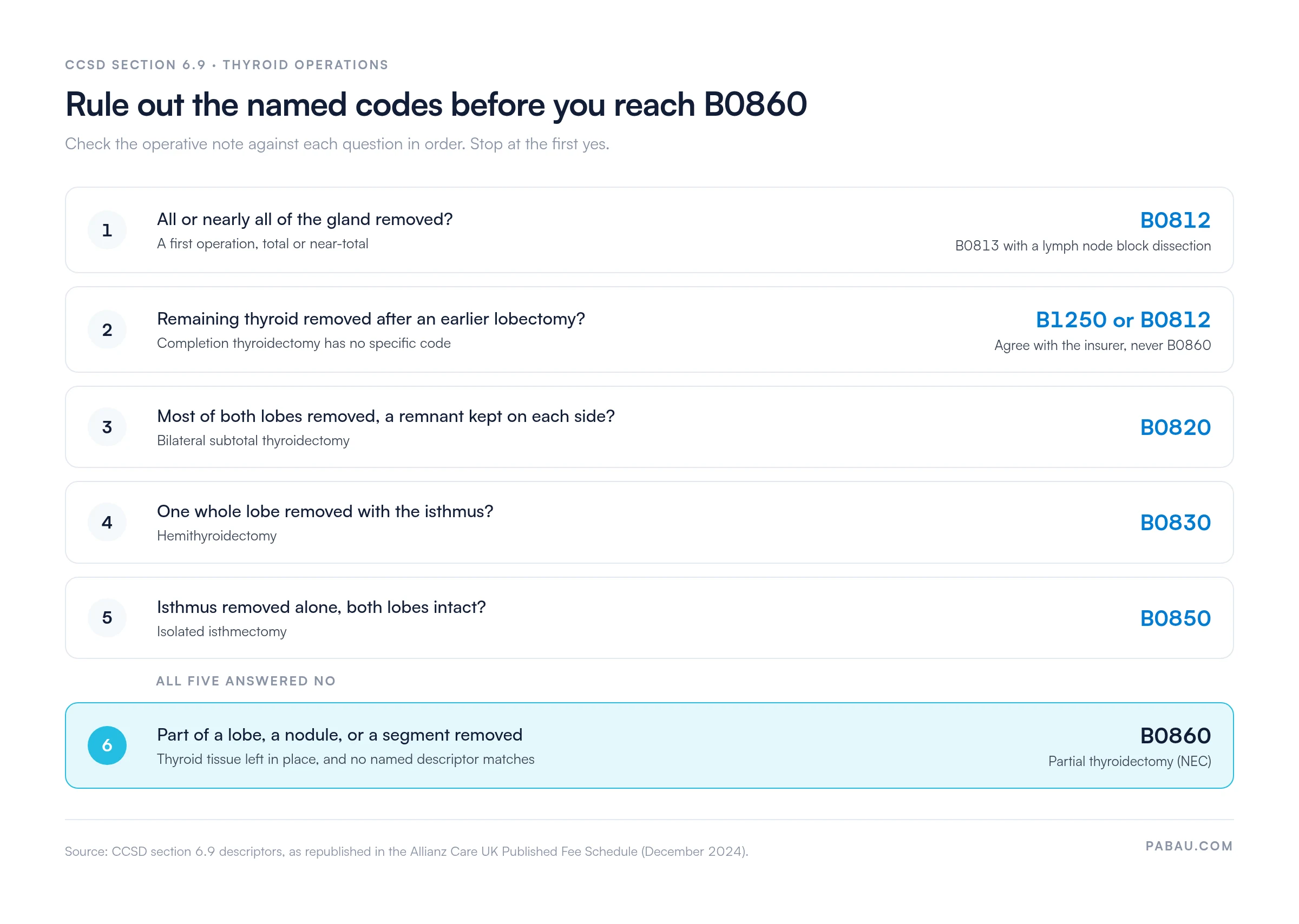
If the operation goes further than planned, code what was done. A planned partial lobectomy that ends as a hemithyroidectomy is B0830, so ask the insurer to amend the authorization before you bill.
Section 6.9 of the schedule holds the thyroid CCSD codes, and each descriptor covers a distinct operation. The table lists the codes to rule out before choosing B0860. Descriptors follow section 6.9 as republished in the Allianz Care UK Published Fee Schedule (December 2024).
The Freedom Elite Schedule of Fees, Chapter 6 (effective May 1, 2026), carries the same section 6.9 codes. Both schedules band B0820, B0830, B0850 and B0860 as Major.
Completion thyroidectomy needs particular care, because no CCSD code is specific to it. The closest listed code is B1250, which covers a thyroid re-operation. Some insurers ask for B0812 instead when the completion was planned as a staged procedure. Confirm the code with the insurer before surgery, and never bill a completion as B0860.
The operative note decides whether a B0860 claim is paid. Insurers audit it for what was removed, from which side, and what was left behind. A note that only confirms the operation took place draws a request for more information or a denial. Digital operative note templates that prompt for each field cut omissions at the source.
These elements must appear in the operative note to support a valid claim:
Review the operative note before the claim goes in. A five-minute check when the theater list closes prevents a three-week dispute with the insurer. Confirm laterality, extent, and residual tissue before the patient leaves the ward.
All major UK private medical insurers require pre-authorization for elective thyroid surgery, and B0860 is no exception. A claim for an operation done without it is one of the fastest routes to non-payment. That holds however good the operative note is, and however valid the code.
The insurer’s authorization number must appear on the invoice. Bupa publishes its fee schedule rules alongside the Bupa CCSD procedure codes on its provider portal. The table below summarizes pre-authorization across the four main UK insurers for B0860 claims.
Pre-authorization rules also differ by policy type within each insurer. Corporate and individual policies from the same insurer can carry different conditions. Always check the member’s own policy document, not a generic insurer guide.
Fees for B0860 are negotiated between insurers and individual consultants or hospital groups, so no single fee applies across insurers. A published schedule shows the insurer’s standard rate. Recognized consultants may hold personally negotiated rates above or below it, so check the current schedule for your recognition tier.
A complete B0860 claim usually involves several codes alongside the primary surgical code:
The consultant invoice must show the CCSD code, the pre-authorization number, the procedure date, and the patient’s membership number. It also needs the hospital and the consultant’s recognition number. A missing field delays payment, however accurate the coding.
A clean first submission is faster and cheaper than a denial and appeal. This sequence fits most major UK private medical insurers, though portals and deadlines differ.
Most rejected B0860 claims trace back to a few repeating causes. Nearly all of them can be caught with a documentation check before submission.
Surgical practices billing B0860 juggle three jobs at once. They track pre-authorization across several insurers, check the operative note before invoicing, and keep each consultant’s recognition current. When those jobs live in separate systems, claims go out with fields missing.
Pabau’s claims management software assigns the CCSD code when the invoice is created. It ties each pre-authorization number to the patient episode and flags claims missing a mandatory field. A B0860 claim is checked before it reaches the insurer, so it doesn’t bounce back weeks later.
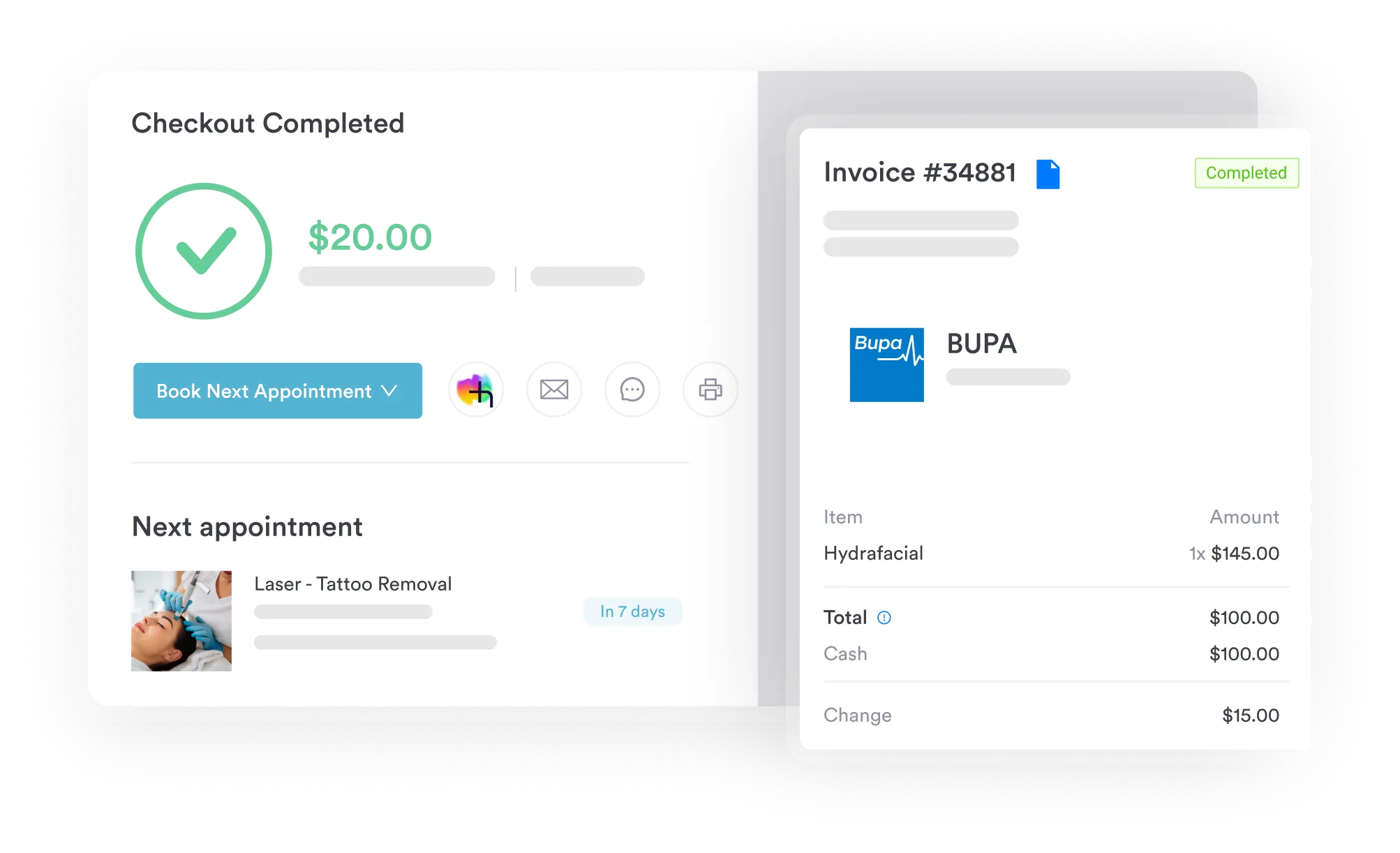
For consultants moving to private practice from the NHS, billing several insurers with different authorization rules is a big adjustment. Pabau keeps each insurer’s submission rules inside the platform, so your team isn’t working from a separate spreadsheet.

Pabau helps UK private practices assign CCSD codes, track pre-authorization status, and submit insurer claims without the manual back-and-forth. See how it works for endocrine and surgical practices.

Treat B0860 as the last code you reach for. Read the operative note against B0812, B0813, B0820, B0830 and B0850 first, and most partial thyroid operations land on a named code. B0860 is left for the resections those descriptors don’t describe.
Two cases catch billers out. An isolated isthmectomy is B0850, never B0860. A completion thyroidectomy has no specific code, so agree B1250 or B0812 with the insurer at pre-authorization, before the claim is written.
Book a demo to see how Pabau checks each thyroid surgery claim for a matching code, note, and authorization before it reaches the insurer.

Need a complete guide to Bupa CCSD procedure codes? Bupa CCSD procedure codes guide covers the full Bupa fee schedule, code lookup rules, and submission requirements for UK private practices.
Looking for CCSD-ready claims management software? Claims management software from Pabau supports CCSD code assignment, pre-auth tracking, and insurer submission for UK private healthcare providers.
B0860 covers partial thyroidectomy not elsewhere classified. It applies to partial thyroid resections, such as a partial lobectomy or a nodule excision, that no named CCSD thyroid code describes. Hemithyroidectomy (B0830), bilateral subtotal thyroidectomy (B0820), and isolated isthmectomy (B0850) each have their own code.
B0850 is isthmectomy of thyroid gland, the removal of the isthmus alone. B0860 is partial thyroidectomy not elsewhere classified, used only when no named code fits. Neither covers total thyroidectomy, which is B0812, or B0813 when a lymph node block dissection is added.
Bupa, AXA Health, Aviva, and Vitality Health all require pre-authorization before elective thyroid surgery coded under B0860. The authorization number must appear on the consultant’s invoice. Without it, none of the four insurers will pay the claim, however good the documentation is.
No. An isolated isthmusectomy has its own code, B0850 (isthmectomy of thyroid gland), so it is never billed as B0860. The operative note should confirm that only the isthmus was removed and both lobes were left intact. If a whole lobe came out with the isthmus, the code is B0830.
No CCSD code is specific to completion thyroidectomy. The closest listed code is B1250 (thyroid: re-operation), and some insurers ask for B0812 when the completion was planned as a staged procedure. Confirm the code with the insurer at pre-authorization, and never bill it as B0860.
The most common error is billing B0860 when a named code applies. Hemithyroidectomy belongs under B0830, isolated isthmectomy under B0850, and total thyroidectomy under B0812. Missing pre-authorization numbers and missing laterality in the operative note are the next most frequent causes of claim delay.
The operative note must give the pathological indication, such as a nodule or goiter, and the exact extent of resection. It must state laterality and confirm which thyroid tissue was left in place. It also needs the hemostasis and closure method, plus the consultant’s name and GMC number.