CPT Code 62284: Injection procedure for myelography
CPT Code 62284: official descriptor and procedure overview The American Medical ...

Last Updated: Oct 19, 2026
V2700 is the HCPCS Level II code for balance lens, per lens. It covers a non-prescription plano lens fitted on the non-prescribing eye of a spectacle frame, so the glasses stay balanced in weight and appearance. The code sits in the V2700-V2799 Vision Services range, within the wider V2020-V2799 Vision Services codes that CMS maintains.
Medicare Part B excludes routine eyeglasses under SSA Section 1862(a)(7). V2700 is usually reimbursed through the post-cataract exception under SSA Section 1861(s)(8), which needs the surgery and the dispensing documented on file.
Let Pabau's smart automation suggest the right codes, reduce claim denials, and keep your practice compliant—effortlessly.
Automate repetitive tasks and focus on what matters most—your patients.
Reduce coding errors and ensure compliance with the latest regulations.
Clean claims, fewer denials, and faster reimbursements.
Powerful insights and reporting to help your practice thrive.
HIPAA compliant SOC 2 certified GDPR-compliant Trusted by 4,000+ clinics worldwide

HCPCS code V2700 covers one plano balance lens, per lens, in the V2700-V2799 Vision Services range, not prescription or contact lenses.
Medicare Part B excludes routine eyeglasses, so V2700 is reimbursed only under a qualifying exception such as post-cataract surgery.
Proof of delivery, a valid prescription, and any payer-required prior authorization must be on file before you bill.
Pabau, the practice management platform we build, supports V2700 charge capture, modifier attachment, and clearinghouse routing in one workflow.
HCPCS code V2700 is officially described as “balance lens, per lens” in the CMS HCPCS Level II code database.
It sits in the V2700-V2799 Vision Services range, part of the wider V2020-V2799 Vision Services codes. The code refers specifically to a non-prescription plano (flat) lens fitted into the frame on the non-prescribing eye. That lens balances the weight and appearance of the glasses without correcting vision.
Because the descriptor is so narrow, billers who apply V2700 to any second-eye lens misreport the claim. The code is billed per lens, so a patient receiving one balance lens on the non-prescribing side generates one unit of V2700.
V2700 covers a plano balance lens supplied to fill the non-prescribing eye of a spectacle frame when only one eye requires a prescription. The clinical rationale is cosmetic balance and frame stability. A prescription lens on one side combined with an empty or grossly asymmetric frame can cause discomfort and physical imbalance.
The balance lens resolves that without correcting vision on the non-prescribing side.
V2700 should never be billed for any of these items:
The Office of Inspector General (OIG) includes ophthalmic supply codes in routine audit targets. An optometry billing team that uses HCPCS code V2700 as a catch-all second-lens code is creating audit exposure.
CMS requires proof of delivery for all HCPCS supply codes billed to Medicare, and HCPCS code V2700 is no exception. A dispensing event must be documented before the claim is submitted. “Dispensing” means the patient physically received the finished optical good, not that the order was placed.
The core documentation set for a V2700 claim mirrors what you would prepare using a structured superbill for optical supply codes:
Store each of these elements in the patient record before you generate the charge. A claim submitted without the dispensing record is the most preventable denial in HCPCS code V2700 billing.
Medicare Part B does not cover routine eyeglasses or spectacle lenses. This is a statutory exclusion under SSA Section 1862(a)(7), and HCPCS code V2700 falls within that exclusion for most clinical scenarios. Coverage exists only when a qualifying exception applies.
The most widely used exception is the post-cataract surgery benefit under SSA Section 1861(s)(8). After cataract extraction with lens implant, Medicare covers one pair of conventional eyeglasses or one set of contact lenses. The benefit applies once per affected eye.
The surgery itself is usually billed as 66984, and its date anchors the dispensing claim. A balance lens on the non-operated eye in that encounter is a covered V2700 claim, because it belongs to the post-surgical dispensing event.
Medicaid is state-administered, so coverage of HCPCS code V2700 varies significantly. Confirm coverage with your state Medicaid agency before you bill.
CMS lists V2700 as a carrier-priced code, so it has no national fee schedule amount. Your Medicare Administrative Contractor (MAC) sets the allowed amount, and that rate can change each year and by locality.
Use the CMS Physician Fee Schedule Look-Up Tool to confirm how V2700 is priced for the year and MAC locality you bill under. Then take the current amount from your MAC’s published rates. For DME suppliers, the DME fee schedule is the correct reference.
Commercial rates for HCPCS code V2700 are typically derived from the Medicare allowed amount using a multiplier. That multiplier ranges from 80% to 140% of Medicare, depending on the plan contract. Vision-specific managed care plans may set their own optical fee schedules outside of the Medicare reference entirely.
V2700 is a per-lens code, so modifier use is primarily about identifying which eye is receiving the balance lens and attesting to coverage criteria. The following modifiers apply to HCPCS code V2700:
Laterality modifiers (RT/LT) are often omitted on lens codes by billing teams who assume per-lens coding makes them redundant. Medicare and many commercial payers use them to confirm that each claim line describes a single lens on a specific side. Missing RT or LT on a V2700 line item is a common, easily avoidable denial trigger.
HCPCS code V2700 is frequently confused with other codes in the spectacle lens range. The key distinction is always the lens prescription status and the clinical purpose of the lens being supplied.
A typical post-cataract dispensing bills three lines. V2100 covers the sphere single vision lens for the operated eye, V2700 the plano balance lens for the other eye, and V2020 the frame. Medicare commonly accepts that combination when the documentation supports it, and the diagram below shows how the lines split by eye.
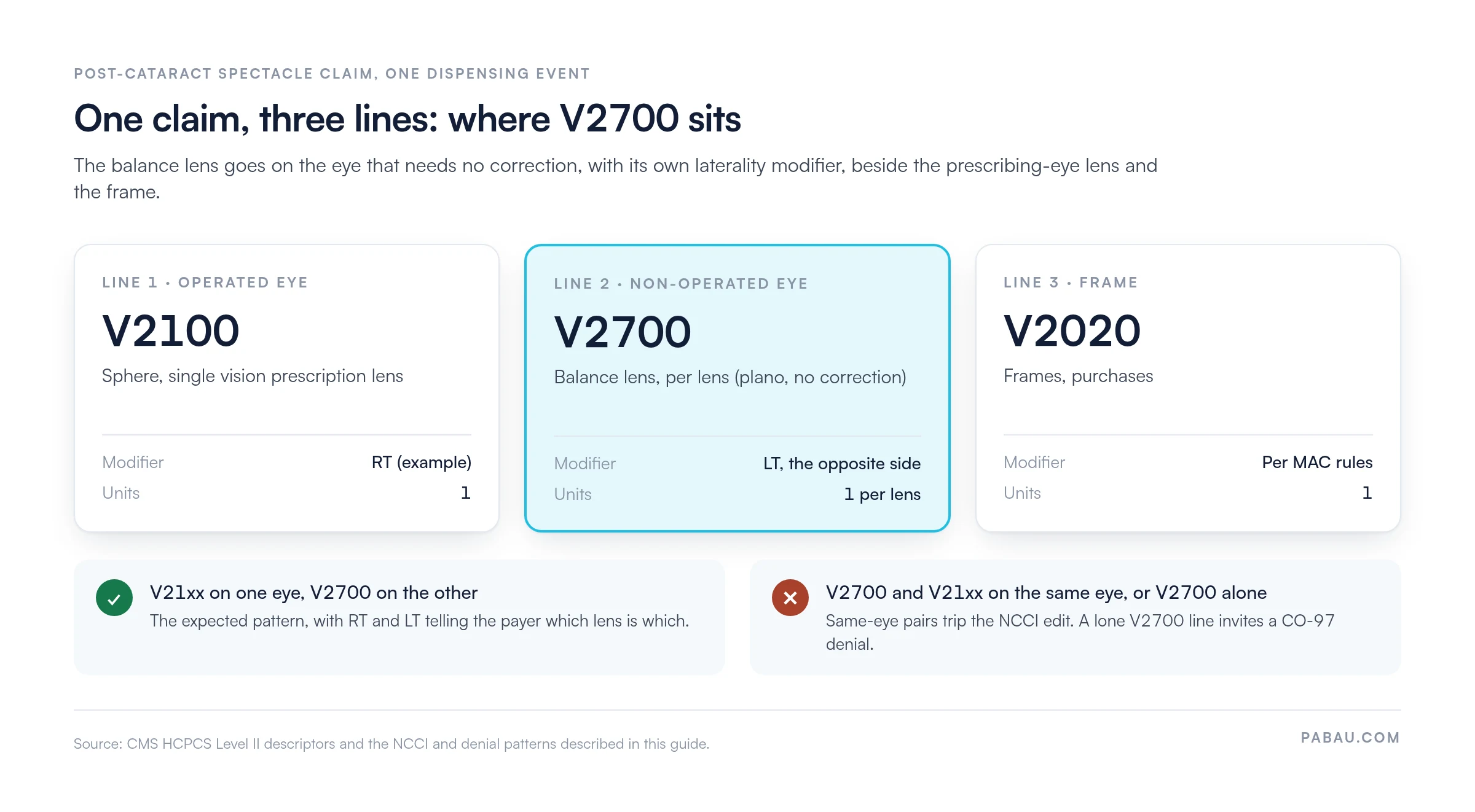
Billing V2700 alone, with no prescribing-eye lens code on the same claim, is unusual enough to invite scrutiny.
V2700 replaces a lens code rather than adding to one, which separates it from the prism add-ons. Where both eyes keep a useful prescription and anisometropia causes vertical imbalance at near, the slab-off grind V2710 is the add-on to bill.
Denials on HCPCS code V2700 follow a predictable pattern. The claim adjustment reason code (CARC) on each denial points to the root cause. Your team can then fix the workflow instead of rebilling the same error.
A structured denial management process reviews the CARC and RARC on each electronic remittance advice before categorizing and correcting the claim. Most V2700 denials can be prevented at charge entry, long before a claim reaches appeal.
Run a monthly query on your V2700 claims: Filter for any line missing RT or LT. Then flag any claim where V2700 appears without a V21xx code on the same date of service. Both patterns account for the majority of preventable HCPCS code V2700 denials across optometry practices.
All HCPCS Level II codes are subject to National Correct Coding Initiative (NCCI) edit review. For HCPCS code V2700, the main bundling concern is how the balance lens code relates to the prescribing-eye lens codes on the same claim.
CMS NCCI edits prohibit billing V2700 and any prescribing-eye V21xx lens code for the same eye on the same date. The edit is a hard denial with no modifier override available.
The correct pattern puts V21xx on the prescribing eye and V2700 on the non-prescribing eye, on the same claim. RT and LT modifiers distinguish each line. When both codes appear on the same eye, the edit fires and both lines may be denied.
Bundling with the frame code (V2020 or V2025) is expected and correct. Frames and lenses are billed together for the same dispensing event. No NCCI edit prohibits this combination. A claim-entry template that blocks same-eye assignment stops the error before the claim leaves the practice.
When optical lines are keyed into a billing screen by hand after the dispensing visit, modifiers and diagnosis links get missed. Turning a V2700 encounter into a clean claim submission works better when the clinical record feeds charge capture directly. In Pabau, the workflow runs in five steps:
The critical control point is step 2. Practices that automate modifier defaults by procedure code catch the RT/LT omission before submission rather than discovering it on a remittance advice three weeks later.

Pabau’s claims management software handles HCPCS code capture, modifier attachment, and clearinghouse routing in one workflow. Your billing team spends less time chasing denials and more time serving patients.

Treat V2700 as a one-lens, one-eye code that belongs beside a prescribing-eye lens code, never on its own. Build that rule into your charge template, and the two most avoidable denials stop reaching the payer. Those are missing laterality modifiers and V2700 lines billed with no prescribing-eye lens.
The trade-off is a few minutes of checking before submission. Confirm the dispensing record, the post-cataract exception and the modifiers on every Medicare claim. A balance lens claim missing any of them comes back unpaid.
Book a demo to see how Pabau checks modifiers and routes V2700 claims to your clearinghouse from one workflow.

Need to understand how optical supply claims move through a clearinghouse? Medical claims clearinghouse overview explains how electronic claims are validated and routed to payers.
Want to reduce HCPCS billing errors before they become denials? Revenue cycle management guide covers the end-to-end billing workflow from charge capture through payment posting.
Building a denial appeal process for optical supply codes? Denial codes in medical billing maps common CARCs and RARCs to corrective actions your billing team can act on.
Upgrading the frame on the same claim? HCPCS code V2025 covers deluxe frame billing and the upgrade ABN that goes with it.
Billing a vision accessory alongside the lenses? HCPCS code V2797 explains how the vision supply accessory code is documented and billed.
HCPCS code V2700 covers a balance lens, billed per lens, for the non-prescribing eye of a spectacle frame. It is used when only the fellow eye needs a prescription. The plano (non-correcting) lens provides cosmetic balance and frame stability, not vision correction.
No, not for routine eyeglass dispensing. Medicare Part B excludes routine vision services under SSA Section 1862(a)(7). V2700 is covered only in specific circumstances, most commonly through the post-cataract benefit under SSA Section 1861(s)(8). That benefit allows one pair of eyeglasses or contact lenses after cataract extraction with lens implant.
V2700 is the only V-series code for a non-prescribing plano balance lens. The V2100-V2115 range covers prescription single vision sphere lenses for the correcting eye, and V2020 covers the frame itself. Billing V2700 for a prescription lens, or on the same eye as a V21xx code, violates NCCI edits and will generate a denial.
At minimum: A signed prescription from the treating OD or MD, and proof of delivery signed by the patient. You also need a lab order confirming fabrication as a plano lens. A medical necessity statement should link the balance lens to the qualifying clinical event. For Medicare claims, some MACs also require the KX modifier and a prior authorization number where applicable.
The most common reasons are missing proof of delivery (CO-4 or CO-97), no documented Medicare exception (CO-167), and a missing RT or LT modifier (CO-4). Billing V2700 without a prescribing-eye lens code, or on the same eye as a V21xx code (CO-97), also triggers denials. Correct templates and modifier defaults prevent all of them at charge entry.
Commercial insurance plans with a vision benefit generally accept V2700 as part of optical dispensing. Medicare accepts it only under specific clinical exceptions such as post-cataract surgery, and Medicaid coverage varies by state. Vision plans such as VSP and EyeMed typically include the balance lens in the frame-and-lens benefit. Always verify plan policies and prior authorization rules before billing.