CPT Code 62284: Injection procedure for myelography
CPT Code 62284: official descriptor and procedure overview The American Medical ...

Last Updated: Oct 19, 2026
V2025 is the HCPCS Level II code for deluxe frame.
The code is used by DMEPOS (Durable Medical Equipment, Prosthetics, Orthotics, and Supplies) suppliers billing for eyeglass frames to Medicare, Medicaid, and many commercial payers. It is not a CPT procedure code. No physician service is billed under V2025. The supplier bills it on a CMS-1500 or 837P claim after furnishing the frame to the beneficiary.
Let Pabau's smart automation suggest the right codes, reduce claim denials, and keep your practice compliant—effortlessly.
Automate repetitive tasks and focus on what matters most—your patients.
Reduce coding errors and ensure compliance with the latest regulations.
Clean claims, fewer denials, and faster reimbursements.
Powerful insights and reporting to help your practice thrive.
HIPAA compliant SOC 2 certified GDPR-compliant Trusted by 4,000+ clinics worldwide

HCPCS code V2025 describes a deluxe frame for prescription eyeglasses, billed by enrolled DMEPOS suppliers to Medicare and Medicaid.
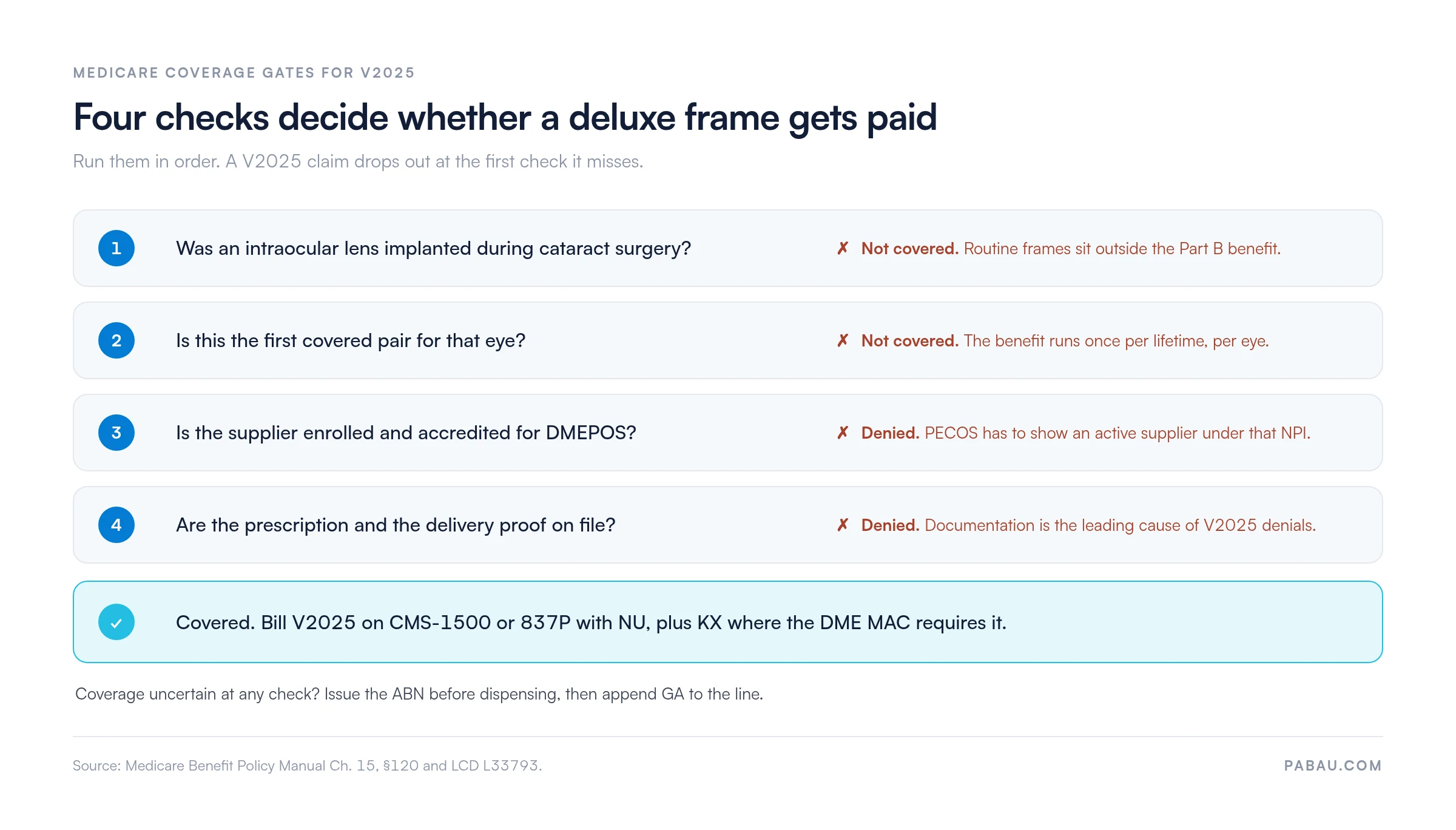
Medicare covers V2025 only after cataract surgery with an intraocular lens (IOL) implant, under the prosthetic-device benefit. Missing IOL documentation is the most common denial trigger.
The frame benefit runs once per lifetime, per eye, so a second pair for the same eye is denied even after a later procedure.
Prior authorization rules and allowed amounts vary by DME MAC jurisdiction, so verify current rates against CMS DMEPOS fee schedule files before submitting.
Practice management software like Pabau flags the errors that sink V2025 claims, including missing modifiers, absent IOL documentation and lapsed supplier enrollment.
The table below captures the key reference data for HCPCS code V2025 in one place. Verify the effective date and fee amounts against your current CMS DMEPOS fee schedule file before submitting claims, as rates are updated annually.
Medicare covers eyeglass frames after cataract surgery with intraocular lens (IOL) insertion, and it pays for them as a prosthetic device. The authority is the Medicare Benefit Policy Manual, Chapter 15, Section 120, with the coverage detail in LCD L33793. The benefit itself comes from Section 1861(s)(8) of the Social Security Act.
This is the only Medicare coverage pathway for HCPCS code V2025. Routine vision exams and ordinary eyeglasses stay excluded from Medicare Part B, so the post-cataract benefit is the one way in.
Before billing, confirm the beneficiary’s eligibility and benefit status with the DME MAC. The key coverage conditions to verify are below.
Run those checks in order. The flow below shows where a V2025 claim drops out, and what the supplier can still do about it.
Commercial payers and Medicaid programs may cover eyeglass frames under different criteria. Always verify each payer’s specific policy before billing V2025.
Medicare reimburses V2025 at the lower of the submitted charge or the fee schedule allowed amount for the supplier’s DME MAC jurisdiction. The CMS DMEPOS fee schedule files carry the current national and jurisdiction-level rates. The Physician Fee Schedule Look-Up Tool does not list V-codes, so it is the wrong place to check a frame.
CMS updates DMEPOS fees each year, usually effective January 1. The table below describes how payment is structured rather than what it pays. Verify current amounts against the applicable DMEPOS fee schedule file before you submit.
To check a descriptor quickly, the AAPC HCPCS code lookup is a convenient reference. For the amount you actually bill against, download the DMEPOS fee schedule file for your jurisdiction from CMS. Third-party aggregators give you a starting estimate, not a source of record.
Download the CMS DMEPOS fee schedule file for your DME MAC jurisdiction at the start of each calendar year. Load it straight into your billing system. Rates change on January 1, and submitting at outdated allowed amounts causes unnecessary underpayment adjustments.
Incomplete documentation is the leading cause of V2025 denials. The fix is to assemble every required document before the claim goes out, rather than after the denial arrives. The checklist below covers the core documentation Medicare expects on a V2025 claim.
Some DME MAC contractors have issued Local Coverage Determinations (LCDs) with additional documentation requirements. Check the applicable LCD for your jurisdiction before billing.
Billing HCPCS code V2025 follows the DMEPOS claim pathway, not the physician or facility one. A UB-04 will be rejected. Use the CMS-1500 paper form or its electronic equivalent, the 837P transaction. Route the claim to the DME MAC that covers the beneficiary’s state.
For a clean claim submission, verify each of these billing elements before sending.
Check that diagnosis code against the current ICD-10-CM code set, not a prior year’s file. The annual update takes effect every October 1. A retired or truncated code fails the claim edit before anyone looks at the frame.
Modifiers communicate item characteristics and delivery circumstances to the payer. The table below covers modifiers that commonly apply to V2025. Always confirm the current modifier requirements with your specific DME MAC and payer contract, as requirements can vary.
The spectacle frames series runs from V2020 to V2025. Knowing where HCPCS code V2025 sits in that range keeps coders from billing a deluxe frame as a standard one, or the reverse.
V2020 covers a standard purchased frame. V2025 applies when the beneficiary chooses materials, styling or a price point above the Medicare-covered standard.
The supplier bills V2025 and may collect an upgrade charge from the beneficiary for the portion above the Medicare allowance. That upgrade charge never goes on the Medicare claim. Record the beneficiary’s choice and the frame specifications in the supplier file.
Most V2025 denials fall into a small number of predictable categories. Knowing which of them your billing team hits most often is what turns a denial log into a fix list. The table below maps the common triggers to their root causes and the correction that stops each one.
Audit your V2025 denial history quarterly. If missing IOL documentation accounts for more than 20% of denials, add a pre-submission checklist to your billing workflow. Make it require the operative report before the claim can be created.
A code lookup tells you what V2025 means. Practice management software like Pabau catches the errors that stop it from being paid, before the claim leaves your office. Billers already know the IOL documentation rule. What breaks down is the handoff between the surgeon’s record and the supplier’s claim.
Pabau’s denial-preventing claims management software ties the clinical record to claim generation. When a biller opens a DMEPOS claim, the checklist for that item comes with it. The operative report, the prescription and the delivery receipt each get flagged while the claim can still be fixed.
Optometry and ophthalmology practices carry the most V2025 volume, so they feel the difference first. Every denial they avoid is a rework cycle their billers never open. It is also a payment that lands on the first pass instead of after an appeal.

Pabau ties the operative report, the prescription and the delivery receipt to the DMEPOS claim. Anything missing is flagged before the claim reaches the DME MAC. Your billers spend their time on claims that will be paid.

V2025 is a narrow code with predictable failure modes. IOL documentation, supplier enrollment, modifier selection and the ABN workflow account for most denials. Each one is a step in the dispensing process, so the fix belongs in the workflow rather than the coder’s reference sheet.
Pabau connects the clinical record to claim generation. Missing IOL confirmation, an incomplete modifier set or a lapsed enrollment surfaces before the claim reaches the DME MAC. To see that inside a live billing workflow, book a demo.

Need a broader look at claim denial patterns? Denial management in healthcare covers the full lifecycle from denial prevention to appeals tracking.
Want to understand how DMEPOS claims move through the clearinghouse? Clean claim submission explains what makes a claim pass or fail at the first edit check.
Looking for the right billing software for your optometry or ophthalmology practice? Medical billing software for US practices compares the leading platforms by specialty fit and workflow integration.
HCPCS code V2025 is a Level II HCPCS code used to bill a deluxe eyeglass frame furnished to a Medicare or Medicaid beneficiary. It is billed by enrolled DMEPOS suppliers, most commonly after cataract surgery with IOL insertion. That surgery is what opens Medicare’s prosthetic-device benefit for eyeglass frames.
Yes, but only after cataract surgery with intraocular lens (IOL) insertion. Routine eyeglasses fall outside Medicare Part B coverage. The benefit runs once per lifetime, per eye, and the supplier must be enrolled and accredited with Medicare as a DMEPOS supplier.
V2020 covers a standard purchased frame and V2025 covers a deluxe frame that exceeds the standard specifications. When a beneficiary selects a deluxe frame, the supplier bills V2025. The Medicare allowed amount for V2025 is higher than for V2020, and the beneficiary may be charged an upgrade difference above the Medicare allowance.
Prior authorization requirements for V2025 vary by DME MAC jurisdiction and commercial payer. Medicare does not universally require prior authorization for V2025, but some MAC contractors and commercial plans do. Always verify the prior authorization rules with the applicable payer before furnishing the item.
Required documentation includes the operative report confirming IOL insertion, a valid physician prescription and the date of surgery. You also need supplier delivery documentation with the beneficiary’s signature, plus a signed ABN if coverage is uncertain. Some DME MACs have additional LCD requirements, so verify with your jurisdiction before submitting.
The most common modifiers for V2025 are NU (new equipment), KX (coverage criteria met) and GA (ABN on file). NU applies in most cases, since frames are purchased rather than rented. Some DME MACs require KX. Append GA when an ABN has been issued and signed. Check your DME MAC’s LCD for the mandatory modifiers in your jurisdiction.