



HCPCS code E0198: Water pressure pad billing guide
HCPCS code E0198 is a water pad for a standard mattress HCPCS code E0198 is the ...

Last Updated: Oct 13, 2026

CPT code 66984 covers routine cataract surgery with an intraocular lens implanted in the same session, under a 90-day global period.
Put RT or LT on every claim line, and bill bilateral surgery as two lines, because Medicare rejects modifier 50 here.
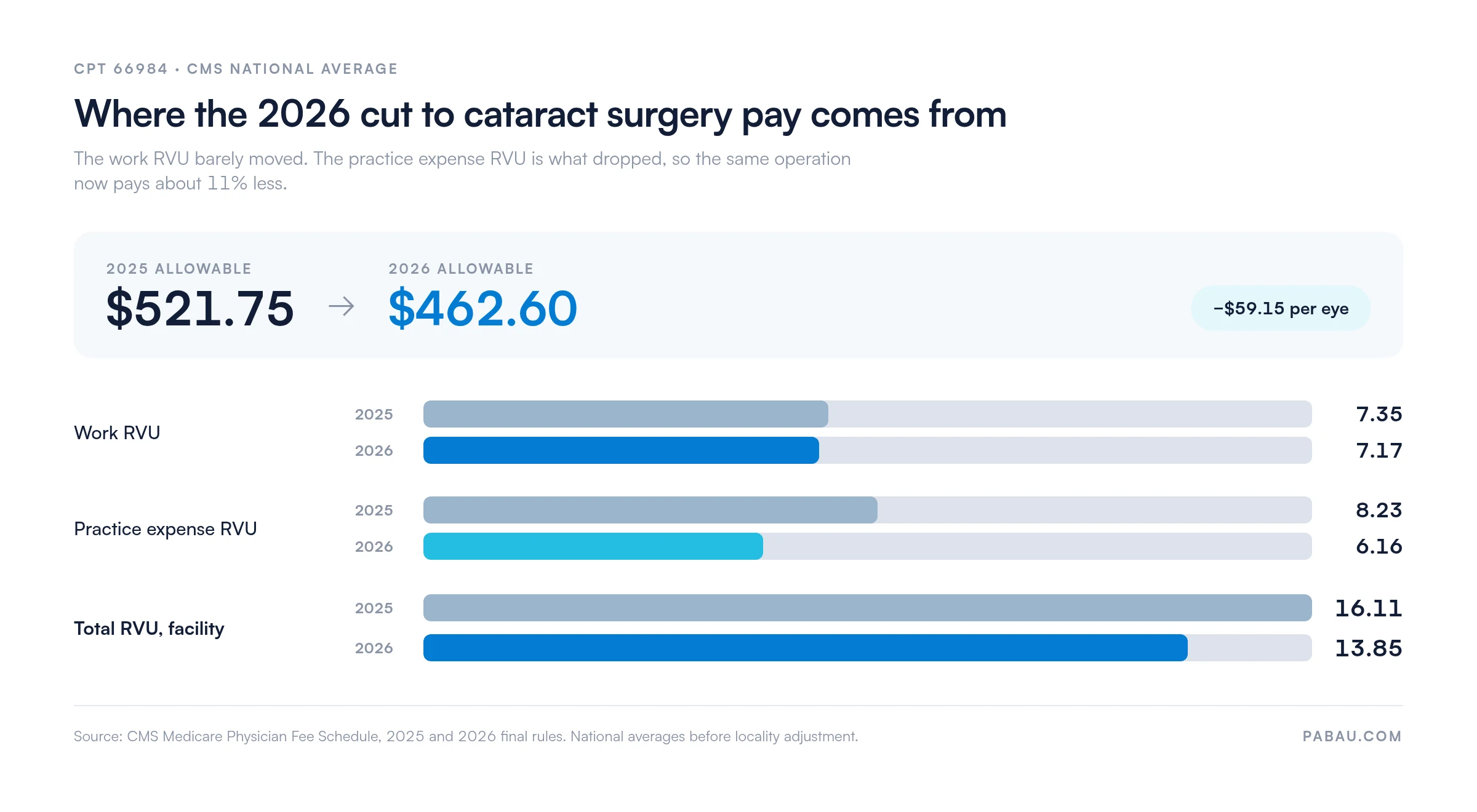
The 2026 CMS national allowable falls to about $462.60 from roughly $521.75, an 11% cut driven almost entirely by the practice expense RVU.
Coding 66982 without a qualifying factor named in the operative note is an OIG audit target, so bill 66984 unless the chart supports more.
Practice management software like Pabau pre-fills the CMS-1500 from the record and routes US claims through Claim.MD, with eligibility checks and ERA posting.
CPT code 66984 is the billing code for routine cataract surgery, covering extracapsular lens removal with an intraocular lens placed in the same session. The detail that decides most claims is laterality. Adding cosmetic injectables to an eye surgery practice calls for charting and payment tools, which our ranking of the best medical spa software compares.
Medicare will not take modifier 50 here, so each eye goes on its own line with RT or LT. Add the 90-day global period, and a second eye operated inside it needs modifier 79 as well.
That matters more in 2026 than it did last year. CMS cut the national allowable for 66984 by roughly 11%, so every rework now costs a bigger share of the payment. The sections below walk the claim from operative note to remittance, and flag what stalls it along the way.
Here is the official American Medical Association descriptor. Extracapsular cataract removal with insertion of intraocular lens prosthesis (1 stage procedure), manual or mechanical technique (e.g., irrigation and aspiration or phacoemulsification).
In plain terms, one trip to the operating room removes the lens and seats the implant. Phacoemulsification is the technique behind almost every claim on this code. Manual extracapsular extraction bills the same way, which is why the descriptor names both.
The code sits in the Eye and Ocular Adnexa section of CPT and carries a 90-day global period. Routine post-op visits inside those 90 days are already paid for. That single fact explains two of the billing rules further down this page, so keep it in view.
Code 66982 belongs to cases where the surgeon used a device or technique beyond standard phacoemulsification, and where the note says which one. Otherwise the case is 66984.
The AAPC coding reference lists the qualifying factors, and a difficult case on its own is not one of them.
Practices that reach for 66982 as a habit attract RAC and MAC review. If the note does not name the pupil expansion device, the sutured lens, or the tension ring, bill 66984 and keep the payment. An upcode that survives submission still loses on audit, with interest.
Every 66984 claim needs at least one ICD-10-CM code establishing medical necessity, and its laterality has to match the modifier on the line.
The CMS ICD-10 coding guidance puts routine cataract diagnoses in the H25 and H26 series. Subcategory specificity is what payers check first, so the chapter-level code will not carry a surgical claim.
Our ICD-10-CM code library holds the full subcategory lists if you need to look one up mid-claim. Pick the code that names the operative eye, then carry that same eye onto the claim line.
A laterality mismatch is a silent denial. H25.11 sitting next to modifier LT trips an automated payer edit long before a human reads the claim.
Where the record documents an age-related cataract without naming the morphology, H25.9 is the correct unspecified option. Reach for it only when the chart genuinely lacks that detail.
Put RT or LT on every 66984 line. Medicare does not accept modifier 50 for eye procedures, so bilateral surgery never rides on a single line. Getting that one rule right removes the most common denial on this code.
E1 through E4 confuse a lot of billers, so it is worth being blunt about them. Those four mark eyelid location, meaning upper or lower, left or right eyelid.
Their home is lid work such as blepharoplasty, chalazion excision, or punctal plugs. They have no place on a cataract claim, and they were never an alternative to RT and LT.
Bill 66984 twice, one line with RT and one with LT. Medicare pays the first eye in full and reduces the second by 50%. Some MAC jurisdictions want those lines sequenced a particular way, so check your contractor’s guidance before the batch goes out.
Where the second eye falls inside the 90-day global of the first, append modifier 79 to that line. Skip it and the payer reads a duplicate inside the global period, then denies. Once day 91 arrives the global has closed, and modifier 79 is no longer needed.
The CMS national average allowable for 66984 is roughly $462.60 in 2026, down from about $521.75 in 2025. That is a cut of around 11%, not the modest rise many practices budgeted for. Locality adjustment moves the figure either way, so confirm yours in the CMS Physician Fee Schedule lookup tool.
Commercial payers usually price off Medicare, which means the cut travels. Any contract written as a percentage of the current fee schedule reprices itself every January without anyone signing a thing.
CMS did not decide the surgery got easier. The work RVU moved from 7.35 to 7.17, which is a rounding error in daily practice. Practice expense fell from 8.23 to 6.16, and that is where the money went.
Knowing which component moved tells you whether to look at your staffing model or your surgical schedule.
Multiply the total by your locality-adjusted conversion factor to get your own allowable. Then compare that figure against the remittance when payment lands. A shortfall that repeats across a month rarely comes from the payer’s fee schedule. Look at the place of service and the facility designation on the claim.
Audit your 66984 claims quarterly. Pull every claim by date of service and compare the expected Medicare allowable against what was actually paid. Flag anything under 95% of the fee schedule. Repeat shortfalls usually trace to the wrong place of service or a facility designation that does not match where the surgery happened.
Coverage rests on documented functional impairment. Published LCDs commonly reference best corrected visual acuity around 20/40, and First Coast is one example. No MAC treats a single acuity reading as the whole test, though. Record what the patient can no longer do, not just the line they managed on the chart.
CMS guidance asks for three things in the chart: the visual impairment, the acuity measurement, and a statement that surgery is medically necessary. Miss any one of them and a medical necessity denial follows.
MAC jurisdictions publish their own Local Coverage Determinations, and they do not all read the same. Palmetto GBA, Noridian, and First Coast each set out their required documentation elements. Read the LCD for your jurisdiction once a year, and again whenever a revision notice lands.
The denial pattern on this code is narrow, which is good news. Fix these five at charge entry and the appeal queue mostly empties on its own. Workflow changes beat appeals here, because an appeal costs staff time on a claim you already earned.
One more is worth knowing. CPT 66821, the YAG laser posterior capsulotomy, cannot be billed on the same date as 66984. CCI edits and the 90-day global both block it. The YAG belongs to a separate session weeks or months later, once the capsule has actually clouded.
Run a monthly CCI edit check on your top 10 ophthalmology code pairs. The 66984 plus 66821 same-day pair is the most common trigger, but also check 66984 against 92012, an established patient office visit. Most MACs bundle that visit into the global period unless the note documents a separately identifiable service.
Most cataract surgery happens in ambulatory surgery centers, and the facility claim there looks nothing like the hospital version. Put the charges on the wrong form and both payments stall while the payer sorts it out.
Sending both claims electronically as 837P keeps the professional and facility charges routed correctly. The remittance comes back as a structured 835 file you can post automatically. Paper billing at cataract volumes creates reconciliation delays that compound month over month.
Most of the codes below are alternatives to 66984, chosen at the time of surgery. One of them, 66821, is a bundling conflict rather than a choice, so it needs watching on the calendar as well as the claim.
A HCPCS drug code is not built like the surgical codes above. J0456 pays for the azithromycin vial itself, and the infusion that delivers it is reported under a separate administration code.
The IOL implant also opens Medicare’s post-cataract eyeglass benefit. One pair of glasses is covered after each cataract surgery, and the frame on that order is billed as V2020.
Most ophthalmology billing teams work across three screens. The chart holds the operative note, a code lookup sits in a browser tab, and the claim form waits in a separate billing system. Retyping between them is exactly where laterality and diagnosis errors get in.
Practice management software like Pabau closes that loop, and cleaner claims management is the point of it. The CMS-1500 pre-fills from the record. The CPT code attached to the service lands on the charge line, and the ICD-10 slots seed from the recorded problem list.
Built-in ICD-10-CM and CPT lookup libraries let a coder search without leaving the claim. Required-field validation holds the send button until membership numbers and authorization codes are in place.
In the US, claims route through the Claim.MD clearinghouse, which runs real-time eligibility checks and posts ERA remittances straight back against the charge.
For a cataract-heavy surgical list, the payoff is fewer return trips to the same claim. Coverage is confirmed before surgery day, the claim leaves complete, and the 835 posts itself when payment arrives. Modifier choice still belongs to your coder, and no software should pretend otherwise.
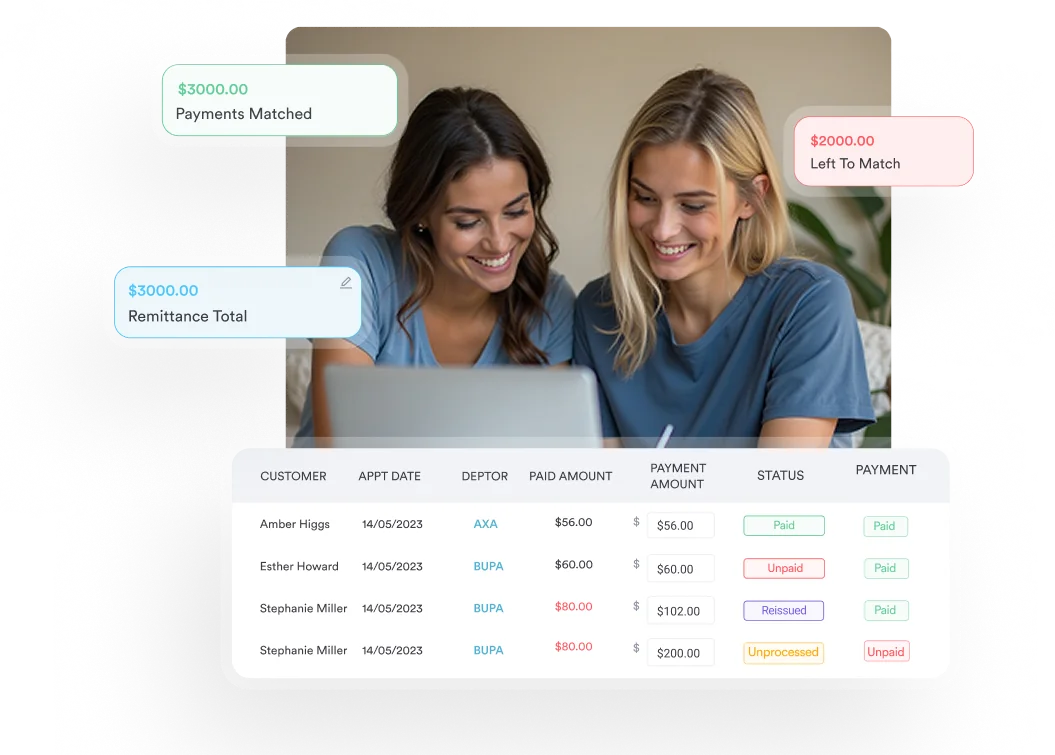

Pabau pre-fills the CMS-1500 from the patient record and checks required fields before it sends. Claims route through Claim.MD, with real-time eligibility verification and ERA posting built in. Ophthalmology teams stop retyping cataract claims between systems.

None of this is difficult coding. It is repetitive coding, which is a different problem. A practice running forty cataract cases a month cannot absorb a 10% denial rate, and the controls that prevent one are small and mechanical.
So build the habits into the workflow rather than the memory. Put a laterality modifier on every line and match it in the diagnosis code. Add modifier 79 to a second eye inside the global period. Write down what the patient can no longer do, not just the acuity.
Then check each payment against the 2026 figure rather than last year’s. With the allowable down about 11%, rework costs more than it used to. Book a demo to see how Pabau builds cataract claims from the patient record and routes them with eligibility checks already done.

Need to understand how clearinghouse claims submission works? Medical claims clearinghouse guide explains the end-to-end electronic submission process from 837P file to ERA.
Tracking denials across your ophthalmology practice? Denial codes in medical billing covers CARC codes and how to read remittance advice to categorize and appeal rejections.
Want to automate eligibility checks before surgery day? Insurance eligibility verification walks through real-time payer verification workflows that reduce authorization surprises on day of service.
Yes, through split global billing. The surgeon bills 66984 with modifier 54 for the surgical care, and the optometrist bills the same code with modifier 55 for the post-op period. Both claims carry the surgery date, and the transfer of care has to be documented.
Use POS 24 for an ambulatory surgery center and POS 22 for hospital outpatient. The wrong code pays at the non-facility rate, which usually turns into a payer takeback later.
Medicare covers the surgery and a conventional monofocal lens. The added cost of a presbyopia-correcting or astigmatism-correcting lens is the patient’s responsibility. Document that conversation and collect the difference before surgery day.
Routine post-op visits are already paid for inside the 66984 payment. An unrelated problem seen in those 90 days is billable with modifier 24 on the office visit code. The note has to stand on its own.
Traditional Medicare does not require it for cataract surgery. Plenty of Medicare Advantage and commercial plans do, and the requirement can change with the plan year. Check at scheduling, then carry the authorization number onto the claim.
Yes. Cataract extraction with an IOL is among the highest-volume procedures on that list. The center earns an ASC facility payment separate from the surgeon’s fee.



