CPT Code 62284: Injection procedure for myelography
CPT Code 62284: official descriptor and procedure overview The American Medical ...

Last Updated: Oct 19, 2026
V2797 is the HCPCS Level II code for a vision supply, accessory or service component of another HCPCS vision code. It reports the part of a vision service that no specific V-code describes, and it's always billed alongside the primary code it belongs to.
Medicare generally doesn't pay separately for V2797, so the charge is often patient-pay with a signed ABN on file. Claims are most often denied when the primary code is missing or the record doesn't name the component.
Let Pabau's smart automation suggest the right codes, reduce claim denials, and keep your practice compliant—effortlessly.
Automate repetitive tasks and focus on what matters most—your patients.
Reduce coding errors and ensure compliance with the latest regulations.
Clean claims, fewer denials, and faster reimbursements.
Powerful insights and reporting to help your practice thrive.
HIPAA compliant SOC 2 certified GDPR-compliant Trusted by 4,000+ clinics worldwide

V2797 is a catch-all HCPCS accessory code that must accompany a primary vision supply code on the same claim.
Medicare generally doesn’t cover routine refractive services, so V2797 is often non-covered or patient-pay under Policy Article A52499.
Presbyopic IOL upgrades are the most common use, billed as a private-pay component alongside the base IOL code.
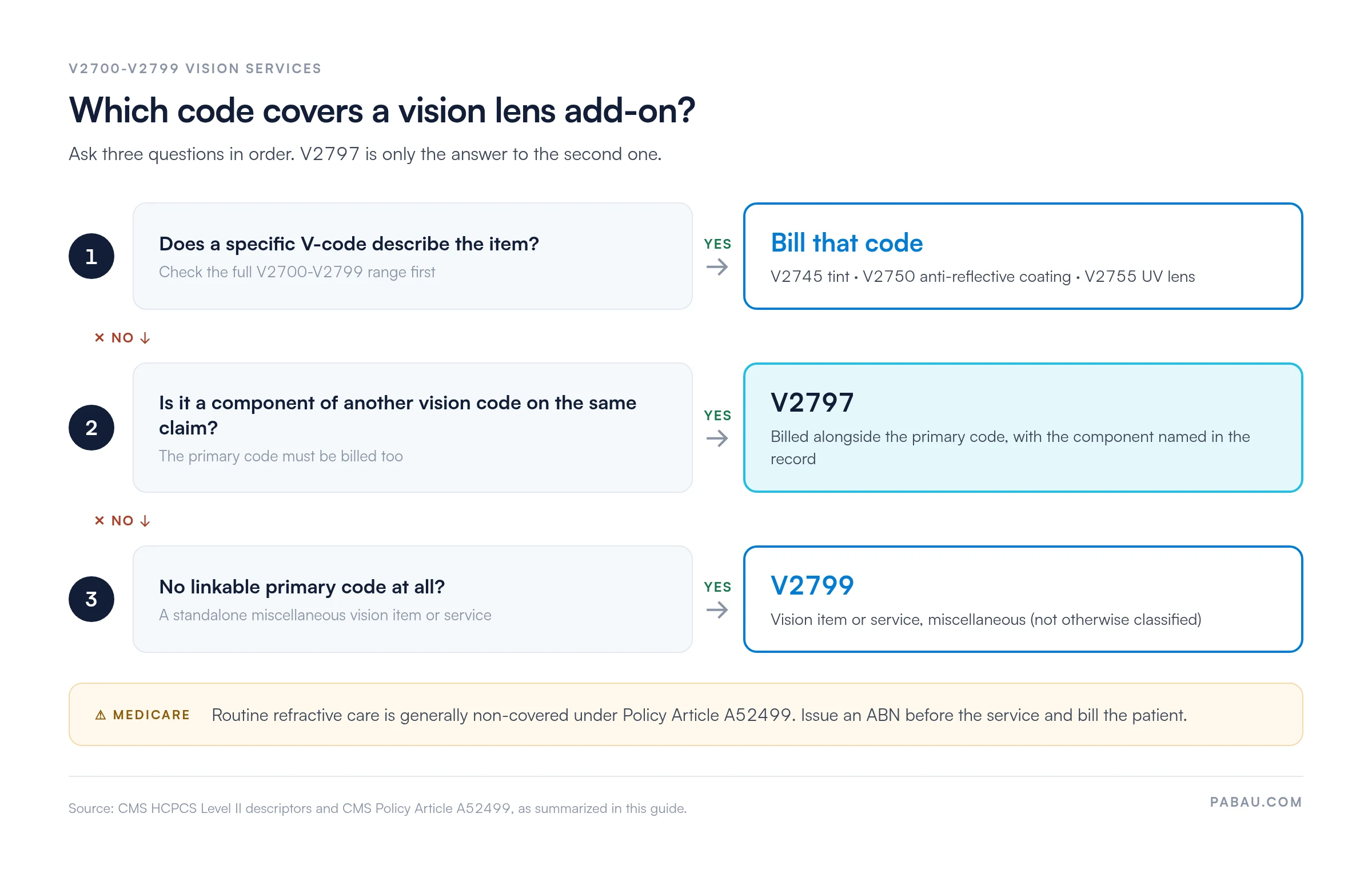
Check the V2700-V2799 range for a specific code first, such as V2750 for anti-reflective coating, before defaulting to V2797.
Practice management software like Pabau tracks each claim’s status and keeps signed ABNs on the patient record.
HCPCS Code V2797 is the Level II code for a vision supply, accessory or service component of another HCPCS vision code. Its official descriptor reads: “Vision supply, accessory and/or service component of another HCPCS vision code.”
The code sits in the V2700-V2799 vision services range maintained by the Centers for Medicare and Medicaid Services (CMS). That range covers spectacle lenses, contact lenses and related accessories. Unlike standalone lens supply codes, V2797 can’t be reported on its own. It must appear on the same claim as the primary vision code it accompanies.
The catch-all structure is deliberate. CMS designed the V2700-V2799 series so practices bill the primary lens or supply code first. V2797 is added only for components or services that fall outside the primary code’s descriptor. This keeps the code set manageable without a unique code for every lens accessory variation.
V2797 is intentionally broad. CMS uses it as a container for ancillary components that do not have their own dedicated vision supply code. Knowing what falls in and what falls out prevents unbundling errors and unnecessary denials. Mirror coating is one such exclusion, since V2761 already names it. Polarization is another exclusion, because V2762 covers it on any lens material.
Three scenarios account for the majority of V2797 claims in active ophthalmic practices. Each has its own documentation and linkage requirements.
The most common application is the presbyopia-correcting (premium) IOL upgrade. Medicare Part B covers a standard monofocal IOL. A patient may elect a presbyopic, multifocal or extended depth of focus (EDOF) lens instead. The practice then bills the standard IOL code for the covered portion. V2797 then captures the additional refractive upgrade component.
That upgrade differential is typically a private-pay amount collected directly from the patient. CMS also maintains V2788 for the presbyopia-correcting function of an IOL, so confirm which code your MAC expects before you bill.
When a practice supplies an accessory alongside a primary contact lens code, V2797 captures the component. Typical examples include a specialty handling kit or a fitting adjunct. The primary contact lens supply code must appear on the same claim line or claim date.
Ophthalmic dispensaries occasionally encounter service elements related to a primary spectacle lens supply that no specific V-code covers. V2797 is the appropriate code here, provided the primary lens code is also billed. The service element must be documented in the encounter record, not just on the claim form.
Coders frequently confuse V2797 with other codes in the V2700-V2799 range, such as V2718 for press-on prism lenses. The most frequent mix-up is billing an anti-reflective coating under V2797 when V2750 already describes it. The table below maps the most commonly confused neighbors and the primary/accessory relationship.
For a searchable reference, the AAPC Codify HCPCS lookup and the PGM Billing HCPCS lookup tool both carry current V-code descriptors.
Put together, the range works as a three-question check, and V2797 only answers the second question. A lens tint never reaches V2797, because V2745 covers a solid or gradient tint on any lens material.
Medicare’s position on V2797 is shaped almost entirely by its broader exclusion of routine refractive services. Verify insurance eligibility before each ophthalmic encounter, because coverage varies materially between traditional Medicare, Medicare Advantage and commercial plans.
CMS Policy Article A52499 governs Medicare coverage for refractive lenses and associated services. Under this policy, Medicare Part B generally doesn’t cover eyeglasses, contact lenses or related services for vision correction after refractive surgery. The same applies to routine vision care. As an accessory to a vision supply code, V2797 typically inherits that non-covered status when the primary service is refractive.
Because Medicare generally considers V2797 non-covered for routine refractive services, a published Medicare fee schedule allowable may not apply in most clinical contexts. Where a MAC does assign a fee schedule amount for specific covered scenarios, the rate varies by jurisdiction.
Practices should use the CMS Physician Fee Schedule search tool to verify whether their MAC carries an allowable for V2797 in the current fee year.
In the presbyopic IOL upgrade scenario, V2797 is billed as a private-pay item, so the “reimbursement rate” is effectively the practice’s self-set upgrade fee. Treat this amount as a separate transaction from the Medicare-covered IOL claim. Collect it from the patient at or before the time of service.
Insufficient documentation is the second most common denial trigger for HCPCS Code V2797, right behind missing primary code linkage. Compliance best practice requires every claim line to be traceable to a matching clinical record entry. For V2797, that means the record must justify both the primary vision code and the accessory component separately.
The clinical record should contain all of the following before V2797 is submitted:
Build a V2797 documentation checklist into your pre-claim review workflow: primary code identified, accessory item named, lens model noted (where applicable), ABN signed and filed. Running this check before submission catches the majority of denial triggers before they reach the payer.
V2797 claims are denied more often than most vision supply codes because coders apply it incorrectly as a standalone code or without adequate supporting documentation. Preventing them starts with knowing the likely denial reasons before claims go out.
Each rejection comes back with a claim adjustment reason code (CARC). Our guide to common denial codes explains what each one means and how to correct the claim.
Premium IOL billing is the scenario where V2797 appears most often in ophthalmology and where the private-pay and Medicare-covered components need to be handled cleanly. A clear superbill prevents confusion between what Medicare owes and what the patient owes.
Commercial insurers and Medicare Advantage plans set their own policies on vision supply accessories. Those policies often differ from traditional Medicare, which creates both billing opportunities and risks.
Commercial PPO and HMO plans with vision benefits may cover certain V2797 accessories that Medicare excludes. Call the plan’s provider services line to confirm whether the specific accessory component qualifies before billing. Storing that verification with the patient record creates an audit trail if the claim is questioned later.
Medicare Advantage plans must cover the services traditional Medicare covers, but many offer supplemental vision benefits that go further. A plan covering one pair of glasses after cataract surgery may extend that benefit to include certain accessories under V2797. The critical step is requesting a coverage determination in writing before the service, not after.
Prior authorization requirements vary widely. Some Medicare Advantage plans require auth for any vision supply code over a threshold dollar amount. Submit the auth request for the primary code and V2797 at the same time. A retroactive auth request for V2797 is almost always denied.
When V2797 represents a non-covered upgrade, the practice’s financial counseling matters as much as the billing process. Patients are far less likely to dispute charges when they get a clear, documented explanation first. It should cover what Medicare pays, what they’re electing beyond that, and what they owe personally. The ABN supports the legal framework; good patient communication supports the relationship.
Track V2797 commercial coverage by plan in your practice management system. When a plan confirms accessory coverage in writing, log it against the plan ID. Your billing team then won’t need to re-verify that plan for every patient encounter.
V2797 denials usually start before the claim is built. An insurer detail is missing from the patient record, the signed ABN sits in a paper file, or the upgrade balance lives in a spreadsheet.
Practice management software like Pabau keeps those pieces on one patient record. In the US, Pabau’s ophthalmic claims tools connect to Claim.MD. You can submit claims electronically, run real-time eligibility checks and track every claim’s status from one dashboard.
Validation checks run each time you send a claim. If a required detail like a membership number or authorization code is missing, the Send button stays disabled until it’s fixed. When a claim is paid, you record the payment against the right invoice, so the IOL claim and the patient-pay upgrade stay reconciled.
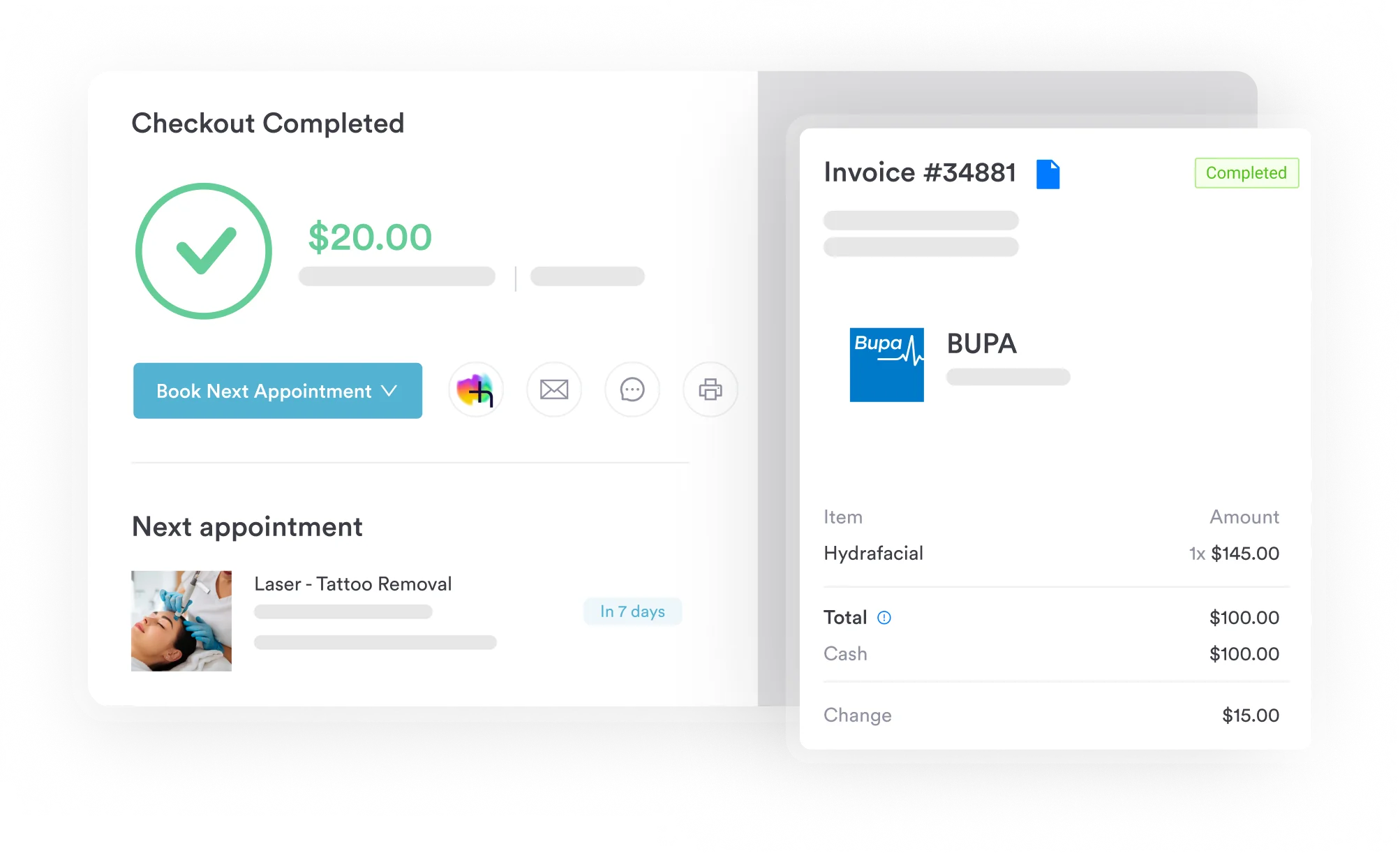

Pabau helps eye care practices submit and track claims, run eligibility checks, and keep signed ABNs on the patient record.

Treat V2797 as a last resort within the V2700-V2799 range. Bill it only when no specific code fits and a primary vision code sits on the same claim.
For presbyopic IOL upgrades, the trade-off is paperwork. Keeping the Medicare claim and the patient-pay upgrade apart takes an ABN, a named lens model and a second transaction. Skip one and the practice risks losing the upgrade fee or failing an audit.
Book a demo to see how Pabau keeps V2797 claims, signed ABNs and patient-pay balances on one record for your ophthalmology billing team.

Need to understand how denial codes map to V2797 rejections? Common denial codes in medical billing covers CARC and RARC codes with corrective action guidance for each rejection type.
Want a structured approach to medical billing compliance? Billing compliance best practices outlines documentation standards and audit-readiness steps for ophthalmic and specialty practices.
Looking to reduce claim rework across your revenue cycle? Revenue cycle management fundamentals explains how to structure billing workflows from eligibility check through payment posting.
Billing the standard lens under an upgrade? HCPCS Code V2631 covers the intraocular lens code a V2797 upgrade component usually accompanies.
Want fewer claims bounced back for errors? What makes a clean claim walks through the checks that get a claim paid on first submission.
HCPCS Code V2797 is a Level II supply and accessory code with the descriptor “Vision supply, accessory and/or service component of another HCPCS vision code.” It bills ancillary components or service elements that accompany a primary HCPCS vision code. The most common uses are presbyopic IOL upgrades and ophthalmic fittings. It cannot be reported as a standalone claim line.
Medicare generally does not cover V2797 when the associated service is refractive or routine vision care in nature, per CMS Policy Article A52499. The exception is the post-cataract vision supply benefit, where limited accessories may be covered. Always verify the applicable MAC’s current Local Coverage Determination and issue an ABN before providing any service that may be non-covered.
V2797 is specifically an accessory or service component of another billed HCPCS vision code and must accompany that primary code on the same claim. V2799 is a broader not-otherwise-classified (NOC) code for vision items or services not classifiable under any other V-code. If the item is an ancillary component of a code already on the claim, V2797 is correct. If it’s a standalone miscellaneous item with no linkable primary code, V2799 may apply.
Bill the Medicare-covered standard IOL and surgical CPT code to Medicare in the normal way. Separately, report V2797 for the refractive upgrade component as a patient-pay charge. Document the specific premium lens model, the patient’s upgrade election, and the signed ABN in the clinical record. Do not submit the V2797 upgrade differential to Medicare as a billable claim line.
The clinical record must identify the primary HCPCS vision code that V2797 accompanies. It must also name the specific accessory or service component, not just “vision accessory”, and include the lens model for IOL scenarios. For non-covered services, a signed Advance Beneficiary Notice of Noncoverage must be on file before the service is provided. Generic documentation is the most common audit finding on V2797 claims.
Because V2797 is generally non-covered for routine refractive services, many MAC jurisdictions do not publish a covered fee schedule allowable for this code. For a covered scenario, check the CMS Physician Fee Schedule search tool for your MAC jurisdiction and the current fee year. Rates vary by location and are updated annually; always use the current year’s file.
Yes, V2797 is designed to be billed alongside a primary HCPCS vision code on the same claim. If a more specific V-code already describes the item, use that code instead of V2797. Examples include V2750 for anti-reflective coating and V2755 for a UV lens. Apply V2797 only when no other code in the V2700-V2799 range accurately captures the accessory or service component being billed.
The most common reason is V2797 submitted without a primary vision code on the same claim. Other triggers are a missing ABN for non-covered refractive care and documentation that doesn’t name the accessory. Billing V2797 when a more specific V-code applies also leads to denials. Reviewing the claim against a pre-submission checklist catches most of these issues before they reach the payer.