CCSD Code D0342: Bony meatoplasty billing guide for ENT practices
CCSD Code D0342: Definition and clinical scope CCSD Code D0342 describes a bony ...

Last Updated: Nov 26, 2026
V2101 is the HCPCS Level II code for sphere, single vision, plus or minus 4.12 to plus or minus 7.00d, per lens. It is billed per lens, so each eye goes on its own claim line.
The code is the middle tier of the sphere-only band. V2100 carries the lower powers and V2102 the higher ones, while V2103 onward covers spherocylinder lenses with a cylinder value. Medicare Part B covers V2101 only for aphakia or pseudophakia.
Let Pabau's smart automation suggest the right codes, reduce claim denials, and keep your practice compliant—effortlessly.
Automate repetitive tasks and focus on what matters most—your patients.
Reduce coding errors and ensure compliance with the latest regulations.
Clean claims, fewer denials, and faster reimbursements.
Powerful insights and reporting to help your practice thrive.
HIPAA compliant SOC 2 certified GDPR-compliant Trusted by 4,000+ clinics worldwide

HCPCS Code V2101 covers a sphere, single vision lens from plus or minus 4.12 to plus or minus 7.00 diopters, billed per lens.
Lenses up to 4.00 diopters belong to V2100, and lenses from 7.12 to 20.00 diopters belong to V2102. Any cylinder moves the lens to the spherocylinder codes.
Medicare pays for V2101 only as a prosthetic lens for aphakia or pseudophakia, never for routine refractive error.
Bill each eye on its own line with one unit and an RT or LT modifier. Add GY when Medicare excludes the lens by statute, such as a second pair after the same surgery.
Pabau keeps the prescription, surgical history, and claim on one patient file, so each V2101 line goes out with its support.
HCPCS Code V2101 is a CMS HCPCS Level II code. It describes a sphere, single vision ophthalmic lens with a power of plus or minus 4.12 to plus or minus 7.00 diopters, per lens. Medicare Part B covers it only for patients with aphakia or pseudophakia, as the DME MACs’ Refractive Lenses policy article sets out.
It belongs to the V-series of the HCPCS code set, the range reserved for vision and hearing services and supplies. V-codes describe the item dispensed, in this case the lens, not the eye exam or the fitting.
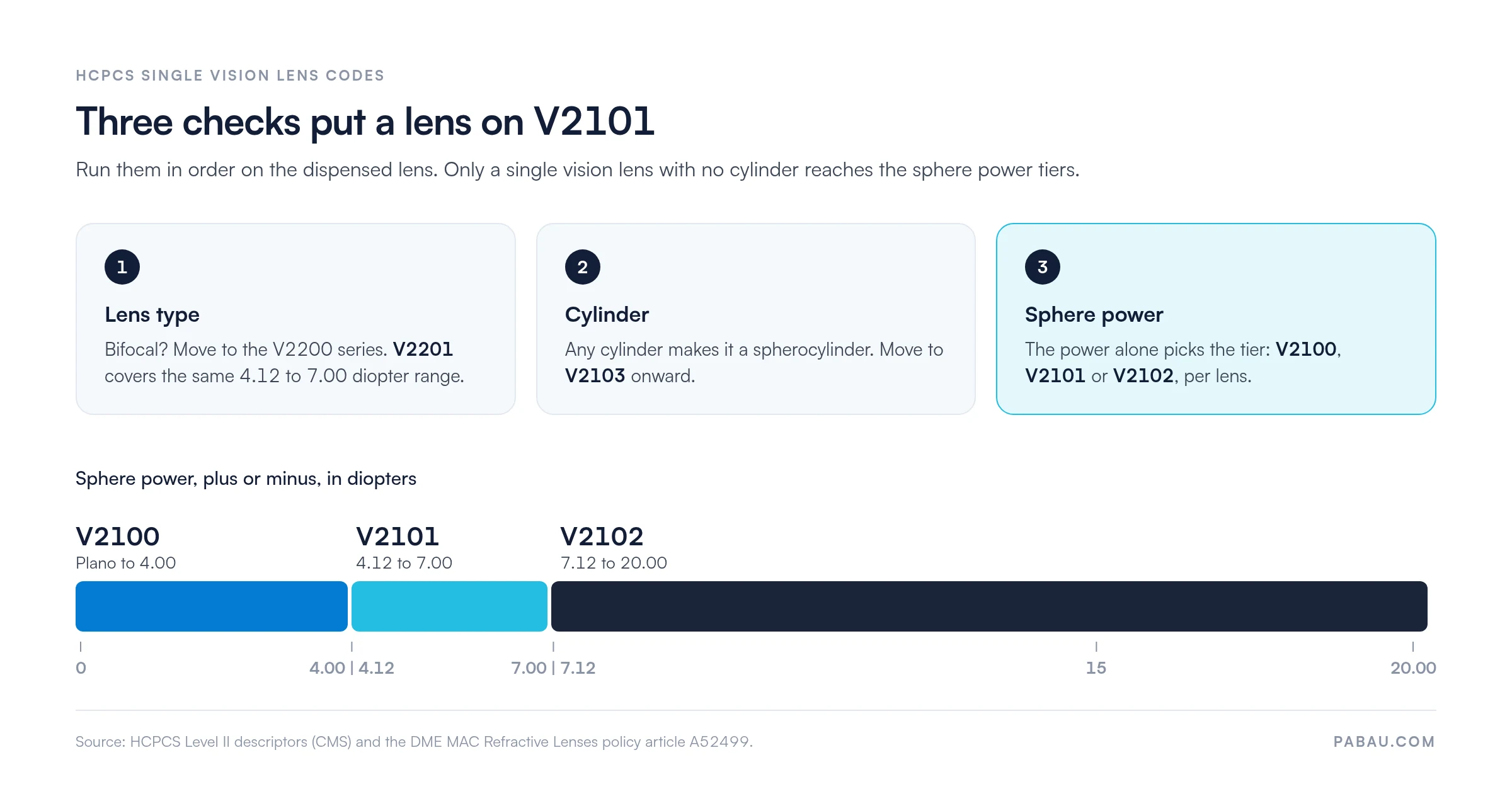
V2101 is the middle tier of the three single vision sphere codes. Below it, V2100 covers plano to plus or minus 4.00 diopters. Above it, V2102 covers plus or minus 7.12 to plus or minus 20.00 diopters. A “sphere” lens has no cylinder, so a prescription with any astigmatism correction leaves this family altogether.
The single vision sphere codes split one continuous power scale into three tiers, and the spherocylinder codes start right after them. A lens coded to the wrong tier is paid at the wrong rate, and that creates compliance risk whether the error runs high or low.
The table maps V2101 against its neighbors so the biller can confirm the code before the claim goes out.
Critical distinction: Check three things in order, which are lens type, cylinder, and then sphere power. A bifocal lens moves to the V2200 series, where V2201 covers the same 4.12 to 7.00 diopter sphere range. A prescription with cylinder moves to the spherocylinder codes from V2103 onward.
Only a single vision lens with no cylinder reaches the V2100 to V2102 power tiers, laid out below.
Medicare Part B covers V2101 under the prosthetic device benefit, not as routine vision care. Medicare generally does not pay for eyeglasses or contact lenses. Section 1861(s)(8) of the Social Security Act creates the exception. The DME MAC Refractive Lenses LCD (L33793) and its policy article (A52499) set the rules.
For V2101 to be payable by Medicare, the claim has to meet these conditions:
Lenses for routine refractive error, such as myopia, hyperopia, or presbyopia, are not covered without one of those diagnoses. The four DME MACs (Jurisdictions A, B, C, and D) apply the same LCD, but each publishes its own billing guidance. The Medicare eyeglasses and contact lenses benefit page gives the patient-facing summary of the benefit.
Every V2101 claim line needs a diagnosis that supports the lens. On a Medicare claim, only the aphakia and pseudophakia codes in the policy article support coverage.
A refractive error code alone on a Medicare V2101 claim is denied as noncovered. Match the diagnosis to the operative record for the eye that had surgery.
A clean V2101 claim needs the right modifiers, the right unit count, and a diagnosis that supports the lens. Missing any of them is enough to trigger a rejection or a records request from the DME MAC. Each lens takes its own service line, whether the claim goes out as an 837P file or on a paper CMS-1500 claim form.
Laterality is mandatory on every V2101 line. A lens that Medicare does not cover takes a second modifier that tells the DME MAC why.
When both lenses use V2101, bill two claim lines with one unit each, one with RT and one with LT. Do not bill RTLT on one line with two units, which the DME MACs reject as incorrect coding. If the two eyes fall in different power tiers, each line carries its own code, such as V2100-RT and V2101-LT.
KX does not go on V2101 itself. The policy article reserves it for add-ons such as tints or anti-reflective coating when medical necessity is documented. Add-ons and frames go on their own lines, and only one basic lens code can be billed for each lens.
A V2101 claim holds up when the lens, the diagnosis, and the order all point the same way. Keep these records on file for every dispensing:
Claims often fail because nothing in the file ties the lens to the qualifying surgery. When the dispensing happens weeks after the procedure, the record should still name the surgery date and the eye. Without that link, a records request often turns into a medical necessity denial.
Medicare pays V2101 from the CMS DMEPOS fee schedule, which updates each January 1. Allowed amounts are set per lens and vary by state, so this guide does not publish a fixed rate. A figure printed here would soon become an outdated allowable.
To find the current amount, download the DMEPOS fee schedule file and look up V2101 for your state. Medicare pays 80% of the approved amount after the Part B deductible. The patient or a supplemental plan covers the remaining 20%.
Load the new V2101 allowed amount for your state into your fee table each January. Rate changes take effect January 1, and billing to a prior-year amount causes adjustment write-offs that often surface only at year-end reconciliation.
Medicare’s prosthetic lens benefit is narrowly defined. Medicaid programs and private payers set their own coverage rules, prior authorization requirements, and allowances.
Original Medicare does not require prior authorization for V2101, because coverage is decided when the claim is processed. CMS does update its DMEPOS prior authorization list, so recheck it when a new list is published. Keeping medical billing compliance current across payers also means storing each plan’s policy where the billing team can find it.
Before submitting V2101 to any non-Medicare payer, run an eligibility and benefits check. Confirm that the plan covers HCPCS V-codes, what the allowance is, and whether prior authorization is required.
Most V2101 denials trace back to the power tier, the lens type, laterality, or the diagnosis. These patterns show up across optometry and ophthalmology practices:
Initial claims must reach Medicare within 12 months of the date of service. A denial management routine that sorts rejections by cause shows which error keeps repeating. Coding errors are usually faster to fix with a corrected claim than with an appeal.
A V2101 claim depends on records that often live apart. The prescription sits in the exam notes, the surgery date in a referral letter, and the ABN in a paper file. When a DME MAC asks for support, someone has to rebuild the case.
Pabau, a practice management platform, keeps those records on one patient file. Staff can confirm the eye, the sphere power, and the surgery before the lenses are ordered. Its built-in claims management software lets the team submit each lens line and track it in the same place.
The result is fewer lens claims sent without support, and faster fixes when a line comes back rejected.

Pabau holds the prescription, surgical history, and signed ABN on one patient file. Your team can check the power tier and laterality before a V2101 claim leaves the practice.

V2101 is the middle single vision sphere tier, and it fits one lens only. That lens is single vision, has no cylinder, and has a sphere power from 4.12 to 7.00 diopters. Read the dispensed lens, not the exam note, before you pick the code.
On a Medicare claim, the diagnosis decides payment as much as the code does. Tie each lens to aphakia or pseudophakia, code each eye on its own line, and flag a second pair after the same surgery with GY. Book a demo to see how Pabau keeps your lens claims and their records together.

Need a foundation for understanding V-code billing categories? Medical billing workflows explained covers how HCPCS codes move from charge entry to payer payment.
Looking to cut denial rates across your coding portfolio? Denial codes in medical billing breaks down the most common rejection reasons and how to resolve each one.
Billing the frames on the same claim? HCPCS code V2020 covers spectacle frames, which go on their own line next to the lenses.
Dispensing a lens no specific code describes? HCPCS code V2199 explains when the not otherwise classified single vision code applies.
HCPCS Code V2101 is a Level II billing code for a sphere, single vision lens, billed per lens. It covers powers from plus or minus 4.12 to plus or minus 7.00 diopters. Optometrists, ophthalmologists, and optical suppliers use it to bill Medicare and other payers for lenses in this power range.
Medicare Part B covers V2101 only as a prosthetic lens for patients with aphakia, congenital aphakia, or pseudophakia. For pseudophakia, coverage is one pair of glasses or contact lenses after each cataract surgery with an intraocular lens. Medicare does not cover V2101 for routine refractive error.
RT (right side) or LT (left side) is required on every V2101 line to identify the eye. Add GY when Medicare excludes the lens by statute, such as a second pair after the same surgery. KX, GA, and GZ belong on add-on codes such as tints, not on V2101 itself.
Medicare pays V2101 from the CMS DMEPOS fee schedule, which varies by state and updates each January 1. Look up the current allowed amount for your state in the fee schedule file. Medicare pays 80% of the approved amount after the Part B deductible, and the patient owes the remaining 20%.
All three are sphere, single vision lens codes, and the sphere power decides between them. V2100 covers plano to plus or minus 4.00 diopters, and V2101 covers plus or minus 4.12 to 7.00 diopters. V2102 covers plus or minus 7.12 to 20.00 diopters.
Submit V2101 on two separate claim lines, one with modifier RT and one with modifier LT, each with one unit. Do not bill RTLT on a single line with two units, which the DME MACs reject. If the two eyes fall in different power tiers, bill each eye under its own code.