CPT Code 98981: RTM Treatment Management Billing Guide
CPT code 98981: Definition and official descriptor CPT code 98981 is an add-on c...

Last Updated: Nov 9, 2026
Q4114 is the HCPCS Level II code for Integra flowable wound matrix, injectable, 1 cc. It covers a bovine collagen matrix injected into irregular wound cavities, billed as one unit per cc applied.
Medicare pays Q4114 at a price each Medicare Administrative Contractor (MAC) sets, outside both ASP pricing and the 2026 flat skin substitute rate. Coverage and documentation rules are MAC-determined too, and many commercial payers require prior authorization.
Let Pabau's smart automation suggest the right codes, reduce claim denials, and keep your practice compliant—effortlessly.
Automate repetitive tasks and focus on what matters most—your patients.
Reduce coding errors and ensure compliance with the latest regulations.
Clean claims, fewer denials, and faster reimbursements.
Powerful insights and reporting to help your practice thrive.
HIPAA compliant SOC 2 certified GDPR-compliant Trusted by 4,000+ clinics worldwide

Q4114 is an HCPCS Level II Q-code that identifies one product, the injectable Integra Flowable Wound Matrix, billed per 1cc.
Units are calculated as total cc applied per session, in whole numbers. 2.5cc applied rounds to 3 units (confirm your MAC’s rounding rule).
Medicare pays Q4114 at a price your MAC sets, outside both ASP pricing and the 2026 flat skin substitute rate.
The KX modifier on Medicare claims affirms that medical necessity criteria are met, and leaving it off is a leading denial trigger.
In Pabau’s claims management software, wound measurements and cc applied are recorded at the point of care, so billed units match the chart.
HCPCS code Q4114 describes the Integra Flowable Wound Matrix injectable at a unit of service of 1cc. The full official descriptor, as published by the Centers for Medicare and Medicaid Services (CMS), is: Integra flowable wound matrix, injectable, 1cc.
Integra Flowable Wound Matrix is a bovine collagen-based extracellular matrix product manufactured by Integra LifeSciences. It is indicated for managing chronic and acute wounds, including diabetic foot ulcers, venous leg ulcers, and surgical wounds.
The flowable, injectable formulation sets it apart from sheet-form skin substitutes. It is delivered directly into irregular wound cavities where a flat graft would not conform.
Q4114 sits within the HCPCS Level II Q-code range. These are temporary codes CMS assigns to products and services that CPT’s permanent codes don’t cover.
Payers file it under skin and soft tissue substitutes, also called cellular and tissue-based products (CTPs). That category decides how Medicare and most commercial payers classify, authorize, and reimburse wound matrix products.
Medicare coverage and documentation rules for Q4114 are set by your Medicare Administrative Contractor (MAC). The CMS billing guidance written for sheet-form skin substitute grafts on lower-extremity wounds excludes injected products like Q4114. Check your own MAC’s policy and published articles before the first application.
MACs commonly cover Q4114 for the following wound types, provided the wound has failed to improve with at least four weeks of standard wound care:
Medicare does not cover Q4114 for cosmetic purposes. Acute traumatic wounds without documented failure of conservative care are excluded too, as are burns that fall under a separate wound-care policy. Claims are routinely denied as not medically necessary when the wound skipped the minimum period of conservative treatment.
Three variables decide whether a Q4114 claim pays: the cc applied per session, the place-of-service (POS) code, and any required claim modifiers. Errors in any of them are among the top reasons Q4114 claims are flagged or denied.
Q4114 is billed per 1cc of product applied, and units must be whole numbers. When a fraction remains, round per your MAC’s published policy. If 2.5cc is applied in one session, most MACs allow 3 units, but confirm the rounding rule before submitting.
Medicare pays Q4114 at a price your MAC sets. CMS gives the code HCPCS pricing indicator 13, which means the price is established by the carrier. Each MAC therefore publishes its own allowed amount.
CMS’s CY2026 skin substitute rule moved most sheet products to a flat rate of $127.14 per square centimeter. Non-sheet and injectable products like Q4114 were left out of that rate and out of Average Sales Price (ASP) pricing. They stay on MAC-determined pricing.
Because the rate comes from your MAC, check its current fee schedule before each billing cycle. If you bill in both office and hospital outpatient settings, confirm how your MAC prices the code in each one.
Commercial payer rates vary by contract. BCBS plans, UnitedHealthcare, and Medicaid each apply their own fee schedules, which may sit above or below your MAC’s rate. Never assume the Medicare rate applies to a commercial claim.
Prior authorization (PA) requirements for Q4114 vary by payer and are a common root cause of post-service denials. Medical billing workflows that front-load the PA step prevent most of these denials before a claim goes out.
For BCBS and UHC, the PA request typically asks for:
Every element below must appear in the medical record at each application visit, not only at the initial assessment. Complete records are what medical billing compliance rests on when a payer requests documentation for a skin substitute claim.
Q4114 is frequently confused with adjacent Integra product codes and other skin substitute Q-codes. The table below is the fastest way to confirm you are using the right code before submitting a claim. Coders can look up any of these codes using the AAPC HCPCS code lookup or the PGM Billing HCPCS lookup tool.
The most common confusion is between Q4114 and the sheet-form Integra codes. Q4108 covers Integra Matrix, a single-layer sheet billed per square centimeter.
The two-layer Integra Bilayer Matrix Wound Dressing has its own code, Q4104. Q4114 covers only the injectable flowable matrix, billed per cc, so submit the code that matches the product applied.
Graftjacket Xpress bills per cc under Q4113, but it is a human acellular dermal matrix rather than Integra’s bovine collagen. Both products are injected, so the code follows the product name, not the delivery method.
Most Q4114 denials fall into a small set of recurring patterns. Good denial management in healthcare starts with identifying the pattern before choosing a resolution path. The remittance advice names each one with a reason code, and our reference on denial codes for billers explains them.
Mapped back to the workflow, those seven denials trace to five checkpoints, each completed before the claim is submitted.
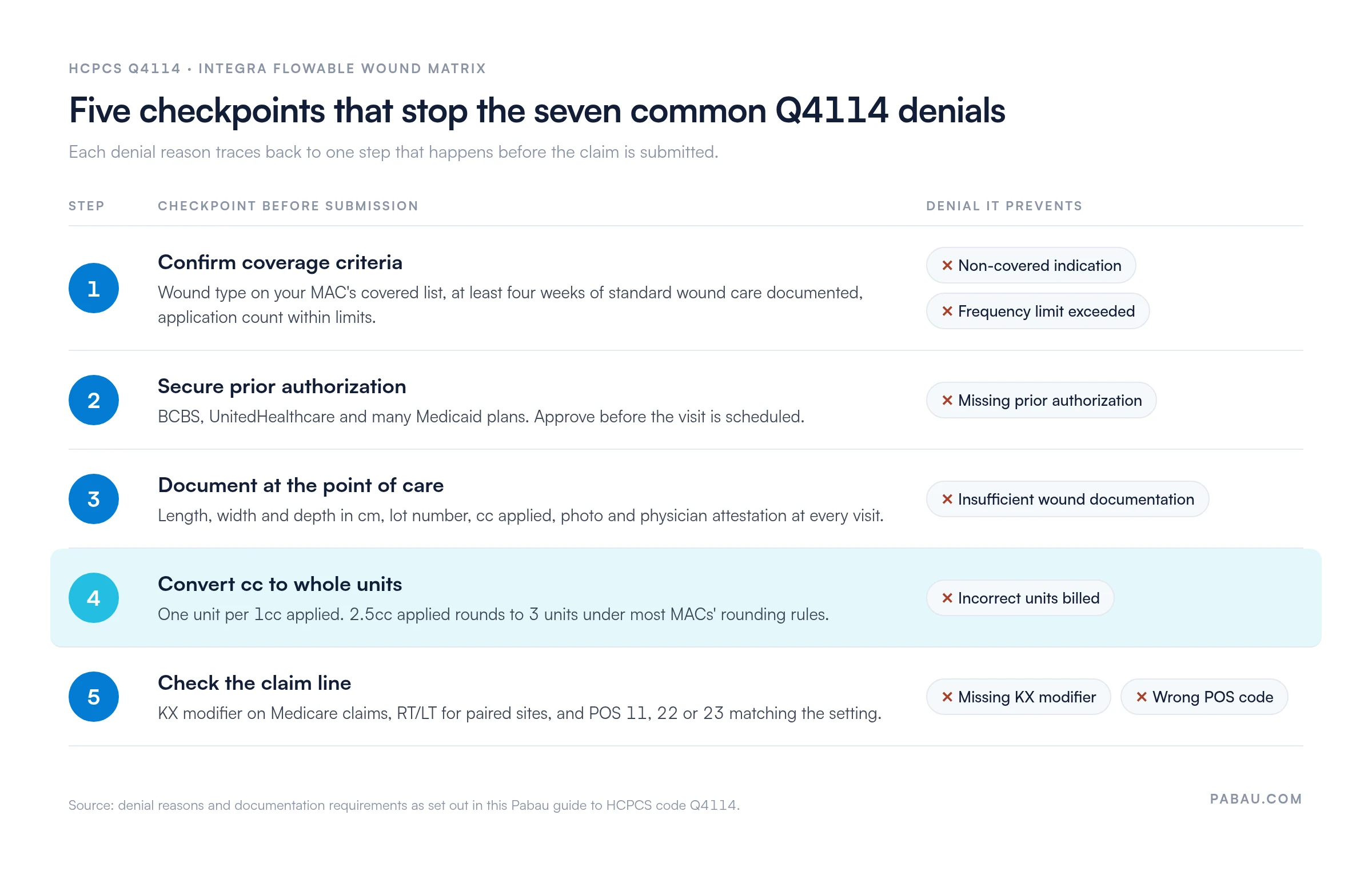
Before submitting any Q4114 claim, run a three-point check. Confirm the KX modifier is on the claim line, and check that billed units match the cc in the chart note. For commercial payers, confirm prior authorization status. Catching these three items before submission prevents most Q4114 denials.
A consistent pre-submission checklist prevents the recurring errors that turn into denied and resubmitted claims. Build it into your wound care claims software, and units, modifiers and lot numbers get checked before each claim leaves your system.
Wound care practices billing Q4114 work across three records. Wound measurements live in the clinical note, the lot number sits on the vial label, and the billed units have to match both. When those records sit in separate systems, unit mismatches and missing lot numbers follow.
Pabau records wound measurements and the cc applied inside the clinical note at the point of care. Billing staff check the documented cc against the Q4114 units on the claim without switching between a paper chart and a billing platform.
For commercial payers, your team attaches an authorization case when booking the application. Pabau then tracks how many approved sessions have been used, so the next visit isn’t booked against an exhausted approval.

Your team attaches an authorization case when booking each Q4114 application. Pabau tracks the approved sessions through to claim submission, so no visit is billed against an expired approval.

Q4114 claims get paid when three numbers agree: the cc in the chart, the units on the claim, and the sessions your payer approved. Each of those is settled before the patient leaves the room, so that is where the checking belongs.
Pricing is the other moving part. Because Q4114 is carrier-priced, a rate copied from an ASP file or another MAC’s schedule will be wrong. Keep your MAC’s current fee schedule in your billing system and recheck it every cycle.
Book a demo to see how Pabau links wound notes, authorization cases and Q4114 claims in one patient record.

Comparing sheet skin substitute payment in 2026? HCPCS code Q4124 shows how the flat per-square-centimeter rate applies to a sheet product.
HCPCS code Q4114 is a Level II temporary code for the Integra Flowable Wound Matrix injectable, billed per 1cc of product applied. It sits in the skin and soft tissue substitute (CTP) payer category. Practices use it to bill this bovine collagen-based injectable matrix when managing chronic and acute wounds.
Medicare pays Q4114 at a price set by your Medicare Administrative Contractor (MAC), under HCPCS pricing indicator 13. The CY2026 skin substitute rule keeps injectables like Q4114 outside both ASP pricing and the $127.14 per square centimeter flat rate. Check your MAC’s current fee schedule before each billing cycle.
Bill one unit for each 1cc of Integra Flowable Wound Matrix applied during the encounter. If 3cc is applied, bill 3 units. Your MAC’s coverage policy sets any frequency limit on total applications per wound episode, so check its current rules.
Q4114 may be billed under POS 11 (physician office), POS 22 (on-campus outpatient hospital), or POS 23 (emergency department). The POS code must match where the application took place, and it affects which fee schedule (PFS vs OPPS) applies to the claim.
The leading denial reasons are a missing KX modifier on Medicare claims and billed units that don’t match the cc in the chart note. Missing commercial prior authorization and incomplete wound documentation follow close behind. A pre-submission checklist prevents most of them.