CPT code 51797: Intra-abdominal voiding pressure add-on
What CPT code 51797 covers CPT code 51797 is the add-on code for intra-abdominal...

Last Updated: Oct 19, 2026
Q4124 is the HCPCS Level II code for Oasis ultra tri-layer wound matrix, per square centimeter. It's a product-specific supply code for one skin substitute, a three-layer matrix made from porcine small intestinal submucosa. Each unit is one square centimeter of product applied to the wound.
The application is billed separately with a CPT code from 15271 to 15278, chosen by wound site and size. From January 1, 2026, Medicare pays Q4124 as an incident-to supply at a national rate of $127.14 per square centimeter.
Let Pabau's smart automation suggest the right codes, reduce claim denials, and keep your practice compliant—effortlessly.
Automate repetitive tasks and focus on what matters most—your patients.
Reduce coding errors and ensure compliance with the latest regulations.
Clean claims, fewer denials, and faster reimbursements.
Powerful insights and reporting to help your practice thrive.
HIPAA compliant SOC 2 certified GDPR-compliant Trusted by 4,000+ clinics worldwide

HCPCS code Q4124 covers Oasis Ultra tri-layer wound matrix only, so billing it for any other product is an incorrect code.
Bill one Q4124 unit per square centimeter of graft applied, not per square centimeter of wound measured.
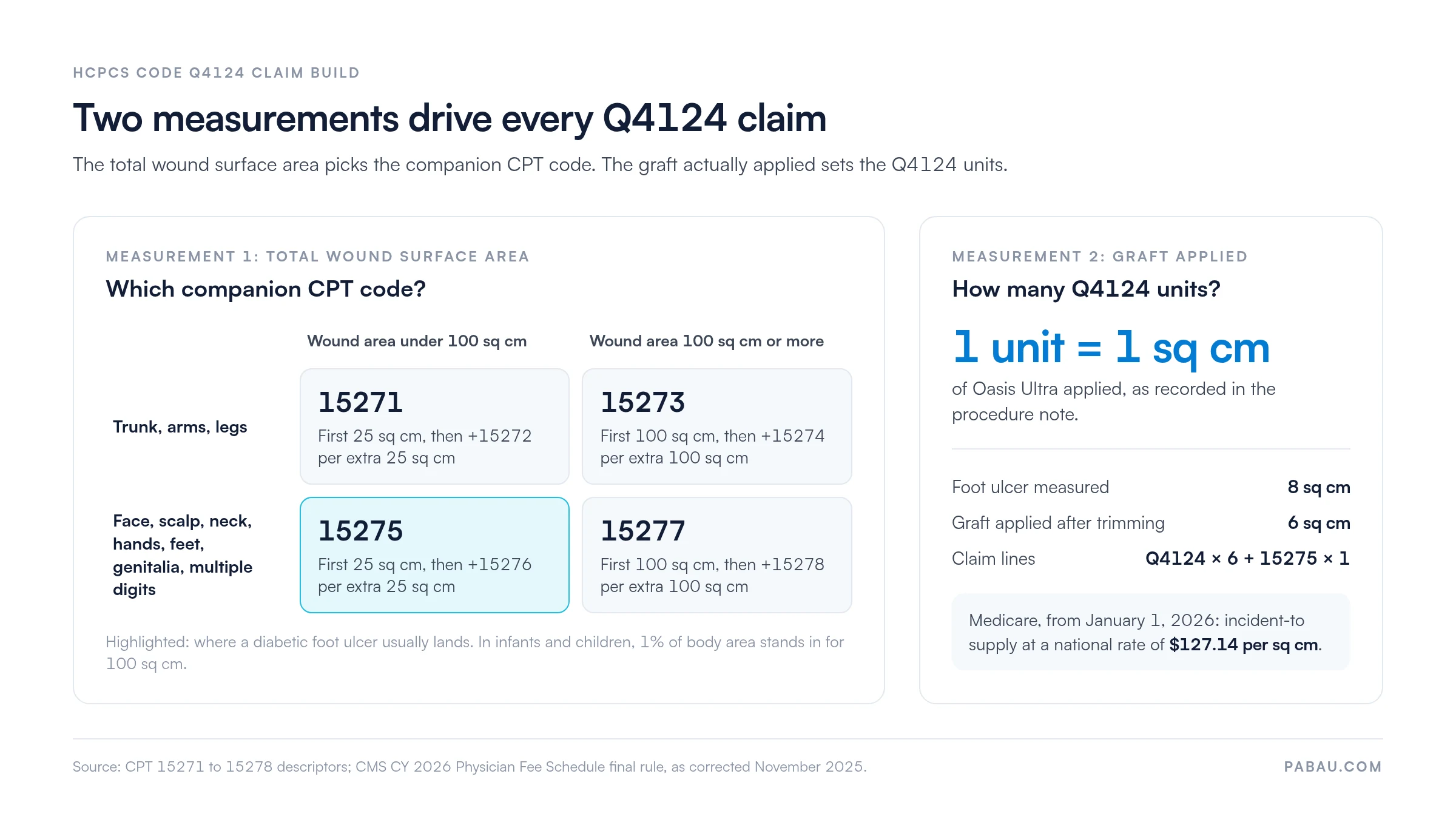
Wound site and total surface area pick the companion CPT code. Trunk and limb wounds use 15271 to 15274, while feet and hands use 15275 to 15278.
From January 1, 2026, Medicare pays Q4124 as an incident-to supply at a national rate of $127.14 per square centimeter.
Coverage still depends on your MAC’s LCD, so wound duration, measurements and failed conservative care must be documented first.
HCPCS code Q4124 is the supply code for Oasis Ultra tri-layer wound matrix, billed per square centimeter applied. Its official descriptor is Oasis ultra tri-layer wound matrix, per square centimeter.
Oasis Ultra is a three-layer matrix made from porcine small intestinal submucosa, cleared by the FDA through the 510(k) pathway.
CMS gives each skin substitute its own Q-code, so the product on the shelf decides the code. Check the box label against the descriptor before the claim goes out. Q4124 is also a supply code only. The application is billed separately with a CPT code from 15271 to 15278, and neither line pays on its own.
Q-codes are temporary HCPCS Level II codes, which means CMS can revise or retire them in any update. Q4124 is active today. Even so, confirm it against the current HCPCS file whenever CMS publishes a new one.
Medicare covers Q4124 only when the wound meets the Local Coverage Determination (LCD) of your Medicare Administrative Contractor (MAC). Applying a skin substitute doesn’t make a chronic wound covered on its own.
Covered wounds generally include diabetic foot ulcers (DFUs), venous leg ulcers (VLUs), and pressure ulcers that haven’t healed with conservative care. The LCD usually wants the wound present for four weeks or more, with a poor response to standard wound care first.
Once the wound qualifies, the next question is how much to bill. That’s where most Q4124 claims go wrong.
One unit of Q4124 equals one square centimeter of product applied. The wound measurement doesn’t set the count, and neither does the sheet size on the packaging.
Here’s how that plays out. A foot ulcer measures 8 sq cm. The clinician trims the graft to fit and applies 6 sq cm. The claim carries 6 units of Q4124. Billing 8 units overstates the supply and can trigger an audit.
Enter the quantity in the units field, box 24G on the CMS-1500. For a clean claim, those units must match the applied area in the procedure note. That note is the first place an auditor looks.
Modifier rules vary by MAC and payer, so use the table below as a starting point rather than a rulebook.
Every Q4124 claim needs a supporting ICD-10-CM code at the highest specificity available. Unspecified laterality or an unspecified wound type is the leading cause of LCD denials. Check your MAC’s LCD for the codes it accepts, because payers update these lists every year.
So does the claim name both the wound and its cause? It should. Payers applying LCD criteria usually want the underlying condition, such as E11.621 for a diabetic foot or an I83 code for venous disease. The L97 ulcer code then describes the wound itself. Coding one without the other is a common reason for denial.
Q4124 covers the product, so the application needs its own CPT code from the 15271 to 15278 family. Two things decide which one: where the wound is, and its total surface area.
Trunk, arms, and legs use 15271 to 15274. Face, scalp, eyelids, mouth, neck, ears, orbits, genitalia, hands, feet, and multiple digits use 15275 to 15278.
Within each group, the split falls at 100 sq cm of total wound surface area. A leg ulcer under that size, for example, starts with CPT 15271 for the first 25 sq cm.
A diabetic foot ulcer belongs in the 15275 family, because feet sit in the second location group. Billing 15271 for a foot wound is a common cross-code error, and payer edits catch it. Confirm the site in the operative note before you choose the code.
Notice that the two claim lines rely on two different numbers. The chart below puts them side by side. Your superbill should capture both, the product lot number for Q4124 and the measured wound area for the CPT code.
From January 1, 2026, Medicare pays most skin substitutes as incident-to supplies at a single national rate. CMS set that rate at $127.14 per square centimeter in its CY 2026 Physician Fee Schedule final rule, after a November 2025 correction.
The policy covers products that aren’t licensed as biologics under section 351 of the Public Health Service Act. Oasis Ultra is a 510(k) device, so Q4124 falls under the flat rate. The old per-product rates, based on average sales price (ASP), no longer apply to it.
The flat rate reaches human tissue allografts too. Q4187 covers Epicord, a dehydrated umbilical cord graft paid at the same $127.14 per square centimeter.
In practice, the supply line is now simple math. Six units at the national rate come to $762.84 before any local adjustment. You can check current Medicare pricing in the CMS Physician Fee Schedule lookup tool.
Coverage rules haven’t changed the same way. The stricter LCDs proposed for 2026 were withdrawn, so existing MAC policies still apply. Novitas (L35041), CGS (L36690), First Coast, Palmetto GBA, WPS, and NGS each publish their own criteria, and they differ.
Prior authorization rules vary by MAC and by commercial plan. Where a payer requires it, get approval before the application date, since retroactive approval isn’t accepted. Add a Q4124 prior auth check to the eligibility check before each wound care visit.
Commercial payers set their own policies and rates. Some adopt Medicare LCD criteria by reference, while others apply stricter rules. After payment, read the remittance advice for the allowed amount and any adjustment codes that point to a policy limit.
The Q4100 series holds more than 100 product-specific codes. The neighbors of Q4124 each describe a different product, and some carry the same brand name. A wrong pick makes the whole supply line invalid, so it denies however accurate the units are.
The unit alone never settles the code. ArthroFlex, an acellular dermal matrix made from human tissue, also bills per square centimeter, but only under HCPCS code Q4125. Codes further along the series work the same way. Q4127 covers Talymed, a marine-derived matrix also billed per square centimeter, so the product on the shelf decides the code.
Product names can move between codes, so verify against the current CMS HCPCS file rather than a saved list. The AAPC Q4124 entry is a quick way to double-check the descriptor.
Keep a product-to-code sheet for every skin substitute you stock. List the product name, lot number format, Q-code and the LCD that covers it. Keep Oasis Wound Matrix (Q4102) and Oasis Ultra (Q4124) on separate lines, since the brand name alone won’t tell a coder which one was used. Update the sheet whenever CMS publishes a HCPCS update.
LCD-compliant documentation is what makes a Q4124 claim payable. Missing or thin notes are the main reason skin substitute claims deny or get recouped on audit. The record has to support each element of the claim, not only the procedure.
Keep these records easy to retrieve for years. An audit request for a Q4124 claim can arrive 12 to 24 months after the service date. A filing system that works today may not hold up by then.
With the documentation in place, the claim itself follows five steps. Each one hands something to the next, so a slip early on shows up later as a denial.
Q4124 denials follow the same patterns across MACs, and a pre-submission review catches most of them. When one does slip through, start with the remark code. A generic “not medically necessary” claim adjustment reason code (CARC) tells you little without it.
Group your denials by root cause, such as product mismatch, unit errors, missing documentation, or frequency limits. Then fix each group where it starts. Reading the medical billing denial codes alongside your MAC’s LCD helps the billing team work each group separately.
Wound care billing often runs across a spreadsheet, a clearinghouse portal, and a paper superbill. Units, lot numbers, and prior auth numbers get retyped at each step. Every retype is another chance to send the wrong figure.
Practice management software like Pabau keeps that work in one place. Its claims management software pre-fills the CMS-1500 from the patient record and includes a HCPCS and CPT code lookup. It also holds a claim back until required fields, such as authorization numbers, are complete.
In the US, claims go out through Claim.MD, with eligibility checks, claim status tracking, and remittance posting in the same system. Your billing team spends less time rekeying and chasing claims, and more time on the checks above.

Pabau pre-fills claims from the patient record and checks required fields before sending. You can then track each Q4124 claim from submission to remittance.

Q4124 rewards practices that treat each claim as one product and two measurements. Match the box label, bill the area applied, and choose the CPT code from the wound’s total surface. Get those three right and most denials never start.
The 2026 flat rate makes Q4124 easier to price, but it doesn’t loosen coverage. Your MAC’s LCD still decides whether the claim pays, so the chart matters as much as the code.
If you’d like to see how Pabau pre-fills and tracks skin substitute claims for wound care practices, book a demo.

Billing the single-layer Oasis product instead? HCPCS code Q4102 covers Oasis Wound Matrix, the product most often confused with Oasis Ultra.
Working with another skin substitute brand? HCPCS code Q4122 walks through DermACELL billing, a neighboring code in the same Q4100 series.
Need a framework for tracking medical billing compliance? Medical billing compliance covers the documentation standards and audit-readiness habits wound care billers should build in.
Want to understand how claim denials are categorized? Denial management in healthcare explains how to group and resolve denial patterns by root cause.
Looking to strengthen your pre-service eligibility checks? Insurance eligibility verification outlines the steps that reduce prior authorization surprises before an application date.
No. Oasis Wound Matrix is the single-layer product and bills under Q4102. Oasis Ultra is the three-layer version and bills under Q4124. Check the box label, because the two are easy to mix up.
It means Medicare pays Q4124 as a supply used during the application procedure, rather than as a separately priced biological. From 2026, that supply is paid at one national rate per square centimeter.
No. The flat rate covers skin substitutes that aren’t licensed as biologics under section 351 of the Public Health Service Act. Products licensed that way stay on payment based on average sales price.
Not necessarily. Commercial payers set Q4124 rates in their own contracts and fee schedules. Check the allowed amount on each remittance against your contract rather than the Medicare figure.
In a physician office, Q4124 goes on the CMS-1500 with the application CPT code. In a hospital outpatient department, the facility bills it on the UB-04 institutional claim.