CPT Code 25210: Excision of a single carpal bone
CPT Code 25210: Official descriptor and quick-reference data CPT Code 25210 is a...

Last Updated: Nov 26, 2026
HCPCS code Q4105 reports Integra Dermal Regeneration Template (DRT) or Integra Omnigraft Dermal Regeneration Matrix, per square centimeter. It is an add-on code, so it always rides with a skin substitute application code from CPT 15271-15278.
For 2026, Medicare pays the product as a supply at $127.14 per square centimeter in the office and hospital outpatient settings. The costly slip is coding it as Q4104, the Integra bilayer wound dressing made from the same materials. The sections below cover units, payment, coverage and the checks to run before you submit.
Let Pabau's smart automation suggest the right codes, reduce claim denials, and keep your practice compliant—effortlessly.
Automate repetitive tasks and focus on what matters most—your patients.
Reduce coding errors and ensure compliance with the latest regulations.
Clean claims, fewer denials, and faster reimbursements.
Powerful insights and reporting to help your practice thrive.
HIPAA compliant SOC 2 certified GDPR-compliant Trusted by 4,000+ clinics worldwide

HCPCS code Q4105 reports Integra Dermal Regeneration Template or Integra Omnigraft Dermal Regeneration Matrix, per square centimeter.
Since January 2026 it is an add-on code, so it always goes on the claim with an application code from CPT 15271-15278.
Medicare pays the product as an incident-to supply at $127.14 per square centimeter for 2026.
Q4104 is the Integra bilayer wound dressing, which uses the same materials, so check the product label before you code.
Coverage is left to each Medicare Administrative Contractor, so check your MAC’s policy and any payer prior authorization first.
HCPCS code Q4105 is the Level II code for Integra Dermal Regeneration Template (DRT) and Integra Omnigraft Dermal Regeneration Matrix. The CMS HCPCS quarterly update files list it as an add-on code, billed per square centimeter of product.
CMS added the code on January 1, 2009, and it is still active in the January 2027 file. The add-on wording arrived with the January 2026 update. These are the details billers ask about most.
Integra Template is a bilayer matrix for dermal regeneration. Its lower layer is a porous matrix of bovine collagen and chondroitin-6-sulfate. A thin silicone layer on top covers the wound and controls moisture loss.
The FDA approved it under PMA P900033 on March 1, 1996, for life-threatening full-thickness or deep partial-thickness burns. Scar contracture repair followed in 2002. On January 7, 2016, the FDA added diabetic foot ulcers under the Omnigraft name, according to the FDA summary of safety and effectiveness.
That foot ulcer indication is narrow. It covers partial and full-thickness neuropathic diabetic foot ulcers open for more than six weeks, with no capsule, tendon or bone exposed. The product is used alongside standard diabetic ulcer care.
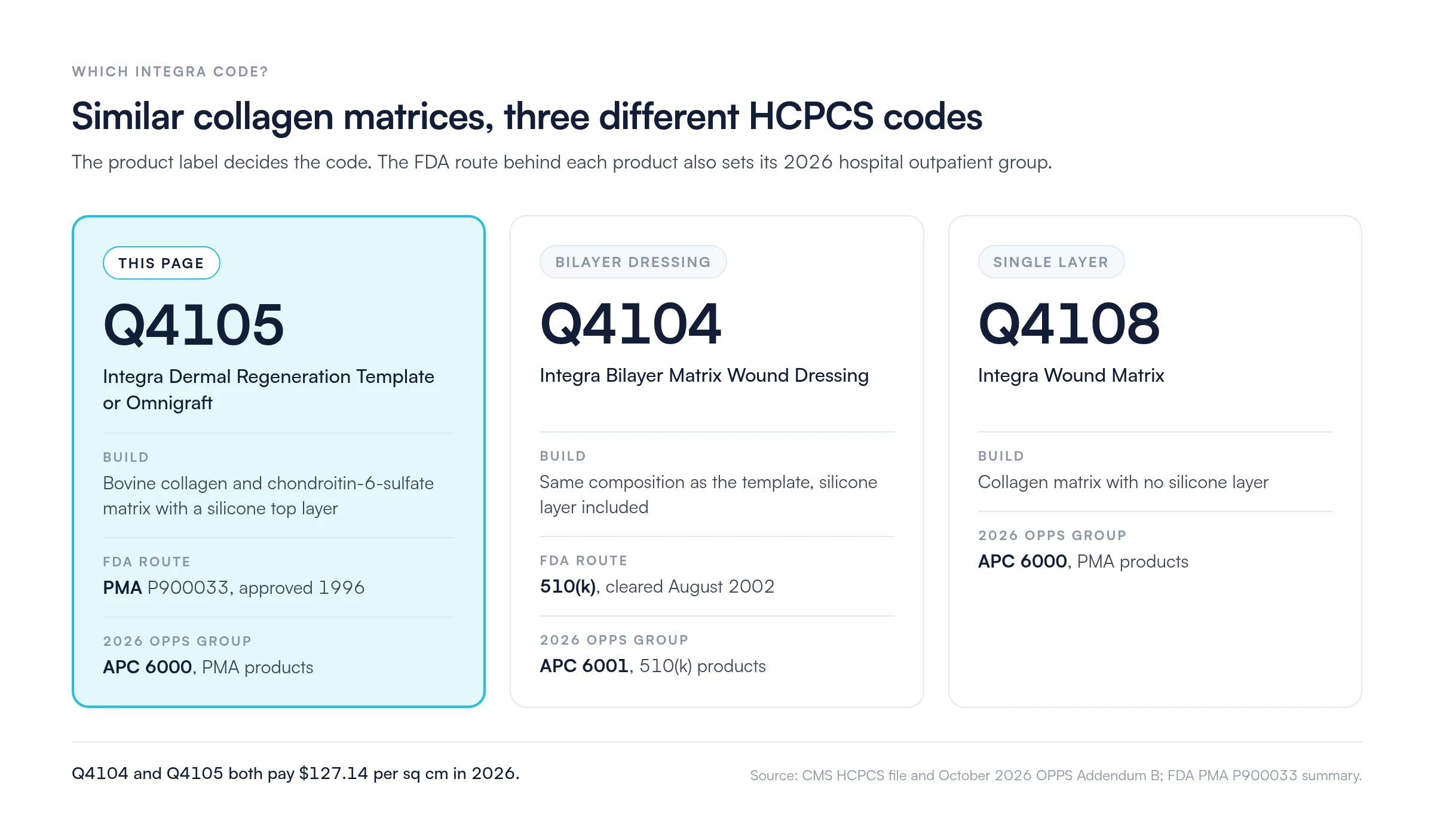
The Integra Bilayer Matrix Wound Dressing has the same composition as Integra Template. However, it was cleared through the 510(k) route in August 2002 for chronic and surgical wounds. It bills as HCPCS code Q4104. Integra Wound Matrix drops the silicone layer and bills as Q4108.
The pathway now shows up in hospital payment, too. The October 2026 OPPS Addendum B places Q4105 in APC 6000 for PMA products and Q4104 in APC 6001 for 510(k) products. Both pay $127.14 in 2026. CMS set that single rate for CY 2026, so the groups could be priced apart in later years.
Side by side, the three Integra codes split on the product label and the FDA route behind it.
Every Q4105 claim has two parts, the procedure and the product. In a physician office, your practice bills both lines, and the claim moves like this.
In the hospital outpatient department, the split changes. The physician bills the application code at the facility rate, and the hospital bills Q4105 on its own claim. On an inpatient burn admission, the product is part of the inpatient stay payment rather than a separate line.
The CPT code follows the wound, while the Q4105 units follow the product. Keep those two measurements separate in the note, so a reviewer can check each one.
Take a patient with type 2 diabetes and a neuropathic ulcer on the right forefoot. It measures 4 cm by 3 cm, or 12 sq cm, with the fat layer exposed. It has been open for eight weeks despite standard care, and no tendon or bone is exposed.
The diagnosis lines are E11.621 for type 2 diabetes with foot ulcer and L97.512 for the ulcer itself. The application is CPT 15275, one unit, because the foot is a listed site and the wound is under 25 sq cm.
The note shows 12 sq cm of Omnigraft applied, with none discarded. So Q4105 goes on the claim as 12 units. At the 2026 national rate, that line comes to 12 × $127.14, or $1,525.68, before geographic adjustment.
From January 1, 2026, Medicare pays skin substitutes as incident-to supplies rather than as biologicals. The product is paid separately from the application procedure, at one rate across products.
The CY 2026 physician fee schedule final rule printed that rate as $127.28 per sq cm. A correction notice published on November 28, 2025 lowered it to $127.14. Fee schedules loaded straight from the final rule may still carry the higher figure.
Hospitals follow the outpatient system. The January 2026 OPPS update created APCs 6000 to 6002 and a new status indicator, S1, for skin substitute products. Q4105 sits in APC 6000 at the same $127.14, with a minimum unadjusted copayment of $25.43 per unit.
That pricing indicator change matters for your chargemaster. If your system still prices Q4105 from a drug pricing file, the expected payment on your remittance will not match.
The HCPCS file gives Q4105 coverage code C, which means carrier judgment. In practice, your Medicare Administrative Contractor decides coverage through its local policies and claim reviews.
Before the first application, pull your MAC’s current skin substitute policy and its billing article. Check which wound types it covers, any wound-duration or prior-care rules and how many applications it allows.
Keep the use inside the FDA-approved indications, too. Omnigraft is approved for neuropathic diabetic foot ulcers, not venous leg ulcers or pressure injuries. A claim outside that label is a likely target for medical review.
Commercial plans set their own rules, and many require prior authorization for skin substitutes. Check that the policy names the product you plan to use, not only the code.
Most Q4105 problems start before the claim is built. These are the ones that come up again and again, with the fix for each.
When denials do arrive, group them by reason rather than by patient. Our guide to denial codes in medical billing explains the reason codes you will see on the remittance.
The Q4100 series runs product by product, so neighboring codes often look alike. Dermagraft’s old code, Q4106, was deleted at the end of 2025, while Graftjacket’s Q4107 is still active. Here is where each one stands in 2026.
Q4431 is for a PMA skin substitute that has no product-specific code. DRT and Omnigraft have their own code, so Q4431 never applies to them.
Skin substitute claims carry more detail than most lines, from wound measurements to lot numbers. When that detail sits in one system and the claim in another, units and codes drift apart.
Pabau, a practice management platform with built-in claims management software, pre-fills the CMS-1500 from the patient record. Its code library covers CPT and HCPCS lookups. Required claim fields are checked before the claim can be sent.
In the US, claims go out through Claim.MD, with eligibility checks, claim status tracking and ERA posting. So if a Q4105 line comes back short-paid, you see it against the claim.
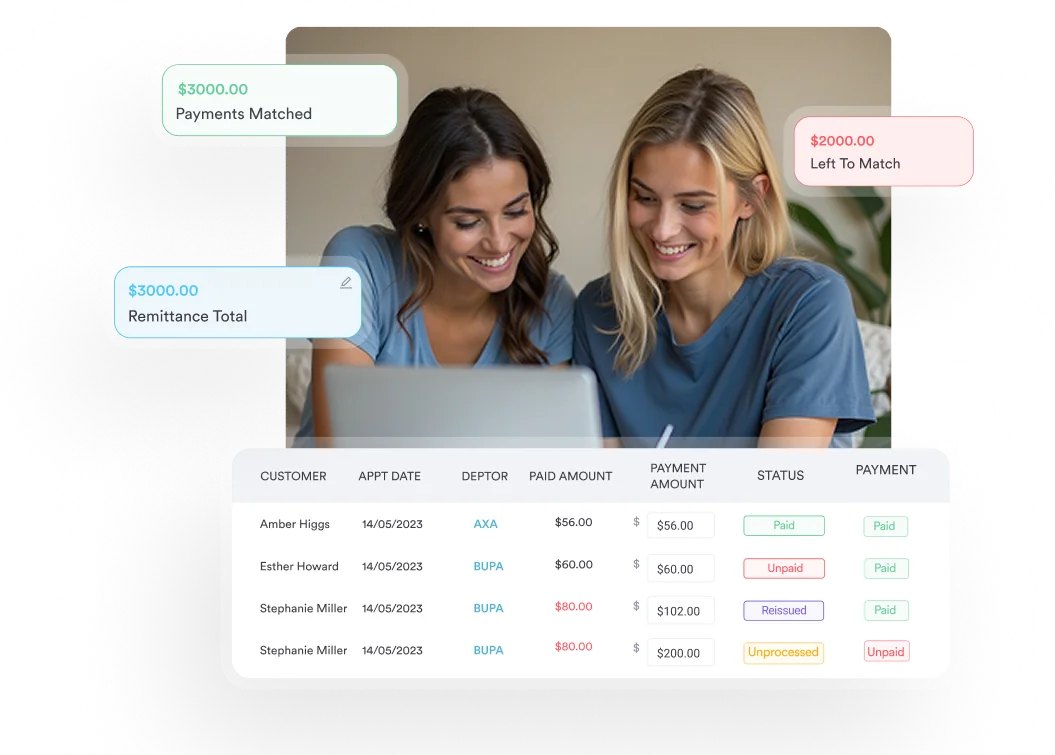

Pabau pre-fills claims from the patient record, checks required fields before sending and posts remittances against each claim. See how it fits your wound care workflow.

Q4105 is a simple code once the product is right. It reports Integra DRT or Omnigraft by the square centimeter, always next to an application code. The work happens earlier, when you read the label, record the product and size the application code to the wound.
For 2026, a clean Q4105 line pays $127.14 per sq cm. Check that figure, your MAC’s policy and the Q4104 distinction before your next application. Book a demo to see how Pabau keeps the claim and the patient record in step.

Billing the bilayer dressing instead? HCPCS code Q4104 covers Integra Bilayer Matrix Wound Dressing, the 510(k) product with the same materials.
Using the single-layer Integra product? HCPCS code Q4108 explains how Integra Matrix is coded and how it differs from the bilayer products.
Still have Dermagraft in your chargemaster? HCPCS code Q4106 sets out why the code was deleted and how 2026 skin substitute payment works.
Want fewer claims bounced back? Clean claim submission breaks down the elements a claim needs to pass first-pass adjudication.
The FDA labeling lists two contraindications. Don’t use it in patients with a known sensitivity to bovine collagen or chondroitin, or on clinically diagnosed infected wounds. Record an infection check in the note before application.
Yes. Q4105 is listed as active in the CMS January 2027 HCPCS file, with no termination date. Payment rates are set separately, so check the 2027 fee schedule before you update your chargemaster.
Under Medicare Part B, the patient usually owes 20% coinsurance after the annual deductible. In the hospital outpatient setting, the 2026 OPPS file lists a minimum unadjusted copayment of $25.43 per square centimeter.
Once the new dermal layer has formed, the surgeon removes the silicone layer and places a thin autograft. That later procedure takes its own skin graft CPT code, not Q4105, because no new Integra product is applied.