HCPCS Code L0472: Hyperextension TLSO billing guide
HCPCS code L0472: Official descriptor and device definition HCPCS code L0472 des...

Last Updated: Nov 5, 2026
Q4113 is the HCPCS Level II code for Graftjacket Xpress, injectable, 1 cc.
Graftjacket Xpress is the flowable, injectable form of the Graftjacket acellular dermal matrix, used to fill deep or tunneling wounds. Each unit equals 1 cc injected, so units come from the documented volume, not from wound length and width. The sheet form of the Graftjacket family bills separately under Q4107, per square centimeter.
Let Pabau's smart automation suggest the right codes, reduce claim denials, and keep your practice compliant—effortlessly.
Automate repetitive tasks and focus on what matters most—your patients.
Reduce coding errors and ensure compliance with the latest regulations.
Clean claims, fewer denials, and faster reimbursements.
Powerful insights and reporting to help your practice thrive.
HIPAA compliant SOC 2 certified GDPR-compliant Trusted by 4,000+ clinics worldwide

HCPCS Code Q4113 identifies one product: Graftjacket Xpress, the injectable form of the Graftjacket acellular dermal matrix.
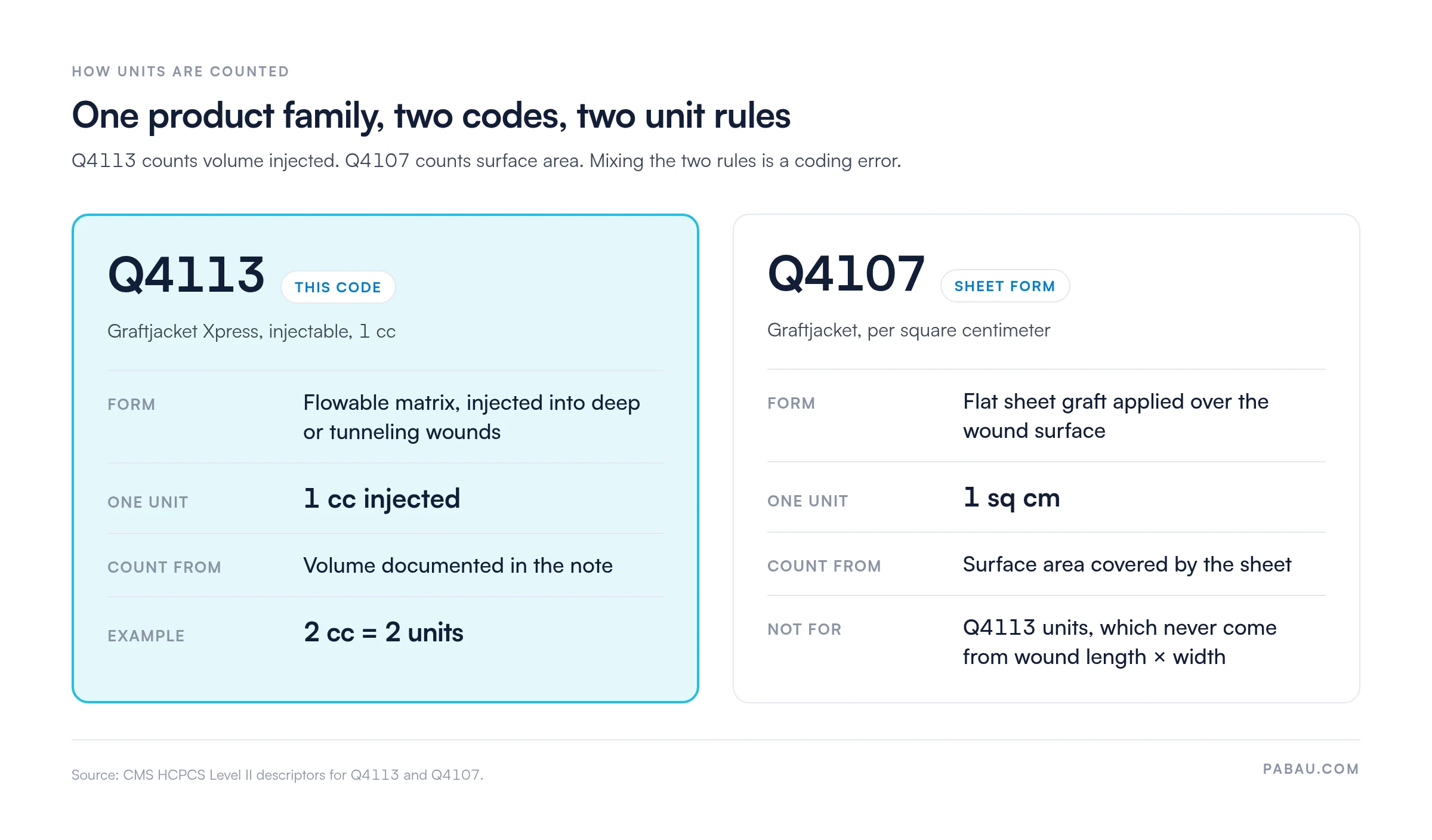
One unit equals 1 cc injected, so units come from the documented volume, never from wound length times width.
The sheet form of the Graftjacket family bills under Q4107 per square centimeter, so the two codes are not interchangeable.
Modifier KX belongs on the claim only where your MAC’s LCD or billing article tells you to add it.
Confirm the CY2026 payment status and rate for Q4113 in the CMS addenda before you quote a figure or set a fee.
HCPCS Code Q4113 is the Medicare billing code for Graftjacket Xpress, injectable, 1 cc. Graftjacket Xpress is a flowable, injectable acellular human dermal matrix. Clinicians use it to fill deep or tunneling wounds that a flat sheet graft cannot reach.
The code sits in the HCPCS Level II Q-code series, which CMS maintains. CMS revises HCPCS codes each quarter. Check that Q4113 is still active for the date of service as part of the medical billing workflows your practice follows.
Because Q4113 names a single product in a single form, billing any other dermal matrix under it is a coding error. The same applies to billing a Graftjacket sheet under Q4113. Match the product label and lot number to the descriptor before you submit.
Q4113 covers the supply of Graftjacket Xpress, counted in 1 cc units. It does not describe the work of injecting the product, which is reported separately.
No single national coverage rule applies to Q4113 today. Check your MAC and each commercial payer policy before you treat the product as covered for a given wound type.
Each encounter note has to support both the supply line and the procedure you report with it. Good medical billing compliance means every element below is in the chart before the claim goes out.
Units on the claim must equal the number of 1 cc units documented as injected. Wound length and width belong in the clinical note, but they never set the Q4113 unit count.
A clean Q4113 claim pairs the supply line with the right procedure code. It adds only the modifiers your payer asks for and reports the correct place of service. Submitting a clean claim for an injectable skin substitute depends on all three.
Q4113 is billed per 1 cc of product injected. If the clinician injects 2 cc of Graftjacket Xpress, the claim shows 2 units. Bill from the volume recorded in the note, not from the vial size or the wound surface area. The side-by-side below shows how that rule differs from the sheet form.
For a partial cc or leftover product, follow the written instructions of the payer or MAC. Do not assume a waste modifier applies.
Important: KX is not a universal Q4113 requirement. Add it only when a MAC LCD or billing article instructs it for this product. Check the current NCCI edit table before you add modifier 59 or XS, as misuse is a common audit target.
Q4113 pays for the product only. CPT codes 15271 to 15278 describe applying a sheet or membrane skin substitute graft, counted by surface area. They do not describe injecting Graftjacket Xpress, so do not report them as the default pair for Q4113.
Report the procedure the clinician actually performed, such as a debridement, under its own CPT code. Where a MAC billing article names the procedure code to use with injectable skin substitutes, follow that article.
In a physician office (POS 11), the practice is paid the single non-facility rate for the procedure. In a facility such as a hospital outpatient department (POS 22) or an ASC (POS 24), the clinician is paid the lower facility rate. The facility then bills its own claim. Make sure the POS code matches where the service took place.
From January 1, 2026, CMS pays most skin substitutes that are not licensed as biologics as incident-to supplies, at a flat rate. That replaced the old product-specific, quarterly ASP-based pricing for those products.
Confirm the payment status and rate for Q4113 in the CMS CY2026 Physician Fee Schedule and OPPS addenda before you set a fee. Track the figure as part of your revenue cycle management so you protect margin on a high-cost supply.
The MAC skin substitute LCDs for diabetic foot ulcers and venous leg ulcers were scheduled to take effect January 1, 2026. They were withdrawn on December 24, 2025, before taking effect, so their criteria never became CMS requirements.
Many payers still apply similar tests, so they remain common practice. These include at least four weeks of failed standard care, an adequate vascular assessment and regular wound measurements. Check your own MAC and each commercial payer policy before each course of treatment.
Prior authorization (PA) for Q4113 depends on the payer and, for Medicare, on where the patient is treated. Missing a required authorization is one of the most avoidable causes of denial.
Traditional Medicare does not require PA for every skin substitute. CMS runs the WISeR model in six states from January 2026: Arizona, New Jersey, Ohio, Oklahoma, Texas and Washington. Check whether your state and the service are in scope.
Where PA applies, send wound photos, recent measurements, a summary of prior wound care and the vascular assessment. Note the planned volume of Graftjacket Xpress in cc.
Most commercial payers require PA for skin substitute products, and turnaround times vary by payer. Submit the request well before the planned treatment date so the patient is not rescheduled. Record the PA number on the claim and keep a copy of the approval.
The Q4100 range holds dozens of skin substitute codes, and each one maps to a named product. Picking the wrong code because products look alike is a frequent audit finding. The AAPC Codify HCPCS lookup lets you compare descriptors side by side.
If the product given does not match the code billed, Medicare can recoup payment in an audit, even years later. For the sheet form, see our guide to HCPCS Code Q4107.
The diagnosis on a Q4113 claim must match what the payer policy covers. The codes below are common on skin substitute claims for chronic wounds. Your payer policy decides which ones it accepts.
ICD-10-CM instructional notes put the underlying cause first and the ulcer site code second. Follow any extra sequencing rules in your payer policy.
Q4113 denials follow a predictable pattern, and most can be prevented with a check before submission. Good denial management strategies start by mapping each claim adjustment reason code (CARC) to its root cause.
Build a short Q4113 check into your billing workflow. Confirm the cc injected matches the units, the lot number matches Graftjacket Xpress, and any required PA is active. Then check that the diagnosis fits the payer policy and that KX appears only where an LCD or billing article requires it.
Most Q4113 denials trace back to the chart. A missing lot number, a volume recorded in the wrong field, or an unclear wound note can each stall a claim.
Pabau, the practice management and billing platform we build, keeps the treatment note, wound measurements, photos and product details on one patient record. Its claims management software pulls that existing record data into a pre-filled claim. US practices then submit and track it through Claim.MD.
Your coder still chooses the codes and modifiers. They just stop hunting for the volume, lot number and wound note, because those are already on the record when the claim is built.

Pabau keeps treatment notes, product details and wound photos on one record, then pulls them into a pre-filled claim. Your team spends less time chasing missing documentation.

Treat Q4113 as a volume code. If the units on the claim match the cc recorded in the note, and the lot number matches Graftjacket Xpress, most coding risk goes away.
The harder part is coverage, which rests with each MAC and payer policy, as no national LCD governs Q4113. Check the payer policy and the CY2026 CMS addenda before the first injection, while the treatment plan can still change. Book a demo to see how Pabau keeps wound care documentation ready for every claim.

Need to compare another skin substitute code? HCPCS Code Q4110 covers PriMatrix, a sheet product billed per square centimeter, with its units and Medicare rate.
Want to reduce claim errors before submission? What makes a clean claim explains the elements that decide whether a claim pays the first time.
Requesting authorization before an injection? Medical prior authorization form gives you a ready template for sending wound history and planned treatment to the payer.
Appealing a denied skin substitute claim? Medical appeal form template helps you lay out the clinical record behind a disputed line.
Handling a high volume of denials? Denial management in healthcare covers how to sort, appeal and prevent recurring denial patterns.
HCPCS Code Q4113 covers the supply of Graftjacket Xpress, the injectable form of the Graftjacket acellular dermal matrix, in 1 cc units. It is often used to fill deep or tunneling chronic wounds. The code covers the product only, so the procedure is reported with its own code.
One unit of Q4113 equals 1 cc of Graftjacket Xpress injected. Bill the number of cc documented in the note, for example 2 units for 2 cc. Never calculate Q4113 units from wound length and width, which is how sheet codes such as Q4107 are counted.
Common causes are missing prior authorization (CO-15), a medical necessity denial (CO-50), and a diagnosis the payer does not accept (CO-11). Units over a payer limit and missing documentation such as cc injected or lot number also cause denials. A short check before submission prevents most of them.
Q4113 is Graftjacket Xpress, the injectable form, billed per 1 cc. Q4107 is the Graftjacket sheet, billed per square centimeter. Other codes, such as Q4101 for Apligraf and Q4115 for Alloskin, name different products. Billing the wrong code for the product given is a coding error and an audit risk.