CCSD code L6530: Revision femoral bypass graft
CCSD code L6530: Definition and clinical scope CCSD code L6530 carries the offic...

Last Updated: Nov 13, 2026
HCPCS code Q4100 is the Level II code for a skin substitute, not otherwise specified. CMS deleted it effective December 31, 2025, so it is not valid for dates of service from January 1, 2026.
A skin substitute product without its own code now bills one of three new codes, chosen by FDA pathway. Q4431 covers PMA products, Q4432 covers 510(k) products, and Q4433 covers 361 HCT/P products.
Let Pabau's smart automation suggest the right codes, reduce claim denials, and keep your practice compliant—effortlessly.
Automate repetitive tasks and focus on what matters most—your patients.
Reduce coding errors and ensure compliance with the latest regulations.
Clean claims, fewer denials, and faster reimbursements.
Powerful insights and reporting to help your practice thrive.
HIPAA compliant SOC 2 certified GDPR-compliant Trusted by 4,000+ clinics worldwide

HCPCS code Q4100 (skin substitute, not otherwise specified) was deleted effective December 31, 2025, and is not valid for 2026 dates of service
Q4100 was never an Integra code: Integra bilayer matrix wound dressing bills Q4104, and Apligraf bills Q4101
From January 1, 2026, an unspecified skin substitute bills Q4431, Q4432 or Q4433, chosen by the product’s FDA pathway
CMS dropped the high-cost and low-cost tiers. Sheet-form skin substitutes are now paid as incident-to supplies at one national rate of about $127.14 per square centimeter
Pabau, the practice management platform we build, keeps wound documentation, the code library, and claims in one workflow, so a retired code stops reaching payers
No. HCPCS code Q4100 (skin substitute, not otherwise specified) was deleted effective December 31, 2025. It cannot be billed for any date of service on or after January 1, 2026.
The code still shows up in lookup tools because CMS keeps deleted codes in its reference file for a year. The record itself settles the question. In the CMS January 2026 Alpha-Numeric HCPCS file, Q4100 carries action code D, meaning discontinued, and a termination date of 20251231.
You can check the record yourself. Download the January 2026 file from the CMS HCPCS quarterly update page and search the text file for the line starting Q4100. The termination date and action code sit at the end of the record.
Q4100 was the catch-all code for a skin substitute product with no product-specific HCPCS code of its own. It named no product, no manufacturer, and no FDA pathway. Coders reached for it when a new or uncommon product had not yet received its own Q-code. A product with its own code bills under that code instead, as Dermavest and Plurivest do under Q4153.
Some code references have mislabeled Q4100 as an Integra product. That is wrong. Integra bilayer matrix wound dressing (BMWD) has its own code, Q4104, billed per square centimeter. Q4101 is Apligraf, not an Integra product either. The single-layer Integra Matrix Wound Dressing has a code of its own too, HCPCS code Q4108, billed per square centimeter.
So the fix for a chargemaster that maps Integra BMWD to Q4100 is simple. Map it to Q4104. A product with its own code should always be billed under that code, never under a not-otherwise-specified one.
CMS replaced the single unspecified code with three, one for each FDA regulatory pathway. All three were added to the HCPCS file effective January 1, 2026. Their descriptors below are copied from the CMS January 2026 Alpha-Numeric HCPCS file.
The split explains why Q4100 had to go. Medicare now groups skin substitutes by FDA pathway, and a code that names no pathway cannot be placed in a group. Pick the replacement from the product’s FDA status, which the manufacturer’s labeling or 510(k) or PMA record will confirm. The whole decision takes three questions, in this order.
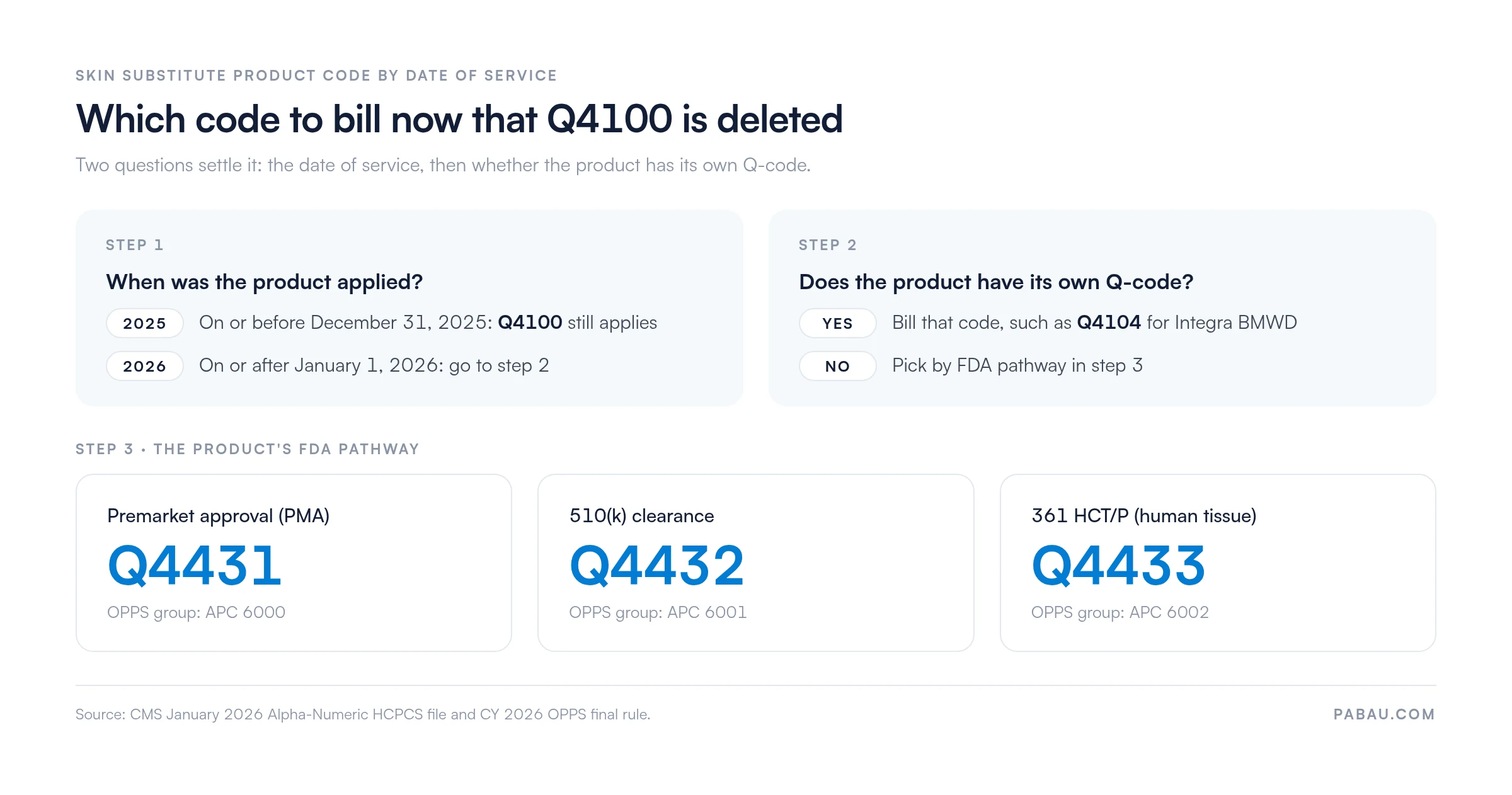
Use these codes only when the product has no product-specific Q-code. Like any not-otherwise-specified code, most payers expect the product name and size in the claim’s narrative field. Note too that the three descriptors name no unit of measure, so confirm the unit convention with the payer before the first claim.
Before you bill Q4431, Q4432 or Q4433, search the current HCPCS file for the product name. Many products have their own Q-code, and a not-otherwise-specified code on a product with its own code invites a denial.
For CY 2026, CMS pays skin substitute products as incident-to supplies at one national rate, regardless of which product was applied. The rate is about $127.14 per square centimeter, before geographic adjustment.
That per-square-centimeter rate applies to sheet-form products. Non-sheet products, such as flowable or injectable forms, may stay packaged with the procedure or bill under separate non-sheet rules. Check your MAC’s guidance before you bill one.
CMS first published $127.28 in the final rules. The physician fee schedule correction notice of November 28, 2025 brought it to $127.14. The hospital outpatient side is set out in the CY 2026 OPPS and ASC final rule.
For sheet-form products, the practical effect is that product choice no longer moves the Medicare payment. Margin now depends on acquisition cost and on the documented area applied. CMS has said it will revisit the rate each year through rulemaking.
A skin substitute product code covers the product only. The application itself is billed with a CPT code from 15271 through 15278. The right code depends on the wound site, the total wound surface area, and whether the patient is an infant or child.
The product code always travels with an application code on the same claim. The 2026 product descriptors say so directly, with the phrase “list in addition to primary procedure”. The AMA’s CPT code set overview explains how the application codes are maintained.
Payment is set per square centimeter, so the record has to show how much product reached the wound. The common mistake is billing the wound measurement or the full sheet size instead of the area applied.
When a sheet is trimmed to fit an irregular wound, document the trimmed dimensions and the reason. Payer rules on discarded product vary, so check the MAC billing article before you bill any wastage.
Every skin substitute claim needs an ICD-10-CM diagnosis that establishes medical necessity. The wound type in the chart has to match the diagnosis on the claim. Use the most specific code the chart supports.
A type 2 diabetic foot ulcer, for example, pairs E11.621 with an L97.- code for the ulcer’s site and depth. Check the covered diagnosis list in your MAC’s billing article before you submit. Our ICD-10-CM code reference covers each of these diagnoses on its own page.
Coverage for a skin substitute application is decided by your MAC’s local coverage policy, not by the payment rule. Search the Medicare Coverage Database for the LCD and billing article in force in your jurisdiction. Several MACs changed their skin substitute policies around the 2026 payment reform, so re-pull them rather than relying on a saved copy.
Most policies in this category expect the following:
Prior authorization: Original Medicare does not universally require it for skin substitute applications, but many Medicare Advantage plans do. Check the plan before the appointment, because an application performed without a required authorization is rarely recoverable on appeal.
Incomplete documentation drives more skin substitute denials than coding errors do. Record the following at every application encounter:
Product identity matters more now that Q4100 is gone. A claim for Q4431, Q4432 or Q4433 has to show which pathway the product belongs to. The record is where that proof lives.
Most avoidable rejections in 2026 come from protocols written for the old rules. The table maps the usual claim adjustment reason codes to their causes. Pabau’s guide to denial management covers the wider workflow.
A denial for missing records is different from a denial for an uncovered wound. The first can be appealed with more documentation. The second needs a wound type that the policy covers. Pabau’s medical billing compliance guide covers that distinction in more depth.
A deleted code costs money for as long as it stays in the system. Q4100 is a clear example, because it was a default that coders reached for without thinking. The pattern repeats every January, when codes are retired and nobody reconciles the chargemaster.
In Pabau, the clinical note, the code library, and the claim sit on the same patient record. When a code is retired, you change it once, and every future charge picks up the change. Pabau’s claims management software then submits the claim and tracks its status.
The result is a 2026 claim that carries the right product code and the record to back it up.

Pabau connects wound documentation, your code library, and claim submission in one workflow, so a code change reaches every future charge. See how it works for your practice.

Q4100 is now a historical code. It belongs on closed 2025 claims and nowhere else. The work it used to do is split across Q4431, Q4432 and Q4433, and the right one depends on the product’s FDA pathway.
The payment side changed just as much. One national rate replaced the cost tiers, so the documented area and the product’s identity carry the claim. Practices that update their chargemaster and wound templates once will avoid a year of invalid-code rejections.
Book a demo to see how Pabau keeps wound documentation, coding, and claims moving together.

Need a clean-claim reference for HCPCS submissions? Clean claim requirements in medical billing outlines the data elements every HCPCS claim must carry to avoid front-end rejection.
New to the revenue cycle behind a HCPCS claim? Medical billing fundamentals covers how the revenue cycle connects coding accuracy to claim payment.
Billing a skin substitute that has its own code? HCPCS code Q4102 walks through Oasis wound matrix, a product billed under its own Q-code rather than a not-otherwise-specified one.
HCPCS code Q4100 is the Level II code for a skin substitute, not otherwise specified. It covered skin substitute products that had no product-specific code. CMS deleted it effective December 31, 2025, so it is not valid for dates of service from January 1, 2026.
Three codes replaced it, one per FDA pathway. Q4431 covers PMA products, Q4432 covers 510(k) products, and Q4433 covers 361 HCT/P products. All three took effect January 1, 2026. Use them only when the product has no product-specific Q-code.
No. Integra bilayer matrix wound dressing bills Q4104, per square centimeter. Q4101 is Apligraf. Q4100 was a not-otherwise-specified code that named no product at all.
CMS pays sheet-form skin substitute products as incident-to supplies at one national rate of about $127.14 per square centimeter, geographically adjusted. Non-sheet products, such as flowables, may be packaged or billed under separate rules, so check your MAC. Under the OPPS, products sit in APCs 6000, 6001 and 6002 by FDA pathway. In the physician office, the product is paid separately from the application code.
Original Medicare does not universally require it, but many Medicare Advantage plans do. Requirements also vary by MAC. Check the plan before the first application, because a missing authorization is rarely recoverable on appeal.