

HCPCS Code Q4175: Billing, coverage, and documentation guide
HCPCS code Q4175: Code description and product identity HCPCS Code Q4175 is the ...

Last Updated: Nov 20, 2026
Q4173 is the HCPCS Level II code for Palingen or Palingen Xplus, per square centimeter (add-on, list separately in addition to primary procedure).
It reports the skin substitute product itself, one unit per square centimeter applied. Typical wounds are diabetic foot ulcers and venous leg ulcers. The application work is billed separately with a code from CPT 15271-15278. For 2026 dates of service, Medicare pays Q4173 as an incident-to supply at a flat rate of roughly $127 per square centimeter.
Let Pabau's smart automation suggest the right codes, reduce claim denials, and keep your practice compliant—effortlessly.
Automate repetitive tasks and focus on what matters most—your patients.
Reduce coding errors and ensure compliance with the latest regulations.
Clean claims, fewer denials, and faster reimbursements.
Powerful insights and reporting to help your practice thrive.
HIPAA compliant SOC 2 certified GDPR-compliant Trusted by 4,000+ clinics worldwide

HCPCS Code Q4173 reports Palingen or Palingen Xplus per square centimeter, billed alongside an application code from the CPT 15271-15278 series
For 2026 dates of service, Medicare pays Q4173 as an incident-to supply at a flat rate of roughly $127 per sq cm, geographically adjusted
The application CPT pair is chosen by wound site and total wound surface area, not by patient age
KX belongs on the claim only where your MAC’s LCD requires it, and JW and JZ are not used on 2026 claims
Most denials trace back to medical necessity documentation (CO-50), missing claim data (CO-16) or a missing or inconsistent modifier (CO-4)
HCPCS Code Q4173 reports Palingen or Palingen Xplus, a skin substitute for chronic wounds, billed per square centimeter as an add-on code. The Centers for Medicare and Medicaid Services (CMS) publishes that descriptor in its quarterly HCPCS update files. The code sits in the Q4100-Q4440 range, which assigns codes to named skin substitute products. Q4173 therefore covers those two Palingen products and no other manufacturer’s graft.
The table below summarizes the key reference data for Q4173.
Important: CMS updates the Q4100 series in its annual HCPCS release. Verify Q4173’s active status and effective date in the current CMS HCPCS data file before billing. Codes in this range are periodically retired, reassigned, or replaced when product formulations change.
Q4173 covers two named skin substitute products, Palingen and Palingen Xplus, applied to qualifying wound types. The code is designed for use in chronic or complex wounds where a biologic graft material is clinically indicated. Wound types that commonly qualify include diabetic foot ulcers (DFUs) and venous leg ulcers (VLUs). Selected surgical wounds that have failed to heal with standard care can qualify too.
What Q4173 does NOT cover:
Billing Q4173 for a product that Q4174 or Q4175 describes typically draws a CO-11, CO-50 or non-covered denial. CO-4 is a different problem, raised when the procedure code is inconsistent with the modifier used or a required modifier is missing. Confirm the exact product applied against the CMS HCPCS data file before the claim is built.
Q4173 is billed per square centimeter of skin substitute applied. The number of units on the claim line equals the total wound surface area covered, rounded to the nearest whole square centimeter. Accurate unit calculation starts with an accurate wound measurement at the time of application, documented in the clinical record.
Measure wound length and width in centimeters at the time of application. Multiply the two figures to get the area in sq cm. For irregular wound shapes, billers often use the greatest length multiplied by the greatest perpendicular width. Document the exact measurements in the procedure note.
Append modifier KX only where your MAC’s LCD requires it, to certify that the LCD’s medical necessity criteria are met. Some MACs also require modifier 59 when separate wound sites are treated in the same encounter. Check your MAC’s billing guidelines before submitting, because modifier requirements vary by jurisdiction.
The JW and JZ drug-wastage modifiers no longer apply to skin substitutes. CMS rejects them on these codes for dates of service on or after January 1, 2026.
Q4173 is a supply code. It reports the skin substitute product, not the work of applying it. Bill the application separately with a CPT code from the 15271-15278 series, maintained by the American Medical Association.
Wound site and total surface area pick the pair, never the patient’s age. A venous leg ulcer under 100 sq cm takes 15271. A diabetic foot ulcer of the same size takes 15275, because the foot sits in the second site group.
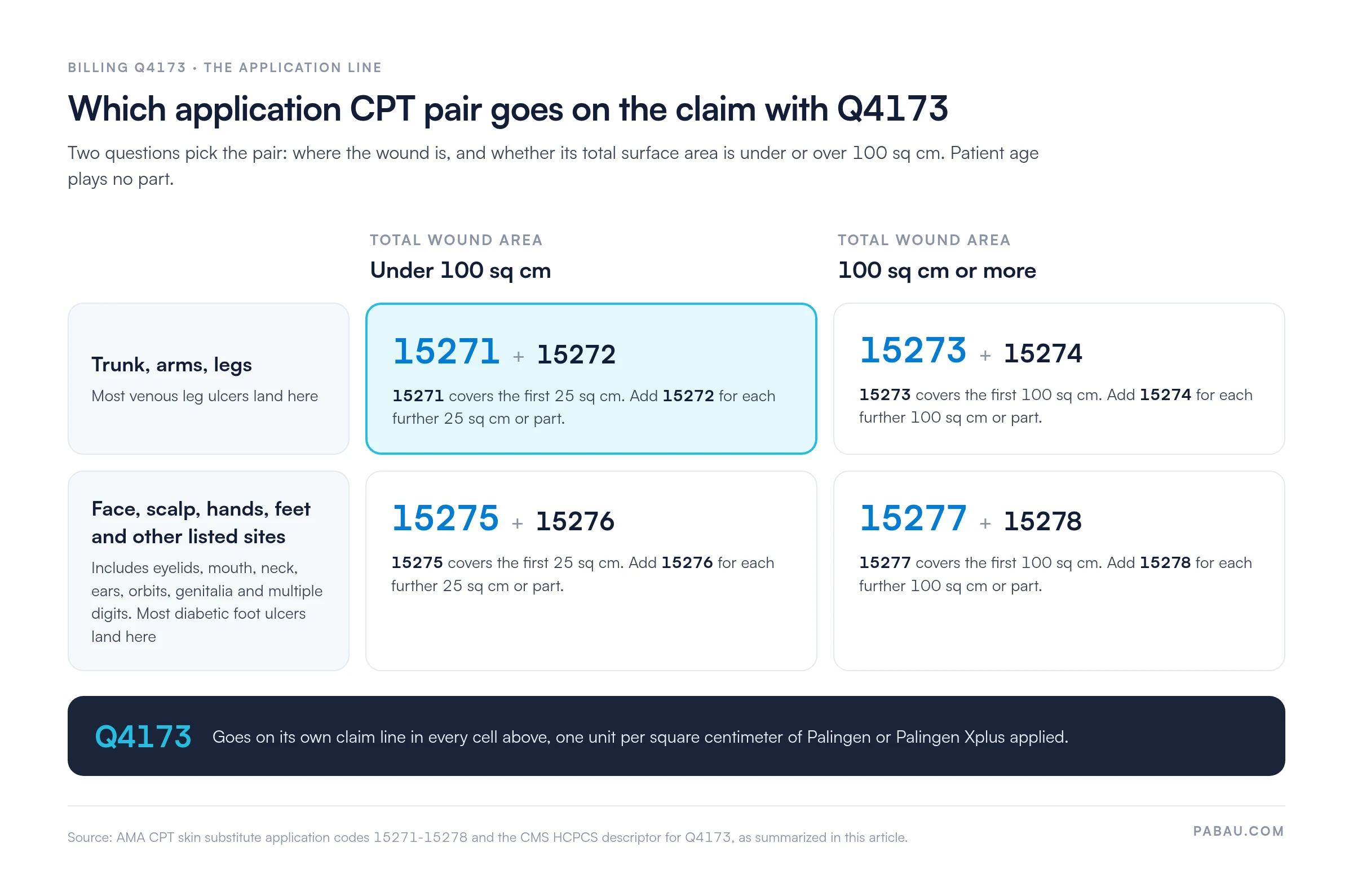
Report the CPT code and Q4173 on separate lines of one claim. Medicare does not bundle the supply into the application code.
Confirm NCCI edit pairs every quarter, because CMS updates them and bundling can change.
For dates of service from January 1, 2026, Medicare pays Q4173 as an incident-to supply rather than as a separately priced biological. Palingen is regulated as a 361 HCT/P, so it takes the single skin substitute rate in the CY 2026 physician fee schedule final rule. That rate is roughly $127 per square centimeter before geographic adjustment.
ASP-based pricing now applies only to products licensed under a biologics license application (BLA). Confirm Q4173’s 2026 payment status in the CMS HCPCS file and the CMS Physician Fee Schedule search before you bill.
Key reimbursement concepts for Q4173 claims:
Coverage for Q4173 under Medicare Part B is governed by MAC Local Coverage Determinations (LCDs). There is no single national Medicare LCD for all skin substitutes. Instead, each MAC publishes its own LCD, which sets the medical necessity criteria for the region it serves. Major MACs with active skin substitute LCDs include Novitas Solutions, CGS Administrators, Palmetto GBA, NGS Medicare, First Coast Service Options, and WPS Government Health Administrators.
Although LCD criteria vary by MAC, the following requirements appear consistently across jurisdictions:
A diabetic foot ulcer, for example, is reported with E11.621 plus an L97 code for the ulcer’s site and severity.
Coverage criteria for commercial payers are set separately and may differ materially from Medicare’s LCD requirements. Always verify the specific payer’s wound care policy before billing Q4173 to a commercial plan.
Traditional Medicare Part B runs no universal prior authorization program for Q4173. Requirements still vary by MAC and payer type, so check each one.
When prior authorization is obtained, retain the authorization number and attach it to the claim. Missing or expired authorization numbers are a leading cause of post-payment audits for skin substitute claims.
Documentation failures account for a significant share of Q4173 claim denials. Maintaining medical billing compliance for skin substitute claims means building a documentation checklist into the clinical workflow, not the billing workflow. By the time the claim is built, the documentation window has closed.
Required elements for every Q4173 claim:
A clean claim submission for Q4173 means every one of these elements is present before the claim leaves the practice. Post-submission attempts to retrieve missing wound measurements from memory are rarely successful in an audit.
Q4173 claims face a predictable set of denial patterns. Each has a denial reason code, a root cause, and a corrective action. Understanding denial management workflows before claims are built prevents most of these from reaching the payer at all.
Reviewing your denial codes in medical billing systematically, by code rather than by encounter, reveals patterns that a claim-by-claim review misses. Practices billing Q4173 regularly should run a denial code frequency report at least monthly.
Run a quarterly denial code audit specific to your Q4100-series claims. CO-50 and CO-16 denials that cluster on one provider or one wound type usually trace back to how the clinical note is written. Fix the note template first, and those denials drop with it.
The Q4100 series assigns a separate code to each skin substitute product. Q4173 sits among dozens of similar codes, and the difference between them is the specific product they describe. Billing the wrong code is the single most avoidable denial in this category. The table below shows Q4173 alongside its nearest neighbors.
Most mix-ups happen inside the Palingen family. Q4174 reports Palingen or ProMatrX by volume, so a Palingen graft billed by area belongs on Q4173. Outside that family, a Woundex or Bioskin graft goes on code Q4163, not on either Palingen code.
The safest workflow starts at the point of care. Pull the product’s National Drug Code (NDC) from the label. Then check it against the current HCPCS Level II code set or the CMS HCPCS release files. Never select a Q-code from memory or from a saved template that may carry a prior-year code assignment.
A Q4173 claim stands or falls on details recorded at the bedside: the wound measurements, the product, the lot number and the square centimeters applied. In many wound care practices, those details sit in a procedure note while the claim gets built later in a separate billing tool.
Pabau, a practice management platform with built-in claims management software, keeps both on one patient record. The treatment note holds the measurements, and stock tracking records the graft’s batch number and expiry against the patient and the appointment.
US claims go out through Claim.MD as CMS-1500/837P submissions, with eligibility checks before the visit and ERA remittances posted back to the account. Your biller works from the same record the clinician signed. A unit count that doesn’t match the documented wound area is then easier to catch before submission.

Pabau keeps wound measurements, graft lot numbers and the claim on one patient record. US practices submit through Claim.MD and see remittances post back to the same account.

Q4173 is one of the easier skin substitute codes to get right, because its product identity is narrow. The money is lost around it. A unit count drifts from the documented wound area, the wrong application pair goes out, or a template still runs on pre-2026 pricing.
Before your next skin substitute claim, retire any template that adds JW or JZ or appends KX by default. Retire any that still prices the code from an ASP or contractor file, too. Then make the wound measurement and lot number part of the application note itself, where an auditor will look first.
Book a demo to see how Pabau keeps the wound note, the graft lot and the Q4173 claim on one patient record.

Need a framework for reducing claim rejections practice-wide? Denial management in healthcare covers the end-to-end workflow for tracking, appealing, and preventing claim rejections across code types.
Want to understand what makes a claim clean before it reaches the payer? Clean claim submission breaks down every element payers check on first pass and how to pass that check every time.
Looking for a compliance audit checklist for your billing team? Medical billing compliance outlines the documentation standards, audit triggers, and corrective action steps practices need in place.
Treating a wound of 100 sq cm or more? CPT 15273 covers the larger trunk, arm and leg applications and how its add-on is counted.
Billing the application on a face, hand or foot wound? CPT 15277 explains the large-wound code for those special sites.
HCPCS Code Q4173 covers Palingen or Palingen Xplus, a skin substitute applied to qualifying chronic wounds such as diabetic foot ulcers and venous leg ulcers. It is billed per square centimeter. The application procedure itself is reported separately with CPT codes 15271-15278.
Q4173 is billed per square centimeter. Multiply wound length by wound width (both in centimeters) at the time of application. The result, rounded to the nearest whole number, is the number of units entered on the claim line. Document the measurements in the clinical record on the date of application.
Medicare covers Q4173 when the wound meets the criteria in your MAC’s LCD. Coverage requires documented wound chronicity, failed conservative care, wound measurements at application and a signed physician order. Confirm Q4173’s 2026 payment status in the CMS HCPCS and PFS files before billing.
Record the wound measurements in cm on the application date, plus the wound diagnosis with its ICD-10-CM code. Add the wound duration and the prior conservative care record. Add the signed physician order, the procedure note and the product label or NDC. Use KX only where the MAC’s LCD requires it, and leave JW and JZ off 2026 claims.





