

CPT code 48152: Whipple procedure without pancreatojejunostomy
CPT code 48152: Official description and procedure overview CPT code 48152 descr...

Last Updated: Nov 13, 2026
Q4153 is the HCPCS Level II code for Dermavest and Plurivest skin substitute, billed per square centimeter of product applied. CMS lists it as an add-on code, reported alongside the CPT application code for the wound (15271-15278).
The Q41xx series is product-specific, so Q4153 applies only to Dermavest and Plurivest. From January 1, 2026, Medicare pays it as an incident-to supply at one national rate of $127.14 per square centimeter.
Let Pabau's smart automation suggest the right codes, reduce claim denials, and keep your practice compliant—effortlessly.
Automate repetitive tasks and focus on what matters most—your patients.
Reduce coding errors and ensure compliance with the latest regulations.
Clean claims, fewer denials, and faster reimbursements.
Powerful insights and reporting to help your practice thrive.
HIPAA compliant SOC 2 certified GDPR-compliant Trusted by 4,000+ clinics worldwide

HCPCS Code Q4153 reports Dermavest and Plurivest skin substitute per square centimeter, so confirm the product name in the current CMS quarterly file before billing.
Units equal the square centimeters of product applied to the wound, and incorrect unit reporting is a frequent denial trigger for skin substitute Q-codes.
From January 1, 2026, Medicare pays Q4153 as an incident-to supply at $127.14 per sq cm in the office, hospital outpatient and ASC settings.
Coverage still follows MAC Local Coverage Determinations, and the CMS WISeR model adds pre-payment review for skin substitutes in six states.
Pabau, our practice management platform, supports insurance billing and claims management, with US claims sent through Claim.MD.
HCPCS Code Q4153 is the Level II code for Dermavest and Plurivest skin substitute, reported per square centimeter of product applied. CMS’s October 2026 HCPCS file gives the full descriptor as “Dermavest and plurivest, per square centimeter (add-on, list separately in addition to primary procedure).”
Codes in the Q41xx range are product-specific, so each one maps to one named product. Q4144 works the same way, with one code for one product. CMS can revise a descriptor in any quarterly update, so check the current file before you submit a claim.
Payment changed on January 1, 2026. The CY2026 Physician Fee Schedule and OPPS final rules pay skin substitutes such as Q4153 as incident-to supplies.
One national rate of $127.14 per square centimeter now applies in the physician office, the hospital outpatient department and the ambulatory surgical center (ASC). Products licensed as biologics stay on average sales price (ASP) payment and sit outside this flat rate.
Q4153 is reported when Dermavest or Plurivest is applied to a qualifying wound under the applicable MAC Local Coverage Determination (LCD). Coverage is not universal. LCDs specify eligible wound types, the minimum period of standard care before a skin substitute, and the conservative treatment that must come first.
Q4153 reports the product, not the procedure. The application is billed separately with CPT codes 15271-15278, which split by wound site and surface area. For example, 15271 covers the first 25 sq cm or less on the trunk, arms or legs.
Wound types that LCDs commonly list as eligible for skin substitute coverage include:
The supporting ICD-10-CM diagnosis code must match the wound type exactly. A diabetic foot ulcer, for example, pairs E11.621 with an L97.4- or L97.5- code for the ulcer’s site and depth. A Q4153 claim paired with an unspecified or non-qualifying diagnosis is a near-certain denial. Check the LCD’s list of covered diagnoses before the claim date, not after.
Several wound types and clinical scenarios fall outside Medicare’s covered indications for Q4153. Billing the code in these situations results in medical necessity denials that are difficult to overturn on appeal.
Q4153 is billed in units of one square centimeter each. Measure the wound at the time of application, calculate the total area, and bill the matching number of units. Round per CMS guidance: Fractional sq cm values are typically rounded to the nearest whole unit unless a MAC-specific LCD states otherwise.
Always cross-check the applying-vs-ordering distinction with your MAC. Some LCDs specify that units should reflect the size of product applied to the wound, not the size of the piece cut from the graft. Overbilling units is an audit risk; underbilling loses legitimate revenue.
The clinical record must demonstrate medical necessity from the first visit through each application. A claim with strong units and correct modifiers will still deny if the supporting documentation does not satisfy the MAC LCD. Maintaining medical billing compliance starts with what the clinician documents at the bedside, not what the biller enters on the claim form.
Run a documentation audit before billing: pull the claim, the note, and your MAC’s LCD side by side. If a required element is absent from the note, hold the claim and obtain an addendum from the clinician before submission. Post-submission corrections are harder to defend on appeal.
Medicare’s coverage framework for Q4153 operates at the MAC jurisdiction level. There is no single national coverage determination for most skin substitute Q-codes. Each MAC issues its own LCD, which sets medical necessity criteria, frequency limits and documentation requirements. Traditional Medicare and Medicare Advantage plans can apply different rules, so check the specific plan’s policy for MA enrollees.
Pabau supports insurance billing through its claims management software, with US claims sent through Claim.MD.
Since January 1, 2026, traditional Medicare pays Q4153 as an incident-to supply at one national rate of $127.14 per square centimeter. The same rate applies under the Physician Fee Schedule, the OPPS and the ASC payment system, although the fee schedule adjusts it by locality. The CPT application code is paid separately from the product.
Retrieve the current figures from the CMS Physician Fee Schedule search tool before you quote a rate to a patient or post a charge.
Traditional Medicare now reviews skin substitutes before payment in six states. The CMS WISeR model started on January 1, 2026. Skin and tissue substitutes are among its selected services in Arizona, New Jersey, Ohio, Oklahoma, Texas and Washington.
Providers there either request prior authorization or accept a medical review before payment. Check the CMS WISeR page for the services active in your state.
Outside those states, traditional Medicare has no universal prior authorization rule for Q4153. Many Medicare Advantage plans and commercial payers do require it, and some MACs publish extra requirements for high-cost CTPs in their billing articles.
When prior authorization is required, the submission typically needs:
Medicare Advantage plans must now issue standard decisions within 7 calendar days and expedited decisions within 72 hours. Document the authorization number on the claim and retain the approval letter in the patient file. When the plan required an authorization, a claim submitted without its number is denied on administrative grounds. Appeals rarely succeed without proof of the prior authorization.
The Q41xx series assigns one HCPCS code per skin substitute product. Because the products share similar clinical applications, miscoding between adjacent codes is a common and costly error. The table below shows the codes most often confused with Q4153 and the product each one reports, as listed in the CMS HCPCS file.
Use the code that matches the manufacturer and product name in the current CMS HCPCS Alpha-Numeric file. Billing Q4153 for a product assigned to Q4152 is an incorrect-code error, and it cannot be appealed on medical necessity grounds. Use the CMS HCPCS coding system quarterly files to recheck every product-to-code assignment after each update.
Most Q4153 denials are preventable. Robust denial management workflows catch these errors before submission rather than on appeal. The table below maps the most frequent reasons to their denial codes and the corrective action for each.
Prevention beats appeals. Build a pre-submission checklist that flags a missing KX modifier and units that do not match the documented wound area. It should also flag any ICD-10 code missing from the LCD’s covered list. The five checks below put that list in the order a claim moves through it.
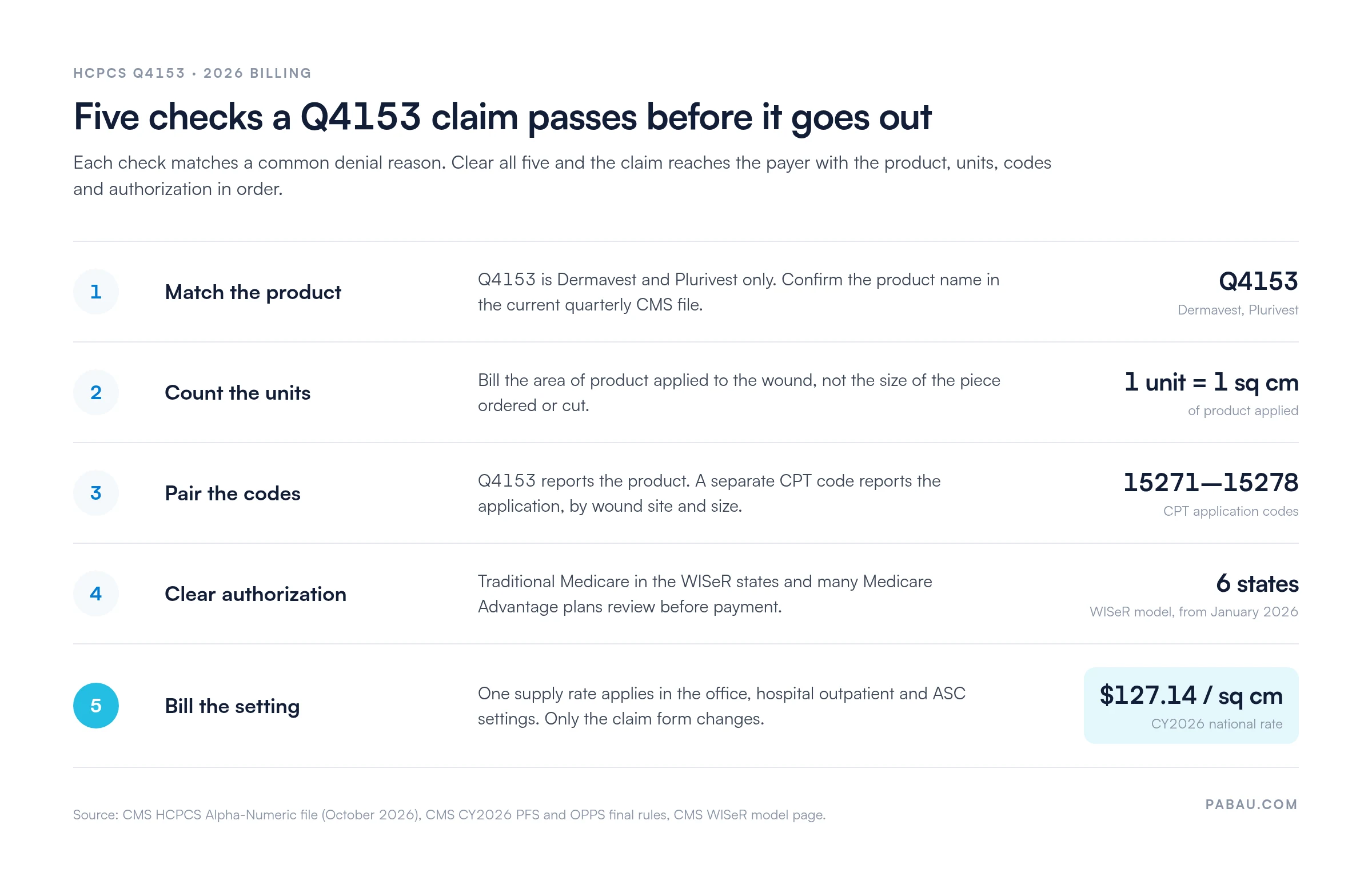
Ensuring every claim is a clean claim before it leaves the practice removes the most common Q4153 denial categories before they reach the payer.
Set a quarterly calendar reminder to download the new CMS HCPCS Alpha-Numeric file when CMS publishes it (typically January, April, July, and October). Check whether Q4153’s product assignment has changed before billing any claims in the new quarter. A product reassigned to a different code mid-year is a systematic miscoding risk if no one is monitoring the updates.
Billing Q4153 often means working across three places: the wound note, a spreadsheet of authorizations, and a separate billing tool. Each hand-copied unit count or authorization number is a chance for one of the denials above.
Pabau keeps those steps on one patient record. The prior authorization code, its dates and its sessions sit on the patient’s case, and Pabau warns the team when an authorization is missing. When the product is tracked as stock, its lot number and expiry date are recorded against the patient and the appointment.
US claims go out through Claim.MD as CMS-1500/837P claims, with eligibility checks, ERA remittances and secondary claims in the same workflow. Your Q4153 claims leave the practice with the authorization and product details already attached, so fewer come back for rework.

Pabau tracks prior authorizations on the patient’s case and sends US claims through Claim.MD, so your Q4153 claims leave with the details payers check.

For 2026 dates of service, the payment side of Q4153 is simpler than it has been. One national rate per square centimeter replaces the old setting-by-setting math, so revenue now turns on the product match, the units and the authorization.
Start with the two checks that changed this year. Confirm whether your state sits in the WISeR model, and make sure every Q4153 line travels with its 15271-15278 application code. Then audit units against the documented wound area, because a unit count the note does not support will not survive review.
Pabau supports insurance billing and claims management, with US claims sent through Claim.MD. Book a demo to see how Pabau keeps authorizations and skin substitute claims on one patient record.

Need to understand how clearinghouses process HCPCS claims? Medical claims clearinghouse guide explains how payers receive and adjudicate HCPCS and CPT claims electronically.
Want a step-by-step guide to reducing claim rejections? Revenue cycle management overview covers the full claim lifecycle from patient registration to payment posting.
Looking for guidance on electronic remittance and ERA files? Electronic remittance advice explained details how to read ERA files and interpret CARC denial codes from payers.
Applying a skin substitute to a large wound? CPT code 15273 billing guide covers the application code for the first 100 sq cm on the trunk, arms or legs.
Billing a different placental skin substitute? HCPCS code Q4154 guide walks through Biovance billing, its Medicare rate and its common denials.
HCPCS Code Q4153 is the Level II code for Dermavest and Plurivest skin substitute, reported per square centimeter when it is applied to qualifying wounds. Those include diabetic foot ulcers, venous leg ulcers and pressure injuries. Coverage requires the wound to meet the medical necessity criteria in the applicable MAC Local Coverage Determination. Those criteria include prior conservative care and a supported ICD-10-CM diagnosis.
Q4153 is billed in units of one square centimeter each, based on the area of product applied to the wound at the time of service. Bill the units that match the wound measurement documented in the clinical note, not the size of the product ordered or dispensed. Fractional sq cm values are typically rounded per CMS guidance or the applicable MAC LCD.
It depends on the payer and the state. The CMS WISeR model, which started on January 1, 2026, reviews skin substitutes before payment in Arizona, New Jersey, Ohio, Oklahoma, Texas and Washington. Elsewhere, traditional Medicare has no universal prior authorization rule for Q4153, but many Medicare Advantage plans and commercial payers do. Verify the payer’s rules before the date of service and record the authorization number on the claim.
The most frequent reasons are medical necessity not established, an incorrect unit count and a diagnosis code missing from the LCD’s covered list. A missing KX modifier and the wrong Q-code for the product applied round out the list. Most of these are preventable with a pre-submission checklist aligned to your MAC’s current LCD.
Each Q41xx code maps to one named product in the quarterly CMS HCPCS Alpha-Numeric file. Q4153 differs from Q4151, Q4152 and Q4154 only by the product it describes. Using the wrong Q-code for the product applied is an incorrect-code error. It cannot be appealed on medical necessity grounds and must be corrected by resubmitting with the right code.
Yes. Q4153 can be billed in a physician office (POS 11), outpatient hospital (POS 22) or ambulatory surgical center (POS 24). From 2026, the same national supply rate of $127.14 per sq cm applies in all three settings. Office claims use the CMS-1500, while outpatient hospital claims use the UB-04. Use the place-of-service code for where the application took place.



