CCSD Code T7790: Excision of benign soft tissue tumour
CCSD Code T7790: Definition and procedure scope CCSD Code T7790 is defined in th...

Last Updated: Nov 20, 2026
Q4174 is the HCPCS Level II code for palingen or promatrx, 0.36 mg per 0.25 cc. It reports liquid, flowable products such as PalinGen Flow and ProMatrX ACF, not graft sheets.
One unit equals 0.25 cc of product, containing 0.36 mg. The per-square-centimeter PalinGen code is Q4173, so check the product name and form on the invoice before choosing between them.
Let Pabau's smart automation suggest the right codes, reduce claim denials, and keep your practice compliant—effortlessly.
Automate repetitive tasks and focus on what matters most—your patients.
Reduce coding errors and ensure compliance with the latest regulations.
Clean claims, fewer denials, and faster reimbursements.
Powerful insights and reporting to help your practice thrive.
HIPAA compliant SOC 2 certified GDPR-compliant Trusted by 4,000+ clinics worldwide

HCPCS code Q4174 reports PalinGen or ProMatrX liquid products, billed per 0.25 cc (0.36 mg), not per square centimeter.
The per-square-centimeter PalinGen code is Q4173, so the product form on the invoice decides which code applies.
Report discarded product on a separate Q4174 line with modifier JW, or append JZ when none was wasted.
Medicare coverage depends on your MAC’s LCD, and prior authorization applies only to selected services in the six WISeR model states.
Pabau, a practice management platform, sends US insurance claims through Claim.MD and keeps authorization codes on the patient’s insurance case.
HCPCS Code Q4174 is the HCPCS Level II code that reports PalinGen or ProMatrX liquid products. CMS maintains the HCPCS Level II code set. Its quarterly HCPCS file gives the official descriptor: Palingen or promatrx, 0.36 mg per 0.25 cc. One unit is 0.25 cc of product, which contains 0.36 mg.
The products billed under Q4174 are cryopreserved liquids, PalinGen Flow and ProMatrX ACF, not graft sheets. That is why the unit is a volume rather than a surface area. PalinGen sheet products are billed under Q4173, which is reported per square centimeter. Confirm the product name and form on the invoice before you choose a code, as product lines change through acquisitions and reformulations.
A Q4174 claim usually carries two kinds of lines: the Q4174 line for the product and a procedure line for the clinician’s work. The descriptor names a volume, not an application method, so it does not point to one procedure code. Choose the procedure code from how the product was administered, then check it against your MAC’s policy. Solid medical billing fundamentals make that check routine.
The skin substitute application series runs from CPT 15271 to 15278, sized by wound surface area. These codes were written for sheet grafts, and Q4174’s descriptor does not require them. Before you pair Q4174 with one of them, confirm with CMS or your MAC that the code fits how the liquid was applied. For reference, the series is grouped like this.
HCPCS Code Q4174 is billed per 0.25 cc of PalinGen or ProMatrX, not per square centimeter of wound. Divide the volume administered by 0.25 to get the unit count. If the clinician administers 0.75 cc, bill 3 units.
Worked example: A clinician opens a container holding 1 cc of PalinGen Flow, administers 0.75 cc and discards 0.25 cc. Bill Q4174 × 3 units on the first line. Bill Q4174-JW × 1 unit on a second line for the discarded 0.25 cc. The 1 cc container is illustrative, so always read the volume from the product label. The walkthrough below puts the code choice, the unit count and the waste line in order.
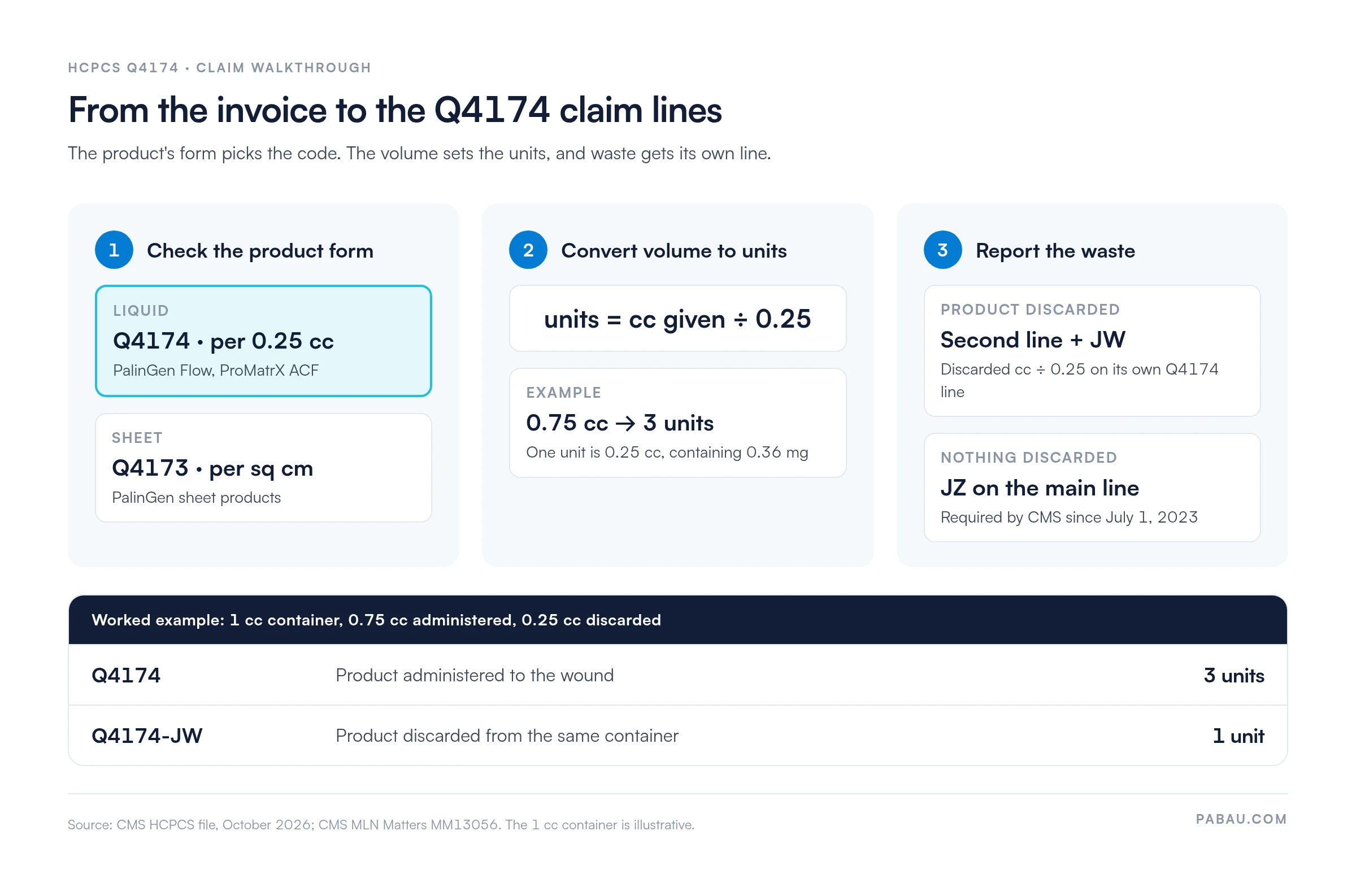
Modifier errors are a common failure point on Q4174 claims. CMS has required the JZ modifier since July 1, 2023, under Change Request 13056 (MLN Matters MM13056). JW reports any discarded amount. Confirm your MAC’s modifier policy before submitting, as some contractors have extra requirements.
Product identity and form, not clinical similarity, decide which Q-code applies. Q4174 covers PalinGen and ProMatrX liquids only. PalinGen sheets go to Q4173, so the same brand name sits under two codes with different units. An amniotic membrane allograft sheet sits under a separate code again, such as code Q4168, billed per square centimeter. The table below shows the codes most often confused with Q4174.
The practical rule: take the product name and form from the invoice and check them against the current CMS HCPCS code file before billing. The code follows the product, not the wound type, and our HCPCS code library covers the neighboring skin substitute Q-codes. Sheet products among them, such as HCPCS code Q4163, are reported per square centimeter. A liquid billed under Q4173, or a sheet billed under Q4174, leaves units on the claim that cannot match the chart.
Before submitting a Q4174 claim, check the product name and form on the invoice against the current CMS HCPCS quarterly file. Product lines change through acquisitions and reformulations. A product billed under the wrong code is denied, and the error often surfaces only at remittance.
Coverage for HCPCS Code Q4174 is governed by Local Coverage Determinations issued by Medicare Administrative Contractors, not by a single national coverage rule. The applicable LCD varies by MAC jurisdiction. Noridian, Novitas, CGS and Palmetto GBA each publish their own skin substitute policy, and the criteria differ.
LCDs apply to Medicare only, and commercial payers set their own policies. Always verify the LCD in effect for your MAC before billing, as criteria change. LCD coverage criteria for skin substitute products typically require all of the following.
Original Medicare does not require prior authorization for Q4174 nationwide. The CMS WISeR model requires it for selected Part B services in six pilot states: Arizona, New Jersey, Ohio, Oklahoma, Texas and Washington. Within the model, skin substitutes are covered only where an active LCD exists.
Confirm the model’s current scope and service list with CMS or your MAC before scheduling, as it can change. The points below cover where prior authorization applies and what to send.
Incomplete charts are a frequent cause of HCPCS Code Q4174 denials. The chart must tell the same story as the claim. Use this checklist against every encounter before submitting, drawing on your practice’s medical billing compliance protocols.
Payment rates for HCPCS Code Q4174 differ by place of service and are updated on a quarterly or annual basis. CMS does not set a single fixed rate for this code across all settings. The rate you receive depends on where the procedure is performed. Always verify the current rate in the official CMS fee schedule files before quoting or budgeting reimbursement.
Use the CMS Physician Fee Schedule Look-Up Tool to retrieve current MPFS rates for Q4174 by locality. For OPPS rates, download the current quarter’s CMS Addendum B. Each unit is 0.25 cc. The product line therefore scales with the volume administered, not with wound size.
Medicare changed skin substitute payment for 2026. Under the CY 2026 Physician Fee Schedule final rule, most products without an FDA biologics license are paid as incident-to supplies from January 1, 2026. CMS set that payment per square centimeter, while Q4174 is reported per 0.25 cc. Check the current CMS fee schedule files and your MAC for how Q4174 is priced this year.
Q4174 claims sit where three audit triggers meet: LCD medical necessity criteria, unit and modifier accuracy and, in the WISeR states, prior authorization. The denial management strategies that work for other wound care Q-codes apply here. Q4174 also has a few patterns of its own.
When a Q4174 claim is denied on medical necessity or LCD grounds, the Medicare appeals process offers a structured path to recovery. Each level has its own deadline and evidence.
Log Q4174 denials by reason code. CO-50 (not deemed a medical necessity) and CO-197 (precertification or authorization absent) need different workflows. A CO-50 denial with strong documentation is an appeal candidate, while a CO-197 denial is usually fixed upstream. Sorting them first keeps billers off appeals with little chance of success.
In many practices, wound care claims live in one tool and authorizations in another. A Q4174 claim then goes out without anyone checking the authorization or the payer on the same screen.
Pabau keeps both on the patient record. Pabau’s claims management sends US insurance claims through Claim.MD and tracks them through to remittance. Authorization codes sit on the patient’s insurance case, so the biller sees them before submitting. The result is fewer claims leaving with a missing authorization or the wrong payer.

Pabau sends US insurance claims through Claim.MD and keeps authorization codes on the patient’s insurance case. Billers check both before a Q4174 claim goes out.

Most Q4174 problems trace back to one mistake: treating a liquid product like a sheet graft. Count units in 0.25 cc, put discarded product on its own JW line, and keep Q4173 for PalinGen sheets billed per square centimeter. Then confirm the procedure code, coverage and any prior authorization with your MAC before the claim goes out.
Pabau keeps the claim and the authorization on the same patient record, with US claims sent through Claim.MD. To see how that works in a wound care billing workflow, book a demo with the team.

Need to understand how claims move through the clearinghouse? Revenue cycle management fundamentals covers the full claim lifecycle from patient encounter to payment posting.
Seeing recurring denials across your wound care claims? Denial codes in medical billing explains what each denial code means and how to respond.
Looking for the supporting documentation framework? Superbill guide for practices walks through how to structure charge capture to support complex HCPCS claims.
HCPCS code Q4174 reports PalinGen or ProMatrX liquid products, such as PalinGen Flow and ProMatrX ACF, used in wound care. It is billed per 0.25 cc, which contains 0.36 mg of product. The procedure code billed with it depends on how the product is applied and on payer policy, so verify it with CMS or your MAC.
Q4174 covers PalinGen and ProMatrX liquid products only, billed per 0.25 cc. PalinGen sheet products go to Q4173, which is billed per square centimeter. Using Q4174 for any other skin substitute product is a coding error and leads to denial.
Not nationwide. Original Medicare requires prior authorization for selected Part B services only in the six WISeR model states: Arizona, New Jersey, Ohio, Oklahoma, Texas and Washington. Elsewhere, check your MAC’s rules, and check each commercial plan separately.
Append modifier JZ when no product was discarded. CMS has required it since July 1, 2023. When product is discarded, report the discarded units on a separate Q4174 line with modifier JW, at the usual charge. Modifiers 59, RT and LT may apply when your MAC’s policy requires them.
Q4174 covers PalinGen and ProMatrX liquids, billed per 0.25 cc. Q4175 covers Miroderm, a porcine liver-derived wound matrix billed per square centimeter. The codes are not interchangeable, because the product decides the code, not the wound type.
Covered diagnosis codes vary by MAC LCD. Common examples are E11.621 (type 2 diabetes mellitus with foot ulcer) and E10.621 (type 1 diabetes mellitus with foot ulcer). Venous ulcers fall in category I83.0- (varicose veins of lower extremity with ulcer), with an L97.- code for the ulcer site. Verify the list in your MAC’s current LCD.