CPT code 21011: Excision of soft tissue tumor of the face
CPT code 21011: Official descriptor and procedure overview CPT code 21011, as pu...

Last Updated: Oct 8, 2026
Q4102 is the HCPCS Level II code for oasis wound matrix, per square centimeter (add-on, list separately in addition to primary procedure).
Medicare pays a single national rate of $127.14 per square centimeter in 2026, then adjusts it for your locality. Coverage still runs through your Medicare Administrative Contractor's Local Coverage Determination. The unit count comes straight from the wound measurement recorded in the clinical note.
Let Pabau's smart automation suggest the right codes, reduce claim denials, and keep your practice compliant—effortlessly.
Automate repetitive tasks and focus on what matters most—your patients.
Reduce coding errors and ensure compliance with the latest regulations.
Clean claims, fewer denials, and faster reimbursements.
Powerful insights and reporting to help your practice thrive.
HIPAA compliant SOC 2 certified GDPR-compliant Trusted by 4,000+ clinics worldwide

HCPCS Code Q4102 covers Oasis wound matrix, per square centimeter, a porcine-derived skin substitute used on chronic wounds.
Q4102 is an add-on code, so it must be reported with a primary application code such as 97597, 97598, or 15271-15278.
Medicare pays a single national rate of $127.14 per square centimeter in 2026, then applies the GPCI adjustment for your locality.
Coverage sits with your MAC’s Local Coverage Determination, so check the current policy in the CMS coverage database before you bill.
Practice management software like Pabau helps wound care practices track Q4102 units, pair add-on codes, and reduce skin substitute denials.
Q4102 is an HCPCS Level II supply code maintained by the Centers for Medicare and Medicaid Services (CMS). It covers Oasis wound matrix, per square centimeter, for use in wound care procedures. The code sits within the Q4100 series of skin substitute supply codes.
According to CMS’s HCPCS overview, HCPCS Level II codes like Q4102 are maintained annually by CMS. They cover supplies, equipment, and products not classified under CPT’s five-digit numeric system.
Oasis wound matrix is a skin substitute manufactured by Smith and Nephew. It is derived from porcine small intestinal submucosa (SIS), a naturally occurring extracellular matrix. That matrix provides structural scaffolding to support tissue regeneration in chronic wounds.
The product works by integrating with the wound bed and promoting cell migration and new tissue formation. A synthetic dressing only covers a wound. This one leaves behind a biological scaffold that the body can remodel.
Coverage for wound types is defined in applicable MAC Local Coverage Determinations. Do not assume coverage based on wound type alone. Verify your specific MAC’s LCD before billing.
Q4102 is an add-on code. It cannot be submitted alone. Every claim for HCPCS Code Q4102 must include a primary wound application procedure code on the same claim.
The primary application codes reported alongside Q4102 fall into two categories. Which one applies depends on whether wound debridement or surgical preparation was performed. Confirm pairing rules against your specific MAC’s LCD, since coverage policy governs which primary codes are accepted.
Q4102 is billed per square centimeter. Measure the wound at its longest length and widest width, multiply those two measurements, and round to the nearest whole centimeter. That figure becomes the unit count on the claim.
Documentation must capture the following at the time of service. A missing field is the most common reason a Q4102 claim is flagged during a pre-payment review. Record these details in the clinical note itself, not in a separate billing memo.
Practices using claims management software can build wound care templates that capture these fields at intake. The note is then complete before the charge is entered, so billing does not stall while someone chases a measurement.
Build a wound measurement macro into your clinical note template. Fields for length, width, and the calculated square centimeter total should populate the note. The same figures then pre-fill the Q4102 unit count on the claim. A mismatch between the note and the claim is the fastest route to a skin substitute denial.
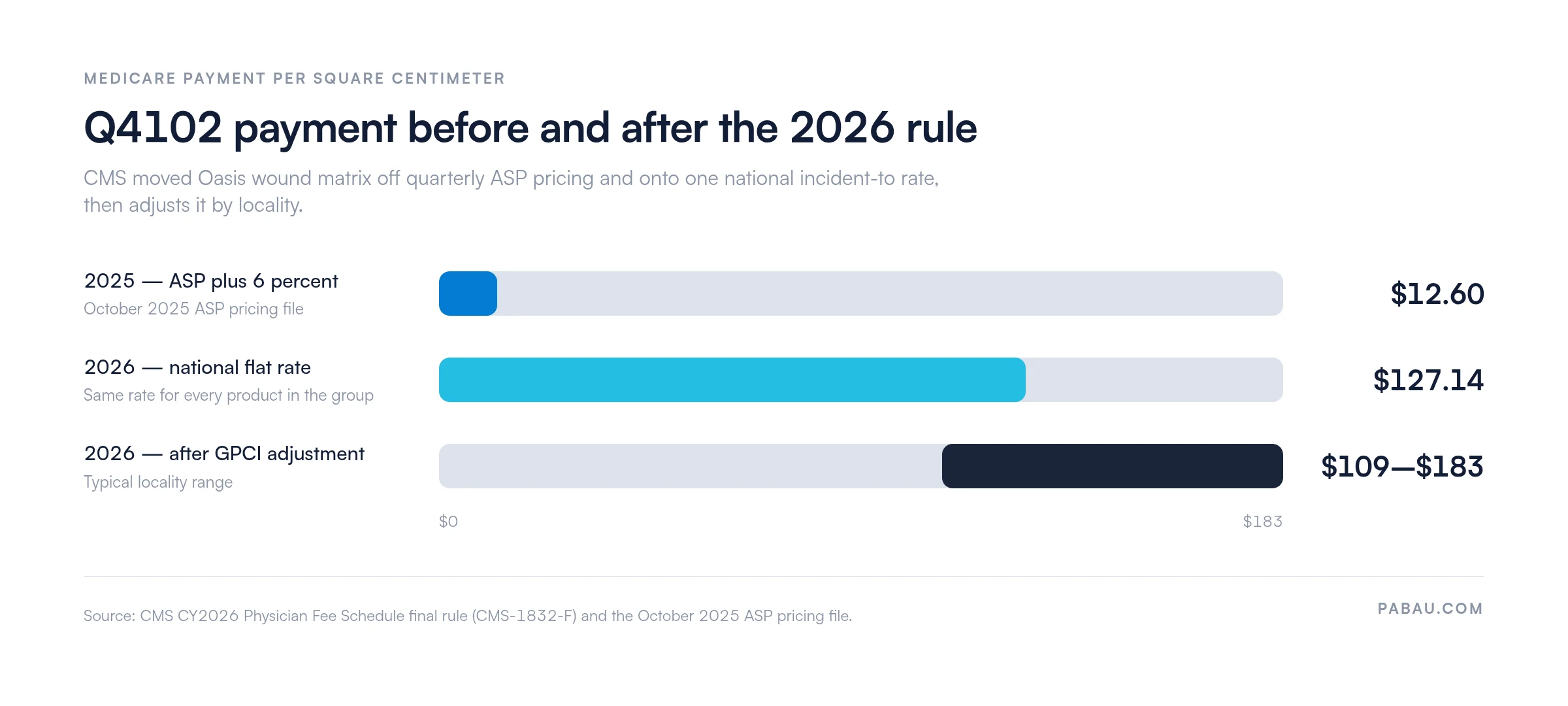
Medicare pays HCPCS Code Q4102 at a single national rate of $127.14 per square centimeter as of January 1, 2026. The code is no longer paid independently. CMS treats Oasis wound matrix as an incident-to supply, tied to the application procedure you report with it.
The change comes from the CY2026 Physician Fee Schedule final rule (CMS-1832-F), and CMS confirmed the $127.14 figure in a technical correction. In the non-facility setting, the supply payment attaches to the application procedure, usually CPT 15271-15278. Report both codes on the same claim.
CMS then applies the standard geographic practice cost index (GPCI) adjustment to that national rate. After adjustment, most localities land somewhere between roughly $109 and $183 per square centimeter. MACs process these claims, but they do not set the rate. CMS sets it through national rulemaking.
Units are still counted per square centimeter of product applied. A wound measuring 5 cm x 4 cm generates 20 billable units of Q4102. More product applied means more units and a higher supply payment. Accurate wound measurement therefore still drives what the claim pays.
Before 2026, Q4102 was priced from the quarterly ASP drug pricing file at ASP plus 6 percent. That came to roughly $12.60 per square centimeter in the October 2025 file. Historical remittances will not match 2026 payments, so do not use them as a benchmark. The size of the shift is easier to read side by side.
Medicare coverage for HCPCS Code Q4102 is not automatic. It is governed by Local Coverage Determinations published by each Medicare Administrative Contractor. Criteria differ by jurisdiction, and several older skin substitute LCDs have since been retired or superseded.
Do not work from a policy number quoted in a billing guide, including this one. Look up your own contractor’s current LCD in the CMS Medicare Coverage Database before you bill. Coverage criteria for wound types, wound duration thresholds, and documentation are set locally, not nationally.
Search the coverage database by contractor name to find the policy that applies to you. Do not rely on a neighboring MAC’s LCD to decide your own coverage criteria, because policies differ across jurisdictions.
Q4102 and Q4103 are both Smith and Nephew Oasis products, and both are HCPCS Level II skin substitute supply codes. They are not interchangeable. Using the wrong code for a wound type will produce a denial. That is a write-off risk for any practice treating both wound and burn patients.
Applying Q4102 to a burn patient claim, or Q4103 to a chronic wound claim, will produce a coverage denial. The indication does not match the approved use documented in the applicable LCD. Always confirm which product was physically applied and code accordingly.
The Q4100 series covers a wide range of skin substitute products. Billers working across several product lines need to tell the codes apart, since payers cross-reference the code against the product applied. Our full HCPCS codes library carries the descriptor and add-on status for each one.
For a broader reference of skin substitute billing codes, AAPC’s HCPCS Level II code lookup lists descriptors and effective dates across the full Q4100 series. Cross-referencing the product applied against the code is non-negotiable for clean claim submission.
Medicare coverage gets most of the attention in skin substitute billing guides. Commercial payer policy for HCPCS Code Q4102 is less standardized and changes more often, which is why it catches practices off guard.
Run an eligibility and benefits check before each Q4102 application appointment. Many commercial plans publish their own clinical coverage policies, and those policies differ from Medicare LCDs on wound criteria and on prior authorization.
Tell patients in financial counseling that coverage varies by plan, and that you verify it before each application. Never promise reimbursement because another patient’s plan approved the same product.
Skin substitute denials are preventable in most cases. The errors below account for the majority of Q4102 rejections across wound care practices. Applying denial management discipline to add-on supply codes reduces write-offs and administrative rework.
Review Q4102 remittances in batches rather than claim by claim. A single coder error can produce five denials in a week. That pattern surfaces at once when denial reasons sit alongside the claim data. Worked claim by claim, it stays hidden.
A charge sheet that pre-populates Q4102 next to its required primary codes helps too. It makes the add-on relationship visible at the moment of manual charge entry, which is where the pairing is usually lost.
Run a monthly audit of Q4102 claims against remittance data. Filter for denials whose reason codes point to a missing primary code or a unit error. Those two categories account for the majority of skin substitute rejections. Most can be fixed with a resubmission if you catch them inside the timely filing window.
In most wound care practices the Q4102 unit count is calculated twice. A clinician measures the wound and writes it in the note, then a biller reads the note and re-enters the arithmetic on the claim. Every denial for an incorrect unit count starts at that second step.
Pabau is practice management software for medical and aesthetic practices. Its wound care note template carries the length and width fields, calculates the square centimeter total, and passes that number to the charge. The biller checks a figure instead of producing one.
The same record holds the wound type, the chronicity, the failed conventional care, and the primary application code. When a MAC asks for LCD documentation, the evidence sits on the encounter. Nobody has to gather it from a note, a photo folder, and a billing memo.

Pabau helps wound care practices pair add-on codes correctly, track square centimeter units, and submit clean Q4102 claims with complete documentation. See how our claims workflows reduce skin substitute denials.

A Q4102 claim survives on three variables: its primary code, its unit count, and the LCD your MAC enforces. All three are settled at the point of care, not at billing. Get them right there and the claim rarely comes back.
The 2026 flat rate raises what each of those variables is worth. A unit is no longer a few dollars of supply cost, so a carelessly rounded measurement now costs the practice money. Rebuild your revenue projections on the current figure and re-check your MAC’s LCD before the next treatment course.
Book a demo to see how Pabau captures wound measurements, pairs add-on codes, and keeps Q4102 documentation ready for a pre-payment review.

Need to understand how denial codes translate to reimbursement action? Denial codes in medical billing walks through the most common remittance advice codes and how to respond to each.
Want to verify patient coverage before applying a skin substitute? Insurance eligibility verification covers how to run real-time checks and document auth numbers before the appointment.
Looking for a broader framework for wound care revenue cycle management? What is revenue cycle management explains the end-to-end billing workflow from charge capture through payment posting.
New to the mechanics behind the claim form? What is medical billing sets out how a charge becomes a submitted claim and then a payment.
Building the charge sheet this article recommends? Superbill explains what belongs on one and how to keep add-on codes paired with their primaries.
HCPCS Code Q4102 is used to bill for Oasis wound matrix, a porcine-derived skin substitute. It is applied to chronic, non-healing wounds such as venous leg ulcers, diabetic foot ulcers, and pressure injuries. It is reported per square centimeter, and it must always be submitted alongside a primary wound application procedure code.
Yes. Q4102 is an add-on code and cannot be reported as a standalone claim. It must be paired with a primary application procedure code. That is usually 97597, 97598, or a code from the 15271-15278 series, depending on the wound site and setting.
Medicare pays Q4102 at a single national rate of $127.14 per square centimeter in 2026. The standard GPCI factors then adjust that rate for your geographic area. The payment is an incident-to supply tied to the application procedure, so the Q code is not paid separately. MACs do not set this rate.
Yes. Medicare coverage for Q4102 is governed by Local Coverage Determinations issued by each MAC jurisdiction. LCD criteria typically require documentation of wound type, wound chronicity, and evidence that standard wound care has failed. Look up your own contractor’s current LCD in the CMS Medicare Coverage Database, because requirements vary by jurisdiction.
Q4102 covers Oasis Wound Matrix, indicated for chronic non-healing wounds, while Q4103 covers Oasis Burn Matrix, indicated for partial-thickness burns. Both are porcine-derived and billed per square centimeter, but they are not interchangeable. Applying Q4103 to a non-burn wound claim, or Q4102 to a burn claim, will result in a coverage denial.
Q4102 is paired with debridement codes 97597 and 97598 for active wound debridement. For graft application procedures, it pairs with codes 15271 through 15278. The correct primary code depends on the procedure performed and the wound site. Verify pairing rules against your MAC’s LCD before submitting.