HCPCS Code Q4175: Billing, coverage, and documentation guide
HCPCS Code Q4175: Code Description and Product Identity HCPCS Code Q4175 is the ...

Last Updated: Nov 20, 2026
Q4136 is the HCPCS Level II code for E-Z Derm, billed per square centimeter as an add-on to the primary skin substitute application procedure. E-Z Derm is a porcine xenograft made from processed pig skin, with no human amniotic or placental tissue.
That difference matters on the claim. You report Q4136 in square centimeter units alongside CPT 15271-15278, chosen by wound site and size, and never on its own. The October 2026 CMS HCPCS file lists the code as active.
Let Pabau's smart automation suggest the right codes, reduce claim denials, and keep your practice compliant—effortlessly.
Automate repetitive tasks and focus on what matters most—your patients.
Reduce coding errors and ensure compliance with the latest regulations.
Clean claims, fewer denials, and faster reimbursements.
Powerful insights and reporting to help your practice thrive.
HIPAA compliant SOC 2 certified GDPR-compliant Trusted by 4,000+ clinics worldwide

HCPCS code Q4136 reports E-Z Derm, a porcine xenograft skin substitute, per square centimeter. It contains no human amniotic tissue.
It’s an add-on code, so it only pays when the CPT 15271-15278 application code sits on the same claim.
The application code depends on the wound’s site and size, with thresholds at 25 sq cm and 100 sq cm.
For CY2026, Medicare pays most skin substitutes as incident-to supplies at one national rate of $127.14 per sq cm.
The October 2026 CMS HCPCS file lists Q4136 as active, with no termination date.
HCPCS code Q4136 is the Level II code for E-Z Derm, billed per square centimeter as an add-on to the skin substitute application procedure.
The official descriptor reads “Ez-derm, per square centimeter (add-on, list separately in addition to primary procedure)”. The CMS quarterly HCPCS update for October 2026 still lists it as active. CMS added the code on January 1, 2013, and the file carries no termination date.
Q4136 sits among amniotic membrane products in the Q4100 range, and that’s where claims go wrong. E-Z Derm is made from pig skin. A note that calls it an amniotic allograft won’t match the code on the claim, and auditors notice.
One more point on that last row. The PDAC contractor reviews coding for some supplies, but it doesn’t create Level II codes. CMS assigns them through its HCPCS application cycle.
E-Z Derm is processed porcine dermis used as a biological wound covering. It contains no human tissue, so terms like “amniotic”, “placental” or “allograft” don’t belong in a Q4136 note. Check the manufacturer’s instructions for use for its cleared indications.
Each Q41xx code belongs to one named product, so the right code is whichever product went on the wound. These are the neighbors most often confused with Q4136.
Older forum threads sometimes show E-Z Derm billed under Q4100. That route closed when Q4100 ended, and Q4136 has been the product’s own code since 2013 anyway.
With the product settled, the claim itself is a short chain. Each link depends on the one before it, so a gap early on shows up as a denial later.
Step three takes the most care, because the CPT family splits two ways. One axis is the body site, and the other is the total wound size.
The add-on CPT codes count each additional block “or part thereof”, so a partial block still earns a unit. For infants and children, the 100 sq cm codes also use 1% of body area.
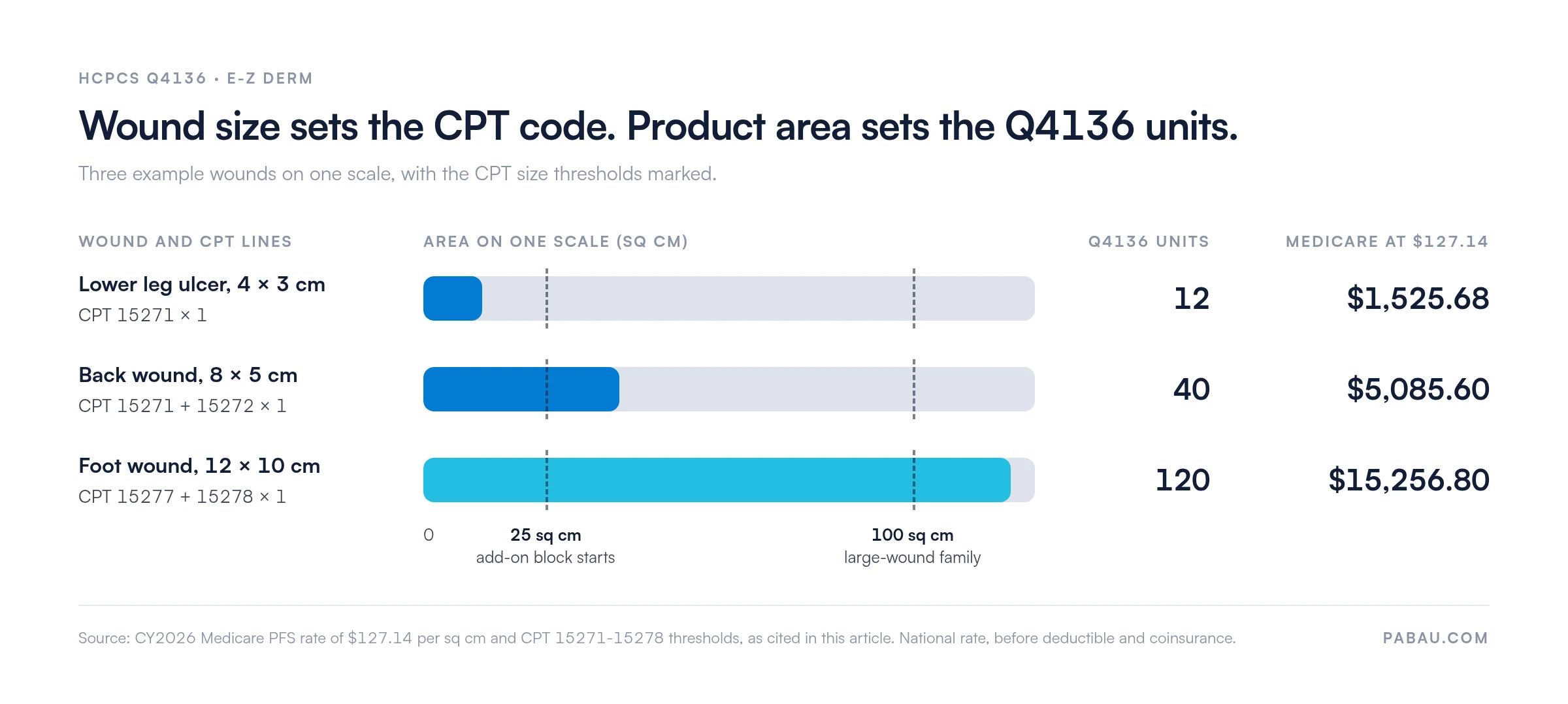
Here are three wounds, each coded from its site and its measured area.
Notice the split. The CPT code follows the wound’s surface area, while Q4136 units follow the product. If you open a larger sheet than the wound needs, follow your MAC’s instructions for reporting discarded product rather than guessing.
Payment changed sharply this year. Under the CY2026 Physician Fee Schedule, Medicare pays most skin substitutes as incident-to supplies at a single national rate of $127.14 per sq cm. CMS first announced $127.28, then corrected it to $127.14 in a technical correction.
That flat rate replaced the old ASP plus 6% method, where each product carried its own price. CMS now groups products by FDA pathway: 361 HCT/P, PMA or 510(k). E-Z Derm is understood to be a 510(k)-cleared product, so confirm its listing in CMS’s “Skin Substitute Products by FDA Regulatory Category” file.
For the 4 x 3 cm example, 12 units at $127.14 comes to $1,525.68 before deductible and coinsurance. The 40 sq cm back wound comes to $5,085.60, and the 120 sq cm foot wound to $15,256.80. Laid on one scale, the three examples show where each CPT threshold falls.
The application code is paid separately. Hospital outpatient claims follow the OPPS rules instead, and commercial rates depend on each contract.
A valid code doesn’t guarantee payment. Medicare coverage comes from your MAC’s local coverage determination and billing article, and the criteria vary by MAC. Typical LCD criteria look like this:
Prior authorization works differently by payer. Many commercial and Medicare Advantage plans want it before the first application, so check at scheduling. Traditional Medicare also runs the WISeR model, a prior authorization pilot in six states from 2026 to 2031. The pilot covers skin and tissue substitutes only where a state and MAC are in scope. Check the CMS WISeR model page for your state.
Run through these before the claim leaves the practice. Each one maps to a common denial.
Billing compliance for skin substitutes comes down to this list. The record has to tell the same story as the claim.
Most Q4136 problems are predictable. These are the ones worth fixing first.
When a denial does land, read the claim adjustment reason code on the remittance first. Our guide to medical denial codes explains what each one means. A medical necessity denial needs a different appeal from a bundling denial, and denial management works best when you track which one keeps coming back.
In many practices, the wound note lives in one system and the claim gets built in another. The lot number sits on a sticker, and the authorization number sits in an email. That’s how units drift away from measurements.
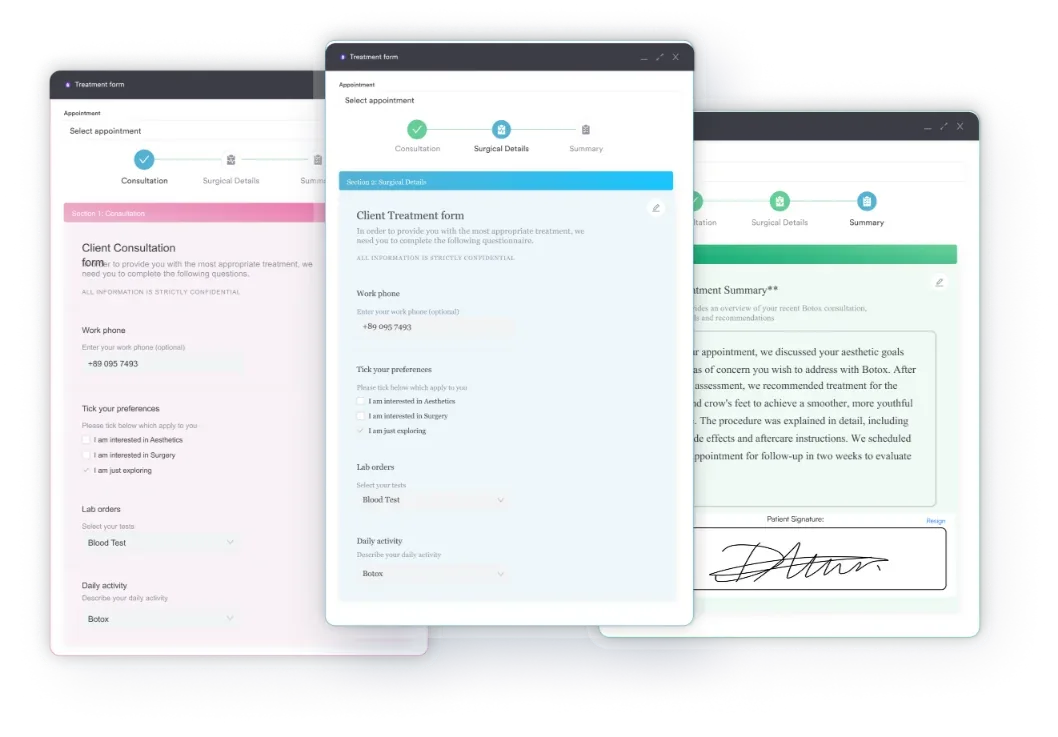
Pabau, a practice management and billing platform, keeps those pieces on one patient record. You can build a wound care form with required fields for lot number and expiration date, so the note can’t be saved without them. The prior authorization code, dates and sessions sit on the patient’s case, with a warning when one is missing.
From there, Pabau’s claims management sends electronic claims, checks eligibility and posts electronic remittances. In the US it runs through Claim.MD. When an ERA comes back with fewer Q4136 units than you billed, you see it against the original claim instead of in a spreadsheet.

Pabau keeps wound forms, prior authorization details and electronic claims on one patient record. Your Q4136 units and measurements stay in step from note to remittance.

Q4136 is a simple code once you see it plainly. It’s pig skin, billed by the square centimeter, and it rides on a CPT application code. Most denials come from losing one of those three facts somewhere between the treatment room and the claim.
If you change one habit, make it the note. When it names E-Z Derm, measures the wound and carries the lot number, the claim almost codes itself. With Medicare now paying a flat rate, the margin for rework is thinner than it was.
Book a demo to see how Pabau keeps wound documentation, prior authorization details and skin substitute claims on one record.

Billing the application procedure that Q4136 rides on? CPT code 15271 covers the first 25 sq cm on the trunk, arms or legs.
Working with an amniotic product instead? HCPCS code Q4138 covers BioDFence DryFlex, a dehydrated human amniotic membrane.
Still seeing old Q4100 claims? HCPCS code Q4100 explains the unlisted skin substitute code that ended in 2025.
Need a framework for reducing claim rejections? Denial management in healthcare covers how practices track, appeal and prevent recurring denials.
Want the full revenue cycle behind skin substitute billing? Revenue cycle management explained outlines the process from eligibility checks to payment posting.
Yes. The descriptor says to list it separately in addition to the primary procedure. That primary procedure is a skin substitute application code from CPT 15271-15278.
Not without an application code. Q4136 needs a code from CPT 15271-15278 on the same claim. CPT 15271 fits only a trunk, arm or leg wound under 25 sq cm, so match the code to the site and size.
E-Z Derm is a porcine xenograft, made from processed pig skin. It contains no human amniotic or placental tissue. Mölnlycke Health Care markets it, and it is understood to be an FDA 510(k)-cleared product.
For CY2026, Medicare pays most skin substitutes as incident-to supplies at $127.14 per sq cm under the Physician Fee Schedule. That national figure is before deductible and coinsurance. Hospital outpatient and commercial payment follow their own rules.
Yes. The October 2026 CMS HCPCS file lists Q4136 with no termination date. Some older references call it terminated, so check the latest quarterly file before you rely on any code.