CPT code 93503: Swan-Ganz catheter billing and modifiers
CPT code 93503: Official descriptor and procedure overview In the AMA CPT code s...

Last Updated: Oct 23, 2026
L1851 is the HCPCS Level II code for a prefabricated, off-the-shelf knee orthosis with a single upright spanning thigh and calf. It has an adjustable flexion and extension joint, unicentric or polycentric, plus medial-lateral and rotation control, with or without varus/valgus adjustment.
The supplier dispenses it with only minimal self-adjustment. When an individual with expertise customizes the same brace to the patient, it bills as L1843 instead. Diagnosis does not separate the two codes, because LCD L33318 applies the same coverage criteria to both. Medicare also requires PDAC verification and an affirmed prior authorization for L1851.
Let Pabau's smart automation suggest the right codes, reduce claim denials, and keep your practice compliant—effortlessly.
Automate repetitive tasks and focus on what matters most—your patients.
Reduce coding errors and ensure compliance with the latest regulations.
Clean claims, fewer denials, and faster reimbursements.
Powerful insights and reporting to help your practice thrive.
HIPAA compliant SOC 2 certified GDPR-compliant Trusted by 4,000+ clinics worldwide

HCPCS code L1851 describes an off-the-shelf knee orthosis with a single upright, an adjustable joint, and medial-lateral and rotation control. L1843 is the same brace when an expert customizes it to the patient.
Medicare coverage under LCD L33318 requires an ambulatory patient with objectively documented knee instability and a PDAC-verified product. The same criteria apply to L1843, so diagnosis never decides between the two codes.
Common CERT error sources include missing physician orders, absent medical necessity documentation, and billing off-the-shelf L1851 for a custom-fitted device, or the reverse.
Pabau’s claims management software checks each claim for missing details, such as authorization codes, before it goes out and tracks its status in one dashboard.
HCPCS code L1851 is the billing code for a knee orthosis, single upright with adjustable joint, prefabricated, off-the-shelf. Every word in that descriptor matters for code selection. Changing any element moves the claim to a different code, such as adding a second upright, switching to a non-adjustable hinge, or custom-fitting the brace.
The table below breaks down each descriptor element and its clinical meaning.
Suppliers must confirm the dispensed product meets all five elements before billing L1851. A double-upright brace with medial-lateral control does not qualify for this code, however the manufacturer markets it. It bills as L1852 or L1845.
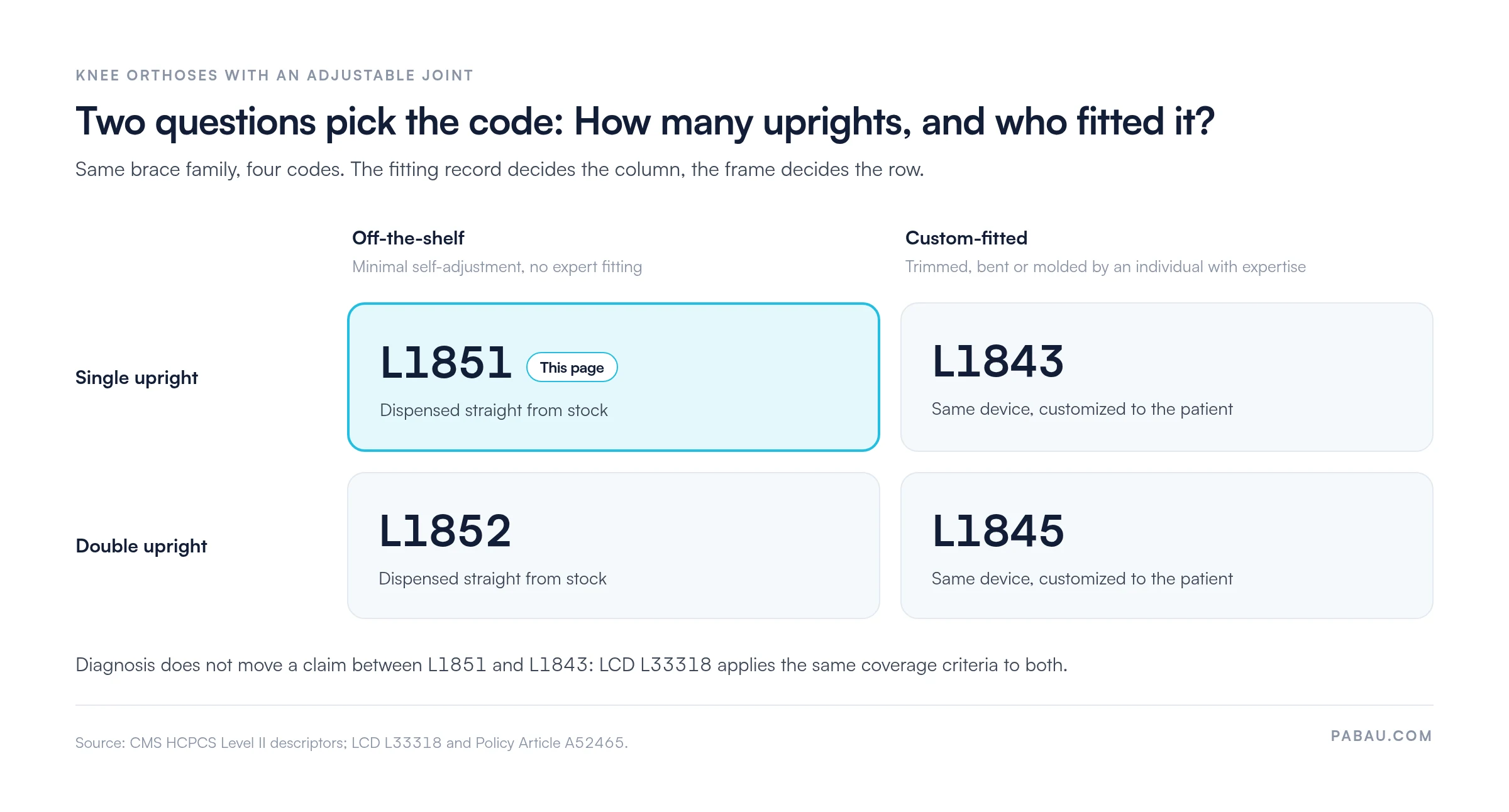
L1851 and L1843 describe the same single-upright knee orthosis, with an adjustable joint and medial-lateral and rotation control. What separates them is fitting. HCPCS code L1851 applies when the brace is dispensed off the shelf with only minimal self-adjustment. L1843 applies when an individual with expertise trims, bends, molds, assembles or otherwise customizes the prefabricated brace to fit that patient.
Neither descriptor mentions osteoarthritis or condylar pads. LCD L33318 and Policy Article A52465 apply the same coverage criteria to both codes, so the choice between them is never a diagnosis question.
Billing L1843 for a brace handed over straight from stock is upcoding, because the custom-fitted code pays for fitting work that did not happen. Billing L1851 after an orthotist substantially modified the brace leaves the claim at odds with the fitting record. Many brace models are PDAC-coded for both codes, so the product alone does not settle the choice. The documented fitting does.
Selecting the right knee orthosis HCPCS code requires mapping the dispensed device against the full L18xx series. The table below covers the codes most commonly encountered alongside HCPCS code L1851.
The upright braces form a simple grid. Single-upright braces bill as L1851 off the shelf or L1843 custom-fitted, and double-upright braces bill as L1852 or L1845. L1832 and L1833 describe positional orthoses with rigid support rather than upright designs. A Swedish-type knee orthosis sits outside this grid and bills as HCPCS code L1850, covered only for knee instability from genu recurvatum. Verify the physical device and its PDAC listing before code selection.
Medicare coverage for HCPCS code L1851 follows CMS’s HCPCS Level II coding system. For knee orthoses specifically, it is governed by LCD L33318, administered by the Durable Medical Equipment Medicare Administrative Contractors (DME MACs). Suppliers, and practices that dispense braces in-office, must confirm patient eligibility against each of the criteria below before dispensing.
LCD L33318 is maintained by the DME MACs. CGS Administrators runs Jurisdictions B and C, and Noridian runs Jurisdictions A and D. The LCD is subject to revision. Always verify its effective date and version in the CMS Medicare Coverage Database before citing specific criteria in compliance documentation.
Pull Policy Article A52465 alongside LCD L33318. The policy article lists the ICD-10 codes that support medical necessity, and CMS revises it on its own schedule. A compliance review that checks only the LCD can miss a change to the accepted diagnosis list.
PDAC verification means the Pricing, Data Analysis and Coding contractor has reviewed a specific brace model. It confirms the model meets the descriptor elements of a given HCPCS code. For HCPCS code L1851, Medicare treats PDAC verification as a billing requirement. A claim for a brace with no L1851 PDAC listing is denied as incorrect coding.
Many brace models carry PDAC verification for both L1843 and L1851. For those products, the code follows how the brace was fitted, not which code pays more. Billing L1843 without documented custom fitting by an individual with expertise is a false claims risk.
Insufficient documentation is a leading cause of CERT errors on DMEPOS claims, knee orthoses included. Consistent with medical billing compliance standards, every L1851 claim file must contain the following elements before submission.
CMS’s CERT program reviews knee orthosis claims for these elements, starting with the physician order and the medical necessity notes. Maintaining a pre-dispensing checklist aligned to these requirements reduces the risk of post-payment audit recoupment.
HCPCS code L1851 is on the CMS Required Prior Authorization List for DMEPOS items. Prior authorization applies nationwide for dates of service from 10/10/2022. Submit the request to your DME MAC and receive an affirmed decision before you dispense the brace. Medicare Advantage plans set their own rules, so check them through your insurance eligibility verification process.
Medicare’s prior authorization framework keeps expanding. Verify requirements against current CMS guidance before each dispensing cycle rather than assuming last year’s policy still applies.
Medicare CERT findings and claim denials on knee orthoses trace back to a short list of errors. An effective denial management workflow for L1851 starts with knowing where these failures occur before the claim reaches the payer. Learning to read denial codes quickly also stops the same error from repeating on the next claim.
Automated claims management with pre-submission checks catches missing details before the claim reaches the DME MAC. Each item above can also become a line on a pre-dispensing and pre-submission checklist.
Knee orthoses fall into three fabrication tiers, and each tier carries its own codes and its own documentation burden. L1851 sits in the first tier: Prefabricated and dispensed off the shelf (OTS).
A common audit finding involves suppliers who make minor adjustments, such as strap repositioning, to an off-the-shelf brace and then bill L1843. Medicare counts a fit as custom only when an individual with expertise substantially modifies the brace for that patient. Adjusting straps or choosing a standard size does not qualify. When in doubt, the code should match the documented fitting work, not the supplier’s characterization.
Billing HCPCS code L1851 requires familiarity with modifier requirements and claim submission rules specific to the DMEPOS benefit. A clean claim submission for L1851 carries the NU modifier for a new purchase and the correct place of service. It also carries the KX modifier where the LCD criteria are documented. Check your DME MAC’s supplier manual for the current modifier list and usage rules.
The KX modifier is the most consequential for L1851. Appending KX certifies that the supplier has on file all documentation required by LCD L33318. Claims submitted without KX where coverage criteria apply are returned as unprocessable or denied. The supplier is liable for repayment if a post-payment audit finds the KX was appended without the supporting documentation.
A structured superbill documentation process that captures modifier rationale at the point of dispensing prevents modifier errors from reaching the claim form.
The ICD-10-CM codes accepted under LCD L33318 for knee orthosis claims are listed in Policy Article A52465, not in the LCD text itself. For HCPCS code L1851, acceptable diagnoses cover knee instability conditions. L1843 draws on the same diagnosis groups, so the ICD-10 code never decides between the two.
Always verify accepted ICD-10 codes against the current version of Policy Article A52465, which lists the approved codes explicitly. Billing with an ICD-10 code not on the list results in denial, however clinically valid the diagnosis.
Medicare reimburses HCPCS code L1851 as a purchase item under the DMEPOS fee schedule. The allowable amount varies by geographic location based on the competitive bidding program status of the supplier’s service area. Orthotic suppliers should check the fee schedule every year, because CMS updates DMEPOS payment amounts each January.
Use the PGM Billing HCPCS lookup tool to retrieve the current fee schedule allowable for L1851 by state. The source file is the CMS DMEPOS fee schedule, which CMS publishes quarterly. Check the figure there before quoting reimbursement amounts to patients or in compliance documentation.
Run a fee schedule verification at the start of each plan year. DMEPOS allowables for L-series orthosis codes reset on January 1. Billing staff who use last year’s allowable figures in ABN calculations may produce inaccurate patient liability estimates. Those errors lead to patient satisfaction issues and refund requests.
A practice that dispenses knee braces in-office often tracks each L1851 claim across a spreadsheet, a clearinghouse portal and the patient chart. The authorization number lives in one place and the PDAC printout in another, so claims go out with one of them missing.
Pabau, the practice management platform we build, keeps the claim next to the patient record it came from. The patient’s insurer and policy sit on that record, so the invoice routes to the right payer without re-keying. Before you send, Pabau checks that required details such as authorization codes are filled in.
In the US, claims go out electronically through Claim.MD, with real-time eligibility checks and ERA remittance posting in the same dashboard. Every claim shows as pending, submitted, processing, paid or error, so your billing team can work a stalled brace claim before it ages.

Pabau’s claims management checks each claim for missing details before it goes out and tracks its status in one dashboard. Your team spends less time reworking rejected brace claims.

HCPCS code L1851 is the off-the-shelf code, and how the brace was fitted decides most of the claim. If an expert customized the brace to the patient, the claim belongs under L1843. If it was dispensed with only minimal self-adjustment, it belongs under L1851. The diagnosis never makes that call.
Coverage then rests on documented knee instability under LCD L33318, a PDAC-verified product, an affirmed prior authorization, and the KX modifier. Missing any one of them produces a denial that takes far longer to appeal than to prevent.
Build your pre-dispensing checklist around those four items, and recheck it whenever LCD L33318 or Policy Article A52465 changes. Your system should hold the order, the PDAC record and the authorization beside the claim. Weigh that first when you compare medical billing software. Book a demo to see how Pabau keeps your knee orthosis claims, authorizations and invoices in one place.

Fitting the brace to the patient instead? L1843 covers the custom-fitted version of this single-upright knee orthosis and the fitting record it needs.
Need to understand denial patterns across your billing portfolio? Denial management in healthcare covers the systematic approach to tracking, categorizing, and resolving claim denials across payer types.
Looking for a structured claims submission reference? Clean claim submission explains every element of a technically complete claim that clears payer edits on first pass.
Want to strengthen your revenue cycle foundations? Revenue cycle management outlines the end-to-end billing cycle from patient eligibility through payment posting.
Billing original Medicare for the first time? Medicare billing walks through enrollment, claim submission and the rules that apply to Part B suppliers.
HCPCS code L1851 is used to bill a prefabricated knee orthosis with a single upright, adjustable joint, and medial-lateral control. Suppliers use it when dispensing an off-the-shelf brace that meets those structural criteria to Medicare beneficiaries with documented knee instability requiring orthotic support.
L1851 is the off-the-shelf code, and L1843 is the custom-fitted code for the same single-upright knee orthosis. L1843 applies when an individual with expertise trims, bends, molds or otherwise customizes the brace to the patient. Neither descriptor mentions osteoarthritis or condylar pads, and both codes share the coverage criteria in LCD L33318.
Yes, Medicare Part B covers knee braces billed under L1851 when the patient meets the LCD L33318 coverage criteria. The device must also be PDAC-verified for that code. The detailed written order, clinical notes, delivery confirmation and an affirmed prior authorization must also be on file before the claim is submitted.
Yes, PDAC verification is required for L1851 claims billed to Medicare. The specific brace model dispensed must appear in the PDAC product classification list with a confirmed L1851 designation. Billing a non-verified product results in automatic denial under Medicare DMEPOS policy.
The most common denial reasons are: A brace without PDAC verification for L1851, missing or post-dated physician orders, and no documented medical necessity. Others include billing L1851 for a custom-fitted device (or L1843 for an off-the-shelf one), a missing prior authorization, and a missing KX modifier.
LCD L33318, titled Knee Orthoses, governs Medicare coverage for HCPCS code L1851. It is administered by the four DME MACs and defines qualifying diagnoses, documentation requirements, and coverage limitations. The associated coverage article specifies the accepted ICD-10-CM codes and should be reviewed alongside the LCD itself.