HCPCS code V2300: Sphere trifocal lens billing guide
HCPCS code V2300 covers one sphere trifocal lens up to 4.00D HCPCS code V2300 is...

Last Updated: Oct 19, 2026
L1025 is the HCPCS Level II code for a floating kyphosis pad added to a cervical-thoracic-lumbar-sacral orthosis (CTLSO) or scoliosis orthosis. It is one of the L1010 to L1120 additions to the Milwaukee brace.
The pad is only payable when the base code L1000 is on the same claim. L1020 is the non-floating kyphosis pad, so the fitting note has to say which pad was fitted.
Let Pabau's smart automation suggest the right codes, reduce claim denials, and keep your practice compliant—effortlessly.
Automate repetitive tasks and focus on what matters most—your patients.
Reduce coding errors and ensure compliance with the latest regulations.
Clean claims, fewer denials, and faster reimbursements.
Powerful insights and reporting to help your practice thrive.
HIPAA compliant SOC 2 certified GDPR-compliant Trusted by 4,000+ clinics worldwide

HCPCS code L1025 bills a floating kyphosis pad added to a cervical-thoracic-lumbar-sacral orthosis (CTLSO), the Milwaukee-type scoliosis brace.
It is a spinal brace addition, not a knee orthosis. An elastic knee orthosis with joints is billed as L1810 or L1812.
L1025 is denied as not separately payable unless the base code L1000 is on the same claim.
The fixed kyphosis pad is L1020, so bill one code or the other for a given pad, never both.
No LCD covers the scoliosis range, so the KX modifier does not apply, and a midline brace takes no RT or LT modifier.
Practice software such as Pabau keeps the order, the fitting note and the delivery record on one patient file.
HCPCS code L1025 bills a floating kyphosis pad added to a cervical-thoracic-lumbar-sacral orthosis (CTLSO) or scoliosis orthosis. The official descriptor reads Addition to CTLSO or scoliosis orthosis, kyphosis pad, floating. It describes one component of a spinal brace, not a standalone device.
The code belongs to the L1010 to L1120 group of additions, inside the L1000 to L1120 scoliosis orthotic devices range. The Centers for Medicare and Medicaid Services (CMS) maintains the descriptor through the annual HCPCS update. Orthotists and DMEPOS suppliers bill it to the DME Medicare Administrative Contractor (MAC).
L1025 is the floating counterpart of L1020. Both kyphosis pads sit at the back of the brace, over the apex of a kyphotic curve, and push forward against it. The word floating is the only difference between the two descriptors.
The descriptor decides what can be billed alongside L1025. The table sets out the details a DMEPOS supplier needs before submitting the line.
Some coding references and templates describe L1025 as a knee orthosis. That description is wrong, and a claim built on it will not match the device. L1025 has no connection to the knee.
The knee wording belongs to another part of the L-series. L1810 reads KO, elastic with joints, prefabricated, customized to fit by an individual with expertise. L1812 is the off-the-shelf version of the same knee orthosis.
If the order describes a knee brace, check the code before the claim goes out. A knee orthosis billed as L1025 has no L1000 base beside it, so the line is denied as not separately payable.
A kyphosis pad is prescribed when a CTLSO has to control a sagittal curve, either alone or alongside a lateral curve. It concentrates pressure at the kyphotic apex, which the brace frame cannot do on its own.
Situations where L1025 is typically supplied with an L1000 brace include:
The HCPCS descriptor does not define what makes a pad floating. The orthotist’s fitting note should describe how the pad is mounted, because that note decides between L1020 and L1025.
The additions around L1025 describe different components on the same brace. These are the ones most often swapped on a claim.
Read the fitting note for the word floating before choosing the code. A floating pad is L1025 alone, and billing L1020 and L1025 for the same pad duplicates the component.
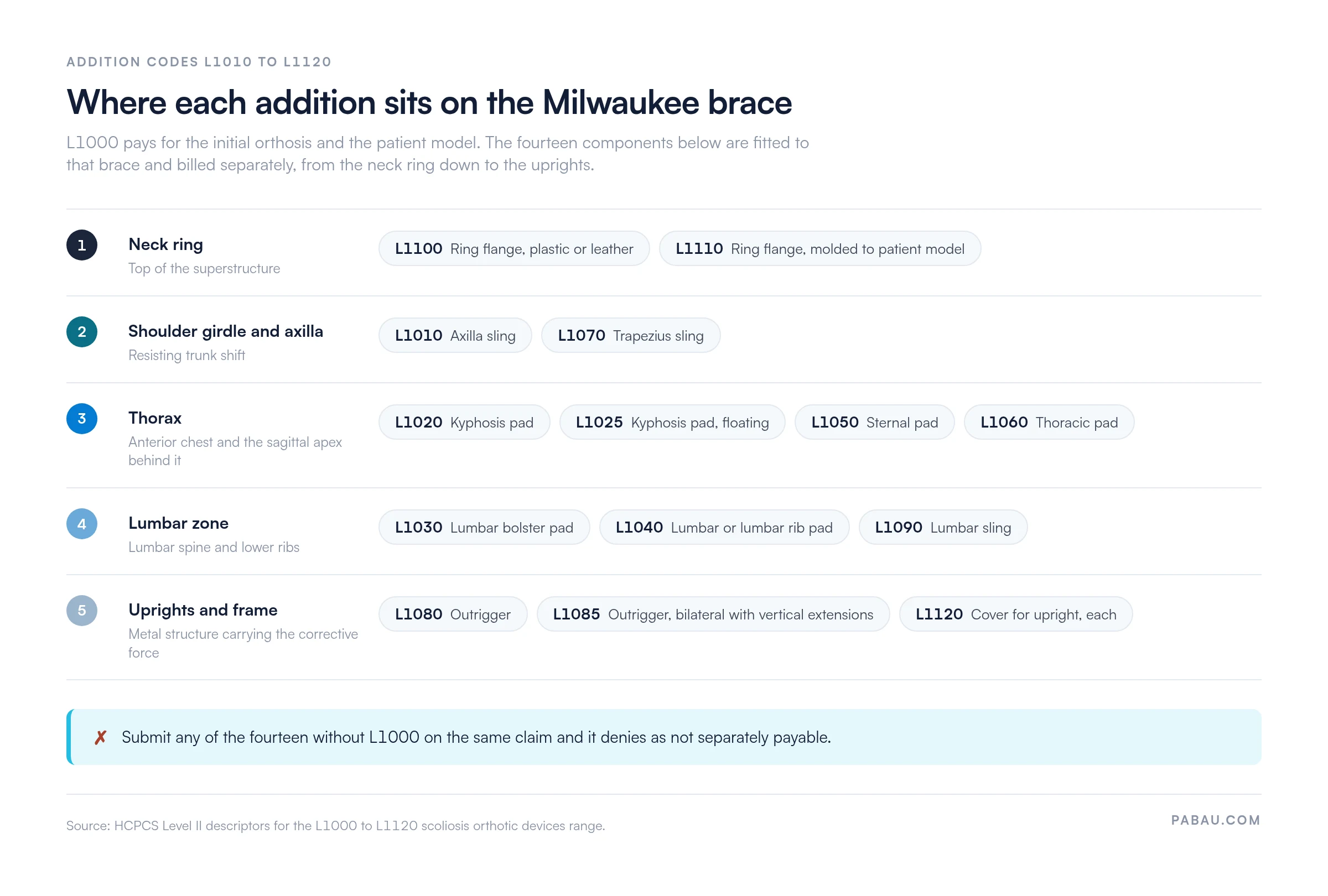
L1025 is only payable with a base brace that accepts additions. The DME MACs and the Pricing, Data Analysis and Coding (PDAC) contractor recognize seven scoliosis base codes, and only two of them take additions.
Billed without L1000 on the same claim, L1025 is denied as not separately payable. Our guide to HCPCS code L1000 covers the base brace and its allowance in full.
The three checks below run in the order a biller meets them: the base code, then the pad type, then the modifiers.
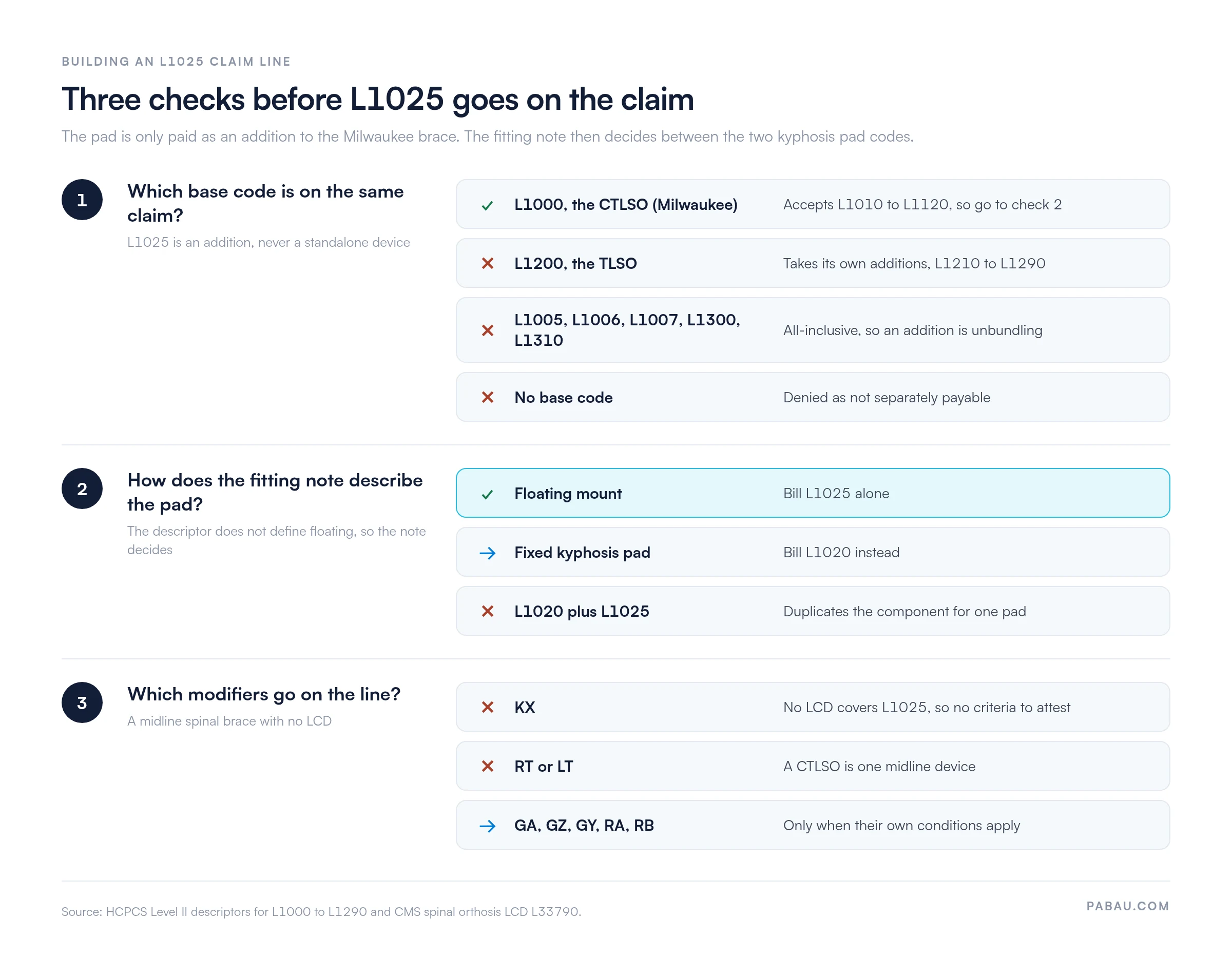
Build L1000 and its additions from the same fitting encounter. A claim-build setting that splits the base and the additions onto separate claims produces a run of not separately payable denials.
L1025 is covered under the brace benefit in section 1861(s)(9) of the Social Security Act. The DME MAC processes the claim, and the DMEPOS fee schedule sets the allowance.
No Local Coverage Determination governs L1025. The spinal orthosis LCD, LCD L33790, lists codes L0450 to L0651 only, so it does not reach the scoliosis range. The knee orthosis LCD does not apply either.
Without an LCD, the DME MAC reviews each claim against the general reasonable and necessary standard. So the claim file needs all of the following:
Medicare pays L1025 from the DMEPOS fee schedule, not the physician fee schedule. Allowances vary by state and CMS republishes them each January, so check the CMS DMEPOS fee schedule files before you submit.
Medicare pays 80% of the allowed amount once the Part B deductible is met. The patient or a secondary payer covers the 20% coinsurance. The L1025 allowance is paid on top of the L1000 allowance, never in place of it.
The descriptor carries no each qualifier, unlike the upright cover code L1120. Confirm unit reporting with your DME MAC before billing more than one unit of L1025 on a line.
Modifier habits from other orthosis claims are where L1025 lines go wrong. A clean L1025 line uses fewer modifiers than a knee, TLSO or ankle-foot orthosis claim.
Check for a stray RT or LT first. They usually arrive with a knee orthosis template, and on an L1025 line they signal the coding error described above.
The diagnosis on the claim has to match the sagittal deformity the record describes. Most L1025 claims draw on the M40 kyphosis range or the M42.0 range for Scheuermann kyphosis.
Code to the site the record documents. A category header such as M42.0 or M40.29 is not billable, so the site character has to be on the claim line. Knee diagnoses such as M17 osteoarthritis never support L1025.
No LCD sets out a checklist, so the medical record carries the whole case for payment. Assemble the file before the brace ships rather than after a denial.
A standard written order (SWO) has to be on file before the claim is submitted. Certificates of Medical Necessity and DME Information Forms were discontinued on January 1, 2023, so the order and the chart carry the burden. The SWO includes:
CMS also publishes a master list of DMEPOS items that may need a face-to-face encounter, a written order before delivery, or prior authorization. Check the current list before each new fitting cycle, because CMS revises it.
The order alone does not prove medical necessity. The treating practitioner’s record has to support it independently, and that record is what a MAC reviewer asks for.
Most L1025 denials come from how the claim was assembled. Catching them before the claim reaches the MAC costs far less than an appeal.
Medicare redeterminations are filed with the MAC within 120 days of the initial determination. A reconsideration follows with the Qualified Independent Contractor within 180 days. Send the order, the clinical notes, the imaging report and the fitting record with each level.
An L1025 claim fails when its pieces sit in different places. The order arrives by email, the Cobb angle sits in an imaging report, and the fitting note stays with the orthotist. The shortfall only shows up when the remittance advice arrives.
In Pabau’s practice software, those records live on one patient file. The order, the fitting note, the scan record and the signed delivery confirmation attach to the same record. The base code and its additions come from one encounter, so they are submitted together.
Pabau’s claims management software then tracks each submitted line and shows what it is waiting on. Your team sees a missing signature before the brace ships, so the claim goes out complete.

Pabau holds the order, the fitting note and the proof of delivery on one patient file. L1000 and its L1025 addition then go out on the same claim.

HCPCS code L1025 is a small line on a scoliosis brace claim, but it is cheap to get right. Whether it pays comes down to how the brace order was assembled.
Treat the floating kyphosis pad as part of the brace order. Name it in the order, describe its mount in the fitting note and bill it beside L1000 without KX. Our hub covers every HCPCS code family a DMEPOS supplier bills. To see how Pabau keeps that file together, book a demo.

Adding a lumbar pad to the same brace? HCPCS code L1030 covers the lumbar bolster pad addition.
Fitting a thoracic pad on the same brace? HCPCS code L1060 covers the thoracic pad addition and how it is billed.
Working a run of denied L-code claims? Denial management in healthcare covers root-cause analysis and appeal workflows.
HCPCS code L1025 bills a floating kyphosis pad added to a cervical-thoracic-lumbar-sacral orthosis (CTLSO) or scoliosis orthosis. It sits in the L1010 to L1120 additions group and is billed with the L1000 Milwaukee brace.
No. L1025 is a spinal orthosis addition for kyphosis and scoliosis bracing. An elastic knee orthosis with joints is billed as L1810, or as L1812 when it is supplied off the shelf.
L1020 is the standard kyphosis pad, and L1025 is a kyphosis pad on a floating mount. Bill one or the other for a given pad, based on what the fitting note describes.
No. L1025 is an addition code, so it is denied as not separately payable unless the base code L1000 is on the same claim. It does not attach to L1200 or to the all-inclusive scoliosis base codes.
No. KX attests that the criteria of a specific Local Coverage Determination are met, and no LCD covers L1025. The spinal orthosis LCD L33790 lists L0450 to L0651 only.
Most claims use Scheuermann kyphosis codes from M42.0, such as M42.04, or kyphosis codes from M40, such as M40.14 and M40.294. Kyphoscoliosis cases may also carry an M41 scoliosis code.