

CCSD code G5100: Bypass of duodenum billing guide
CCSD code G5100 bills a bypass that leaves the duodenum in place CCSD code G5100...

Last Updated: Oct 16, 2026
L1000 is the HCPCS Level II code for a cervical-thoracic-lumbar-sacral orthosis (CTLSO), the custom-fabricated Milwaukee brace. The allowance covers furnishing the initial orthosis and the patient model it is built from.
L1000 is one of seven base codes for scoliosis braces, and one of only two that accept addition codes. Components fitted to the brace bill separately from the L1010 to L1120 range, which is denied when L1000 is missing from the claim.
Let Pabau's smart automation suggest the right codes, reduce claim denials, and keep your practice compliant—effortlessly.
Automate repetitive tasks and focus on what matters most—your patients.
Reduce coding errors and ensure compliance with the latest regulations.
Clean claims, fewer denials, and faster reimbursements.
Powerful insights and reporting to help your practice thrive.
HIPAA compliant SOC 2 certified GDPR-compliant Trusted by 4,000+ clinics worldwide

L1000 is the custom-fabricated CTLSO, the Milwaukee scoliosis brace, and its allowance includes the patient model.
In fact, it is one of seven scoliosis brace base codes, and one of only two that accept addition codes.
As a result, the additions L1010 through L1120 are denied as not separately payable unless L1000 is on the same claim.
No spinal orthosis LCD covers L1000, so the KX modifier habit carried over from TLSO and LSO claims does not apply.
Overall, practice management software like Pabau keeps the order, the fitting note and the delivery record on one patient file.
HCPCS code L1000 bills a cervical-thoracic-lumbar-sacral orthosis (CTLSO), the custom-fabricated brace commonly called the Milwaukee brace. In fact, the allowance covers furnishing the initial orthosis and the patient model it is built from. Instead, it is a spinal orthosis for scoliosis and related deformity, not a limb brace.
The code sits in the L1000 to L1120 range, the scoliosis orthotic devices section of the L-series. So, the Centers for Medicare and Medicaid Services (CMS) maintains the descriptor through the annual HCPCS update cycle. Then, orthotists and DMEPOS suppliers bill it to the DME Medicare Administrative Contractor (MAC).
A Milwaukee brace has a pelvic section, metal uprights and a superstructure that reaches the neck. Because the pelvic section is molded over a cast or digital scan of the patient, the device is custom fabricated. Indeed, that model is what the phrase including model in the descriptor pays for.
The descriptor decides what you can and cannot bill alongside the base code. So, the table below sets out the details a DMEPOS supplier needs before submitting an L1000 line.
A CTLSO is prescribed when a curve sits too high for a brace that stops at the axilla. In fact, the superstructure and neck ring give the corrective force a point to push against above the thoracic spine. Lower curves are usually managed with a thoracolumbosacral orthosis instead.
Situations where an L1000 device is typically supplied:
The prescription usually follows a Cobb angle measurement and a skeletal maturity assessment. Both belong in the medical record, because they are what the payer reads as the clinical basis for a custom brace.
L1000 is covered under the brace benefit, not the durable medical equipment benefit. That distinction matters, because braces are paid as orthotics under section 1861(s)(9) of the Social Security Act. However, the DME MAC still processes the claim and the DMEPOS fee schedule still sets the allowance.
There is a second distinction that catches experienced billers. The spinal orthosis Local Coverage Determination, LCD L33790, lists codes L0450 through L0651 only. Scoliosis orthoses in the L1000 range are not on that list, so no LCD governs an L1000 claim.
With no LCD in force, the DME MAC adjudicates each claim on its own record. Coverage then rests on the general reasonable and necessary standard, the supplier standards, and the documentation in the file. So the claim needs all of the following:
Some scenarios fall outside the descriptor no matter how well the chart reads. As a result, billing them under L1000 produces a denial or, worse, a recoupment on audit.
Medicare pays L1000 from the DMEPOS fee schedule, not the physician fee schedule. Also, allowances are locality based and CMS republishes them each January. Because the figure changes annually and by jurisdiction, verify it in the CMS DMEPOS fee schedule files before you submit.
Medicare pays 80% of the allowed amount once the deductible is satisfied. Then, a secondary insurer or the patient covers the rest. Participating suppliers accept assignment, so the allowed amount is the ceiling on what the claim can collect.
Modifier habits carry over from other spinal orthosis claims, and that is where L1000 lines go wrong. In fact, a clean claim submission for L1000 uses fewer modifiers than a TLSO or LSO claim, not more.
Appending KX out of habit is the error worth checking first. Indeed, it attests to criteria that do not exist for this code, and on audit that attestation is hard to defend.
Because no LCD sets out a checklist, the medical record is the whole argument for payment. Assemble it before delivery rather than after a denial. In short, on L-series claims that comes down to having the file complete on the day the brace ships.
A standard written order (SWO) has to reach the supplier before the claim is submitted, and before delivery where the item requires it. Certificates of Medical Necessity and DME Information Forms were discontinued on January 1, 2023, so the order and the chart now carry the burden. The SWO includes:
CMS also publishes a master list of DMEPOS items potentially subject to a face-to-face encounter, a written order prior to delivery, or prior authorization. L1005 appears on that list. L1000 does not, though CMS revises the list, so check it before each new fitting cycle.
The order alone does not prove medical necessity. Instead, the treating practitioner’s record has to support it independently, and that is what a MAC reviewer asks for.
Date-stamp the casting or scan record and keep it with the claim. Indeed, it is the one document that proves L1000 rather than a prefabricated code. Reviewers ask for it first whenever custom fabrication is questioned.
The diagnosis on the claim has to match the deformity described in the record. Most L1000 claims draw from the M41 scoliosis range, with congenital cases coded from Q67.5. Code to the highest level of specificity the documentation supports.
Watch the fourth and fifth characters in the M41 range. M41.12 is a category header rather than a billable code, so the site digit has to be present. Overall, a header code on the claim line is an avoidable rejection.
The DME MACs and the Pricing, Data Analysis and Coding (PDAC) contractor recognize seven base codes that fully describe a scoliosis brace. In fact, five of them are all-inclusive. However, only two accept addition codes, and L1000 is one of those two.
Attaching an addition code to one of the five all-inclusive bases is unbundling. Then, attaching an L1010 to L1120 addition to any other base code puts the line outside its descriptor. Overall, both errors deny, and both are visible on the claim before it goes out. The kyphosis pad addition, L1020, is payable only on a claim carrying L1000.
Each addition describes a component built into the L1000 brace that the base allowance does not cover. As a result, when it is billed without L1000 on the same claim, every one of them is denied as not separately payable. The map below places all fourteen on the brace, from the neck ring down to the uprights.
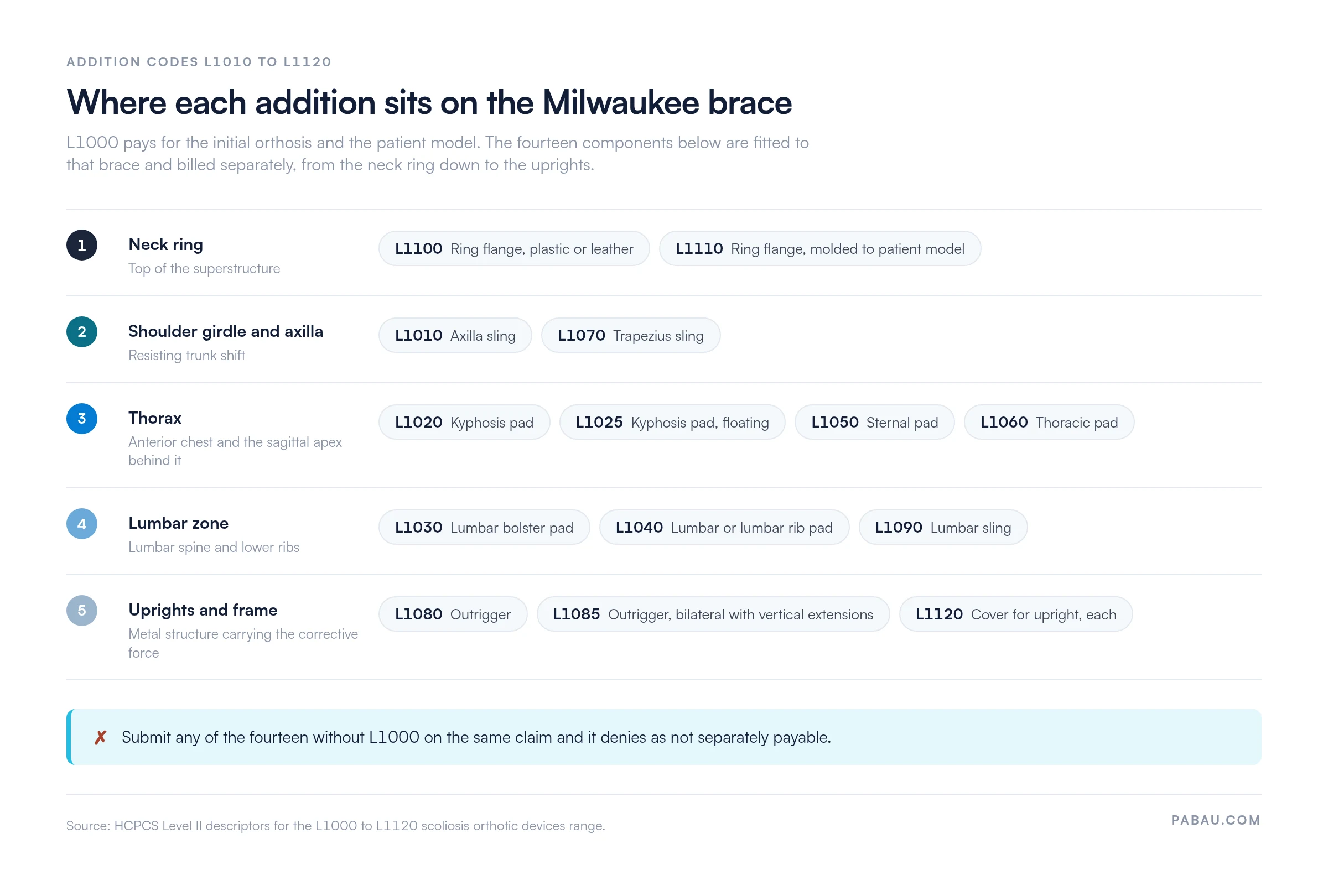
Three neighbors account for most of the misrouted claims in this family. In fact, reading the base code first settles all three.
Our hub covers every HCPCS code family a DMEPOS supplier bills. In addition, the AAPC HCPCS lookup gives searchable access to the current descriptors.
Most L1000 denials trace back to the same handful of causes. Indeed, catching them before the claim reaches the MAC costs far less than appealing afterwards.
Read the denial codes on the remittance advice before deciding whether to appeal or recode. In fact, Medicare runs a five-level appeals process, and scoliosis brace cases usually resolve at the first two levels.
Checking the electronic remittance advice for the specific CARC and RARC codes resolves cases faster than a generic appeal letter. Grouping denials by cause also shows which step in the fitting workflow needs fixing.
Group L1000 denials by cause before you appeal any of them. In fact, a run of not separately payable denials on addition lines usually means one claim-build setting is splitting the base and the additions onto different claims.
An L1000 claim fails when its pieces live in separate places. For example, the order sits in an email and the Cobb angle sits in an imaging report. Meanwhile, the casting record stays with the fabricator, and the delivery slip goes into a folder. As a result, nobody sees the file is short until the remittance advice arrives.
Practice management software like Pabau keeps those pieces on one patient record. In fact, the order, the fitting note, the scan record and the signed delivery confirmation attach to the same file. The HCPCS and ICD-10 codes then carry through to the claim without retyping. The base code and its additions stay together, because they were built from the same encounter.
Pabau then keeps claims moving to payment, showing what each submitted line is waiting on. Suppliers see which files are missing a signature before the brace ships, so the denial never happens and the cash arrives on the first pass.

Pabau holds the order, the fitting note, the scan record and the proof of delivery against one patient file. Base codes and their additions then leave together. See how it works for your practice.

HCPCS code L1000 is narrow and well defined, yet it produces more denials than its volume suggests. Two features explain why. Namely, it is one of only two scoliosis base codes that accept additions, and no LCD tells you what the record has to contain.
Three habits keep the claim routine. First, keep L1000 and its L1010 to L1120 additions on one claim, and leave the KX modifier off. Then, file the curve measurement and the casting record with the order. To see how Pabau keeps that documentation together, book a demo.

Billing a pad or sling onto the brace? HCPCS code L1030 walks through how an addition code depends on its base.
Working a run of denied L-code claims? Denial management in healthcare covers root-cause analysis and appeal workflows.
Building the billing process from scratch? What is revenue cycle management explains the cycle from encounter to payment posting.
HCPCS code L1000 bills a custom-fabricated cervical-thoracic-lumbar-sacral orthosis (CTLSO), the brace usually called the Milwaukee brace. In fact, its allowance covers furnishing the initial orthosis and the patient model it is built from. Namely, it sits in the L1000 to L1120 scoliosis orthotic devices range of the HCPCS Level II L-series.
No. L1000 is a spinal orthosis code for scoliosis bracing, and it has no relationship to the ankle or foot. Instead, ankle-foot orthoses sit in the L1900 to L1990 range, and a custom-fabricated plastic AFO is L1940.
The additions L1010 through L1120 attach to L1000. They cover components such as the axilla sling, kyphosis pad, lumbar bolster pad, thoracic pad, trapezius sling, outriggers, ring flanges and upright covers. As a result, each one is denied as not separately payable when L1000 is missing from the same claim.
No. KX attests that the criteria of a specific Local Coverage Determination are met, and no LCD covers L1000. Namely, the spinal orthosis LCD L33790 lists codes L0450 through L0651, which does not include the scoliosis range. So, appending KX out of habit attests to criteria that do not exist for this code.
Instead, L1000 is paid from the DMEPOS fee schedule by the DME MAC, under the brace benefit in section 1861(s)(9) of the Social Security Act. Allowances are locality based and CMS updates them each January, so verify the current amount in the CMS fee schedule files before submitting.



