CPT Code 62284: Injection procedure for myelography
CPT Code 62284: official descriptor and procedure overview The American Medical ...

Last Updated: Oct 19, 2026
L1030 is the HCPCS Level II code for addition to ctlso or scoliosis orthosis, lumbar bolster pad.
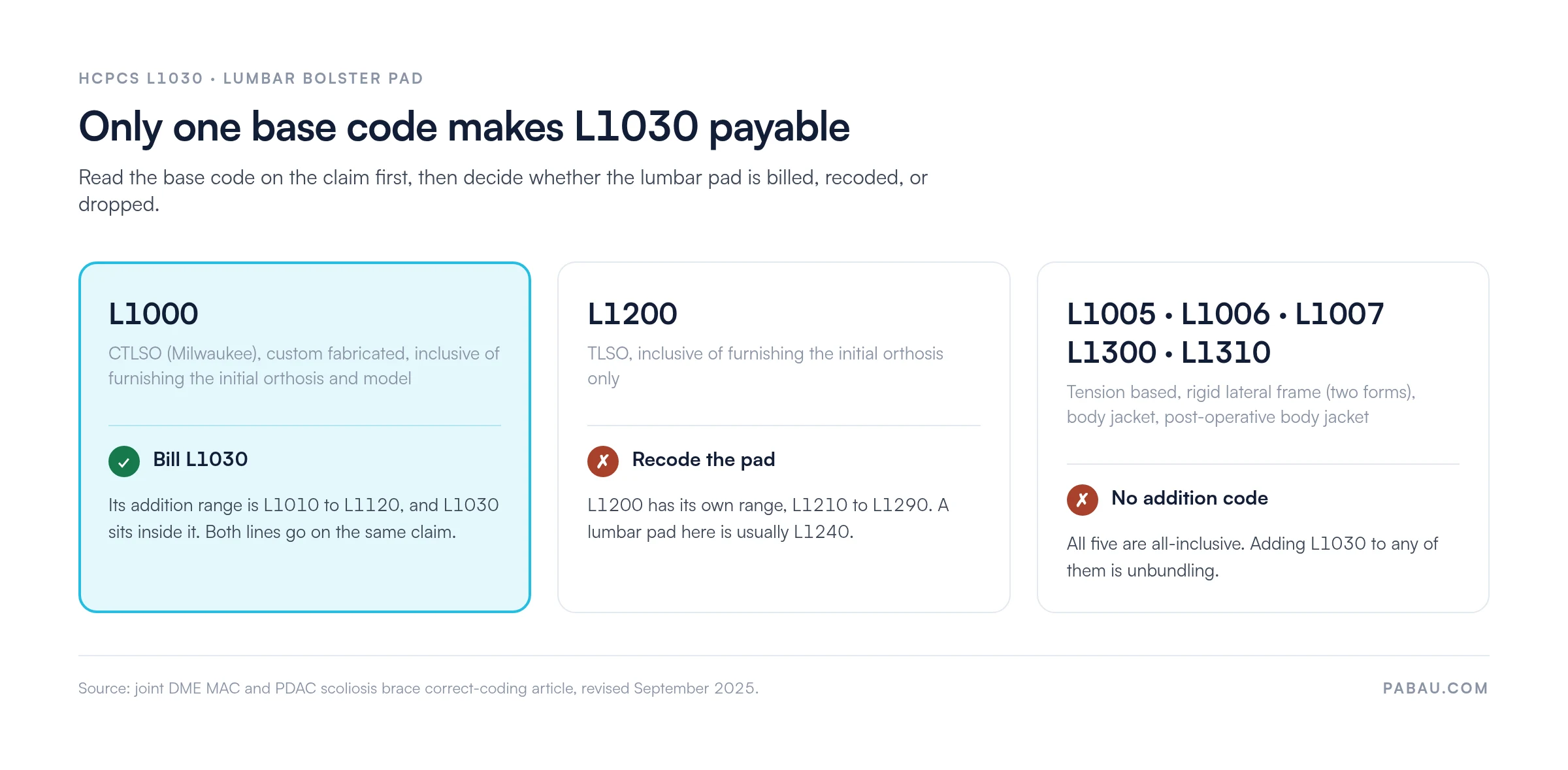
A second error costs orthotists and DME suppliers just as much. Five of the seven scoliosis brace base codes are all-inclusive, so attaching L1030 to one of them is unbundling rather than a missing-code error.
Let Pabau's smart automation suggest the right codes, reduce claim denials, and keep your practice compliant—effortlessly.
Automate repetitive tasks and focus on what matters most—your patients.
Reduce coding errors and ensure compliance with the latest regulations.
Clean claims, fewer denials, and faster reimbursements.
Powerful insights and reporting to help your practice thrive.
HIPAA compliant SOC 2 certified GDPR-compliant Trusted by 4,000+ clinics worldwide

HCPCS code L1030 describes a lumbar bolster pad added to a CTLSO or scoliosis orthosis. It is an addition code, not a standalone billable device
L1030 is separately payable only when base code L1000 appears on the same claim. L1000 is the custom-fabricated CTLSO (Milwaukee), and omitting it is the leading denial trigger
Never attach L1030 to L1005, L1006, L1007, L1300 or L1310. The DME MACs treat those five base codes as all-inclusive, so adding a component code to them is unbundling
L1030 is not one of L1200’s addition codes. A lumbar pad on a TLSO is coded from the L1210 to L1290 range instead
Medicare covers L1030 under the DME benefit when a qualifying ICD-10-CM scoliosis diagnosis and a signed standard written order support medical necessity
Pabau’s claims management software helps orthotists and DME suppliers pair addition codes correctly, attach supporting documentation, and cut L1030 denials
HCPCS code L1030 is a Level II HCPCS code maintained by the Centers for Medicare and Medicaid Services (CMS). Its official descriptor is: Addition to CTLSO or scoliosis orthosis, lumbar bolster pad. The code sits within the L1000 to L1499 range, which covers spinal orthoses and their approved additions.
A CTLSO (cervicothoracolumbosacral orthosis) is a spinal brace that extends from the cervical spine down to the sacrum. When a clinician determines that a patient’s curve pattern needs a lumbar bolster pad, L1030 captures that specific addition to the base device. It does not describe the orthosis itself, only the bolster pad component.
That distinction is what makes the code fragile on a claim. L1030 carries its own fee schedule allowance, but the allowance is only released when the related base code is present. On its own, the line is denied as not separately payable.
Use the reference table below to confirm the key attributes of L1030 before submitting any claim.
A lumbar bolster pad is a contoured padding component fitted to the lumbar region of a CTLSO or scoliosis orthosis. Its clinical purpose is to apply corrective lateral pressure on the spine, reinforcing the forces the base brace already exerts.
Orthotists add bolster pads when the patient’s curve pattern or body habitus needs localized support beyond what the base orthosis delivers.
L1030 covers the supply and fitting of that addition. It does not describe the base CTLSO, and it cannot be billed in isolation. The claim must show the base orthosis code and L1030 together to represent a complete, accurately coded device.
The DME MACs and the PDAC contractor recognize seven HCPCS base codes that fully describe scoliosis braces. Five of them are all-inclusive: L1005, L1006, L1007, L1300 and L1310. Their allowance already covers the accessory pads, straps and interface, so no addition code belongs on a claim with them.
Only two base codes have addition codes of their own, and those two are L1000 and L1200. Each carries a separate addition range. L1010 through L1120 attach to L1000, the custom-fabricated CTLSO. L1210 through L1290 attach to L1200, the TLSO.
L1030 sits in the first range, so L1000 is its only valid base code. L1010 and L1020 are addition codes as well, not base codes. Each describes a component fitted to an L1000 orthosis, exactly as L1030 does. Any reference that lists them as bases for L1030 has the tiers inverted.
Think of it as two tiers. The base code records which device the patient received. The addition code records which component was fitted to it. A claim missing either tier is incomplete, and it will deny or downcode.
L1030 pairs with L1000 alone. It is not one of L1200’s addition codes, so a lumbar pad added to a TLSO is coded from the L1210 to L1290 range instead. The nearest equivalent there is L1240, the lumbar derotation pad. Reading the base code first settles which of three outcomes applies.
L1001 causes particular trouble here, because its number sits next to L1000. Its descriptor is a CTLSO immobilizer, infant size, prefabricated, includes fitting and adjustment.
That is an unrelated device, and it is not among the seven scoliosis base codes, so it is never a valid partner for L1030. Verify any base code selection against the AAPC HCPCS Level II code lookup before billing.
Billers coding scoliosis orthoses cross-reference the surrounding addition codes to confirm they have picked the right component. The table below shows the codes closest to L1030 and the base each one attaches to. L1050, the sternal pad addition, attaches to that same L1000 base code and carries its own billing rules.
L1030 vs L1040: these describe two different pads, not a first and a second unit of the same pad. L1030 is the lumbar bolster pad. L1040 is the lumbar or lumbar rib pad. Neither descriptor contains “each additional” language, so L1040 is not the second-pad version of L1030. Neither code depends on the other, and each one needs L1000 on the claim to be separately payable.
Payers require a qualifying diagnosis to establish medical necessity for the lumbar bolster pad addition. The ICD-10-CM codes below are the most commonly accepted diagnoses. Always check the applicable local coverage policy for your DME MAC jurisdiction, because covered diagnoses vary by region.
Site-specific codes such as M41.12 for the thoracic region are preferable to unspecified codes. Use one whenever the ordering provider has documented the spinal region in the chart. Using the most specific ICD-10-CM code available reduces the chance of a medical necessity denial.
Check any diagnosis you plan to pair with L1030 in our ICD-10-CM codes library before the claim goes out. Confirm the pairing against your local coverage policy as well.
Medicare covers HCPCS code L1030 under the Durable Medical Equipment benefit when the claim meets the standard DME medical necessity requirements. The ordering provider has to document the clinical rationale for the pad in the patient record before the orthosis is fitted.
Reimbursement for L1030 is set by the Medicare DMEPOS fee schedule, which covers durable medical equipment, prosthetics, orthotics and supplies. Rates vary by geographic area and CMS updates them annually. Check the current payment amount with the CMS DMEPOS fee schedule.
A complete claim file for each L1030 submission carries four elements. Those are base code L1000, the L1030 addition, the supporting ICD-10-CM diagnosis, and the signed written order. Including all four in the first submission cuts the audit and denial rate sharply.
Modifiers tell the DME MAC about device status and your medical necessity attestation. Apply the same modifier logic to the L1030 line as to the L1000 base line, because the addition is adjudicated as its own line item.
RT and LT have no role here. A spinal orthosis is not a right or left device, so laterality modifiers on an L1030 line will reject.
Incomplete documentation is the second-most-common reason L1030 claims deny, after base-code omission. CMS and the DME MACs expect a paper trail before the claim reaches the payer. It has to establish the device and the medical necessity for the addition.
Keep these records in a structured format that is reachable at the moment of billing. Payers run post-payment audits, and the file has to be retrievable on request. Knowing how to submit a clean claim from the outset cuts the recovery risk on every L1030 line.
Run a three-point check before an L1030 line leaves the queue. Confirm L1000 is on the same claim, not a different date of service. Confirm the base code is not one of the five all-inclusive codes. Then confirm the written order names the bolster pad and not only the brace. Those three checks catch most of the denials on this code.
Billing errors on HCPCS code L1030 follow recognizable patterns. The same handful shows up across DME suppliers, and each one has a straightforward fix.
The DME MACs and the PDAC contractor publish a joint correct-coding article for scoliosis braces. CGS Medicare hosts it as Scoliosis Brace, Correct Coding, Revised. It is the clearest statement of how an addition code such as L1030 may be billed. The article was published in July 2020 and revised in September 2025 to add L1006 and L1007.
Key points from the joint DME MAC and PDAC guidance:
Because this is a joint publication, the coding rules apply in every DME MAC jurisdiction rather than in Jurisdiction B alone. Coverage criteria still sit with your own MAC, so read its local policy alongside the coding article.
Coverage for HCPCS code L1030 outside Medicare is not standardized. Medicaid programs vary by state. Some follow Medicare coverage policy for DME orthotics, others maintain separate fee schedules, and a few require a prior authorization step that Medicare does not. Confirm coverage and authorization rules with each payer before the orthosis is fitted.
Commercial insurers generally cover scoliosis orthoses and their additions when medical necessity criteria are met. The criteria, the required documentation and the prior authorization thresholds differ by plan. Key steps for non-Medicare payers:
In most orthotic practices the pieces that decide an L1030 claim sit in different places. The written order is with the prescriber. The delivery receipt is in a folder, the fitting note is in the chart, and the base-code pairing lives in the biller’s head. A reviewer asks for all of it at once.
Practice management software like Pabau holds those pieces against a single patient record instead. The order, the fitting note and the signed delivery document attach to the same file. The HCPCS and ICD-10 codes then carry through to the claim without retyping, so L1000 and L1030 stay together.
Pabau’s claims management software tracks each submission through to payment. An L1030 line with no base code beside it, or a missing delivery record, surfaces while you can still fix it. When a review contractor writes, the file is already assembled, so the response takes minutes.

Pabau’s claims management tools help orthotists and DME suppliers pair addition codes with the right base code. Attach the required documentation and track payer-specific rules, so fewer L1030 claims deny on the first pass.

HCPCS code L1030 is a narrow, well-defined code, yet it produces a disproportionate share of DME denials. The reason is its dependency on one specific base code. Bill it without L1000 and the line is denied as not separately payable.
The other two failure points are just as predictable. Attach L1030 to an all-inclusive base code such as L1005 and you have unbundled the claim. Pair it with a diagnosis your local policy does not cover and it denies on medical necessity. Get the base code, the diagnosis and the written order right, and this claim is routine.
Pabau’s claims management software gives DME suppliers and orthotists a way to catch a missing code pairing before submission rather than after denial. To see how it fits your existing billing workflow, book a demo.

Want to understand how denial patterns form across DME claims? Denial management in healthcare breaks down how to track, analyze and reduce recurring claim denials by code type.
Unsure how superbills support DME documentation? Superbill documentation guide explains what a superbill must contain to satisfy payer audit requirements for orthotic claims.
Looking for a broader view of billing compliance for orthotics practices? Medical billing compliance requirements covers the documentation standards, audit risks and payer policies that affect DME suppliers.
HCPCS code L1030 bills a lumbar bolster pad addition to a cervicothoracolumbosacral orthosis (CTLSO) or scoliosis orthosis. It is an addition code, so it has to appear on the same claim as its base code, L1000. Orthotists use it in scoliosis and spinal deformity management when a patient needs localized lumbar support beyond what the base brace provides.
L1000, the custom-fabricated CTLSO (Milwaukee), inclusive of furnishing the initial orthosis and model. L1030 sits in the L1010 to L1120 addition range, and the DME MACs tie that whole range to L1000. Billed on its own, L1030 is denied as not separately payable, which is the leading cause of denial for this code.
No. The DME MACs and PDAC treat L1005, L1006, L1007, L1300 and L1310 as all-inclusive base codes. Their allowance already covers the accessory pads, straps and interface. Adding L1030, or any other addition code, to one of those five is incorrect coding and counts as unbundling.
No. L1200 has its own addition range, L1210 to L1290, and L1030 is not part of it. A lumbar pad fitted to a TLSO is coded from that range instead, most often L1240 for a lumbar derotation pad. L1200 and L1000 are the only two scoliosis base codes that accept addition codes at all.
Yes, Medicare covers L1030 under the DME benefit when medical necessity is established. The claim needs a qualifying ICD-10-CM diagnosis and a signed standard written order. You also need documentation that the base orthosis and the bolster pad reached the patient. Coverage also depends on your DME MAC’s local policy, so check it before the fitting.
They describe two different pads, not a first and second unit of the same pad. L1030 is the lumbar bolster pad. L1040 is the lumbar or lumbar rib pad. Neither descriptor carries “each additional” language, so L1040 is not the second-pad version of L1030. Both are additions to L1000 and need that base code on the claim.
The M41 scoliosis codes are the most commonly accepted. Examples include M41.00 for infantile idiopathic scoliosis, M41.10 for juvenile idiopathic scoliosis and M41.20 for other idiopathic scoliosis. Site-specific variants such as M41.12 for the thoracic region are preferable to unspecified codes. Always verify accepted diagnoses against your DME MAC’s local coverage policy before submitting.
The Medicare DMEPOS fee schedule rate for L1030 varies by geographic area and CMS updates it annually. Retrieve the current amount from the CMS DMEPOS fee schedule files at cms.gov. Suppliers in Competitive Bidding Program areas may have contract pricing that supersedes the standard rate.