CCSD Code H3320: Abdominoperineal resection of rectum
CCSD code H3320: Definition and clinical scope CCSD code H3320 is the UK private...

Last Updated: Oct 20, 2026
L0491 is the HCPCS Level II code for a prefabricated thoracic-lumbar-sacral orthosis (TLSO) with sagittal-coronal control and two rigid plastic shells. The shells form a modular segmented system. At the back it runs from the sacrococcygeal junction to just below the scapular spine. At the front it runs from the symphysis pubis to the xiphoid, and fitting at delivery is part of the code.
Shell count separates L0491 from its neighbors. L0490 is a one-piece shell and L0492 has three shells. L0458 has two shells too, but it also restricts rotation.
Let Pabau's smart automation suggest the right codes, reduce claim denials, and keep your practice compliant—effortlessly.
Automate repetitive tasks and focus on what matters most—your patients.
Reduce coding errors and ensure compliance with the latest regulations.
Clean claims, fewer denials, and faster reimbursements.
Powerful insights and reporting to help your practice thrive.
HIPAA compliant SOC 2 certified GDPR-compliant Trusted by 4,000+ clinics worldwide

HCPCS code L0491 is a prefabricated TLSO with sagittal-coronal control, built as a modular segmented spinal system with two rigid plastic shells.
Shell count separates the family. L0490 is a one-piece shell, L0491 has two shells and L0492 has three.
L0458 also has two shells, but it adds rotational control, so plane of control is the second check before you code.
Medicare covers L0491 under LCD L33790 when the record documents at least one of the four covered indications.
A standard written order, a fitting note that describes each modification and proof of delivery carry most L0491 claims through review.
HCPCS code L0491 is the Level II code for a prefabricated thoracic-lumbar-sacral orthosis (TLSO) with two rigid plastic shells. The shells form a modular segmented spinal system rather than one molded piece. The brace restricts gross trunk motion in the sagittal and coronal planes, and fitting at delivery is part of the code.
L0491 sits in the L0450 to L0492 range of TLSO codes that the Centers for Medicare and Medicaid Services (CMS) maintains.
It is a DMEPOS code, so DME MAC policy governs coverage rather than the physician fee schedule. The claim goes to the DME MAC, and the spinal orthoses policy sets the rules.
The official long descriptor is one long sentence, but each clause does separate work. Here it is broken out in order, with what each part means for coding.
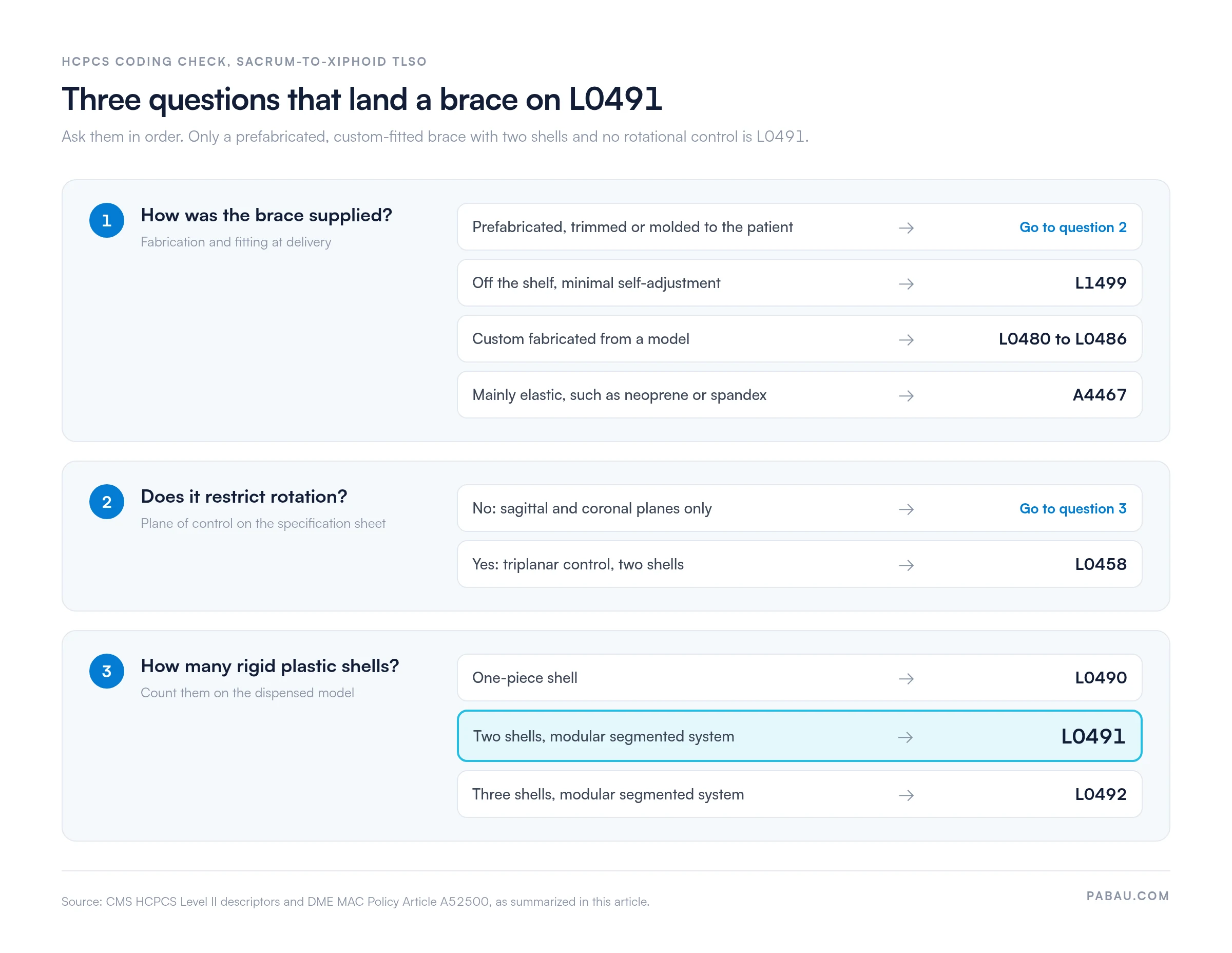
Two features settle the code for a prefabricated TLSO that runs from the sacrum to the xiphoid. The first is how many rigid plastic shells the brace has. The second is how many planes of trunk motion it restricts.
The L0491 decision rule: count the rigid plastic shells on the dispensed brace, then read the plane of control on the specification sheet. Two shells and sagittal-coronal control point to L0491. A one-piece shell points to L0490, and three shells point to L0492.
The trap is L0458. It has the same two shells and the same xiphoid termination as L0491. The only difference is that L0458 also restricts rotation, so reading the shell count alone sends the claim to the wrong code.
Check the model on the PDAC Product Classification List before the claim goes out. Record the shell count and the listed code in the fitting note, because reviewers compare the claim with the device that was dispensed.
Five situations pull the claim off L0491, and each one has a code of its own. The decision path after this list puts them in the order a coder checks them.
Medicare covers L0491 under LCD L33790 (Spinal Orthoses: TLSO and LSO) and its Policy Article A52500. The medical record has to show that the brace was ordered for at least one covered indication.
One indication is enough, but the treating practitioner has to document it. A diagnosis code on the claim does not establish the indication by itself, and reviewers ask for the note behind it.
L0491 does not need prior authorization from Medicare. Among spinal orthoses, prior authorization applies to L0648 and L0650, plus L0631, L0637 and L0639 from August 12, 2024. Commercial payers set their own rules, so confirm them at the eligibility check.
A diagnosis code alone does not secure coverage. It has to line up with the indication the practitioner documented. The codes below are often paired with L0491, but check the payer’s current policy before you submit.
Match the diagnosis to what the chart supports, not to the code that seems most likely to pay. Covered lists move with each LCD revision, so re-check the policy article when it changes.
A standard written order (SWO) must reach the supplier before the claim is submitted. LCD L33790 denies a claim billed without a completed SWO as not reasonable and necessary. Because L0491 is custom fitted, the fitting itself has to be evidenced too. The CGS spinal orthoses documentation checklist sets out what the record must contain.
Keep these records for at least seven years from the date of service, and have them ready to send when a DME MAC asks. Our guide to medical billing compliance covers the wider audit-readiness picture.
L0491 is billed to the DME MAC on the CMS-1500 claim form or its electronic equivalent, the 837P. Medicare pays it from the DMEPOS fee schedule, which is updated each January and varies by state.
Spinal orthoses are purchased items, so rental modifiers do not apply. The patient owes 20% coinsurance after the Part B deductible. Pull the current-year fee schedule file before you set your charges.
GA moves liability to the patient, but only when the notice was signed before delivery. GZ moves no liability, so the supplier absorbs the write-off. Pick the modifier at the fitting appointment, while the notice can still be signed.
Run four checks before an L0491 claim leaves your office. Is the signed order dated on or before the date of service? Does the fitting note count two shells and name each modification? Does the specification sheet say sagittal-coronal, with no rotational control? Does the practitioner’s note state a covered indication?
L0491 denials fall into three groups: incomplete documentation, the wrong code and the wrong modifier. Sort each denial into one of the three before anyone touches a corrected claim. Our guide to common denial codes helps your team read the CARC and RARC entries on the remittance.
Most of these rows are fixed before the brace is dispensed, not after the denial arrives. The wider set of conditions a DMEPOS claim has to meet is in our guide to clean claim requirements.
Orthotic practices and DME suppliers billing L-codes face a records problem that a code lookup cannot solve. The written order, the fitting note and the proof of delivery have to be on file for every patient. The right code and modifiers then have to go out with the claim.
Pabau, the practice management platform we build, keeps those documents in the patient record rather than in a separate billing folder. Its claims management software ties clinical documentation to the billing workflow, so the records an L0491 claim needs are captured at the point of care.
For orthotic practices, Pabau supports the L0491 billing cycle at three points:

Pabau helps orthotic practices and DME suppliers capture written orders, document fittings and submit claims with the right codes and modifiers attached.

L0491 rewards a supplier who checks two physical facts before the paperwork starts. Count the rigid plastic shells, then confirm the brace restricts the sagittal and coronal planes without limiting rotation. Two shells and two planes point to L0491, and any other combination points to a neighboring code.
The documentation side is just as mechanical. The written order, a fitting note that names each modification and a chart entry with a covered indication carry most claims through review.
Build those checks into the fitting appointment, so the record is complete before the claim leaves your office. Book a demo to see how Pabau keeps L0491 records attached to the claim they support.

Dealing with recurring claim rejections? Denial management in healthcare explains how to build a workflow for resolving and preventing DMEPOS denials.
HCPCS code L0491 describes a prefabricated TLSO with sagittal-coronal control, built as a modular segmented spinal system with two rigid plastic shells. It runs from the sacrococcygeal junction to just below the scapular spine at the back. Fitting and adjustment at delivery are included in the code.
The difference is the shell construction. L0490 is a one-piece rigid plastic shell whose posterior stops at or before T-9. L0491 is a modular system with two rigid plastic shells, and L0492 is the same system with three. All three control the sagittal and coronal planes only.
Both codes describe a prefabricated modular TLSO with two rigid plastic shells. L0491 restricts the sagittal and coronal planes, while L0458 also restricts the transverse plane, which means rotation. Check the specification sheet and the PDAC listing to tell them apart.
Yes. Medicare Part B covers L0491 under LCD L33790 when the record documents at least one covered indication. The supplier also needs a standard written order before billing, a fitting note and proof of delivery.
No. Medicare does not require prior authorization for L0491. Among spinal orthoses, it applies to L0648, L0650, L0631, L0637 and L0639. Commercial payers set their own rules, so confirm them before dispensing.
Bill L1499 instead. L0491 is a custom fitted code with no off-the-shelf equivalent. A brace that needed only minimal self-adjustment does not match the descriptor.
No. An orthosis supplied during an inpatient stay or a Part A skilled nursing stay is included in the facility payment. Suppliers may deliver up to two days before discharge for fitting, and the date of service is then the discharge date.