

HCPCS code E0198: Water pressure pad billing guide
HCPCS code E0198 is a water pad for a standard mattress HCPCS code E0198 is the ...

Last Updated: Oct 13, 2026
L0458 is the HCPCS Level II code for tlso, triplanar control, modular segmented spinal system, two rigid plastic shells, posterior extends from the sacrococcygeal junction and terminates just inferior to the scapular spine, anterior extends from the symphysis pubis to the xiphoid, soft liner, restricts gross trunk motion in the sagittal, coronal, and transverse planes, lateral strength is provided by overlapping plastic and stabilizing closures, includes straps and closures, prefabricated, includes fitting and adjustment.
Every word of the descriptor matters during a DME MAC audit. The official CMS long descriptor reads as follows, split at the commas that separate each clause:
"Triplanar control" means the brace restricts motion in the sagittal, coronal, and transverse planes at once. "Modular segmented spinal system" describes the construction method. "Two rigid plastic shells" specifies the anterior and posterior shell configuration.
The clause that trips up coders is "prefabricated." L0458 is manufactured in advance and then fitted to the patient. It is not built from a cast or a CAD-CAM model, which is what custom fabrication means under CMS rules.
Prefabricated does not mean off-the-shelf either. CMS keeps L0458 off its off-the-shelf back-brace list, so the code sits in the middle category that DMEPOS policy calls custom fitted. Someone with the right training has to fit and adjust the brace.
L0458 is maintained under the CMS HCPCS Level II code set, which governs supplies, equipment, and non-physician services not covered by CPT. Only DMEPOS-accredited suppliers may bill this code to Medicare.
Let Pabau's smart automation suggest the right codes, reduce claim denials, and keep your practice compliant—effortlessly.
Automate repetitive tasks and focus on what matters most—your patients.
Reduce coding errors and ensure compliance with the latest regulations.
Clean claims, fewer denials, and faster reimbursements.
Powerful insights and reporting to help your practice thrive.
HIPAA compliant SOC 2 certified GDPR-compliant Trusted by 4,000+ clinics worldwide

HCPCS code L0458 describes a prefabricated TLSO with triplanar control, a modular segmented spinal system, two rigid plastic shells, and a soft liner.
L0458 is prefabricated but not off-the-shelf. CMS leaves it off the off-the-shelf back-brace list because it needs fitting and adjustment by a qualified practitioner.
The custom-fabricated equivalents are L0484 and L0486. Billing L0458 for a brace built from a plaster or CAD-CAM model is a coding error.
Medicare requires modifier KX on every L0458 claim to confirm the documentation is on file. A missing KX is the leading cause of denial.
Practice management software like Pabau helps orthotics suppliers track written orders, attach supporting ICD-10 codes, and monitor claim status across payers.
Medicare pays L0458 through the DMEPOS fee schedule, and the allowable amount varies by payment locality. The 2026 rate reflects a prefabricated device, so it sits well below the custom-fabricated two-shell codes L0484 and L0486.
Verify current rates directly through the CMS DMEPOS fee schedule before submitting claims. Rates published by third-party lookup tools may lag behind mid-year CMS updates. Private payers set their own fee schedules and their own prior authorization rules. Billing for IVF CPT codes runs into the same payer-by-payer variation.
LCD L33790 and Policy Article A52500 govern Medicare coverage of spinal orthoses, including L0458. A TLSO is covered when the medical record shows the brace serves at least one of these purposes:
Because L0458 is prefabricated, the file does not have to argue that a prefabricated brace would fail. That argument belongs to the custom-fabricated codes. What the record must show is why this patient needs rigid triplanar control from a two-shell brace.
Clinical situations that commonly support that level of control include:
Medical necessity alone is not enough. Because L0458 is custom fitted rather than off-the-shelf, the file also has to show that a qualified practitioner fitted and adjusted the brace. A note reading “patient needs a back brace” will not survive a DME MAC audit.
Physical therapy practices and chiropractic offices that refer patients for a TLSO should coordinate with the prescribing physician early. Practice management software like Pabau includes physical therapy documentation workflows that capture this clinical rationale before the referral goes out.
The most common miscoding error in this range is billing L0458 for a brace that was actually custom fabricated. CMS treats prefabricated and custom-fabricated orthoses as separate code families, and the descriptor decides which one you are in.
Custom fabricated means the orthosis was built for one named patient from a carved plaster or CAD-CAM model. For a two-shell triplanar TLSO, those codes are L0484 and L0486. LCD L33790 lists the custom-fabricated spinal codes as L0452, L0480, L0482, L0484, L0486, L0629, L0632, L0634, L0636, L0638, and L0640. L0458 is not among them.
The error runs in both directions. Billing L0458 for a brace built from a patient model understates the device and underpays the supplier. Billing L0484 or L0486 for a stock brace invites recoupment.
Auditors settle the question by reading the fitting record against the descriptor. Casting notes and model records belong in an L0484 or L0486 file. An L0458 file needs a fitting and adjustment note instead. For chiropractic practices coordinating TLSO prescriptions, chiropractic practice software that supports structured clinical notes helps capture that detail at the point of care.
L0458 sits inside the wider TLSO family spanning L0450 through L0492. Coders choosing between these codes should match the exact descriptor, including shell count, liner type, fabrication method, and how the brace is fitted.
For a complete searchable lookup of the L0450-L0492 range, the AAPC HCPCS Level II directory gives descriptor-level detail. Suppliers working across the wider DMEPOS range apply the same descriptor-matching discipline to equipment codes such as equipment codes such as E0248.
Every L0458 claim needs at least one supporting ICD-10 diagnosis code that establishes medical necessity. The diagnosis has to be clinically consistent with a need for rigid triplanar trunk control. A vague or non-specific code is one of the fastest routes to a medical necessity denial.
Low back pain codes in the M54.5x range rarely justify a rigid TLSO on their own. They work as secondary codes when a structural primary diagnosis supports the claim. Always verify ICD-10 pairings against LCD L33790 and your DME MAC’s guidance before submitting. Specificity matters just as much in fracture coding, where the seventh character records healing status, as it does for S52.262K.
Policy Article A52500 and the standard documentation requirements article A55426 set out what an L0458 file must contain. Missing any one item is enough to trigger a denial or a recoupment after payment.
Casting notes, plaster models, and CAD-CAM fabrication records do not belong in an L0458 file. The brace was never fabricated for this patient, so filing them alongside L0458 signals a coding mismatch to any reviewer.
DME suppliers billing spinal orthoses need organized medical forms and one predictable filing routine. A disorganized records system creates audit exposure even when the clinical justification is solid. Record retention and payer audit readiness also depend on HIPAA-compliant documentation standards.
Run every L0458 file past a five-point check before submission. You need a signed SWO on file, an ICD-10 code supported by LCD L33790, and modifier KX on the claim line. You also need a dated fitting note naming the fitter, plus a signed proof of delivery. If the file contains a casting or model record, stop and re-code. That brace is L0484 or L0486, not L0458.
Modifier selection is where many L0458 claims fail after the documentation is otherwise complete. Each modifier carries a specific meaning under CMS DMEPOS billing rules. Using the wrong one, or omitting a required one, results in denial.
No modifier signals that a brace is custom fitted rather than off-the-shelf. The code itself carries that distinction, which is why picking the right L-code matters so much. NU behaves the same way across purchased DMEPOS items, including equipment codes such as E0329.
Modifier KX is the baseline for any Medicare TLSO claim. Without it, the claim is denied as not medically necessary, however thorough the file may be. Verify modifier requirements against current DME MAC bulletins, since contractors such as Palmetto GBA and CGS Administrators issue periodic clarifications. CGS Medicare publishes DMEPOS policy updates for its own jurisdiction.
Missing a step in the L0458 workflow delays payment and leaves the file incomplete. That incomplete file outlives the original denial and resurfaces at audit. Follow this sequence on every claim.
The same documentation discipline applies across private and government payers, as the Bupa procedure codes schedule shows. For practices managing intake and authorization alongside billing, patient management software reduces the friction between clinical documentation and claim submission.
L0458 denials cluster around a small set of preventable errors. Knowing them in advance is more useful than diagnosing them after the remittance arrives.
Most denied L0458 claims can be appealed when the documentation exists but was not sent with the original claim. When the order itself was never obtained, the path to payment is far narrower. Building pre-submission checks into daily healthcare compliance workflows keeps those situations from arising.
Orthotics suppliers rarely lose an L0458 claim on clinical grounds. They lose it because the written order sits in one inbox and the fitting note in a paper chart. The delivery receipt waits in a scanning queue. By the time an ADR lands, nobody can assemble the file inside the response window.
Pabau keeps the whole file on one patient record. The SWO, the supporting ICD-10 codes, the fitting and adjustment note, and the signed delivery form attach to the claim before it leaves the practice. Claim status and ADR deadlines sit on the same screen as the documents that answer them.
The result is fewer resubmissions, faster payment, and a claim file that holds together when a DME MAC asks to see it. Pabau’s claims management software also applies payer-specific rules before submission, so coding mismatches surface while you can still fix them.
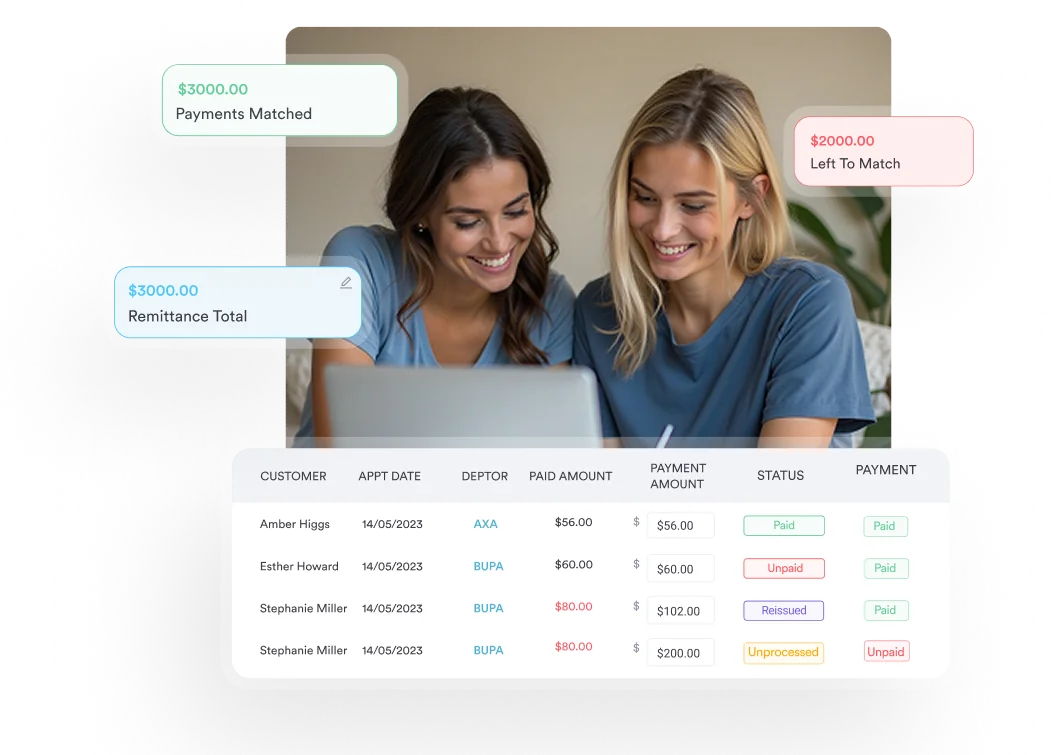

Pabau helps DME suppliers and orthotics practices track written orders, attach ICD-10 codes, and record fittings. Every required document sits in one place before submission. See how it works.

The judgment call on L0458 is settled before the claim is ever built. Read the descriptor to its final clause, then check how the brace in front of you was made. A patient model means L0484 or L0486, every time.
The compliance risk here is procedural rather than clinical. A missing KX modifier, an order that arrives after the claim, or a fitting visit nobody wrote up will sink an otherwise valid claim. Each of those is a workflow problem you can design out.
For suppliers and orthotics practices billing L0458 at any volume, centralizing the file reduces audit exposure and lifts clean claim rates. Pabau’s digital forms and documentation tools support the order, fitting, and delivery records this code demands. To see how Pabau helps DMEPOS billing teams reduce denials and stay audit-ready, book a demo.

Coding a behavioral health diagnosis instead? ICD-11 6A02 coding guide ICD-11 code 6A02 represents Autism Spectrum Disorder under the World Health Organization’s eleventh classification revision.
Billing DMEPOS accessories under the same DME MAC rules? K0065 shows how a small accessory code still carries its own documentation demands.
Supplying DMEPOS items beyond orthoses? A4771 covers supply-level billing, where proof of delivery carries just as much weight.
Coding a recurrent depressive episode? ICD-11 6A71 coding guide ICD-11 code 6A71 identifies Recurrent Depressive Disorder, marked by at least two distinct depressive episodes.
Coding essential hypertension in primary care? ICD-11 BA00.Z coding guide ICD-11 BA00.Z covers essential hypertension without an identified secondary cause, replacing ICD-10 code I10.
HCPCS code L0458 is a DMEPOS billing code for a prefabricated thoracic-lumbar-sacral orthosis (TLSO). The brace has triplanar control, a modular segmented spinal system, two rigid plastic shells, and a soft liner. The code includes fitting and adjustment, and it is active and billable under Medicare’s 2026 DMEPOS fee schedule.
L0458 is prefabricated. The CMS long descriptor ends with the words “prefabricated, includes fitting and adjustment,” and LCD L33790 does not list L0458 among the custom-fabricated spinal codes. The custom-fabricated equivalents of this two-shell design are L0484 and L0486, which are built from a carved plaster or CAD-CAM model of the patient.
No. L0458 is prefabricated but custom fitted, which means it needs fitting and adjustment by someone with the training to do it. CMS leaves L0458 off its off-the-shelf back-brace list, so the file has to record the fitting work performed rather than a simple handover.
Modifier KX is required on every Medicare L0458 claim to certify that the documentation on file meets the LCD requirements for medical necessity. Modifier NU is also typically required, since the brace is purchased outright rather than rented. A missing KX modifier is the single most common cause of L0458 denial.
An L0458 file needs a signed standard written order and practitioner records supporting medical necessity. It also needs a dated fitting and adjustment note, product identification for the brace, and a signed proof of delivery. Casting or fabrication records are not required, because L0458 is prefabricated rather than made from a patient model.
Commonly accepted ICD-10 codes include vertebral fracture codes (S22.xxx and S32.xxx) and scoliosis codes (M41.xx). Others include spondylosis with radiculopathy (M47.26 to M47.27), collapsed vertebra (M48.5x), and spinal cord injury codes (G82.xx). Low back pain codes alone (M54.5x) are generally insufficient to justify a rigid TLSO without a structural primary diagnosis.
A standard written order (SWO) names the patient, the item ordered, and the treating practitioner, and carries that practitioner’s signature and the order date. CMS replaced the older detailed written order terminology with the SWO in 2020. The SWO must be on file before the L0458 claim is submitted, and it cannot be backdated.



