CPT Code 62284: Injection procedure for myelography
CPT Code 62284: official descriptor and procedure overview The American Medical ...

Last Updated: Oct 19, 2026
L0490 is the HCPCS Level II code for tlso, sagittal-coronal control, one piece rigid plastic shell, with overlapping reinforced anterior, with multiple straps and closures, posterior extends from sacrococcygeal junction and terminates at or before the t-9 vertebra, anterior extends from symphysis pubis to xiphoid, anterior opening, restricts gross trunk motion in sagittal and coronal planes, prefabricated, includes fitting and adjustment.
Let Pabau's smart automation suggest the right codes, reduce claim denials, and keep your practice compliant—effortlessly.
Automate repetitive tasks and focus on what matters most—your patients.
Reduce coding errors and ensure compliance with the latest regulations.
Clean claims, fewer denials, and faster reimbursements.
Powerful insights and reporting to help your practice thrive.
HIPAA compliant SOC 2 certified GDPR-compliant Trusted by 4,000+ clinics worldwide

HCPCS Code L0490 covers a prefabricated TLSO with sagittal-coronal control in a one-piece rigid plastic shell, and fitting is included.
L0490 is a HCPCS Level II DME code billed to Medicare Part B, and the written physician order must predate dispensing.
L0490, L0491 and L0492 are all prefabricated, so shell construction rather than fabrication method separates them.
Missing or vague medical necessity documentation causes more L0490 denials than any other single error.
Practice management software like Pabau links the physician order, dispensing notes and delivery proof to each claim.
The full official descriptor reads: TLSO, sagittal-coronal control, one piece rigid plastic shell, prefabricated, includes fitting and adjustment. Three clauses in it do the work.
They name the planes of motion the brace controls, the way the shell is built, and the fabrication method. Descriptors for the whole L0450 to L0492 range are published in CMS’s HCPCS Level II code set.
Two distinctions decide whether L0490 is the right code. First, L0490 is strictly prefabricated, so a device fabricated in a lab from patient measurements belongs elsewhere in the range.
Second, sagittal-coronal control means the brace limits both flexion and extension and side-to-side bending. A brace that controls one plane only maps to a different code.
Medicare Part B covers HCPCS Code L0490 as a DMEPOS benefit when medical necessity criteria are met and an enrolled DME supplier submits the claim. CMS Policy Article A52500 governs coverage for both TLSOs and lumbar-sacral orthoses.
Medicare will consider L0490 covered when all of the following conditions are satisfied. Missing any single element is grounds for denial.
Three situations put an L0490 claim outside coverage:
CMS and the DME MACs recognize specific ICD-10-CM diagnosis codes as supporting medical necessity for HCPCS Code L0490. The treating physician must document one of these diagnoses in the medical record. A claim carrying an unsupported diagnosis is denied on review.
Always verify the code list against the applicable DME MAC LCD for your jurisdiction. The codes above are common covered diagnoses under CMS Policy Article A52500, and CMS updates the definitive list annually.
Our ICD-10-CM code reference carries the current descriptors and the seventh-character rules these fracture codes depend on.
Check the 7th character on fracture codes before submitting. ICD-10-CM fracture codes use A (initial encounter), D (subsequent), or S (sequela) as the final character. Submitting M80.08XA on a follow-up visit after the device is already dispensed is a common coding error that triggers review and potential denial. Switch to the D suffix for subsequent encounters.
Documentation causes more L0490 denials than any other factor. The DME MAC expects a specific set of records on file before the claim goes out. Capturing each element at the point of care prevents most of these failures.
Storing these records in one structured digital format matters. An audit-ready claims management setup keeps the order, the delivery proof and the fitting note on the patient record. Retrieval then takes minutes during a retrospective audit rather than weeks of sorting paper.
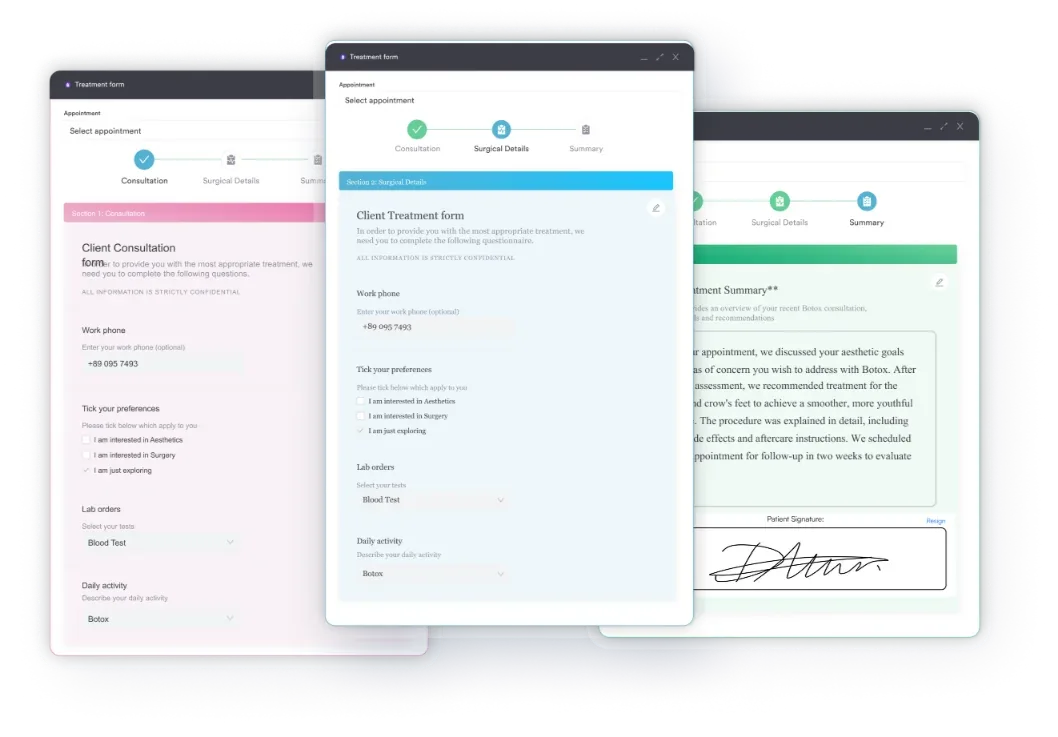
The risk of a documentation mismatch rises when the prescribing physician and the dispensing supplier are separate entities. Linking the HCPCS code, the dispensing event and the physician order in one record closes that risk before the claim goes out.
CMS sets HCPCS Code L0490 reimbursement amounts annually through the DMEPOS fee schedule. Rates vary by locality. The fee schedule assigns a capped rental or purchase allowance, and the payment reflects that amount after the Medicare deductible and 20% co-insurance are applied.
DMEPOS rates change each calendar year and differ across DME MAC jurisdictions. The only reliable source for current figures is the CMS fee schedule lookup tool. Enter L0490, select the year and locality, and the tool returns the participating and non-participating amounts.
Quoting a rate from a prior year or a third-party listing is a compliance risk. Bill above the allowable and Medicare recovers the overpayment.
The DME MAC processes the claim, applies the allowed amount, and remits an explanation of benefits with any adjustments. Reconciling that remittance against the fee schedule is what stops a write-off from slipping through unnoticed.
HCPCS Code L0490 sits inside the broader TLSO code family. Selecting the wrong code in this range is one of the most audited errors in spinal orthosis billing. The table below covers the codes billers most often need to separate from L0490.
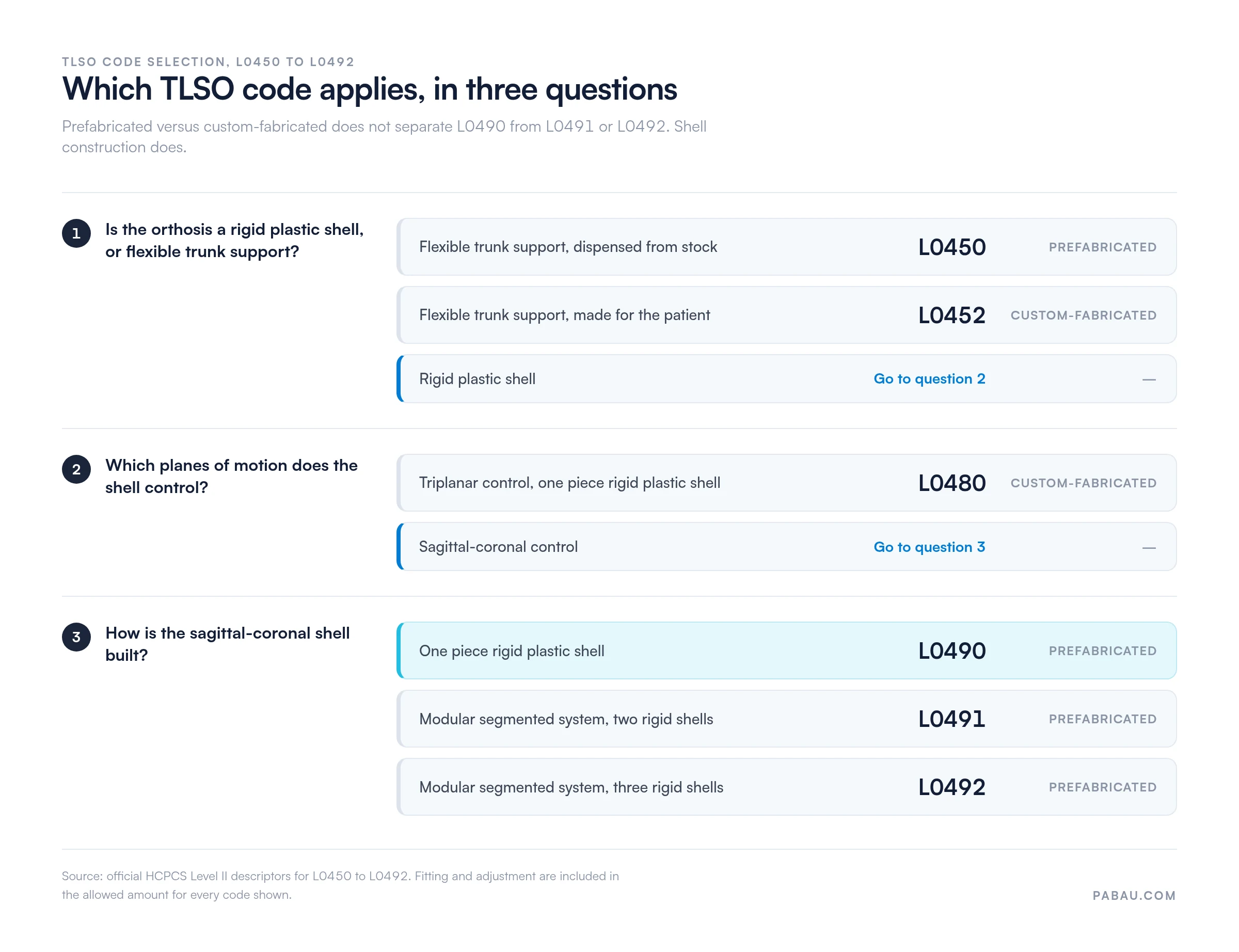
The prefabricated-versus-custom framing that most code references lead with does not separate L0490 from L0491 or L0492. All three are prefabricated, and all three include fitting. What separates them is shell construction.
L0490 is a single one-piece shell. L0491 is a modular segmented system of two rigid shells, and L0492 is the same system with three.
Custom fabrication moves the claim to a different code entirely, such as L0480 for triplanar control. Triplanar control on a prefabricated one-piece shell with an interface liner bills as L0488. Checking the descriptor in the AAPC HCPCS code reference before submission is good practice in this range. The three questions below route the device in front of you to a single code.
A clean L0490 claim follows a predictable sequence. Skipping or reordering a step is where most errors start.
Build a checklist that matches these six steps to your intake and dispensing process. Linking the written order to the dispensing event in the patient record before the claim is generated is the single most reliable prevention step.
Never bill a separate HCPCS code for fitting when submitting L0490. Fitting and adjustment are already included in the code descriptor and the allowed amount. Billing an additional fitting code alongside L0490 constitutes unbundling and will trigger a claim edit or denial. The same rule applies across most prefabricated orthosis codes in the L0450-L0492 range.
DME auditors see the same L0490 errors repeatedly, and each one is preventable at the point of submission. Knowing the denial pattern before it happens is the cheapest form of compliance.
When a denial does arrive, the claim adjustment reason code on the remittance points at the root cause. For a recurring problem such as missing-order denials, a process audit beats appealing claims one at a time. Our guide to medical billing compliance sets out the controls that catch these errors before submission.
Retrospective DME audits reward the supplier who can produce a complete, organized record set inside the response window. That ability, more than the appeal letter, decides whether the audit ends in recoupment or a clean outcome.
Most DME suppliers keep the pieces of an L0490 claim in separate places. The physician order arrives by fax, the fitting note lives in a paper chart, and the signed delivery slip sits in a folder. When the DME MAC asks for records, someone spends a day reassembling them.
Practice management software like Pabau holds those records against one patient timeline. Digital forms capture the order and the delivery signature, clinical notes record the fitting and adjustment, and the diagnosis stays attached to the encounter. The claim is then assembled from records that already agree with each other.
The outcome is a shorter audit response and fewer denials for missing documentation. Every Pabau subscription includes the clinical records, the forms and the claims tools, so none of this sits behind a higher tier.

Pabau links prescriptions, dispensing notes, and medical necessity records to each patient, so your L0490 claims arrive at the DME MAC complete and audit-ready.

The code itself is the easy part. What decides an L0490 claim is the order of operations. The physician order comes first, the diagnosis gets checked against the LCD, the device is matched to the descriptor, and the delivery is signed. Break that sequence and the denial arrives months later as a recoupment.
The trap worth carrying away is the shell. L0490, L0491 and L0492 are all prefabricated, so asking whether the device was custom-made will not tell you which code applies. Count the shells instead.
Build the documentation chain into the workflow and the audit response becomes a lookup rather than a reconstruction. Book a demo to see how Pabau keeps L0490 records ready for the DME MAC.

Need to understand how claims move from submission to payment? Revenue cycle management fundamentals covers the full payment workflow from claim creation to reconciliation.
Seeing recurring denials on DME claims? Denial management in healthcare explains how to classify, appeal, and prevent common claim rejections.
Dispensing a different rigid TLSO? HCPCS Code L0464 covers a neighboring code in the same range, with its own coverage criteria and documentation rules.
Fitting a lumbar-sacral brace rather than a TLSO? HCPCS Code L0650 walks through the LSO equivalent, which CMS covers under the same spinal orthosis policy article.
HCPCS Code L0490 is a Level II code for a prefabricated thoracic-lumbar-sacral orthosis, or TLSO. It provides sagittal-coronal motion control in a one-piece rigid plastic shell, and fitting and adjustment are included. Enrolled DMEPOS suppliers bill it to Medicare Part B when medical necessity criteria are met.
Yes. Medicare Part B covers L0490 when a written physician order is on file and the patient has a covered ICD-10 diagnosis. The claim must also come from an accredited DMEPOS supplier and go to the correct DME MAC. CMS Policy Article A52500 governs coverage.
You need a written physician order dated before dispensing and a signed proof of delivery that references L0490. You also need dispensing and fitting notes, plus physician records confirming the covered diagnosis and the clinical rationale. An Advance Beneficiary Notice is required when coverage is uncertain.
Both codes cover a prefabricated sagittal-coronal TLSO with fitting included. L0490 is a single one-piece rigid plastic shell. L0491 is a modular segmented spinal system built from two rigid shells. Choosing the wrong one is a frequent audit finding.
Medicare reimbursement for L0490 is set annually through the DMEPOS fee schedule and varies by locality. Verify the current allowed amount with the CMS fee schedule lookup tool at cms.gov. Quoting a prior-year rate for billing purposes is a compliance risk.
Commonly covered diagnoses include vertebral compression fracture codes from M48.50 to M48.56 and the osteoporotic fracture codes M80.08XA and M80.08XD. Scoliosis code M41.20 and acute traumatic fracture codes such as S32.000A also appear. The definitive list sits in the applicable DME MAC LCD and CMS Policy Article A52500.
No. Fitting and adjustment are included in the L0490 descriptor and in the allowed amount. Billing a separate fitting code alongside L0490 is an unbundling error that draws a claim edit or a denial.
A prefabricated orthosis is manufactured in standard sizes and dispensed from inventory, without fabrication from a mold or from patient measurements. L0490, L0491 and L0492 are all prefabricated TLSO codes, and each includes fitting and adjustment. Custom-fabricated TLSOs sit under separate codes such as L0480.