

CCSD code XR940: Foreign body retrieval billing guide
CCSD code XR940 is the UK private healthcare code for retrieval of a foreign bod...

Last Updated: Nov 26, 2026
L0450 is the HCPCS Level II code for a flexible, prefabricated, off-the-shelf TLSO that supports the upper thoracic region. It uses rigid stays or panels, shoulder straps and closures, and compresses the trunk to reduce load on the intervertebral disks.
Coders most often confuse L0450 with L0452, its custom-fabricated version, and with the off-the-shelf flexible TLSOs L0455 and L0457. Each describes a different build or spinal reach, so the wrong pick is a fast route to a denial. This reference covers what L0450 describes, how to tell it from adjacent codes, what Medicare documentation it needs and how to prevent common denials.
Let Pabau's smart automation suggest the right codes, reduce claim denials, and keep your practice compliant—effortlessly.
Automate repetitive tasks and focus on what matters most—your patients.
Reduce coding errors and ensure compliance with the latest regulations.
Clean claims, fewer denials, and faster reimbursements.
Powerful insights and reporting to help your practice thrive.
HIPAA compliant SOC 2 certified GDPR-compliant Trusted by 4,000+ clinics worldwide

HCPCS code L0450 describes a flexible, prefabricated, off-the-shelf TLSO that supports the upper thoracic region with rigid stays or panels and shoulder straps.
Coders most often confuse L0450 with L0452, its custom-fabricated version, and with the off-the-shelf flexible TLSOs L0455 and L0457.
The Standard Written Order must reach the supplier before the claim is submitted. It is needed before delivery only where the payer or the WOPD list requires it.
Policy Article A52500 requires modifier CG on L0450 when the brace is made primarily of nonelastic material or has a rigid posterior panel.
Pabau, a practice management platform, tracks prior authorization codes on the case and sends 837P claims through Claim.MD.
HCPCS code L0450 is the Level II orthotic code for a flexible, prefabricated TLSO that supports the upper thoracic region and is supplied off-the-shelf.
The Centers for Medicare and Medicaid Services (CMS) maintains the HCPCS Level II code set, which covers orthotics and other DMEPOS items. Its official long descriptor for L0450 reads as follows.
TLSO, flexible, provides trunk support, upper thoracic region, produces intracavitary pressure to reduce load on the intervertebral disks with rigid stays or panel(s), includes shoulder straps and closures, prefabricated, off-the-shelf.
HCPCS Level II long descriptor for L0450, CMS
That wording carries four facts a coder needs. The brace is flexible, and rigid stays or panels stiffen it. It compresses the trunk to raise intracavitary pressure, which takes load off the intervertebral disks. Shoulder straps carry it up to the upper thoracic region, and it is prefabricated and dispensed off-the-shelf.
Off-the-shelf means the patient receives the brace with only minimal self-adjustment, such as tightening the straps. No one with orthotic expertise trims, bends or molds it to fit. When the same flexible upper-thoracic design is custom fabricated for one patient, the code is L0452.
L0450 covers a flexible, prefabricated TLSO dispensed off-the-shelf to a patient who needs upper thoracic trunk support. The brace compresses the trunk to reduce load on the intervertebral disks. Rigid stays or panels stiffen it, and shoulder straps carry it up to the upper thoracic region.
Three features in the descriptor decide the code: flexible construction, upper thoracic reach with shoulder straps, and off-the-shelf supply. Change any one of them and a different code applies.
The TLSO codes from L0450 to L0462 differ by rigidity, by the spinal levels the brace spans and by how it is supplied. Picking the wrong code is a frequent cause of TLSO denials, after missing documentation. The table maps each code to its official descriptor.
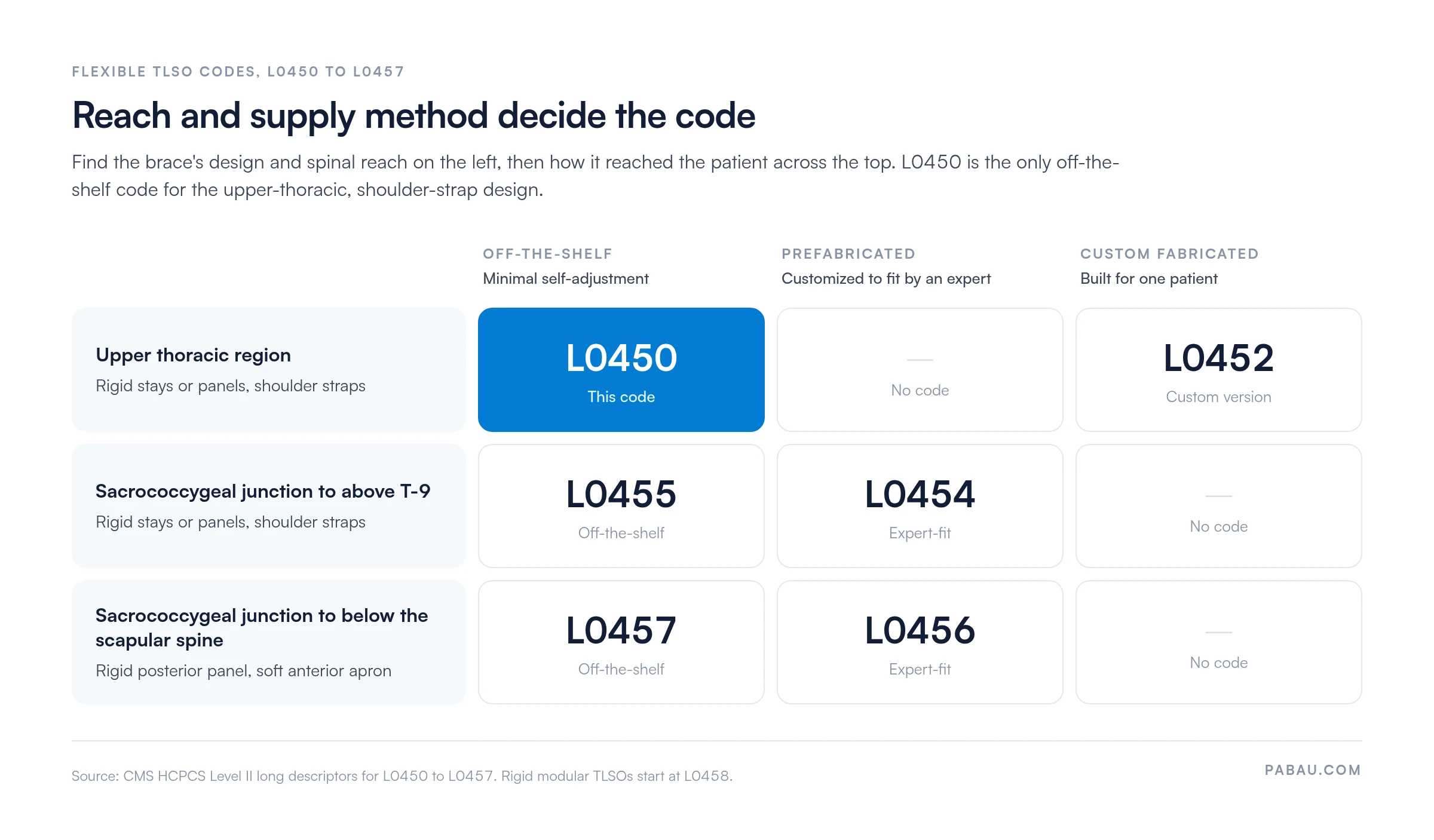
Practical rule: Check the brace’s design and reach first, then how it was supplied. A flexible brace with shoulder straps for upper thoracic support, handed over off-the-shelf, is L0450. A flexible brace that ends above T-9 is L0455, or L0454 when an expert fits it.
One with a rigid back panel ending below the scapular spine is L0457, or L0456 when an expert fits it. The grid below lays out the same choice, with L0450 in the only cell that matches its descriptor.
Medicare covers L0450 when the treating practitioner’s records meet the Spinal Orthoses: TLSO and LSO LCD (L33790). The DME MACs publish that LCD jointly, so the criteria match across jurisdictions. The LCD lists four indications, and the brace must be ordered for at least one of them.
Diagnoses that commonly support L0450 coverage include the following conditions. Each claim must carry the most specific code from the searchable ICD-10-CM library that fits the patient’s documented condition.
Coverage is not automatic when these codes appear. The notes must explain why the patient needs flexible trunk support, what function it should restore and why conservative measures alone are not enough.
Incomplete documentation is the most common reason HCPCS code L0450 claims are denied on audit. The order, the medical record and the proof of delivery have to exist before the claim goes out, not be assembled after a denial. A records request cannot be won with paperwork that was never created, so a checklist on every TLSO order protects the claim.
Medicare reimburses L0450 as a DMEPOS item under Part B through the DMEPOS fee schedule. CMS updates that schedule quarterly, with the annual update effective January 1. Pull the current figure from the CMS DMEPOS fee schedule when you submit, never from a cached rate. L0450 is paid as an outright purchase, so the capped rental rules for other DMEPOS items do not apply.
The billing rules that most affect L0450 payment are captured in the table below.
Medicare does not currently require prior authorization for L0450 under standard Part B DMEPOS rules. CMS has expanded its prior authorization program for some high-volume DMEPOS items over time, though, and commercial payers often set their own requirements.
Check the applicable MAC’s website and each commercial payer’s policy before delivery. Sound medical billing compliance treats that check as a standard step on every order.
When a commercial payer does require prior authorization for L0450, the submission typically needs the following elements.
Timelines vary by payer. Standard prior authorization decisions typically take 5 to 14 business days. Urgent requests for inpatient-to-home discharge scenarios may be expedited to 24 to 72 hours if the clinical situation qualifies.
TLSO claims fail for predictable reasons. Effective denial management starts by recognizing the pattern before the claim goes out, not after the remittance advice arrives. The most frequent L0450 denial triggers are listed below with the preventive action for each.
Run a pre-submission checklist on every L0450 claim before it leaves your queue. Confirm the SWO carries the physician signature and the POD is signed and filed. Append CG when the brace is nonelastic or has a rigid posterior panel. Use the most specific diagnosis code available. Record the PA approval number if one is required. Catching these at billing is far cheaper than working the denial after remittance.
Modifiers clarify circumstances around the L0450 claim and are frequently the difference between payment and denial. The AAPC’s HCPCS code lookup provides current modifier guidance, but the core set coders use with spinal orthosis claims is stable. Submitting a clean claim for L0450 means choosing the right modifier the first time.
Critical compliance note: Append KX only where a payer’s policy lists it for L0450, and only when the record meets every criterion that policy sets. A modifier that attests to criteria the record does not support is a false attestation. The Office of Inspector General (OIG) reviews modifier use in DMEPOS audits. See the NLM HCPCS code reference for the full modifier set applicable to L-codes.
Most L0450 denials trace back to paperwork kept in different places: the order, the delivery receipt, the authorization and the claim. When each sits in a separate tool, a missing signature only shows up after the remittance arrives.
In Pabau’s claims management software, the practice records the prior authorization code, dates and sessions on the patient’s case. Pabau warns when an authorization is missing. Claims go out as 837P files through Claim.MD, and ERA remittances post back, so billers see the payer’s response beside the documentation.

Pabau sends 837P claims through Claim.MD and tracks prior authorization codes on each case. Your team spends less time chasing rejections.

HCPCS code L0450 fits one narrow device, so the safest habit is to code from the spec sheet rather than from the order. Confirm the brace is flexible, reaches the upper thoracic region and arrived off-the-shelf before you choose it over L0452, L0455 or L0457.
Then close the paperwork before the claim goes out. The SWO, the medical record and the signed proof of delivery belong in the file first. CG belongs on the claim line whenever the brace is nonelastic or has a rigid posterior panel. A few minutes per order cost far less than working an audit later.
Book a demo to see how Pabau keeps the authorization, claim and remittance for each L0450 order on one patient record.

Need a broader overview of how DME billing fits into your revenue cycle? What is revenue cycle management explains the end-to-end process from patient encounter to payment posting.
Getting repeated denials on DMEPOS claims? Denial codes in medical billing breaks down the most common CARC and RARC codes and how to appeal them.
Looking to standardize your documentation before TLSO claims go out? Understanding the superbill covers what goes into a compliant claim document and how to structure it for DMEPOS submissions.
Fitting a flexible TLSO that stops above T-9? HCPCS code L0454 covers the expert-fit version of that brace and the documentation it needs.
Dispensing a brace with a rigid back panel and soft apron? HCPCS code L0457 explains when that off-the-shelf design is billed instead of L0450.
HCPCS code L0450 covers a flexible, prefabricated, off-the-shelf TLSO that supports the upper thoracic region. It uses rigid stays or panels, shoulder straps and closures, and compresses the trunk to reduce load on the intervertebral disks. It does not cover the custom-fabricated version (L0452) or rigid modular TLSOs.
All four are flexible TLSOs. L0452 is the custom-fabricated version of the L0450 design. L0455 runs from the sacrococcygeal junction to above T-9. L0457 has a rigid posterior panel and soft anterior apron ending just below the scapular spine. L0450, L0455 and L0457 are all prefabricated and off-the-shelf.
Standard Medicare Part B DMEPOS rules do not currently require prior authorization for L0450. CMS has expanded its prior authorization programs over time, and commercial payers often impose their own requirements. Always verify with the applicable MAC and each individual commercial payer before delivering the device.
At minimum, you need a Standard Written Order that reaches the supplier before the claim is submitted, plus records that meet the LCD criteria. You also need a signed proof of delivery and a device specification confirming the item is prefabricated and off-the-shelf. Medicare requires no Certificate of Medical Necessity for spinal orthoses, but some commercial payers use their own forms.
The most common reasons are a missing or incomplete Standard Written Order, absent proof of delivery and records that do not meet the LCD criteria. Nonspecific ICD-10-CM codes also cause denials, as does a missing CG modifier on a nonelastic brace or one with a rigid posterior panel. Billing L0450 for a custom-fabricated brace or a different flexible TLSO is a frequent audit finding.
L0450 is a prefabricated, off-the-shelf TLSO. When the same flexible upper-thoracic design is custom fabricated for one patient, bill L0452 instead. Billing L0450 for a custom-fabricated brace undercodes the claim, and billing L0452 for an off-the-shelf brace overcodes it.



