Pabau Engage inbox

Pabau Engage is here: every patient conversation in one inbox.

Learn more
Book a demo Book a demo
☰
HCPCS Code

HCPCS code L0454 – Flexible TLSO, prefabricated and custom fitted


Code Definition

L0454 is the HCPCS Level II code for a flexible thoracic-lumbar-sacral orthosis (TLSO) that runs from the sacrococcygeal junction to above the T-9 vertebra. It has rigid stays or panels, shoulder straps and closures, and it limits forward and backward trunk motion.

The brace is prefabricated, then trimmed, bent, molded, assembled or otherwise customized to fit the patient by an individual with expertise. That fitting work separates it from L0455, the same brace supplied off-the-shelf.

Section
L0100-L4999 Orthotic procedures and devices
Category
L0112-L0999 Orthotic devices, spinal
Code range
L0450-L0492 Thoracic-lumbar-sacral orthosis (TLSO)
Billable
No
Code also known as
flexible TLSO, flexible back brace, thoracic lumbar sacral brace, TLSO brace
Save time. Improve accuracy. Get paid faster.
Automate coding with Pabau

Let Pabau's smart automation suggest the right codes, reduce claim denials, and keep your practice compliant—effortlessly.

  • AI-powered code suggestions
  • Real-time compliance checks
  • Faster claims, fewer denials
Why practices choose Pabau
Save hours every week

Automate repetitive tasks and focus on what matters most—your patients.

Improve accuracy

Reduce coding errors and ensure compliance with the latest regulations.

Get paid faster

Clean claims, fewer denials, and faster reimbursements.

Grow with confidence

Powerful insights and reporting to help your practice thrive.

HIPAA compliant SOC 2 certified GDPR-compliant Trusted by 4,000+ clinics worldwide

Key takeaways

Key takeaways

HCPCS code L0454 is a prefabricated flexible TLSO, running from the sacrococcygeal junction to above T-9, customized to fit the patient by someone with expertise.

The same brace dispensed off-the-shelf is L0455, so the fitting note decides which of the two codes you bill.

LCD L33790 applies nationally and covers spinal orthoses for four indications, so the medical record has to show which one applies.

Medicare policy article A52500 requires the CG modifier on L0454, and a Standard Written Order must reach the supplier before the claim goes out.

L0454 isn’t on Medicare’s prior authorization list, but its neighbors L0456 and L0457 joined that list on October 28, 2026.

HCPCS code L0454 is the custom-fitted flexible TLSO

HCPCS code L0454 is a flexible thoracic-lumbar-sacral orthosis (TLSO) that is prefabricated, then customized to fit one patient by an individual with expertise. Medicare treats it as the fitted twin of L0455. CMS policy article A52500 pairs the two as identical products told apart only by the final fitting.

The official descriptor sets out what the brace must be:

  • Flexible, with rigid stays or panel(s), shoulder straps and closures
  • Extends from the sacrococcygeal junction to above the T-9 vertebra
  • Restricts gross trunk motion in the sagittal plane and produces intracavitary pressure to reduce load on the intervertebral disks
  • Prefabricated, then trimmed, bent, molded, assembled or otherwise customized to fit a specific patient by an individual with expertise

That last line carries the code. A52500 classes an off-the-shelf item as one that needs only minimal self-adjustment at delivery. Anything beyond that, done by a trained fitter, makes the brace custom fitted. If nobody trimmed, bent or molded it, bill L0455 instead.

Seven neighbor codes look like L0454 on paper

The HCPCS code library files TLSOs under L0450 to L0492, and the first few codes differ by two things. One is the brace’s design and height. The other is how it reached the patient.

The grid below puts both on one page, so you can match a device to its code before you dispense it.
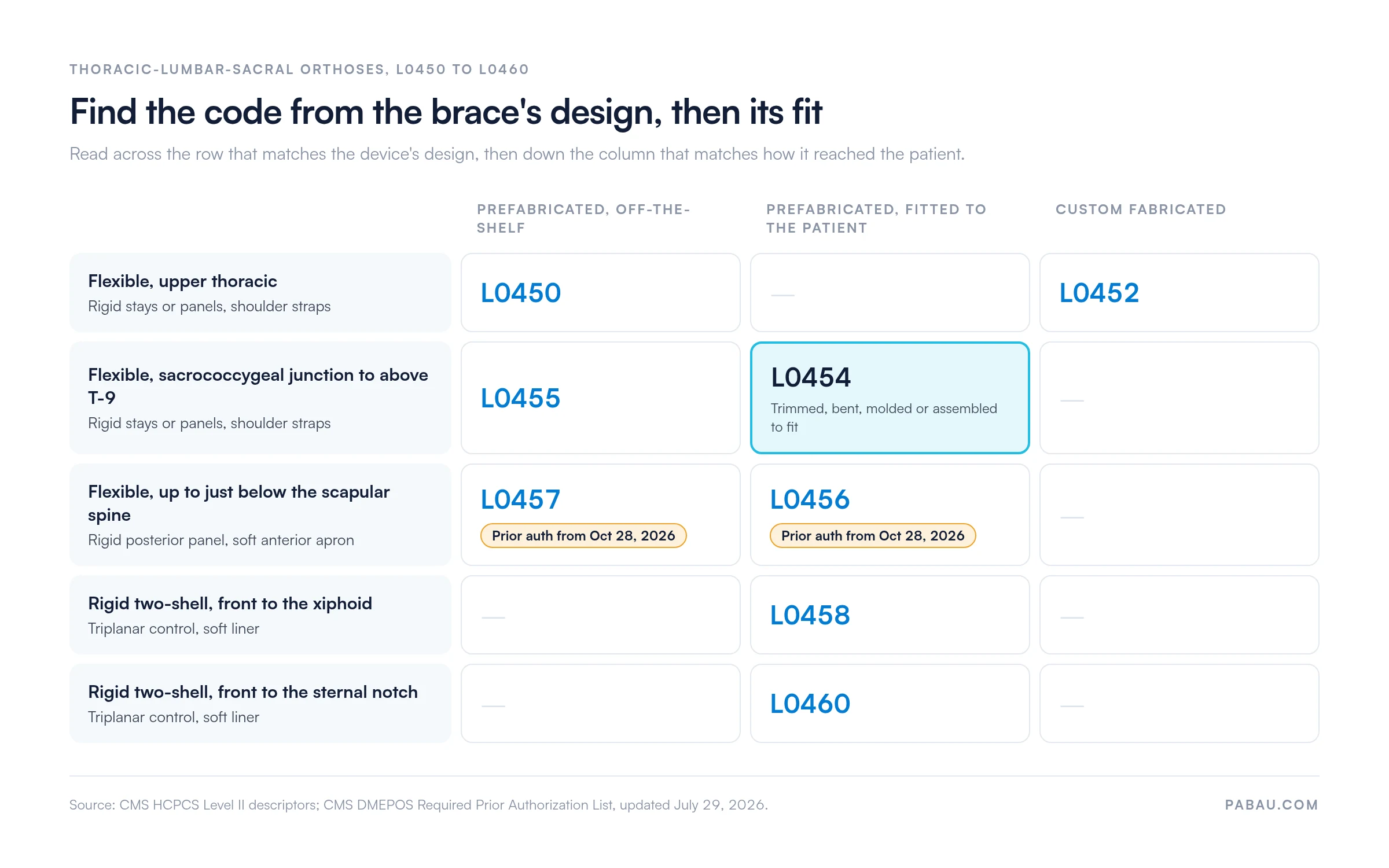
Grid of TLSO codes by design and fit
L0454 is the only flexible TLSO in the series that reaches above T-9 and is fitted by an expert. Descriptors from CMS HCPCS Level II, prior authorization dates from the CMS DMEPOS list.
Code Design Extent Fit Common mix-up
L0450 Flexible, rigid stays or panels, shoulder straps Upper thoracic region Prefabricated, off-the-shelf Billed for a brace that reaches down to the sacrococcygeal junction
L0452 Same design as L0450 Upper thoracic region Custom fabricated Billed for a prefabricated brace that was only adjusted
L0454 Flexible, rigid stays or panels, shoulder straps Sacrococcygeal junction to above T-9 Prefabricated, customized by an individual with expertise Billed when the brace only needed minimal self-adjustment
L0455 Same design as L0454 Sacrococcygeal junction to above T-9 Prefabricated, off-the-shelf Billed as L0454 with no fitting work on record
L0456 Flexible, rigid posterior panel, soft anterior apron Sacrococcygeal junction to just below the scapular spine Prefabricated, customized by an individual with expertise Billed as L0454 when the rigid posterior panel is overlooked
L0457 Same design as L0456 Sacrococcygeal junction to just below the scapular spine Prefabricated, off-the-shelf Dispensed without the prior authorization Medicare now requires
L0458 Triplanar control, modular, two rigid plastic shells, soft liner Front from the symphysis pubis to the xiphoid Prefabricated, fitted and adjusted Billed for a flexible brace that has stiff panels
L0460 Same design as L0458 Front from the symphysis pubis to the sternal notch Prefabricated, fitted and adjusted Swapped with L0458 when nobody measures the front height

In practice, the L0454 versus L0455 call causes the most rework. Same brace, same box, and the only difference is what happened at the fitting. The L0456 mix-up now costs more, too. Since October 28, 2026, Medicare wants prior authorization for L0456 and L0457 before delivery.

Higher up the series, the codes stop being flexible braces at all. L0458 and L0460 are two-shell rigid systems, and L0452 is built from scratch for one patient. Check the current descriptors in the CMS HCPCS Level II files each January, when annual updates land.

Medicare covers L0454 for four reasons under LCD L33790

Medicare covers L0454 under Part B as an orthotic item, using LCD L33790, Spinal Orthoses: TLSO and LSO. All four DME MAC jurisdictions use that one policy. CGS runs Jurisdictions B and C, and Noridian runs A and D, so the same rules apply nationally.

The LCD covers a spinal orthosis ordered for one of these indications:

  • To reduce pain by restricting mobility of the trunk
  • To facilitate healing following an injury to the spine or related soft tissues
  • To facilitate healing following a surgical procedure on the spine or related soft tissue
  • To otherwise support weak spinal muscles and/or a deformed spine

L33790 sets those indications and no diagnosis list. The ICD-10-CM codes below are examples of conditions charts often document under each one. Always code to the highest specificity the FY2026 tabular list allows.

LCD indication Example ICD-10-CM codes Coding note
Pain from trunk motion M51.16, M51.17 (intervertebral disc disorders with radiculopathy, lumbar and lumbosacral); M48.061, M48.062, M48.07 (spinal stenosis); M96.1 (postlaminectomy syndrome) M48.06 is no longer valid on its own. Pick M48.061 or M48.062 by whether neurogenic claudication is present.
Pain from disc degeneration M51.360-M51.369 (lumbar), M51.370-M51.379 (lumbosacral) M51.36 and M51.37 took 6th characters on October 1, 2024, based on where the pain sits.
Healing after spinal injury S22.0- (thoracic vertebra fracture), S32.0- (lumbar vertebra fracture), S32.1- (sacrum fracture) Needs a 7th character for the encounter, such as A for initial or D for subsequent.
Weak muscles or deformed spine M41.- (scoliosis); M80.0- and M80.8- (osteoporosis with current pathological fracture) M80 means a fracture has already happened. Osteoporosis without a current fracture is M81.-.
Healing after spinal surgery The condition that was operated on The surgeon’s note should date the procedure and say why the brace supports healing.

A code on the claim doesn’t prove the indication. The treating practitioner’s note has to say why the patient needs the brace, in terms that match one of the four reasons.

The order, the fitting note and proof of delivery carry the claim

LCD L33790 needs a Standard Written Order (SWO) in the supplier’s hands before the claim is submitted. Where an item requires a Written Order Prior to Delivery, the signed SWO has to arrive before the brace goes to the patient. The LCD sets no face-to-face requirement for this code.

A complete L0454 file usually holds four documents:

  • The SWO. It names the patient, the order date, the item, the quantity and the treating practitioner, with their signature.
  • The treating practitioner’s notes. They show the diagnosis and which of the four indications the brace serves.
  • The fitting record. It says what was trimmed, bent, molded or assembled, and who did the work.
  • Proof of delivery. It is signed and dated by the patient or their representative, and it names the item delivered.

Keep the manufacturer, model number and product sheet on file too. A reviewer who sees a stiff posterior panel in the product photo will ask why you didn’t bill L0456. A rigid posterior frame paired with a soft anterior apron points to the L0466 TLSO instead.

L0454 needs no prior authorization, but check the list anyway

L0454 isn’t on the CMS Required Prior Authorization List for DMEPOS. The spinal codes on it were L0631, L0637, L0639, L0648, L0650 and L0651. On October 28, 2026, CMS added the TLSOs L0456, L0457 and L0486 nationwide.

CMS updates that list without much warning, so check it before you dispense. Other payers set their own rules:

  • Medicare Advantage plans often require authorization for orthoses even when traditional Medicare doesn’t. Check the plan’s portal.
  • Commercial payers vary by plan and sometimes by dollar amount. Confirm the rule in writing before delivery.
  • Medicaid rules are set by each state program or its managed care plans. Call the plan if its policy isn’t published.

The CG modifier is the one L0454 needs on Medicare claims

Policy article A52500 requires the CG modifier on L0450, L0454 and L0455. It applies to an item made mainly of nonelastic material or one with a rigid posterior panel. A claim without it is coded incorrectly, even when the rest of the file is perfect.

Modifier Meaning When to use it on L0454
CG Policy criteria applied Required by A52500 on L0454 claims to Medicare
GA Waiver of liability statement (ABN) issued as required You expect a medical necessity denial and the patient signed an ABN before delivery
GZ Item expected to be denied as not reasonable and necessary, no ABN on file You expect a denial but have no signed ABN, so the supplier carries the cost
GY Item statutorily excluded or outside a benefit category The brace falls outside the orthotics benefit, for example when used for comfort only
RA Replacement of a DME, orthotic or prosthetic item The patient’s brace was lost, stolen or damaged beyond repair; document why
RB Replacement of a part furnished as part of a repair You replace a strap, panel or closure during a covered repair

Look up the L0454 allowable on the DMEPOS fee schedule

Medicare pays L0454 from the DMEPOS fee schedule, which CMS updates each year and sets by state. Rather than print a figure that will date, use the CMS DMEPOS fee schedule files to find the current allowable for your state.

  • The 80/20 split. Medicare pays 80% of the approved amount once the Part B deductible is met. The patient or a secondary payer owes the other 20%.
  • Assignment. Participating suppliers accept assignment on every claim. A non-participating supplier decides claim by claim, and on an unassigned claim the patient pays the supplier and Medicare reimburses the patient.
  • Competitive bidding. No bidding contracts are in force right now. The program has been in a temporary gap period since January 1, 2024, and the next round targets 2028.

Here’s how an L0454 claim moves from order to payment

Each step below feeds the next, and a miss early on shows up as a denial weeks later.

  1. The order arrives. Check that the SWO lists every required element before you schedule a fitting.
  2. The brace is chosen. Match the product to the descriptor, height and panels included, and note the model number.
  3. The fitter customizes it. They write down what they changed, so the record supports L0454 over L0455.
  4. The patient signs for it. Proof of delivery is dated the same day the brace leaves your hands.
  5. The claim is built. It carries L0454, the CG modifier, the diagnosis that matches the indication, and any GA or GZ that applies.
  6. The remittance comes back. Read the denial reason on any rejected line, fix the cause, and resubmit or request a reopening.

Run this checklist before you submit

  • The brace runs from the sacrococcygeal junction to above T-9 and has no rigid posterior panel with an apron.
  • The fitting record shows more than minimal self-adjustment, done by someone with expertise.
  • The SWO was on file before the claim, with the practitioner’s signature.
  • The notes name one of the four LCD indications.
  • The diagnosis code is valid on the date of service, with every required character.
  • The claim line carries CG, plus GA or GZ if you expect a denial.
  • Proof of delivery is signed and dated.
  • The claim goes out within 12 months of the date of service.

Common mistakes that get L0454 claims denied

Most L0454 denials trace back to the wrong code, a missing modifier or a thin record. The table pairs each one with the fix.

Mistake What went wrong Fix
Missing CG modifier The biller left CG off a Medicare L0454 line Add CG and resubmit; build it into the claim template for this code
No indication in the notes The chart names a diagnosis but not why the brace is needed Ask the practitioner for notes that tie the brace to one of the four indications
L0454 billed for an off-the-shelf brace No fitting work is on record Rebill as L0455, or add the fitting record if the work was done
Wrong neighbor code The brace has a rigid posterior panel and apron, so it’s L0456, or rigid shells, so it’s L0458 or L0460 Recode from the descriptor; for L0456, check that prior authorization was affirmed
Order or delivery proof missing No SWO before the claim, or no signed delivery record Hold claims until both documents are scanned to the patient’s file
Timely filing missed The claim went out more than 12 months after the date of service There’s no fix after the deadline; track claim age weekly

A steady denial management process catches the same mistake before it repeats across a month of claims. Track each denial reason, find where it entered the workflow, and change that step.

Pro Tip

Set a timely filing alert 60 days before each payer’s deadline on every L0454 claim. Medicare’s one-year window sounds generous, but a medical necessity appeal can take months, and a late first claim leaves no room for one.

How Pabau keeps L0454 claims clean from order to remittance

Many practices still keep the order in one folder, the fitting note in another and the claim in a third system. When a payer asks for records, someone pulls all three together by hand.

Pabau, a practice management platform with built-in insurance billing, keeps those pieces on the patient record. In the US, its claims management tools submit CMS-1500 and 837P claims through Claim.MD. Your team can also run eligibility checks and post ERA remittances there.

Prior authorization is tracked on the patient’s case, with the auth code, dates and a warning when one is missing. That matters now that L0456 and L0457 need authorization, so a brace swap at the fitting doesn’t slip through unapproved.
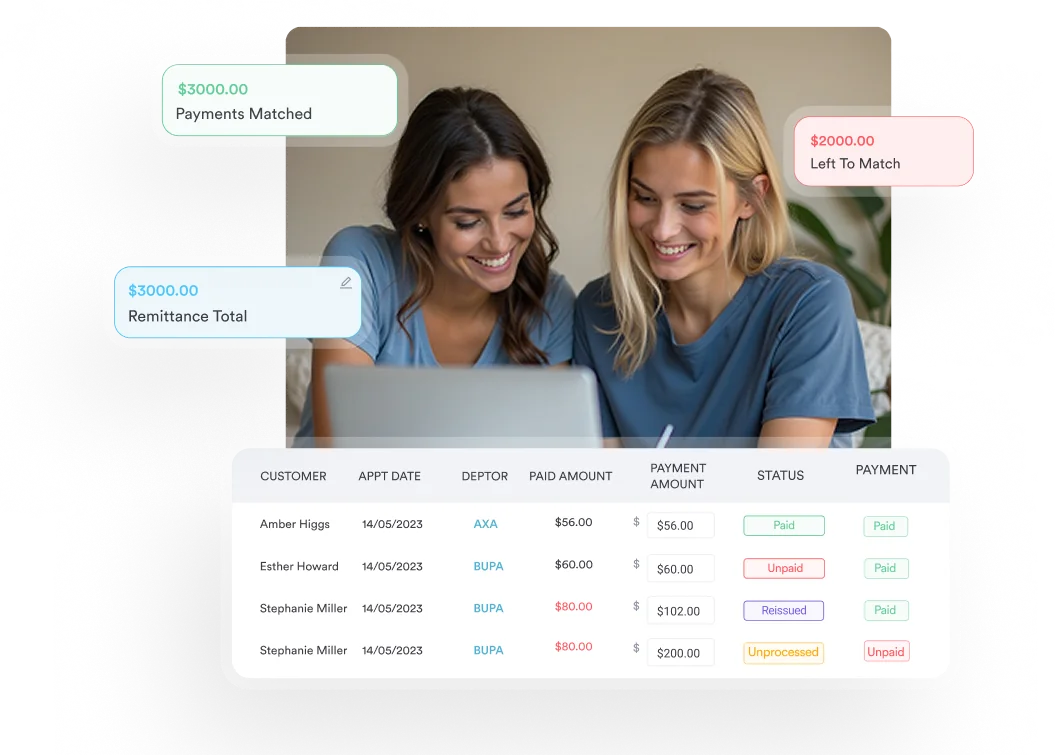

Fully Integrated with Pabau Billing
Pabau’s billing keeps the L0454 claim, its diagnosis and the patient’s documents on one record, so you answer a records request from one screen.

Send L0454 claims with the paperwork attached

Pabau submits US claims through Claim.MD, checks eligibility and posts ERA remittances. Orders, authorizations and patient documents stay on the same record as the claim.

Pabau claims management dashboard

Conclusion

L0454 is won or lost at the fitting. If your fitter customizes the brace and writes down what they did, the code holds up. If the brace goes out of the box as it came, L0455 is the honest code, and it holds up in an audit.

Make the fitting note, the SWO and the CG modifier routine, and most denials on this code disappear. Watch the neighbors as well, since a brace that turns out to be L0456 now needs approval before it leaves the room.

Book a demo to see how Pabau keeps orders, authorizations and orthotic claims on one patient record.

Continue your research

Continue your research

Seeing the same denial reason every month? Denial management in healthcare sets out how to trace each denial back to the step that caused it.

Want claims paid on the first pass? Clean claim submission lists what must be complete before a claim reaches the payer.

Billing the off-the-shelf version instead? HCPCS code L0457 covers the off-the-shelf TLSO with a rigid posterior panel, now on prior authorization.

Reviewing your compliance program? Medical billing compliance covers the audits and controls that keep claims defensible.

Training a new biller? What is medical billing explains the claim cycle from patient encounter to payment.

Frequently asked questions

Is a TLSO the same as a back brace?

A TLSO is one type of back brace. It covers the thoracic, lumbar and sacral spine. That means it reaches higher up the back than a lumbar-sacral orthosis (LSO), which has its own HCPCS codes.

What does sagittal plane control mean on a brace?

It means the brace limits bending forward and backward. A triplanar brace, such as L0458, also limits side bending and twisting, which is why it uses rigid shells instead of flexible panels.

Does Medicare rent or buy a back brace?

Medicare pays for spinal orthoses like L0454 as purchases, not rentals. The patient keeps the brace, and later replacements or repair parts are billed with modifiers such as RA or RB.

Do Medicare Advantage plans follow LCD L33790?

Medicare Advantage plans must cover what traditional Medicare covers, but they set their own authorization and network rules. Check the plan’s orthotics policy before you dispense, even when traditional Medicare wouldn’t ask for approval.

Who can fit an L0454 brace?

The descriptor calls for an individual with expertise, such as a certified orthotist or a trained fitter. Their note should say what they changed, because that work separates L0454 from L0455.


×