

HCPCS code E0198: Water pressure pad billing guide
HCPCS code E0198 is a water pad for a standard mattress HCPCS code E0198 is the ...

Last Updated: Oct 13, 2026
L0492 is the HCPCS Level II code for tlso, sagittal-coronal control, modular segmented spinal system, three rigid plastic shells, posterior extends from the sacrococcygeal junction and terminates just inferior to the scapular spine, anterior extends from the symphysis pubis to the xiphoid, soft liner, restricts gross trunk motion in the sagittal and coronal planes, lateral strength is provided by overlapping plastic and stabilizing closures, includes straps and closures, prefabricated, includes fitting and adjustment.
One clause in the descriptor decides most of these claims. L0492 restricts the sagittal and coronal planes only, and rotation stays unrestricted.
Read that clause wrong and the code stops matching the device, which is where denials and audit letters begin.
Let Pabau's smart automation suggest the right codes, reduce claim denials, and keep your practice compliant—effortlessly.
Automate repetitive tasks and focus on what matters most—your patients.
Reduce coding errors and ensure compliance with the latest regulations.
Clean claims, fewer denials, and faster reimbursements.
Powerful insights and reporting to help your practice thrive.
HIPAA compliant SOC 2 certified GDPR-compliant Trusted by 4,000+ clinics worldwide

L0492 covers a prefabricated TLSO with three rigid plastic shells that restricts trunk motion in the sagittal and coronal planes only.
Shell count separates the family. L0490 uses one rigid shell, L0491 uses two and L0492 uses three, and all three are prefabricated.
Rotational control sits in a separate range. L0462 and L0464 are prefabricated triplanar codes, and L0480 is custom fabricated.
A standard written order must reach the supplier before the claim is submitted, and the orthotist’s record must describe the fitting modifications.
Practice management software like Pabau helps orthotic practices capture order and fitting records before an L-code claim goes out.
HCPCS code L0492 is the Level II code for a prefabricated TLSO with three rigid plastic shells. The device is a modular segmented spinal system, so the shells assemble rather than mold as one piece. It restricts gross trunk motion in the sagittal and coronal planes, and fitting at delivery is part of the code.
The code sits in the L0450 to L0492 range of TLSO codes, a set the Centers for Medicare and Medicaid Services (CMS) maintains. L0492 is a DMEPOS code, so DME MAC policy governs coverage rather than the physician fee schedule. That one fact decides where the claim goes and which rules apply to it.
The official long descriptor reads as one long sentence, yet each clause does separate work. It is broken out below in order, with what each part means for coding.
Trunk motion is described in three planes, not four. Flexion and extension both happen in the sagittal plane. Side bending happens in the coronal plane. Axial rotation happens in the transverse plane.
Reading “flexion, extension, lateral and rotational control” as four separate planes is a common coding error. L0492 restricts two of the three planes, and rotation is not one of them. A brace that restricts all three is triplanar, and triplanar braces carry different codes entirely.
Two features settle the code inside the L0450 to L0492 range. The first is how many planes of trunk motion the device restricts. The second is how many rigid plastic shells it has.
The grid below maps both features onto a single code, and the anterior termination point breaks any remaining tie.
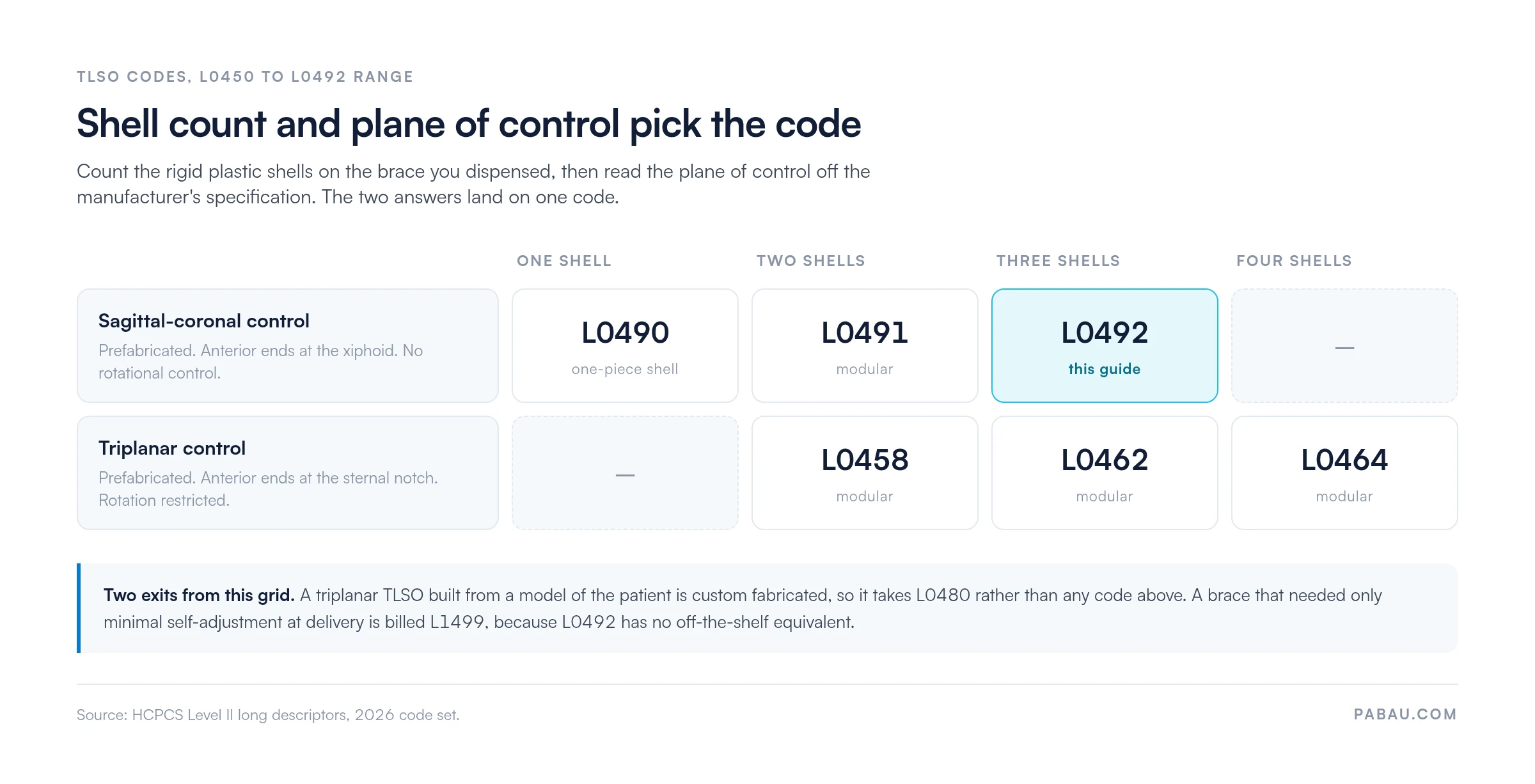
Take a patient braced after a T12 compression fracture. The orthotist dispenses a three-shell modular TLSO, trims the shells at delivery and records what was changed.
If the manufacturer’s specification says sagittal-coronal control, the claim goes out as L0492. If it says triplanar, the same brace becomes L0462, and its anterior section reaches the sternal notch rather than the xiphoid.
Billing a triplanar code for an L0492 device overstates what was dispensed, and that is the version auditors pursue. Billing L0492 for a triplanar device understates it and leaves reimbursement uncollected.
Check the model’s entry on the PDAC Product Classification List before the claim goes out.
Medicare covers L0492 under LCD L33790 (Spinal Orthoses: TLSO and LSO) and its related Policy Article A52500. The medical record has to show that the orthosis was ordered for at least one covered indication.
One indication is enough, but the treating practitioner has to document it. A diagnosis code on the claim line does not establish the indication by itself, and reviewers will ask for the note behind it.
Coverage also runs the other way. Five situations pull the claim off L0492 completely, and each one has a code of its own.
There is no single national figure to quote. Medicare pays L0492 from the DMEPOS fee schedule, which sets a national limitation amount adjusted by geographic pricing.
Spinal orthoses are purchase items, so rental modifiers do not apply. Verify current allowed amounts in the annual DMEPOS fee schedule file, because rates vary by MAC jurisdiction.
Because the file is updated annually, pull the current-year version before you set your charge master. A supplier still billing a 2024 fee in 2026 either leaves reimbursement uncollected or trips a charge-excess edit, depending on which way the rate moved.
Run a quarterly check of your L0492 charge master against the current CMS DMEPOS fee schedule file. Fee schedule amounts for orthotic codes change with each annual update. A charge below the current allowed amount leaves reimbursement uncollected. A charge above it can flag a compliance issue with some MAC jurisdictions.
A standard written order (SWO) must reach the supplier before the claim is submitted. LCD L33790 states that a claim billed without a completed SWO is denied as not reasonable and necessary. That rule applies to every code in the policy, L0492 included.
L0492 does not sit on the CMS required face-to-face encounter and written order prior to delivery list, and it does not require prior authorization. Among spinal orthosis codes, prior authorization applies to L0648 and L0650, plus L0631, L0637 and L0639 from August 12, 2024.
L0492 is classified as prefabricated custom fitted, so the fitting itself has to be evidenced. The CGS spinal orthoses documentation checklist sets out what the record must contain:
A certified orthotist means someone certified by the American Board for Certification in Orthotics and Prosthetics, or by the Board for Orthotist/Prosthetist Certification. Keep the records on file and available on request, because DME MAC reviewers ask for them on these codes.
A diagnosis code alone does not secure coverage. Medical necessity rests on the clinical record, and the diagnosis only has to line up with the indication the practitioner documented.
The codes below are the ones most often paired with L0492 claims. Check the payer’s current policy before you submit, because covered lists move with each LCD revision.
Policy Article A52500 names only one modifier in its modifiers section, and that one does not apply to L0492. The rest come from general DMEPOS billing rules, so check each against your DME MAC’s current instructions before you append it.
Modifier choice changes who carries the balance when a claim is denied. GA moves liability to the patient, but only when the notice was signed before delivery. GZ moves no liability at all, so the supplier absorbs the write-off. Pick the modifier at the fitting appointment, while the notice is still signable.
The order below puts every check ahead of the moment it could cost you the claim. Most L0492 denials are created before the brace is dispensed, long before anyone opens the billing screen.
Six questions catch the traps that produce most L0492 denials. Work through them while the chart is still open, because reworking a denied claim costs far more staff time than the check does.
One weak answer on that list is enough to hold the claim back. The wider set of conditions every DMEPOS claim has to satisfy is covered in our guide to clean claim requirements.
L0492 denials fall into three groups. The first is incomplete documentation. The second is code selection. The third is modifier use. Sorting each denial into one of the three, before anyone touches a corrected claim, saves the most time.
Two of these rows are the same mistake seen from opposite sides, so a single pre-submission check catches both. Match the dispensed model to its PDAC listing, and the shell count and plane of control follow from that.
Reading the remittance is a separate skill, and our guide to common denial codes helps your team decode the CARC and RARC entries.
Keep a one-page spec sheet for every TLSO model you stock. List the shell count, the plane of control, the anterior termination point and the PDAC-verified code. Coders then select the code from the sheet instead of from the brace name, which is where the L0490, L0491 and L0492 mix-ups usually start.
DME suppliers and orthotic practices billing L-codes face a records problem that a code lookup cannot solve. The written order, the fitting note and the proof of delivery all have to be on file for every patient. The right code and modifiers then have to be attached before the claim leaves the practice.
Practice management software like Pabau keeps those documents in the patient record rather than in a separate billing folder.
Pabau’s claims software for suppliers ties clinical documentation to the billing workflow. The records an L0492 claim needs are captured at the point of care, not chased afterwards.
For orthotic practices, Pabau supports the L0492 billing cycle at three points:
Fewer claims then sit in a hold queue waiting for a document someone has to go and find.

Pabau helps DME suppliers and orthotic practices track written orders, document fittings, and submit claims with the right codes and modifiers attached. See how it works for HCPCS L-code billing.

L0492 rewards a supplier who checks two physical facts before the paperwork starts. Count the rigid plastic shells, then confirm the brace restricts the sagittal and coronal planes without limiting rotation. Three shells and two planes of control point to L0492, and any other combination points somewhere else.
The documentation side is just as mechanical. The written order, the fitting note and a chart entry naming a covered indication carry most of these claims through review. Build that check into the fitting appointment, and the denial rate falls without anyone chasing it.
How quickly your team can produce those three records is what decides the rest. Book a demo to see how Pabau keeps L0492 documentation attached to the claim it supports.

Need to understand the broader HCPCS billing landscape? Medical billing fundamentals covers the end-to-end process from patient encounter to paid claim.
Dealing with recurring claim rejections? Denial management in healthcare explains how to build a systematic workflow for resolving and preventing DMEPOS claim denials.
Want to understand what makes a DMEPOS claim payable? Clean claim requirements outlines the conditions a claim must meet before it reaches adjudication without triggering an edit.
The billing entity needs an active Medicare DMEPOS supplier number and has to meet the supplier standards. Accreditation and a surety bond are part of that, though some licensed professionals who dispense to their own patients are exempt from accreditation. A physician practice that fits braces itself still bills the DME MAC.
DME MACs check the beneficiary’s history for the same or similar equipment. A TLSO already on file will deny the new one, even where the clinical need has changed. Check eligibility in your MAC’s portal before dispensing, and document why the replacement is needed.
No. An orthosis supplied during an inpatient stay or a Part A skilled nursing stay is included in the facility’s payment. Suppliers may deliver up to two days before discharge so the brace can be fitted, and the date of service is then the discharge date.
You have 120 days from the date on the remittance advice to request a redetermination from the DME MAC. That is the first of five appeal levels. Send the written order, the fitting note and proof of delivery with the request.



