CCSD code H4430: Examination of rectum under anaesthetic
CCSD code H4430 pays for the examination alone CCSD code H4430 is the UK private...

Last Updated: Oct 20, 2026
K0886 is the HCPCS Level II code for power wheelchair, group 4 heavy duty, multiple power option, sling/solid seat/back, patient weight capacity 301 to 450 pounds.
The beneficiary still gets the chair. The supplier bills it as an upgrade, with a covered code on a second claim line. Payment follows that second line. Put the wrong code or modifier on either one and the claim stalls.
Let Pabau's smart automation suggest the right codes, reduce claim denials, and keep your practice compliant—effortlessly.
Automate repetitive tasks and focus on what matters most—your patients.
Reduce coding errors and ensure compliance with the latest regulations.
Clean claims, fewer denials, and faster reimbursements.
Powerful insights and reporting to help your practice thrive.
HIPAA compliant SOC 2 certified GDPR-compliant Trusted by 4,000+ clinics worldwide

HCPCS code K0886 covers a group 4 heavy duty power wheelchair with multiple power options, rated for 301 to 450 pounds.
The range is bounded at both ends, so a beneficiary over 450 pounds cannot be coded to K0886.
Medicare’s Power Mobility Devices LCD (L33789) denies every group 4 chair as not reasonable and necessary.
Suppliers bill K0886 as an upgrade, pairing it with a covered code such as K0862 on a second claim line.
K0886 is not on the CMS Required Prior Authorization List, though the covered group 3 code billed beside it usually is.
The official CMS long descriptor reads: power wheelchair, group 4 heavy duty, multiple power option, sling/solid seat/back, patient weight capacity 301 to 450 pounds. Each element of that string has to hold. Miss one and the chair belongs under a different code.
K0886 sits in the K0800 to K0899 block, which covers wheelchairs and power mobility devices. The DME MACs maintain the K-code series for durable medical equipment, prosthetics, orthotics, and supplies (DMEPOS).
The multiple power option designation separates K0886 from the rest of its weight tier. An MPO chair carries powered seating functions beyond drive control, such as power tilt with power recline or elevating legrests.
Each of those functions has to be verified. As CGS Medicare’s PDAC coding verification guidance sets out, a chair has to sit on the PDAC product classification list first. Only then can a supplier bill it under K0886.
Meeting every element of that descriptor still will not get the claim paid. That is where K0886 stops behaving like an ordinary code.
Medicare denies K0886 on medical necessity grounds. The Power Mobility Devices LCD (L33789) lists all eleven group 4 codes, running from K0868 through K0886. It says their added capabilities are not needed for use in the home. Any claim for one of them is denied as not reasonable and necessary.
That is a coverage rule rather than a documentation problem, so a thicker file will not reverse it. The beneficiary can still receive the chair.
Payment flows through the covered equipment the practitioner would otherwise have ordered. For a 301 to 450 pound patient needing multiple power options, that is usually K0862.
The covered code on the second claim line carries the full weight of the LCD. Every criterion below applies to it, not to the group 4 chair the beneficiary takes home.
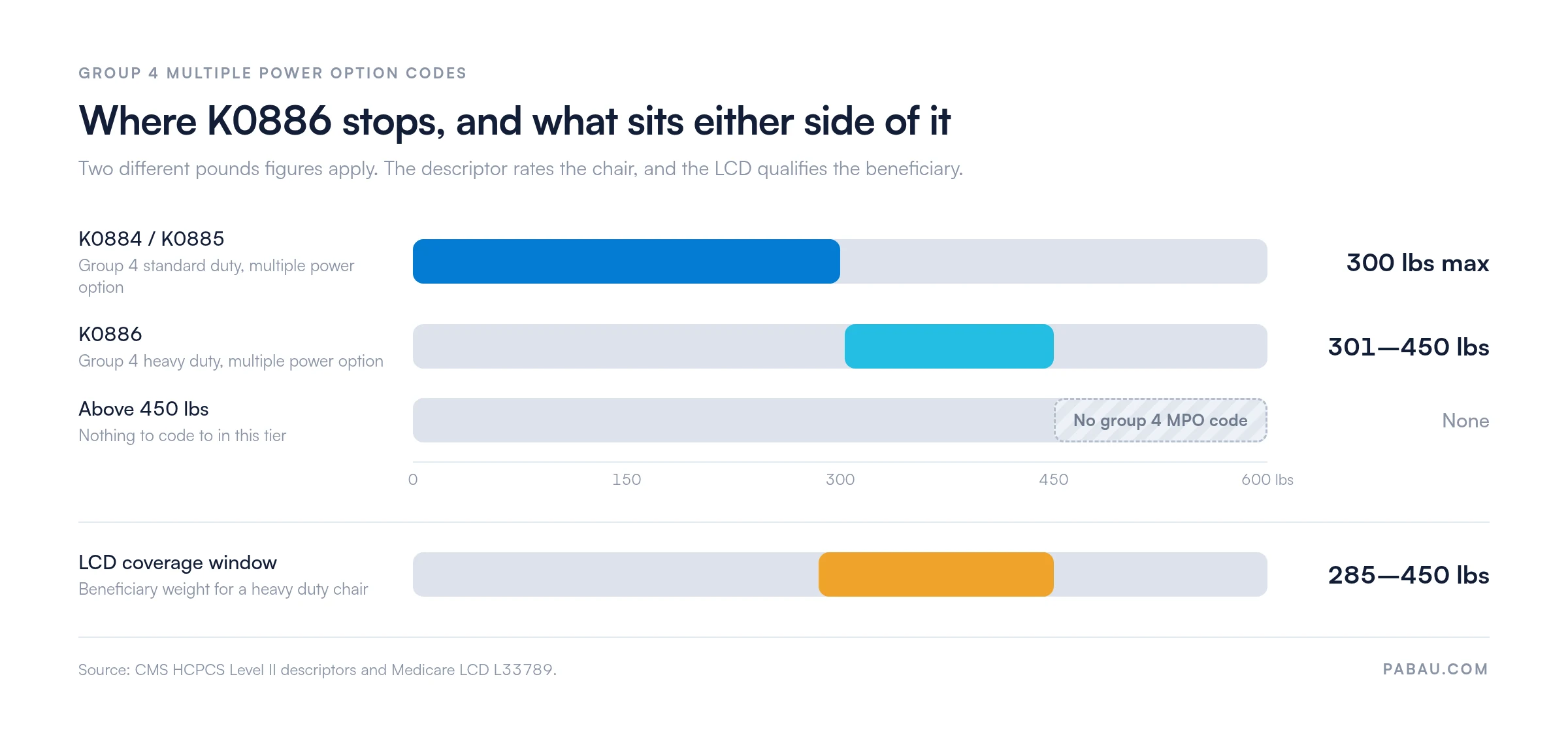
That 285 pound figure looks like a contradiction, but the two numbers answer different questions. The descriptor’s 301 to 450 pounds is the chair’s rated patient weight capacity. The LCD’s 285 to 450 pounds is the beneficiary weight range that justifies a heavy duty chair. That floor sits at 95% of the next lower class capacity.
Laid out on one scale, the tiers and the coverage window line up like this.
LCD language varies slightly by jurisdiction, so check the version published by the contractor that serves your region. That is Noridian for Jurisdictions A and D, or CGS for Jurisdictions B and C.
K0886 is not on the CMS Required Prior Authorization List. The power mobility codes on that list are K0800 to K0802, K0806 to K0808, K0813 to K0829, K0835 to K0843, and K0848 to K0864. Group 4 and group 5 chairs are absent from it.
That absence is easy to read as good news. The covered code billed alongside K0886 is very often K0862. K0862 has required prior authorization nationwide since July 22, 2019. So the request still has to go in. It attaches to the covered chair rather than to the upgrade.
The request goes to the DME MAC for the beneficiary’s region, and the file has to be complete before it lands.
Nearly every document in that request comes out of the same file, and two of the rules governing it changed recently.
The detailed written order became the standard written order (SWO) for dates of service on or after January 1, 2020. Certificates of Medical Necessity were discontinued for dates of service on or after January 1, 2023. A CMN no longer belongs in a power wheelchair file.
The face-to-face window moved as well. CMS now requires the encounter within the 6 months preceding the date of the SWO, not within 45 days. Plenty of supplier templates still carry the 45 day version, so check the one your team works from.
Proof of delivery is the document most often cited as missing in power wheelchair audits. Capture the signature at dispensing, record the serial number, and confirm the address on file still matches.
Keeping the order, the evaluation, and the delivery record together is what makes the claim defensible a year later.
Run this the day the claim goes out, not the week after it denies. Each line is something an auditor asks for.
The fee schedule holds no usable allowance for K0886, because the group 4 line is denied. Medicare’s payment is based on the covered code billed with the GK modifier. The beneficiary covers the difference between the supplier’s charge for the group 4 chair and that allowance.
The covered chair is where the fee schedule work happens. Use the CMS DMEPOS fee schedule to find the current allowed amount for that code in the specific service location. Rates vary by state and by competitive bidding area, and they change annually. Never quote a fixed figure in patient-facing material.
Complex rehabilitative power wheelchairs, which include K0835 to K0843 and K0848 to K0864, can be rented or purchased. The supplier has to offer the purchase option when the chair is first furnished. No rental payment is made for the first month until the DME MAC is told the option was given.
Rental payment for a power wheelchair runs on its own percentages. Months 1 through 3 pay 15% of the purchase price, and months 4 through 13 pay 6%. Payment stops after the thirteenth month, and title transfers to the beneficiary.
The first decision is the upgrade pair. It tells the DME MAC which line holds the denied chair and which holds the covered one. The second is the rental or purchase modifier on the covered line. Modifier errors are the most common technical failure on these claims.
An upgrade is an item with features beyond what the practitioner ordered and beyond what the LCD covers. A group 4 chair is exactly that. The supplier bills two lines at full charge. One covers the chair provided, and the other covers the chair Medicare will pay for.
Take a beneficiary at 380 pounds who needs multiple power options. The first-month claim would read K0886 GA on line one, then K0862 KX GK on line two. K0886 never carries KX, because a group 4 chair cannot meet the LCD’s criteria by definition.
Once the covered code is on the claim, it needs the modifier set that matches how the beneficiary took the chair. The supplier records that decision at the first furnishing.
The KH modifier is no longer required on purchased wheelchairs and accessories for dates of service on or after October 1, 2018. A purchase now reads NU and BP, plus whatever the LCD requires.
Before you bill a group 4 chair, price the same configuration under the covered group 3 code. Show the beneficiary both numbers on the ABN. The difference is what they are agreeing to pay. Putting it in writing at fitting prevents the collections argument that follows a denied upgrade.
The sequence rarely varies, and each step feeds the one after it.
Work the remittance the week it lands. Handling denials as they appear beats appealing in bulk later, and denial management covers how to build that routine.
The group 4 family turns on three variables: the power option count, the seating system, and the weight tier. Eleven codes cover every combination CMS recognizes. The full K0800 series, with current descriptors, sits in our HCPCS code library.
Two codes that often turn up in K0886 discussions do not exist. K0887 and K0888 are not valid HCPCS codes, and no captain’s chair variant of K0886 exists in this weight and power tier.
K0884 and K0885 sit one tier below K0886 rather than beside it. Both are group 4 standard duty with multiple power options and a capacity up to and including 300 pounds.
K0884 has a sling or solid seat, and K0885 has a captain’s chair. Above 450 pounds the multiple power option route ends, leaving K0871 and K0880 to cover the 451 to 600 pound tier.
The wording of the descriptors is deliberate. CMS writes open-ended capacity when it means it, as in K0864’s 601 pounds or more. K0886 is written as a closed range, so 450 pounds is a ceiling and not a shorthand.
One more code gets pulled into these comparisons by mistake. K0800 is a power operated vehicle, group 1 standard, with a capacity up to and including 300 pounds. That is a scooter, not a power wheelchair, and it follows a different coverage pathway.
For the covered line, the group 3 multiple power option codes mirror the same weight tiers.
A K0886 claim depends on paperwork created weeks earlier by different people. Five documents have to be findable on the day the claim goes out. Those are the encounter note, the specialty evaluation, the ATP record, the signed ABN, and the proof of delivery.
Practice management software like Pabau keeps those records against the patient rather than in a shared drive.
Our claims software for practices holds the billing documentation and submits the claim from the same record. It is general billing software rather than a DMEPOS tool. The DME MAC prior authorization portal and PDAC verification stay outside it.
What that removes is the searching. Each month’s rental claim pulls from the same patient record, so staff are not rebuilding the documentation set from scratch. The audit trail stays in one place.

Pabau, our practice management software, stores clinical documentation against the patient record and submits the claim from the same place. See how that shortens the file hunt before a DMEPOS claim goes out.

K0886 is one of the few codes where coding it correctly still produces a denial, by design. Two numbers keep the claim straight. Those are 450 pounds as the descriptor’s ceiling, and 285 pounds as the LCD’s floor.
Before the chair leaves the warehouse, confirm the PDAC coding, the covered code for line two, and the signed ABN. After that, the file is what defends the claim. Keep the encounter note, the evaluation, and the delivery record current under the 6 month and SWO rules.
If your practice bills these every month, holding the documentation and the claim in one record removes most of the searching. Book a demo to see how Pabau keeps the K0886 file together, from the encounter note through to the remittance.

Need a broader overview of how DMEPOS medical billing works? What is medical billing explains the end-to-end claims process from code selection through payment posting.
Want a routine for the denials these claims generate? Denial management in healthcare covers how to investigate adjustment reason codes and build a systematic appeals workflow.
Looking for a full reference on DMEPOS denial codes? Denial codes in medical billing sets out the most common claim adjustment reason codes and how to respond to each one.
Checking whether the beneficiary is in traditional Medicare? Insurance eligibility verification walks through confirming coverage and plan rules before the equipment is ordered.
Want the wider compliance picture behind these files? Medical billing compliance covers the documentation and audit standards that DMEPOS claims are measured against.
Usually not. Medicare pays for a power wheelchair used in the beneficiary’s home. A hospital or skilled nursing facility does not count as a home. A chair for a resident there falls outside the benefit. The facility is expected to supply what the resident needs.
Not always. A Medicare Advantage plan covers at least what original Medicare covers. It still sets its own prior authorization rules and supplier network. Verify the plan’s requirements before delivery, because an out-of-network supplier may not be paid at all.
The reasonable useful lifetime for a power wheelchair is 5 years from the delivery date. Inside that window, replacement is covered only if the chair is lost, stolen, or irreparably damaged. A change in the beneficiary’s condition also qualifies. Ordinary wear is not a covered reason.
The supplier does. During the capped rental period, repairs and maintenance sit with the supplier, and Medicare makes no separate payment for them. Once title transfers to the beneficiary after month 13, Medicare covers reasonable and necessary repairs to the chair they now own.