HCPCS Code G0163: Skilled nursing observation and assessment
What is HCPCS Code G0163? HCPCS Code G0163 is a deleted Level II code for skille...

Last Updated: Oct 15, 2026
L0130 is the HCPCS Level II code for cervical, flexible, thermoplastic collar, molded to patient.
Let Pabau's smart automation suggest the right codes, reduce claim denials, and keep your practice compliant—effortlessly.
Automate repetitive tasks and focus on what matters most—your patients.
Reduce coding errors and ensure compliance with the latest regulations.
Clean claims, fewer denials, and faster reimbursements.
Powerful insights and reporting to help your practice thrive.
HIPAA compliant SOC 2 certified GDPR-compliant Trusted by 4,000+ clinics worldwide

L0130 covers a cervical flexible thermoplastic collar that is heat-molded to the patient at the fitting.
A prefabricated collar in a stock size belongs under L0120, so billing L0130 for one is upcoding.
The code bills under the DMEPOS benefit, so the allowed amount comes from the DMEPOS fee schedule and moves by MAC jurisdiction.
Medicare expects a signed order, a standard written order before delivery, a fitting record, and signed proof of delivery.
Practice management software like Pabau pre-fills the claim from the patient record and checks required fields before you submit.
L0130 describes a cervical, flexible, thermoplastic collar molded to patient. The Centers for Medicare and Medicaid Services (CMS) HCPCS program maintains that long descriptor in the Level II L-series, the section for orthotic devices. Four conditions have to hold at once.
Because the claim goes to the DMEPOS benefit rather than the physician fee schedule, a different set of rules applies. It decides which Medicare Administrative Contractor (MAC) processes the claim. It also decides which Local Coverage Determination (LCD) sets the coverage criteria you have to meet.
The molding is the clinical differentiator, and it doubles as the audit trigger. A collar that arrives prefabricated in small, medium and large will not qualify, no matter how neatly it sits. Your fitting record has to show that the thermoplastic was heated and shaped on the patient.
Rigidity narrows the choice to a pair, and the fabrication detail picks the code from there. Run those two questions in order and the cervical orthosis series stops being confusing.
The chart below is the same sequence a reviewer works through.
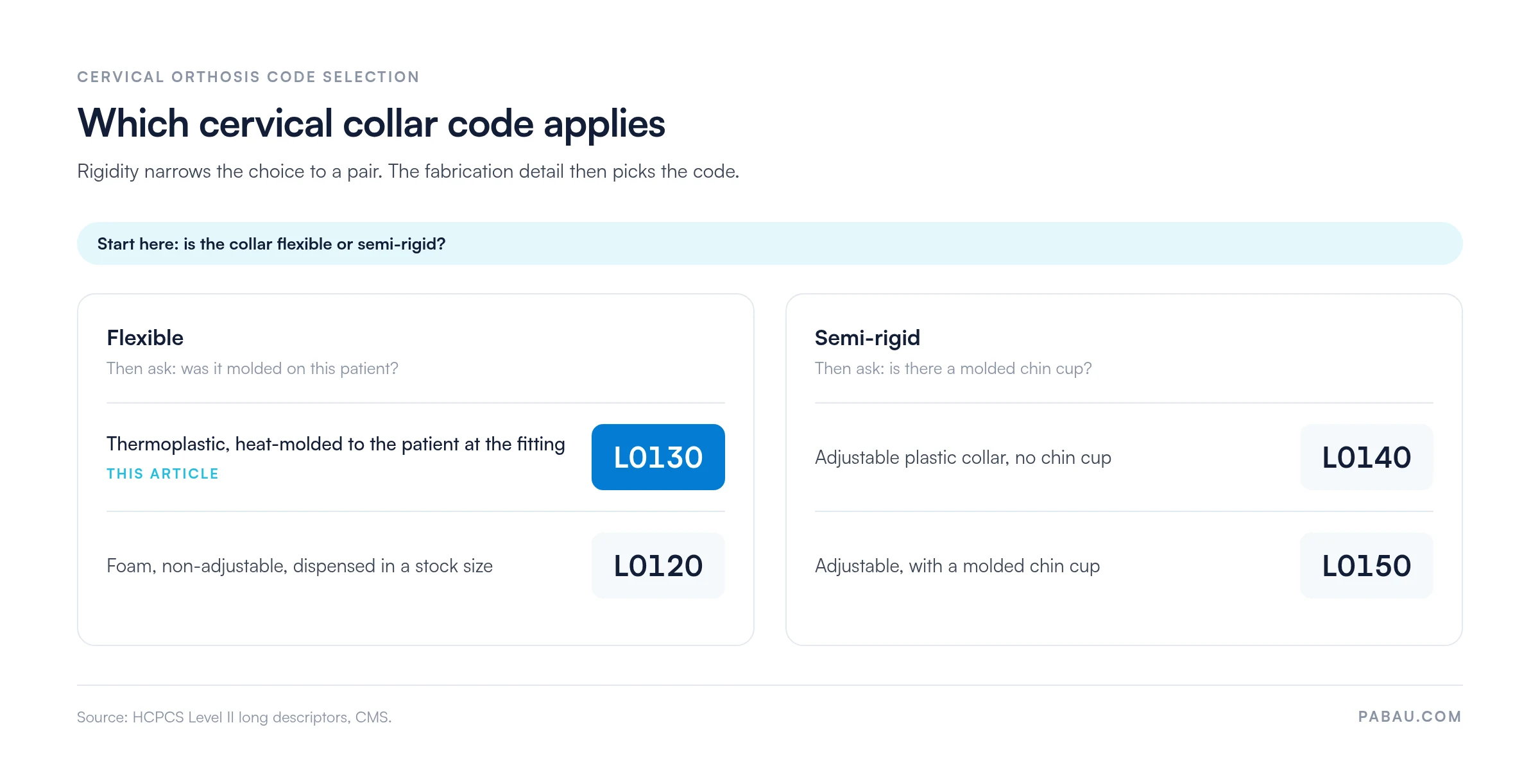
Choosing the wrong code inside this series is one of the more common DMEPOS compliance errors. The Pricing, Data Analysis and Coding (PDAC) contractor publishes coding articles that define each code’s qualifying features. Check current PDAC guidance for your specific product before you bill it.
So the practical test is short. A foam collar pulled off the shelf is L0120. A thermoplastic collar heated and shaped at the appointment is L0130. Billing L0130 for a prefabricated foam collar is upcoding, and cervical orthoses have already drawn CMS compliance review attention.
Custom cervical work outside this group carries its own code. An infant cranial orthosis for congenital torticollis, for example, bills under L0112.
There is no single national figure for L0130. The allowed amount comes from the DMEPOS fee schedule, which CMS updates every January, and it varies by MAC jurisdiction. A supplier in Jurisdiction A will not see the rate a supplier in Jurisdiction D sees.
Pull the current allowed amount for your own region from the CMS DMEPOS fee schedule before you quote a patient a figure.
Participation status changes what you can collect. Participating suppliers accept assignment on every claim, bill Medicare directly, and take the 20% coinsurance from the beneficiary. Non-participating suppliers decide claim by claim, and limiting charge rules cap what they can collect above the approved amount.
Check your MAC jurisdiction’s current DMEPOS fee schedule before you submit. Rates change every January 1, and quoting last year’s allowed amount can leave you with a balance-billing problem if this year’s figure came down.
Six documents carry an L0130 claim, and a missing one is the usual reason a clean-looking claim comes back.
CMS has already run cervical orthoses compliance reviews looking at excessive units and reasonable useful lifetime. So treat the record set as part of dispensing, in the same way you treat the fitting.
That sentence does not separate L0130 from a prefabricated code, so a reviewer cannot use it. What MACs want is the reason off-the-shelf sizing would not have worked.
Atypical cervical anatomy does that job. So does prior surgical hardware, or a documented failure of a prefabricated collar to hold the neck still. One specific line in the clinical note is worth more than a page of general findings.
Having the six documents on file is one half of the job. The other half is when each one gets created, because a date out of step stays visible to a reviewer years later.
Five moments decide it:
Three problems account for most L0130 denials. A missing KX modifier, a diagnosis code that is not on the LCD list, and an order dated after delivery. All three are sequencing problems, and sequencing costs far less to fix upfront than to appeal afterwards.
With the sequence handled, the next risk sits on the claim line itself. Five rules cover most of it: units, replacement timing, modifiers, place of service, and the beneficiary notice.
Correct coding runs through the four regional DME MACs. The AAPC HCPCS code reference and your MAC’s own coding articles are the sources worth trusting.
The setting on the claim can decide whether a code is payable at all. HCPCS code C1764 is reportable only in hospital outpatient departments and ambulatory surgical centers, so a physician office claim carrying it is denied.
Run that check before submission and most L0130 claims go out clean. Run it after a denial and you are rebuilding a record that should have existed on day one.
Medicare covers L0130 under the DMEPOS benefit when the claim meets the applicable Local Coverage Determination. Noridian, CGS, Palmetto GBA and National Government Services each publish LCDs for orthotic devices.
Those policies name the diagnosis codes that support medical necessity, any frequency limits, and the records you need on file. Passing the national benefit category test is not the same as passing your jurisdiction’s LCD.
Commercial payers write their own rules. Some track Medicare’s LCD criteria closely, while others apply medical necessity standards of their own. Medicaid coverage for cervical orthoses is state-specific and usually tighter than Medicare, so verify through the state’s MMIS portal before you dispense.
Three payer considerations are worth settling before the device leaves your hands:
The diagnosis you submit has to appear on your MAC’s LCD-approved list. No cervical diagnosis qualifies automatically, however obvious the clinical picture looks.
The codes below turn up regularly on L0130 claims and on MAC covered-diagnosis lists. Check the current LCD for your jurisdiction before you rely on any of them.
Cross-reference against your MAC’s current LCD every time. A diagnosis that is clinically right but absent from the policy will still deny. Diagnosis selection decides coverage here more often than the procedure code does.
Our ICD-10-CM code library is worth a look before a descriptor goes on the claim line.
Re-check your MAC’s LCD quarterly, not just in January. MACs revise policies through the year. A diagnosis code that was covered when you built your billing template may have come off the list since.
Most DMEPOS billing teams work across three places. The order sits in the chart, the fitting note sits somewhere else, and the claim gets keyed by hand into a portal. Every rekey is another chance for the diagnosis code or the date of service to drift.
Practice management software like Pabau closes that distance. The claim form pre-fills from the patient record, so the HCPCS code attached to the service lands on the charge line. ICD-10 slots seed from the problem list already recorded against that patient. Built-in HCPCS and ICD-10-CM lookup libraries let you confirm a descriptor without leaving the claim.
Pabau’s medical claims management then validates the fields a payer requires. The send button stays locked while a membership number or authorization code is missing. From there the claim submits through the clearinghouse for your region, so a US practice files through Claim.MD without a second portal login.
The result is a shorter queue of exceptions. Your billers spend their time on the claims that need a human decision. Nobody retypes a date of service that was already sitting in the chart.

Pabau pre-fills each claim from the patient record, gives your billers HCPCS and ICD-10-CM lookup libraries, and holds submission until every required field is complete. DMEPOS and procedure code claims leave the practice ready to adjudicate.

L0130 is a narrow code, and the narrowness is where the risk sits. One word in the descriptor separates it from a cheaper prefabricated collar. That word has to be visible in your fitting record, not just in your memory of the appointment.
So build the workflow around the sequence rather than the claim form. Order signed, collar molded, delivery signed, then submit. A supplier who gets that order right rarely ends up arguing with a MAC about L0130. The record answers the question before anyone asks it.
Is your DMEPOS billing still spread across three systems? Book a demo and see how Pabau pre-fills and checks a claim before it leaves the practice.

New to the revenue cycle behind these claims? What is medical billing walks through the full path from encounter to payment, and where HCPCS claims sit in it.
Want the claim right the first time? Clean claim submission covers what a payer checks on arrival and how to clear those checks before you submit.
Trying to read a denial on a DMEPOS claim? Denial codes in medical billing decodes the reason codes payers return and what each one asks you to fix.
Seeing the same rejection month after month? Denial management in healthcare sets out a process for appealing and preventing repeat denials.
No. Both ship prefabricated in stock sizes, so they belong under the prefabricated cervical collar codes. L0130 applies only when the thermoplastic shell is heat-molded to the individual patient at the fitting.
As a purchase. Medicare’s orthotics benefit does not include rental, so rental modifiers do not belong on an L0130 line. Check your MAC’s coding article for the purchase modifier it expects.
An enrolled Medicare DMEPOS supplier that holds current accreditation and meets the supplier standards. A practice that fits collars itself still has to enroll as a DMEPOS supplier before it can bill the code.
Not usually. One cervical orthosis per date of service is the expectation, and a second collar code on the same day reads as duplicate billing. Two distinct devices need documentation explaining why both were medically necessary.
They have to cover at least what Original Medicare covers. Each plan still sets its own prior authorization rules and supplier network, so read the plan’s DME policy before you fit the collar.