HCPCS Code G0163: Skilled nursing observation and assessment
What is HCPCS Code G0163? HCPCS Code G0163 is a deleted Level II code for skille...

Last Updated: Oct 15, 2026
K0890 is the HCPCS Level II code for power wheelchair, group 5 pediatric, single power option, sling/solid seat/back, patient weight capacity up to and including 125 pounds.
Medicare pays K0890 only when the face-to-face exam, the written order, and the prior authorization all land before delivery. Get that sequence wrong and the claim is finished before a reviewer reads a word of clinical detail.
Let Pabau's smart automation suggest the right codes, reduce claim denials, and keep your practice compliant—effortlessly.
Automate repetitive tasks and focus on what matters most—your patients.
Reduce coding errors and ensure compliance with the latest regulations.
Clean claims, fewer denials, and faster reimbursements.
Powerful insights and reporting to help your practice thrive.
HIPAA compliant SOC 2 certified GDPR-compliant Trusted by 4,000+ clinics worldwide

HCPCS code K0890 covers a group 5 pediatric power wheelchair with one power option and a 125 pound weight limit.
K0891 describes the same chair with two or more power options, so the option count decides the code.
The face-to-face exam, the written order, and the prior authorization all have to happen before delivery.
PDAC verifies which manufacturer models carry K0890, and billing an unverified model is a common audit finding.
Two contractors process these claims, Noridian for Jurisdictions A and D and CGS for Jurisdictions B and C.
Read the descriptor as a checklist rather than a label. Each field below has to match the chair that was delivered, because a reviewer compares the two line by line.
Two fields cause most of the trouble. The first is the weight limit. If the child weighs more than 125 pounds at the evaluation, K0890 no longer applies, and a higher-capacity code takes its place.
The second is the power option count. A single power option means one powered adjustable feature, such as tilt or recline. Add a second powered feature and the chair moves to K0891.
Medicare Part B covers K0890 as durable medical equipment, but the conditions below have to hold at the same time. Miss any one of them and the claim is denied, however sound the clinical picture looks.
Start with enrollment, because it is the cheapest check to run. A patient outside traditional Medicare Part B cannot be billed under these rules at all. Members of a Medicare Advantage plan sit under their plan’s own prior authorization policy, which rarely matches the DME MAC version.
The Centers for Medicare and Medicaid Services updates the HCPCS Level II file every year. Check the code status and any LCD revision each January before you bill.
Prior authorization is required for K0890, and the request goes in before the device is delivered. Medicare added power mobility devices to its prior authorization program to cut improper payments. Group 5 pediatric codes sit inside that scope.
Requirements move. CMS changes them through transmittals and LCD revisions, so check the active policy before each new order rather than once a year.
Six documents carry a K0890 claim, and missing paperwork denies more of them than clinical disagreement does. Together they prove medical necessity, prove the exam happened, and prove the delivered chair matches the descriptor.
Power wheelchairs have been an audit priority for CMS for years. Treat every K0890 file as one a reviewer will read, because sooner or later one will.
Write the patient’s weight into the face-to-face note, in pounds, on the day of the exam. K0890 only applies at or below 125 pounds. Without that number in the record, a reviewer cannot confirm the code was the right one. The denial then lands on eligibility rather than on clinical merit.
A K0890 claim follows the standard DMEPOS route with power wheelchair rules stacked on top. The sequence is fixed, and each document’s date has to fall in the right order. Here is where the hard deadline sits.
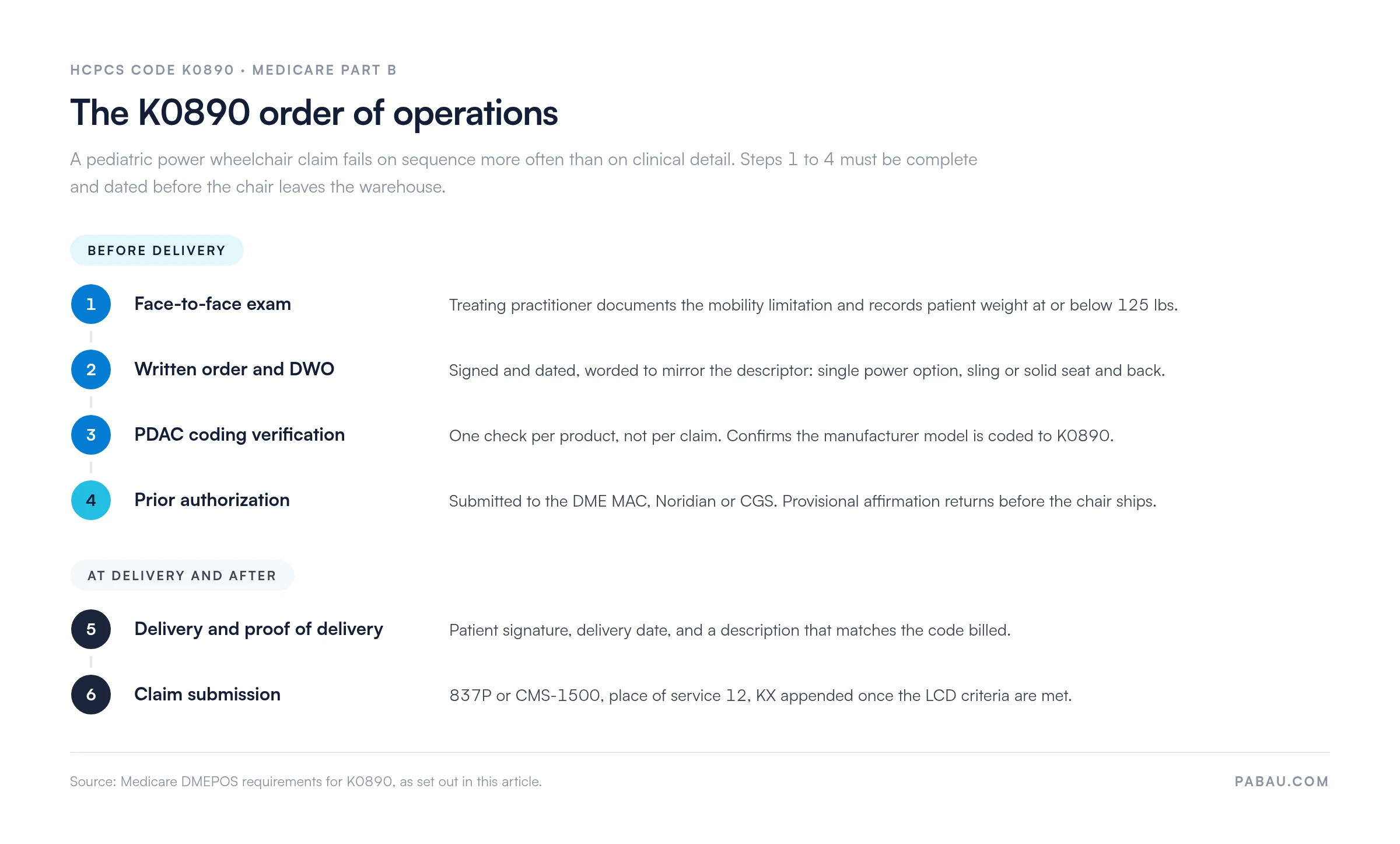
Once the sequence is clean, the claim itself is routine. The table covers what each field needs.
PDAC verification is the step suppliers skip most often. PDAC publishes which manufacturer models are coded to K0890, and the check is done once per product rather than once per claim.
Bill K0890 for a chair PDAC coded elsewhere and the claim becomes an audit finding. A perfect clinical file will not save it.
Most K0890 denials are visible on the file before submission. Seven checks catch them.
Audit your own K0890 volume once a quarter. Compare the claims submitted against the prior authorizations on file and the PDAC verifications completed. If submissions outrun verifications, the control is broken somewhere upstream. Fix it in the intake workflow rather than at the appeal stage.
Most children do not have Medicare. Eligibility usually arrives through Social Security disability rules, so confirm enrollment before you build a Medicare file at all.
Group 5 is the pediatric branch of the power wheelchair codes, and only two codes live there. The confusion comes from neighboring groups, where the descriptors read almost the same on the page.
The distinction that matters most is K0890 against K0891. Both describe the same frame, the same 125 pound limit, and the same seating.
The only difference is how many powered adjustable features the chair carries. One feature means K0890, and two or more means K0891.
The other two rows sit outside group 5 altogether. K0835 is an adult group 2 chair rated to 300 pounds. K0858 is a group 3 heavy duty chair rated from 301 to 450 pounds, and its captains chair version carries its own code.
Cross-check the wording against the AAPC HCPCS lookup before you commit. When none of these descriptors fits the chair, work through the wider K series before reaching for K0898. Our HCPCS billing guides index the rest of them.
Most DME suppliers track prior authorization in a spreadsheet and keep the clinical file in a shared drive. That holds until a reviewer asks for the face-to-face note from eleven months ago. It also holds right up until an order ships before the affirmation comes back.
Practice management software like Pabau keeps that file in one place. Pabau’s medical claims management centralizes the claim lifecycle in one record. A supplier can see which K0890 orders are waiting on prior authorization, and which documents are still missing.
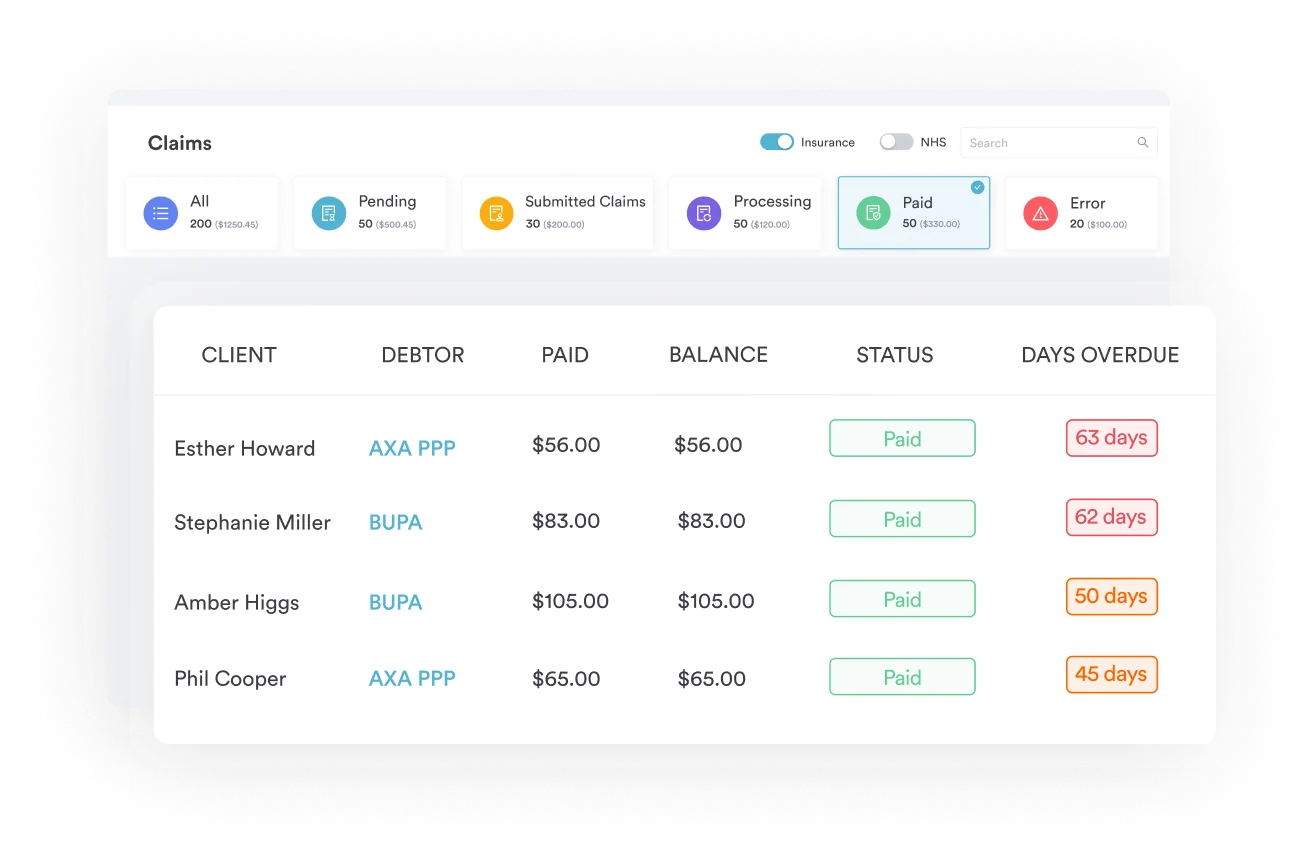
The payoff is straightforward. Fewer K0890 claims sit in a denial queue for reasons the paperwork could have prevented.

Pabau tracks prior authorization status, documentation checklists and remittance detail against each claim. A DMEPOS supplier can spot a missing document before it turns into a denial.

K0890 is a narrow code, and the narrowness is the whole problem. The 125 pound cap, the single power option, and the prior authorization requirement each rule a claim out on their own. None of them needs a clinical argument to do it.
So the work sits in front of the claim, not behind it. A supplier who verifies weight, power options, PDAC coding, and authorization before delivery spends almost no time on appeals. One who checks afterwards spends most of the month there.
Pabau holds the prior authorization status, the documentation checklist, and the remittance detail on a single record for every DME claim. Book a demo to see how a K0890 file looks when every document is in place at submission.

Not sure what makes a DME claim clean before it goes out? Clean claim submission covers the elements every DMEPOS claim needs to clear front-end edits.
Working through a pile of DME denials? Denial management in healthcare sets out how to categorize, appeal, and prevent the rejections that repeat.
Want the whole DME billing cycle in one view? Revenue cycle management walks each stage from eligibility through to payment posting.
Checking Part B enrollment before an order? Insurance eligibility verification explains what to confirm, and when in the workflow to confirm it.
Preparing for a DMEPOS audit? Medical billing compliance lists the documentation rules reviewers apply most often.
That depends on the payment category Medicare assigns the code in the current DMEPOS fee schedule. Check it before you choose between NU for a new purchase and RR for a rental. The modifier has to match the category, and a mismatch is a front-end rejection rather than a coverage denial.
K0890 stops being the right code from that point on. A replacement chair needs a new face-to-face exam, a new order, and a new prior authorization under whichever code fits the child’s current weight. No modifier carries the old code past its descriptor.
Issue an Advance Beneficiary Notice when you expect Medicare to deny the chair as not medically necessary. The patient signs it before delivery, and the claim then carries the GA modifier. Skip that step and the supplier absorbs the cost instead of the patient.
No. Options and accessories carry their own HCPCS codes and go on separate claim lines, each with its own medical necessity documentation. The K0890 line pays for the base chair, so folding an accessory into it understates the claim and invites a review.