CPT Code 86431: Rheumatoid factor quantitative test
CPT code 86431: official descriptor and procedure overview CPT code 86431 is the...

Last Updated: Oct 27, 2026
K0861 is the HCPCS Level II code for power wheelchair, group 3 standard, multiple power option, sling/solid seat/back, patient weight capacity up to and including 300 pounds.
HCPCS code K0861 bills a group 3 standard power wheelchair with multiple power options. The chair carries a sling or solid seat and back, rated to 300 pounds. Multiple power options describes the electronics, which have to run a combination power tilt and recline seating system.
That capability separates K0861 from K0856, the single power option code beside it. Seat type never does the separating, because K0861 through K0864 all carry a sling or solid seat and back.
Group 3 bases count as complex rehab technology, which adds a specialty evaluation and an assistive technology professional to the file. Prior authorization applies to standard power wheelchairs too. Miss one of the three and the denial lands after the chair is delivered.
Let Pabau's smart automation suggest the right codes, reduce claim denials, and keep your practice compliant—effortlessly.
Automate repetitive tasks and focus on what matters most—your patients.
Reduce coding errors and ensure compliance with the latest regulations.
Clean claims, fewer denials, and faster reimbursements.
Powerful insights and reporting to help your practice thrive.
HIPAA compliant SOC 2 certified GDPR-compliant Trusted by 4,000+ clinics worldwide

HCPCS code K0861 covers a group 3 standard power wheelchair with multiple power options, sling or solid seat and back, rated to 300 pounds.
The multiple power option separates K0861 from K0856, and both codes carry a sling or solid seat and back.
Coverage needs a combination power tilt and recline system in use on the chair, or a ventilator mounted on it.
Prior authorization comes before delivery, and every covered claim line carries KX plus one of NU, RR, or UE.
Practice management software like Pabau keeps the evaluation, order, authorization, and proof of delivery on one patient record.
K0861 covers the wheelchair base, and only the base. CMS maintains the descriptor in the HCPCS Level II system. It reads: power wheelchair, group 3 standard, multiple power option, sling/solid seat/back, patient weight capacity up to and including 300 pounds.
CMS coding guidance for power mobility devices sets the test behind that wording. A base in this category has to accept and operate a combination power tilt and recline seating system. A single power option base handles a power tilt, a power recline, or a power standing system on its own. The tilt and recline combination is beyond it.
The seating system itself is not bundled into K0861. Combination tilt and recline systems bill separately under E1006, E1007, and E1008. Those three codes split by shear reduction, which is either absent, mechanical, or power.
Group 3 power wheelchairs run from K0848 to K0864. The first eight codes, K0848 through K0855, describe bases with no power option at all. The power option range starts at K0856, and two axes separate the codes inside it.
The first axis is the rated patient weight band. The second is whether the base runs one powered seating function or a tilt and recline combination. Seat type varies only among the single power option codes, where K0857 and K0859 are the captain’s chair versions.
Three details in that table catch coders out. No captain’s chair code exists above K0860. A captain’s chair running a tilt and recline system therefore has no home in the multiple power option range. There is also no single power option code at the extra heavy duty tier.
The third is K0860 itself. It is the very heavy duty code at 451 to 600 pounds, and the heavy duty single power option pair is K0858 and K0859. Move one weight band and the code changes. Move from one powered function to the tilt and recline combination and it changes again.
Medicare covers K0861 under the power mobility device LCD. A group 3 base has to clear three layers, and the third is the one that separates this code from the rest of the range.
The first layer is the general power wheelchair standard, which every PMD claim has to meet:
The second layer is specific to group 3. The mobility limitation must be due to a neurological condition, a myopathy, or a congenital skeletal deformity. Weight alone qualifies nobody for a group 3 chair, and neither does general deconditioning after surgery or illness.
The third layer is where K0861 parts company with K0856. A multiple power option base is covered only when one of these is true:
Take a 41-year-old with ALS who cannot self-propel a manual chair at home and uses a ventilator mounted on the base. Layer one is met by the mobility limitation inside the home. Layer two is met by the motor neuron diagnosis. Layer three is met by the mounted ventilator, so no tilt and recline system has to be present to justify the base.
Two supplier-side conditions sit on top of all three layers. A licensed or certified medical professional trained in rehabilitation wheelchair evaluations has to perform the specialty evaluation. That professional may hold no financial relationship with the supplier.
The supplier must also employ a RESNA-certified assistive technology professional who specializes in wheelchairs and takes part in the selection in person.
Medicare reimburses K0861 from the DMEPOS fee schedule, which CMS updates each January and revises quarterly. Allowables vary by DME MAC jurisdiction, so pull the rate for the beneficiary’s state and for the date of service.
Check the figure against the CMS DMEPOS fee schedule rather than a third-party lookup, which often lags mid-year updates.
Power wheelchairs sit in the capped rental category, where rental runs up to 13 months of continuous use. Ownership then transfers to the beneficiary at no extra charge.
K0861 is a complex rehabilitative power wheelchair, so the beneficiary may also elect a lump-sum purchase when the supplier furnishes the chair.
Section 3136 of the Affordable Care Act removed that option for standard power wheelchairs in 2011 and left it in place for complex rehab. Purchase is a valid payment route here, so do not treat an NU line as a billing error.
Competitive bidding does not reach K0861. Section 154(a) of the Medicare Improvements for Patients and Providers Act of 2008 permanently excluded group 3 complex rehabilitative wheelchairs from the program. National fee schedule pricing applies everywhere, and no bid contract is needed to supply the chair.
Medicare pays 80% of the approved amount once the Part B deductible is met. The remaining 20% is the beneficiary’s coinsurance, and a supplemental plan may pick it up.
Incomplete records drive most K0861 denials on post-payment review. Four documents carry the claim, and a reviewer reads their dates before reading a single clinical note. The sequence below is the one that has to hold.
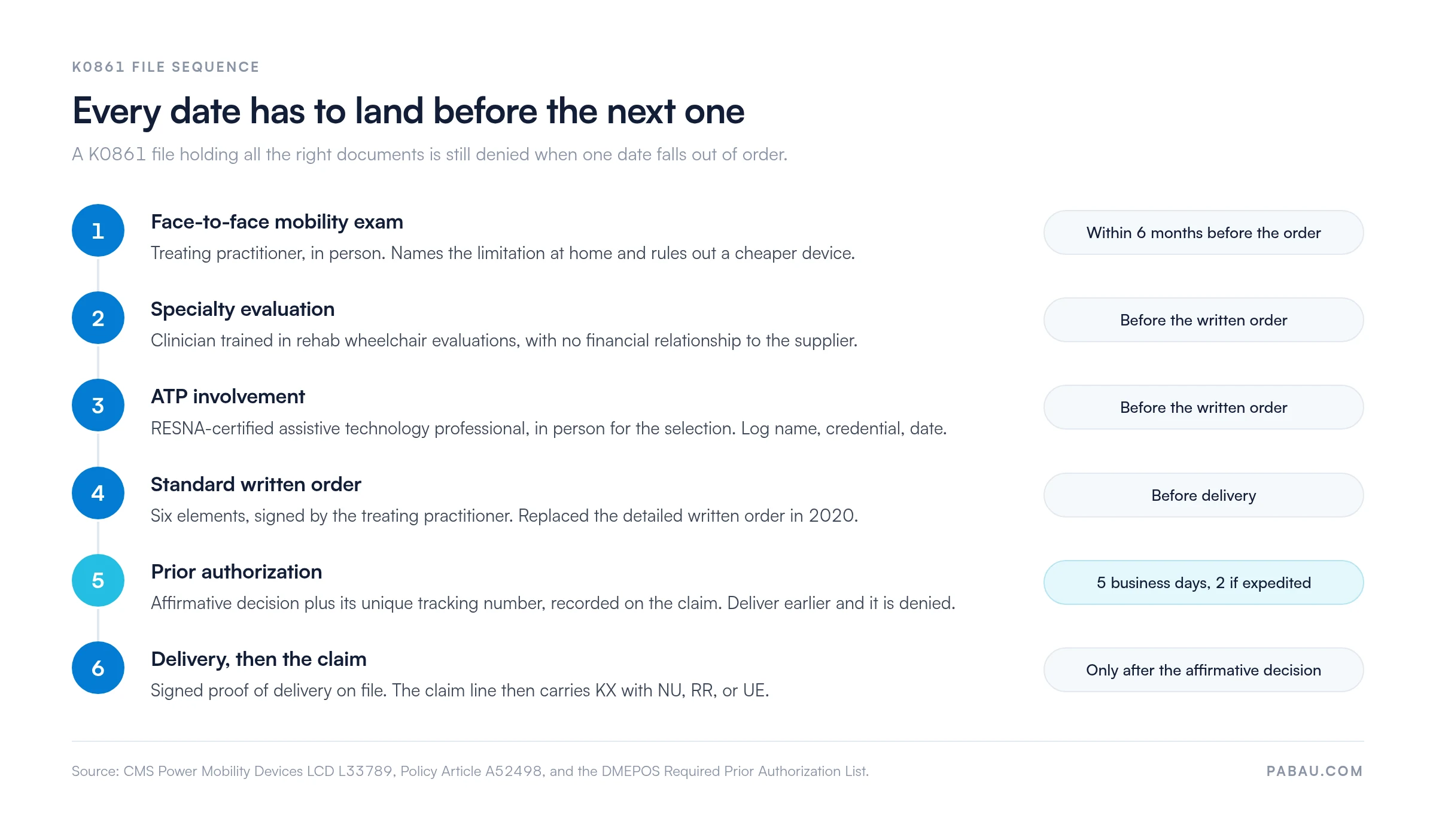
The treating practitioner performs a face-to-face mobility examination, in person, before the order is written. A physician, nurse practitioner, or physician assistant can do it. The note has to describe the mobility limitation, the functional status, and why a less costly device will not work.
The encounter must fall within the six months before the order date. A supplier representative cannot perform this exam, and a clinical qualification does not change that.
Group 3 brings a second clinical assessment on top of the exam above. A physical therapist, occupational therapist, or practitioner with training in rehabilitation wheelchair evaluations documents why this chair and these features are medically necessary. That professional may have no financial relationship with the supplier.
On the supplier side, a RESNA-certified assistive technology professional has to be involved in selecting the chair in person. Record the ATP’s name, credential, and the date of the visit. An ATP credential issued after the visit does not cover it.
Since January 2020, a single standard written order (SWO) has replaced the detailed written order, the seven-element order, and the detailed product description. K0861 needs that SWO in the supplier’s hands before the chair is delivered, which is what written order prior to delivery now means.
The SWO carries six elements:
The diagnosis, the functional findings, and the rest of the medical necessity evidence live in the medical record instead. Keeping the order and the record separate, and both retrievable, is what makes an audit response quick.
The supplier obtains and retains the practitioner’s records behind the necessity decision. That means the examination note, any therapy or functional assessments, and the reasoning that ruled out a simpler device. A written home assessment documents that the doorways, turning space, and surfaces suit the chair.
Proof of delivery closes the file. It records what was delivered, the date, and the signature of the beneficiary or their designee. All of it has to be produced on an additional documentation request, so store the set where one person can retrieve it.
Keep every K0861 document on one patient record rather than across a clinical system, an inbox, and a filing cabinet. When an additional documentation request arrives, the response clock runs while somebody hunts for the ATP’s email.
K0861 sits on the Required Prior Authorization List for DMEPOS. Deliver the chair without an affirmative decision on file and the claim is denied, with no documentation able to rescue it later. Building authorization tracking into intake, rather than into billing, is what keeps that from happening.
The process runs in five steps:
One distinction is worth holding on to here. A non-affirmed request is not an appeal: resubmission fixes the evidence, while an appeal challenges a denied claim, and the two follow different clocks. Suppliers who deliver on a non-affirmed request and plan to argue it later end up writing the chair off.
Every K0861 line carries at least two modifiers. One states the coverage position and the other states the payment route. Pair them wrong and the line is rejected before anyone opens the file behind it.
KX plus one of NU, RR, or UE is the normal pairing on a covered claim. GA replaces KX where coverage is doubtful and an ABN has been signed. Using GA without that signed notice on file creates a compliance exposure.
No national list of covered diagnoses governs K0861. What a reviewer looks for is a code that names the neurological condition, myopathy, or congenital skeletal deformity behind the mobility limitation. The codes below turn up most often on group 3 claims.
Pair the qualifying diagnosis with the functional narrative rather than leaning on the code alone. A reviewer reads G35 as a starting point, then looks for what the beneficiary can no longer do at home.
Our ICD-10-CM code reference carries the full descriptors if you need to confirm a fourth or fifth character first.
K0861 fails more often than most DMEPOS codes, because authorization, two clinical assessments, and a modifier pair all have to land.
Sorting denials by cause beats reworking them one at a time, and seven causes account for most of the volume:
Nearly all of those are visible before the claim ever leaves, which is what the check below is for.
Audit K0861 quarterly. Pull every denial from the last 90 days and sort by reason code. Fix the top two causes rather than reworking claims one at a time. On this code, the top two are usually authorization timing and a documentation date out of sequence.
K0861 entered HCPCS Level II in 2006, when CMS replaced the older power wheelchair codes with the current K-series. Neither the 300-pound capacity nor the multiple power option wording has changed since.
The authorization history moved a good deal more, and it explains why suppliers see K0861 named separately in older guidance. K0861 and K0856 were the first two power wheelchair codes in the DMEPOS prior authorization program.
Both entered on March 20, 2017, in New York, Illinois, Missouri, and West Virginia. The requirement went nationwide on July 17, 2017.
The rest of the series, K0857 through K0860 and K0862 through K0864, joined the list on July 22, 2019. Guidance written between those dates treats the two codes differently, so check the publication date before you trust an old supplier manual.
CMS publishes HCPCS Level II update files each fall for the following calendar year, and the DMEPOS fee schedule is revised quarterly. Coverage policy, modifier requirements, and authorization status changes all appear in the DME MAC bulletins first.
Reading them before the January claim cycle keeps the billing system current.
Most suppliers assemble a K0861 file across several systems. The mobility examination sits in the clinical record, and the specialty evaluation arrives as a scan. The ATP visit is noted in an email, and the delivery receipt is a signed sheet in a folder.
Nobody sees the whole file at once, which is how a chair goes out with one date in the wrong order. Practice management software like Pabau keeps those pieces on a single patient record, each with a timestamp. The sequence a reviewer checks first is then visible before the claim leaves.
Pabau’s claims management software then submits electronically through Claim.MD in the US and tracks what each payer sends back. Codes, modifiers, and supporting documents stay together on the claim, so a follow-up starts from the file rather than from a spreadsheet.
Pabau does not choose codes or modifiers for you, and it runs no crosswalk or clinical decision support. That judgment stays with your coder. What it gives you is one place to confirm the file is complete and in sequence before the claim goes out.

Pabau stores the specialty evaluation, the written order, the authorization decision and the proof of delivery on one patient record. It then submits the claim and tracks what the payer sends back.

One question decides K0861 before any billing mechanic matters. Does the base run a combination power tilt and recline seating system? Answer yes, with the rated capacity at 300 pounds or under, and the code is K0861. Answer no and you are looking at K0856 or one of the codes below it.
After that, K0861 behaves less like a coding problem and more like a sequencing one. Every date has to precede delivery, and the claim line then carries KX with NU, RR, or UE. Suppliers who audit that order each quarter stop rewriting the same denial.
Pabau holds that whole file on one patient record, from the specialty evaluation through to the proof of delivery. Book a demo to see how it keeps a K0861 claim in sequence before it goes out.

Billing the single power option base instead? HCPCS code K0856 covers the group 3 standard chair that runs one powered seating function.
Need the wider DMEPOS billing picture? What is medical billing walks through the revenue cycle end to end.
Seeing K0861 denials with no clear pattern? Denial management in healthcare explains how to categorize and clear them by cause.
Strengthening your position before an audit? Medical billing compliance covers the process controls that protect DMEPOS suppliers on review.
The power option. K0861 runs a combination power tilt and recline system. K0856 handles one powered function on its own. Both are group 3 standard, sling or solid seat, rated to 300 pounds.
The DME benefit pays for use inside the home, so the face-to-face note has to describe what the beneficiary cannot do there. Community use does not qualify the chair on its own.
No. A hospital or a skilled nursing facility does not count as a home under the Part B equipment benefit. Suppliers usually time delivery to the discharge date instead.
Group 3 carries a qualifying-condition test that group 2 does not. The limitation has to stem from a neurological condition, a myopathy, or a congenital skeletal deformity. Group 3 also adds the specialty evaluation and the ATP.
Not always. An Advantage plan sets its own authorization criteria, turnaround times, and supplier network. Read the plan’s equipment policy before the chair is ordered, because the LCD is a floor rather than a guarantee.
Yes. K0861 pays for the base only. The combination system bills under E1006, E1007, or E1008, depending on whether shear reduction is absent, mechanical, or power.