

CCSD code G5100: Bypass of duodenum billing guide
CCSD code G5100 bills a bypass that leaves the duodenum in place CCSD code G5100...

Last Updated: Oct 16, 2026
L0172 is the HCPCS Level II code for cervical, collar, semi-rigid thermoplastic foam, two-piece, prefabricated, off-the-shelf.
HCPCS code L0172 bills a semi-rigid thermoplastic foam cervical collar that comes in two pieces, prefabricated and off-the-shelf. Medicare Part B pays it from the DMEPOS fee schedule, at roughly $68 to $72 in most jurisdictions. One detail decides most of these claims.
The collar has to sit on the PDAC-approved product list before you bill it. A product that isn't listed gets denied, and recoupment risk follows it.
Let Pabau's smart automation suggest the right codes, reduce claim denials, and keep your practice compliant—effortlessly.
Automate repetitive tasks and focus on what matters most—your patients.
Reduce coding errors and ensure compliance with the latest regulations.
Clean claims, fewer denials, and faster reimbursements.
Powerful insights and reporting to help your practice thrive.
HIPAA compliant SOC 2 certified GDPR-compliant Trusted by 4,000+ clinics worldwide

HCPCS code L0172 covers a two-piece prefabricated semi-rigid thermoplastic foam cervical collar, billed to Medicare Part B as DMEPOS.
The collar must appear on the PDAC-approved product list for L0172 before a Medicare claim goes out.
A detailed written order and a signed proof of delivery are mandatory on every L0172 claim.
The national Medicare allowable sits around $68 to $72, and the rate moves by MAC jurisdiction.
L0170 is not the one-piece version of L0172. It is the custom-fabricated collar, molded to a model of the patient.
L0172 is a Level II HCPCS code in the Orthotic Procedures and Services group, the L codes. The Centers for Medicare and Medicaid Services (CMS) maintains the HCPCS Level II set, and L0172 is currently active.
The official full descriptor reads: Cervical, collar, semi-rigid, thermoplastic foam, two-piece, prefabricated, off-the-shelf. Every word in that line is a billing qualifier.
Bill the code for a one-piece collar, a custom-fabricated device, or a rigid collar, and you have made an incorrect code selection. That is one of the most common denial triggers on orthotic claims.
Medicare covers L0172 when the supplier documents medical necessity and the collar carries PDAC product authorization. Coverage is never automatic.
Four conditions have to be met before the claim goes out:
The Pricing, Data Analysis and Coding contractor, known as PDAC, runs the product authorization program for CMS. PDAC reviews whether a given commercial collar meets the L0172 descriptor. Suppliers who skip that check carry recoupment risk into every post-payment audit.
Check the list before you buy inventory, not after a denial lands. Orthotic departments that dispense collars every week usually fold the check into purchasing, which removes the most common coverage denial before it can happen.
Local Coverage Determinations, or LCDs, then add requirements on top of that national baseline. The DME MACs publish LCDs for spinal orthoses naming covered diagnoses, documentation standards, and utilization limits. Read the LCD for the patient’s MAC jurisdiction before you submit.
L0172 is paid from the Medicare DMEPOS fee schedule, and the national average allowable runs roughly $68 to $72 for the device. Rates differ by MAC jurisdiction, so the figure on your remittance may not match that range exactly. CMS republishes the schedule every January.
Look up your own jurisdiction in the CMS DMEPOS fee schedule files rather than working from a national average. Private payer rates are a separate question. Commercial contracts are not bound by the Medicare allowable, and some negotiate orthoses on their own schedule.
Watch the commercial side in particular. A payer that mirrors Medicare on most L codes can still price orthoses separately. Pull the fee schedule attached to your own contract before you assume the Medicare figure applies.
Every L0172 claim needs four documents on file before it goes out. Incomplete paperwork is the second most common denial trigger on DMEPOS orthotics, behind PDAC non-compliance. These stay in the patient file, and an auditor can ask for any of them.
File the four together per encounter rather than per document type. That habit is the core of medical billing compliance for a DMEPOS supplier, and it is what turns an audit request into a five-minute job.
Date the written order before the collar leaves the building. An order dated after delivery is the first thing an auditor spots. It is hard to defend, whatever else the file holds.
An L0172 claim runs through six steps, and skipping one usually surfaces later as a denial or a recoupment. The supplier owns the documentation and the PDAC check, not the referring physician. That surprises practices new to DMEPOS billing.
Run this check before the claim leaves the practice. It takes a minute, and it catches the errors that otherwise cost weeks.
A clean claim usually looks like this. The physician documents cervicalgia and orders a cervical orthosis on a dated, signed DWO. Your team pulls a PDAC-listed collar, dispenses it, and takes the patient’s signature on the delivery receipt.
From there the claim goes out as one unit of L0172, with M54.2 attached. By then the file already holds what an auditor would ask for.
Most L0172 denials trace back to the same short list. When one slips through, the remittance advice names the reason. The billing denial codes reference explains what each code is telling you to fix.
The ICD-10 code on an L0172 claim has to justify cervical support or immobilization. Six diagnoses turn up most often alongside it. Treat them as examples rather than a coverage list, and check each against your MAC’s LCD before you submit.
A code outside the LCD’s covered list will not support medical necessity, however appropriate the collar is clinically. Verify against the CGS Medicare coding guidance and the applicable DME MAC LCD before the claim goes out.
Four cervical orthosis codes sit close enough to be mixed up, and the qualifier that separates them is different in each case. Pick the wrong one and you carry both a compliance risk and a revenue risk.
The table below lines all four up against L0172.
Each of those rows really comes down to one question, which is easier to see side by side.
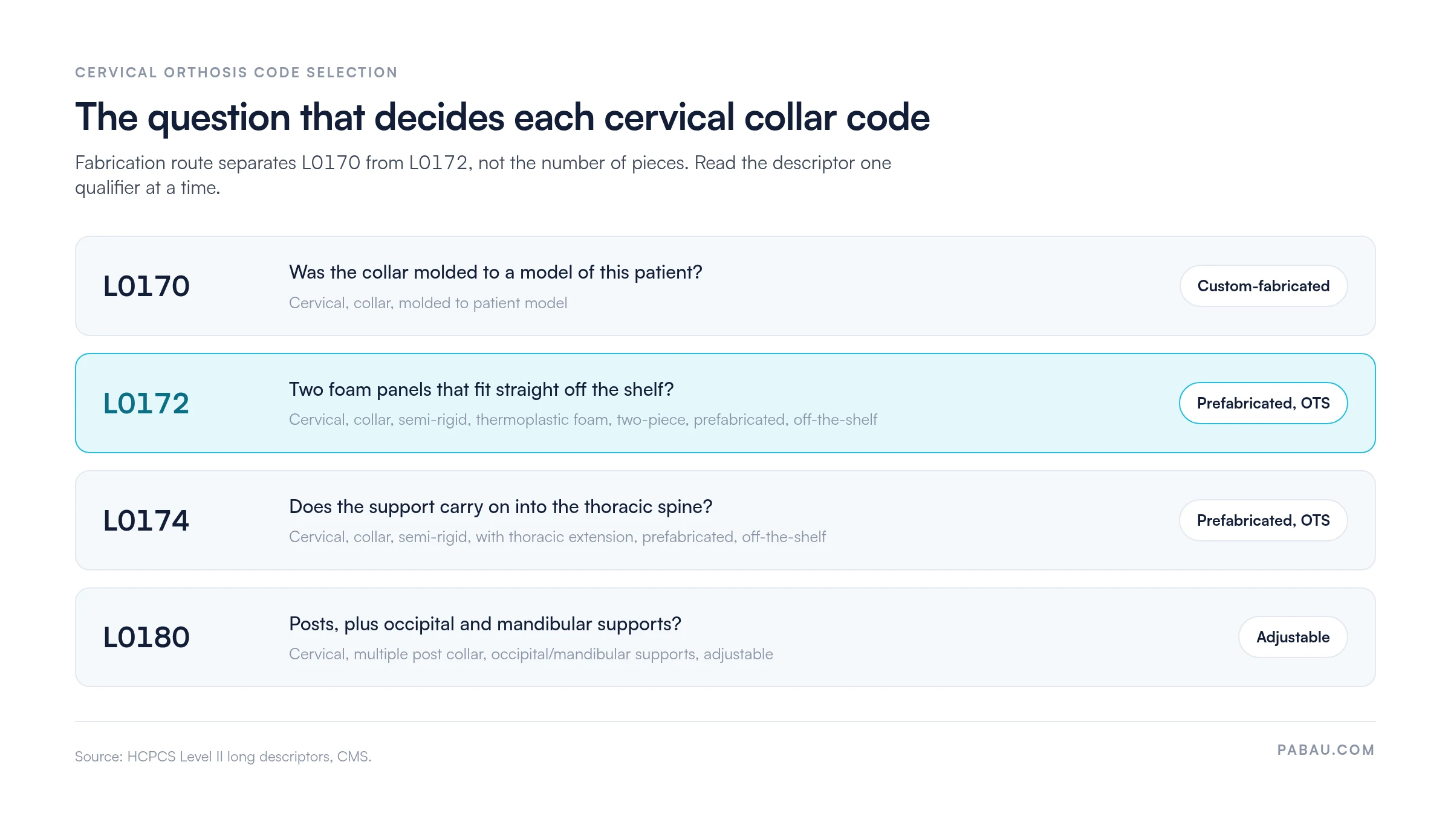
L0170 and L0172 get swapped more than any other pair here, largely because the numbers sit next to each other. They describe different fabrication routes. L0170 is molded to a model of the patient, which makes it custom-fabricated. L0172 is prefabricated and off-the-shelf, built as two thermoplastic foam panels that fit with minor adjustment.
Ask one question before you choose between them. Was this collar made from a model of the patient, or pulled from stock? A clearinghouse will rarely catch the answer, but an auditor will. For a second check on any L code, the AAPC HCPCS code lookup carries the full descriptor text.
A DMEPOS supplier needs two things from a practice management system. Documentation that survives an audit, and claim submission that does not depend on re-keying. Practice management software like Pabau covers both from the same patient record.
Most orthotic teams today keep the written order in one folder, the delivery receipt in another, and the PDAC check in someone’s inbox. Pabau stores all three against the patient record instead. Its claims management software then submits the claim electronically, so the billed line and the paperwork behind it stay together.
That shortens the path from dispensing to payment. It also means an audit request six months later is answered from one screen, rather than from three filing systems. Book a demo if you want to see that record built around an orthotic workflow.

Pabau stores written orders, delivery receipts and clinical notes against the patient record, then submits the claim electronically. Your orthotic documentation is ready before the auditor asks.

L0172 is an easy code to bill and an easy code to lose. The device is inexpensive, the descriptor is short, and the denial usually costs more to appeal than the collar is worth.
So move the checks upstream, out of claim review and into the workflow itself. Verify PDAC status at purchasing, date the order before delivery, and read the descriptor against the device in front of you. Do that consistently and L codes stop showing up in your denial queue.
The paperwork is the job here, far more than the code itself. Book a demo to see how Pabau keeps written orders, delivery receipts and orthotic claims in one audit-ready record.

What makes a claim clean before it leaves? Clean claim submission lists the fields payers reject on first pass.
Need to read a denial on the remittance advice? Billing denial codes explains what each reason code is telling you to fix.
Want the wider picture on DMEPOS revenue? Revenue cycle management follows the money from claim creation through to payment posting.
Not sure what belongs on a superbill? Superbills explained shows how codes and the ordering physician get captured at the point of care.
New to the billing cycle itself? What medical billing is walks through each stage, from patient registration to payment.
Only a supplier enrolled in the Medicare DMEPOS program, holding a valid supplier number. Accreditation and a surety bond are part of that enrollment. A physician practice that wants to dispense and bill collars itself has to enroll as a DMEPOS supplier first.
Only with a signed Advance Beneficiary Notice, known as an ABN, collected before the collar is delivered. The ABN tells the patient Medicare is likely to deny the device and that they accept the cost. Without one on file, the supplier absorbs the denial.
Yes. Off-the-shelf means the device needs only minimal self-adjustment at delivery, with no trimming, bending or molding by a trained fitter. There is no separate fitting charge to add. A collar that genuinely needs skilled fitting belongs under a different code.
Purchased. Medicare pays for orthoses as a lump-sum purchase rather than a monthly rental. An L0172 claim therefore carries no rental modifier and no capped rental period. The patient owns the collar from the date of delivery.



