CPT code 93503: Swan-Ganz catheter billing and modifiers
CPT code 93503: Official descriptor and procedure overview In the AMA CPT code s...

Last Updated: Oct 23, 2026
J7318 is the HCPCS Level II code for hyaluronan or derivative, durolane, for intra-articular injection, 1 mg.
The detail that decides whether the claim pays is the unit count. A standard 60 mg Durolane syringe bills as 60 units, not one.
Let Pabau's smart automation suggest the right codes, reduce claim denials, and keep your practice compliant—effortlessly.
Automate repetitive tasks and focus on what matters most—your patients.
Reduce coding errors and ensure compliance with the latest regulations.
Clean claims, fewer denials, and faster reimbursements.
Powerful insights and reporting to help your practice thrive.
HIPAA compliant SOC 2 certified GDPR-compliant Trusted by 4,000+ clinics worldwide

HCPCS code J7318 describes hyaluronan or derivative, Durolane, for intra-articular injection, billed per 1 mg administered.
J7318 carries a Carrier Judgment (C) coverage code, meaning Medicare coverage decisions are made at the MAC level under local coverage determinations.
Units billed must equal the exact milligram dose injected; a standard single-dose Durolane syringe (60 mg) requires 60 units of J7318 on the claim.
Pabau’s claims management software helps orthopedic and musculoskeletal practices map J7318 to encounters, track payer-specific authorization requirements, and submit clean claims without manual lookups.
HCPCS code J7318 has a precise official description: Hyaluronan or derivative, Durolane, for intra-articular injection, 1 mg. Its short description, used on remittance advice and claim forms, is Inj, durolane 1 mg. The code was established effective January 1, 2019, replacing the temporary outpatient code C9465 that had been used during Durolane’s transition period after FDA approval.
You’ll often see it searched as a “CPT code” — “J7318 CPT code description” is a common query — but J7318 is a HCPCS Level II code, not a CPT code. It identifies the drug, which is why the Durolane HCPCS code goes on the drug line of the claim.
The CPT codes cover the injection procedure separately, which is where the administration code pairing below comes in.
Two administrative properties govern how payers handle J7318. First, its HCPCS coverage code is C, meaning Carrier Judgment applies. No national coverage determination (NCD) exists. Instead, each Medicare Administrative Contractor (MAC) issues its own local coverage determination (LCD) for viscosupplementation.
Second, the action code is N (no annual maintenance), indicating CMS does not anticipate routine code updates unless Durolane’s product status or billing unit changes materially.
Durolane is a single-injection viscosupplement consisting of a stabilized hyaluronic acid gel (NASHA technology) manufactured by Bioventus. The FDA approved Durolane specifically for the treatment of pain due to osteoarthritis of the knee in adults who have failed to respond adequately to conservative nonpharmacologic therapy and to simple analgesics.
Off-label use in joints other than the knee is not covered by most payers, and claims submitted for non-knee joints without supporting documentation will typically be denied.
Each pre-filled Durolane syringe contains 60 mg of hyaluronan in 3 mL of sodium chloride solution. Because J7318 is billed per 1 mg, a single syringe generates 60 units on the claim. The injection is administered once per treatment course.
The code describes 1 mg, so the unit field on the CMS-1500 or 837P must reflect the total milligrams administered. For the standard 60 mg Durolane syringe, that is 60 units.
Billing only 1 unit is a common error that triggers underpayment. Billing the number of syringes rather than the number of milligrams causes the same problem. Report the National Drug Code (NDC) for the Durolane vial alongside the units, since many payers match the NDC to J7318 before they release payment.
Several modifiers apply to J7318 claims depending on the clinical scenario and payer requirements:
J7318 covers only the drug. There is no separate Durolane injection CPT code for the drug itself. The injection procedure is billed with the appropriate CPT administration code, typically 20610 (arthrocentesis, aspiration, and/or injection, major joint, without ultrasound guidance) or 20611 (with ultrasound guidance).
J7318 and the administration CPT code sit as separate line items on the same claim. Practices managing prescription management workflows for injectable drugs should capture both codes at the point of documentation to avoid split-billing errors downstream.
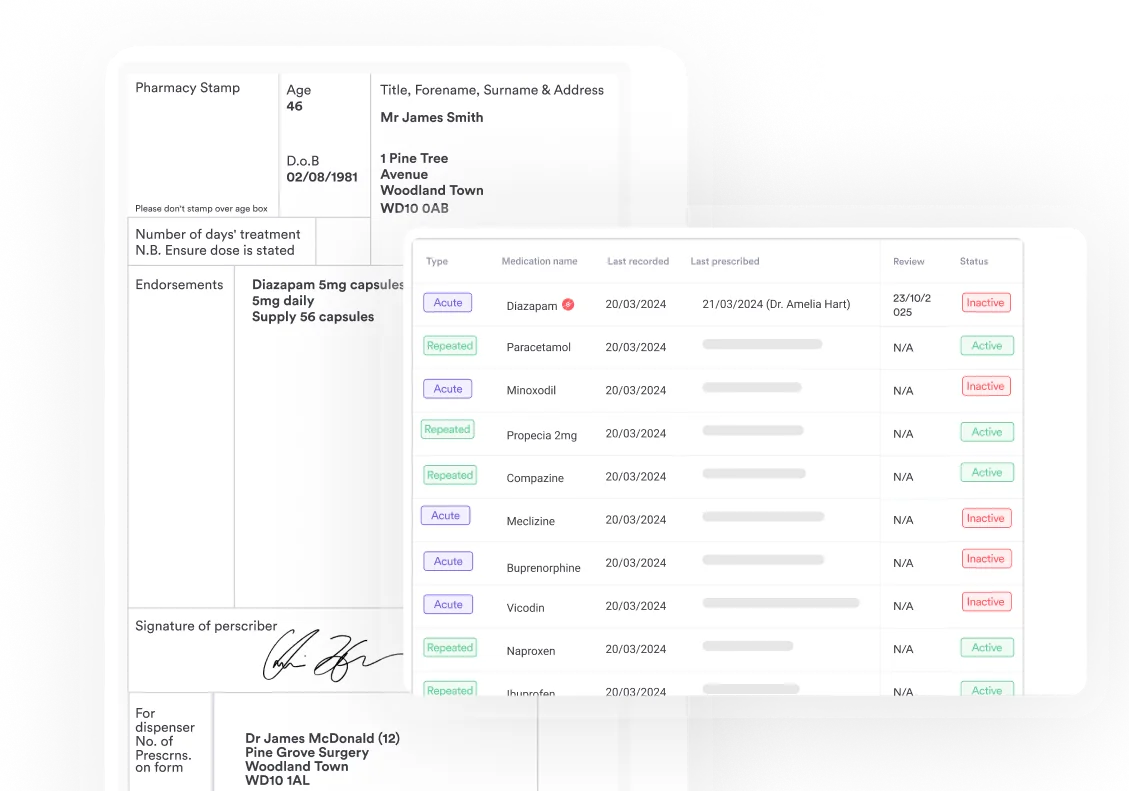
J-codes bill by unit, so inventory management software that tracks vials and wastage protects both compliance and margin.
Medicare Part B reimburses J7318 under the Average Sales Price (ASP) methodology. CMS publishes updated ASP-based payment limits each quarter. The payment limit equals ASP plus 6%, which represents the add-on for drug acquisition and handling under the buy-and-bill model.
Because ASP figures change quarterly, any specific dollar figure cited here may be outdated by the time you read it. Always verify current rates using the CMS Physician Fee Schedule lookup tool or the quarterly ASP drug pricing file published by CMS.
For practices using the buy-and-bill model, the reimbursement calculation works as follows: CMS pays ASP + 6% per billing unit (1 mg). For a 60-unit claim, the total payment is (ASP + 6%) multiplied by 60.
The facility vs. non-facility distinction does not affect the drug payment for J7318 the way it affects physician work RVUs, but site-of-service rules can affect the administration CPT code reimbursement billed alongside J7318.
Under buy-and-bill, the Durolane cost a practice absorbs is the syringe’s acquisition price, and the ASP + 6% payment is meant to cover that plus a handling margin.
Buying below the published ASP protects the practice’s margin on every J7318 claim, while paying above it turns each injection into a loss even when the claim pays in full.
Durolane can be acquired through either the buy-and-bill channel (the practice purchases and stocks the drug, then bills the payer directly) or through a specialty pharmacy (the pharmacy bills the payer and ships the drug to the practice).
For Medicare Part B, buy-and-bill using J7318 is the standard pathway.
Some commercial payers require specialty pharmacy dispensing, which means the practice does not bill J7318 at all. The pharmacy handles the drug claim instead. Confirm the dispensing channel with each payer before assuming buy-and-bill applies.
Coverage for J7318 varies significantly by payer and plan. The coverage code C (Carrier Judgment) means there is no single national rule. Each MAC and commercial insurer sets its own criteria.
Common coverage requirements typically include:
So, is Durolane covered by Medicare? Yes, but only under each Medicare Administrative Contractor’s own local coverage determination. There is no national rule.
MACs that have issued LCDs for hyaluronic acid injections typically require documentation of:
For a repeat course, the record must show the previous series reduced pain and improved function, and most LCDs require at least six months since the last injection in the series.
Practices in orthopedic or musculoskeletal specialties should keep the relevant MAC’s LCD on file and reference it when documenting medical necessity. Pabau’s sports medicine software captures the clinical narrative these determinations depend on.
Commercial payer coverage for J7318 is inconsistent. UnitedHealthcare’s commercial medical benefit drug policy lists J7318 alongside other hyaluronic acid injection codes and applies criteria similar to Medicare, including documented OA diagnosis, conservative treatment failure, and frequency limitations.
CarelonRx (formerly Anthem’s pharmacy benefit arm) applies clinical criteria for hyaluronic acid injections that require medical necessity documentation. The code change from C9465 to J7318 is noted in their criteria document. Medi-Cal covers Durolane under J7318 according to the California CAMMIS provider manual for injection drugs.
Prior authorization requirements vary by plan. Some commercial plans require pre-authorization for every treatment course. Others require it only for repeat courses within the same year.
Never assume authorization carries over from a prior approval. Verify at the start of each benefit year. Practices using digital intake forms can build authorization tracking into the pre-visit workflow so clinical staff capture prior auth numbers before the patient arrives.

Run a payer-specific eligibility and benefits check before every Durolane injection appointment. Confirm the patient’s active coverage, verify that J7318 is on the plan’s covered drug list, and document any prior authorization number in the patient record before the encounter. A missing auth number is one of the top reasons for post-service J7318 denials.
Every J7318 claim requires a supporting ICD-10-CM diagnosis code that establishes medical necessity. The diagnosis must reflect documented knee osteoarthritis, as using a non-specific musculoskeletal diagnosis or a code for a different joint will result in a medical necessity denial.
When laterality is genuinely undocumented, the unspecified code M17.9 applies, though some payers reject unspecified codes outright. The diagnosis must match the documented clinical finding, not just the treatment provided.
Document laterality consistently. If the claim line for J7318 carries modifier RT, the diagnosis code should also specify the right knee (M17.11 or M17.31).
Mismatched laterality between the diagnosis code and the modifier is a common NCCI edit trigger and a frequent source of denials. For the left knee. Integrated documentation workflows reduce these pairing errors by connecting the diagnosis captured in the clinical record directly to the claim line.
Insufficient documentation is the primary driver of J7318 audits and post-payment recoupment. Payers auditing viscosupplementation claims look for specific elements in the medical record. Missing any one of them can convert an approved claim into a demand for repayment.
Using HIPAA-compliant clinical documentation practices ensures records are complete, retrievable, and defensible:

Pabau connects clinical documentation to claims management so your team captures every billing detail at the point of care. From drug lot numbers to diagnosis code pairing, the workflow is built in, not bolted on.

J7318 is one of several product-specific HCPCS codes for hyaluronic acid viscosupplementation. Each code maps to a specific branded product. Billing the wrong code, even for a closely related hyaluronic acid product, is a coding error.
The AAPC Codify HCPCS lookup and the PGM Billing HCPCS lookup tool both provide current code descriptions to verify product-to-code mapping before claim submission.
For practices that also handle other injectable drug billing, the same coding discipline applies across different specialties.
Watch the billing-unit column, because it is not uniform. Durolane, GenVisc 850, Hymovis, Synvisc, TriVisc, Synojoynt, and Triluron bill per 1 mg. Hyalgan, Supartz, Visco-3, Euflexxa, Orthovisc, Gel-One, and Monovisc bill per dose, which is 1 unit regardless of how many milligrams are in the syringe.
GelSyn-3 is the outlier at per 0.1 mg, so a 16.8 mg dose bills as 168 units. Applying Durolane’s 60-unit logic to a per-dose product is a fast way to over- or under-bill.
The products also differ in molecular weight, injection schedule, and payer formulary status. If your practice switches from one viscosupplement to another, the billing code changes immediately.
There is no crosswalk or conversion. Verify the current product on the practice formulary, then map it to the correct code and unit basis before submitting.
CMS deleted J7333, the former per-dose code for Visco-3, effective March 31, 2021. Visco-3 now bills under J7321, and a claim that still carries J7333 after that date is denied as CO-181.
Audit your practice’s viscosupplementation claims quarterly. Check that the HCPCS code on each claim matches the product administered (by lot number in the record), the unit count equals the milligrams given, the laterality modifier matches the documented injection site, and the paired ICD-10-CM code specifies the correct knee. Four data points, one audit step, far fewer denials.
Denials for HCPCS code J7318 cluster around five recurring issues:
HCPCS code data and reimbursement rates are maintained and published by CMS. The CMS HCPCS overview page describes the Level II code set structure, maintenance process, and annual update schedule.
For current ASP-based payment limits for J7318, the CMS quarterly ASP drug pricing file is the authoritative source. It is published each quarter and available for download from the CMS drug pricing page, which also returns J-code reimbursement data by modifier, place of service, and geographic locality.
External references like the CMS HCPCS overview and quarterly ASP files provide code descriptions and pricing data without requiring a subscription, but they supplement rather than replace your practice management system’s billing module.
Integrating coding reference data into the same platform where claims are generated reduces the manual cross-checking steps that introduce errors. Pabau’s practice management software connects the documentation layer to the billing layer, so the clinical record that supports a J7318 claim is captured in the same system that generates the 837P transaction.
Billing HCPCS code J7318 correctly comes down to four disciplines: accurate unit counting (60 units per standard Durolane syringe), laterality modifier consistency, paired ICD-10-CM specificity, and prior authorization verification before the encounter. Most J7318 denials are preventable with the right documentation and pre-service workflow in place.
Pabau’s claims management software supports orthopedic and musculoskeletal practices in building these checks directly into the billing workflow, from drug lot capture at the point of care to claim submission. To see how it maps to your viscosupplementation billing process, book a demo with the Pabau team.

Coding a healed forearm contusion? ICD-10 code S50.10XS guide covers this sequela code for a forearm contusion once the acute injury has healed.
Also billing a related orthopedic device code? L2397 covers a common lower-extremity orthotic addition for practices handling both device and injectable claims.
Handling another injectable HCPCS J-code? J0775 follows similar unit-based billing logic for a different musculoskeletal injectable.
HCPCS code J7318 is used to bill for the administration of Durolane, a hyaluronic acid viscosupplement, when injected intra-articularly into the knee to treat osteoarthritis pain in adults who have not responded to conservative therapy.
Units billed equal the total milligrams administered. A standard Durolane syringe contains 60 mg, so 60 units of J7318 are billed for a single injection. Billing 1 unit for the entire syringe is incorrect and results in significant underpayment.
Medicare coverage for J7318 is determined at the MAC level under local coverage determinations (LCDs). Coverage typically requires documented knee osteoarthritis, documented failure of at least three months of conservative treatment, and adherence to frequency limitations. There is no national coverage determination (NCD) for viscosupplementation.
The most commonly paired ICD-10-CM codes are M17.11 (primary osteoarthritis, right knee) and M17.12 (primary osteoarthritis, left knee). M17.31 and M17.32 apply when osteoarthritis follows documented trauma. The diagnosis code laterality must match the LT or RT modifier on the J7318 claim line.
J7318 is product-specific to Durolane (Bioventus), while J7325 is specific to Synvisc or Synvisc-One (Sanofi). Each code maps to exactly one branded product; billing J7325 when Durolane was administered is a coding error regardless of their clinical similarity. Always match the HCPCS code to the specific product administered.
Medicare reimburses J7318 at ASP plus 6% per billing unit under the buy-and-bill model, with rates updated quarterly by CMS. Because figures change each quarter, verify current rates in the CMS quarterly ASP drug pricing file or the CMS Physician Fee Schedule lookup tool before submitting claims.
The Durolane J code is HCPCS code J7318 — Hyaluronan or derivative, Durolane, for intra-articular injection, 1 mg. It replaced the temporary outpatient code C9465 on January 1, 2019, and is billed per milligram, so a standard 60 mg syringe is reported as 60 units.
There is no CPT code for the Durolane drug itself; Durolane is billed with the HCPCS code J7318. The injection procedure is billed separately with CPT code 20610 (without ultrasound guidance) or 20611 (with ultrasound guidance) on the same claim as J7318.