CCSD code H4430: Examination of rectum under anaesthetic
CCSD code H4430 pays for the examination alone CCSD code H4430 is the UK private...

Last Updated: Oct 20, 2026
J7193 is the HCPCS Level II code for factor ix (antihemophilic factor, purified, non-recombinant) per i.u..
Recombinant Factor IX without its own product-specific code is billed under J7195 instead. Mixing the two is a denial or a recoupment on audit. That means per-IU unit math, JW and JZ modifiers, diagnosis pairings, home infusion rules, and MAC documentation.
Let Pabau's smart automation suggest the right codes, reduce claim denials, and keep your practice compliant—effortlessly.
Automate repetitive tasks and focus on what matters most—your patients.
Reduce coding errors and ensure compliance with the latest regulations.
Clean claims, fewer denials, and faster reimbursements.
Powerful insights and reporting to help your practice thrive.
HIPAA compliant SOC 2 certified GDPR-compliant Trusted by 4,000+ clinics worldwide

HCPCS Code J7193 describes Factor IX (antihemophilic factor, purified, non-recombinant), per IU. It covers plasma-derived concentrates such as AlphaNine SD.
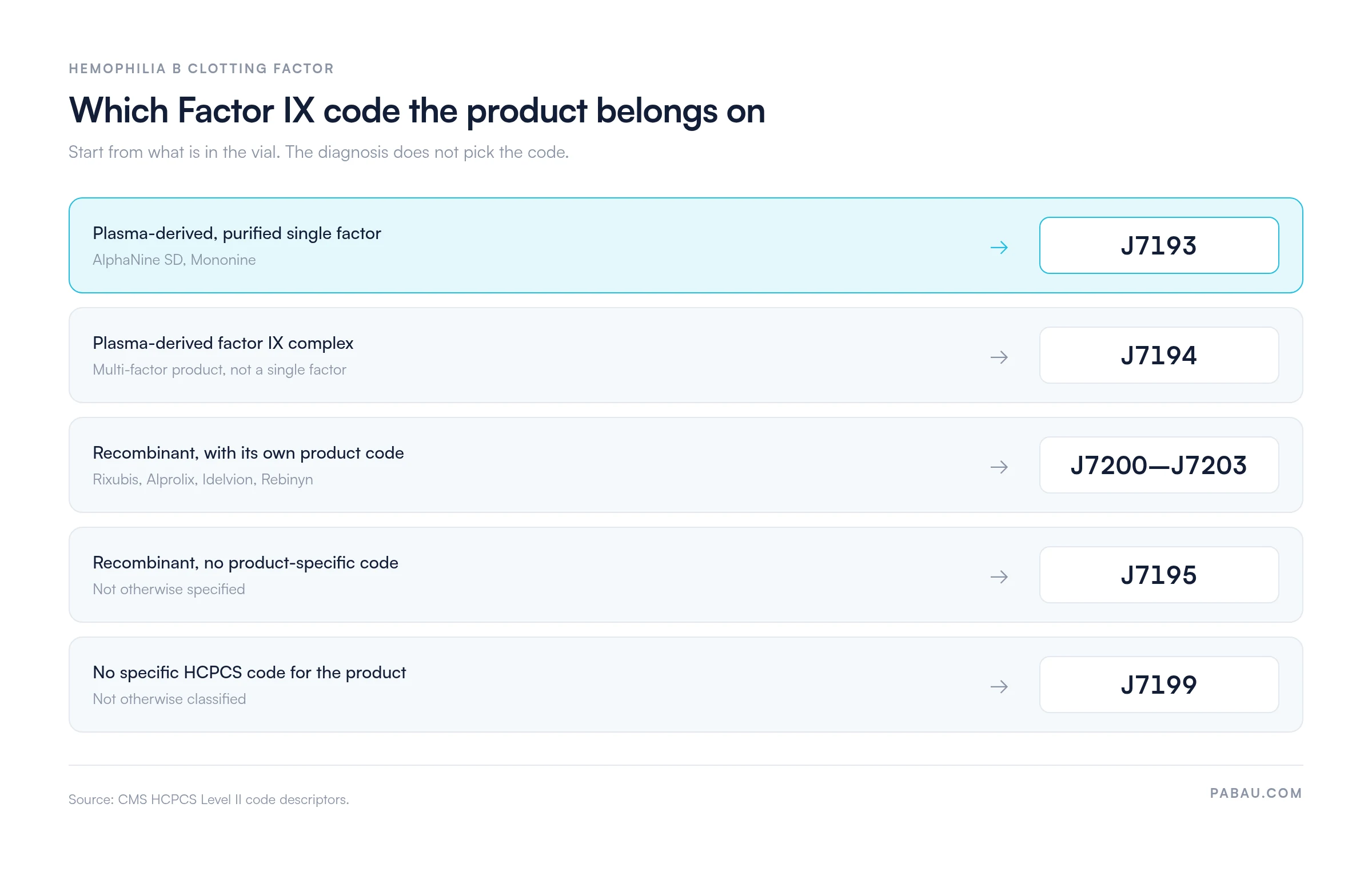
J7193 is not a recombinant code. Recombinant Factor IX with no product-specific code is billed under J7195, and factor IX complex is billed under J7194.
Bill the International Units administered to the patient, not the vials opened. Billing vials is the most common denial trigger for this code.
JZ reporting became mandatory on July 1, 2023. Since October 1, 2023, claims missing the required JW or JZ modifier are returned as unprocessable.
Pabau, our practice management software, keeps the infusion record and the claim in one system, so billed units match the log behind them.
HCPCS Code J7193 is a Level II HCPCS J-code for Factor IX (antihemophilic factor, purified, non-recombinant), per IU. Outpatient facilities, physician offices, and home infusion suppliers use it to bill plasma-derived Factor IX concentrate. The patients treated have hemophilia B, also known as hereditary factor IX deficiency.
The full CMS descriptor is Factor IX (antihemophilic factor, purified, non-recombinant), per IU. The code remains active in the current HCPCS Level II file. CMS maintains the HCPCS Level II code set, publishes the annual file each fall, and applies changes from January 1, with quarterly updates in between.
Two words in that descriptor do the heavy lifting. Purified, non-recombinant means the product is fractionated from pooled human plasma. A recombinant Factor IX made in cell culture is never billed under J7193. Neither is factor IX complex, which is a multi-factor product with its own code.
Use this table as a quick reference before submitting any claim for HCPCS Code J7193.
Factor IX is a clotting protein that patients with hemophilia B lack. The condition is also called Christmas disease. Without enough Factor IX, blood does not clot properly after injury, and bleeding episodes run long enough to become dangerous.
Products billed under HCPCS Code J7193 are fractionated from pooled human donor plasma rather than grown in cell culture. Manufacturers purify the Factor IX out of that plasma and run viral inactivation and removal steps. Solvent and detergent treatment, nanofiltration, and monoclonal antibody chromatography are the usual methods.
AlphaNine SD and Mononine are the products long associated with this code. Verify current product-to-code mapping against the CMS HCPCS annual file before relying on any brand name, because manufacturers discontinue products and CMS reassigns codes.
Medicare Part B covers clotting factor products when they are medically necessary for hemophilia patients. For HCPCS Code J7193, coverage conditions include a confirmed hemophilia B diagnosis, a prescriber order, and documented medical necessity. Confirming all three before the claim goes out is what claims management software is built to do.
Coverage is subject to Local Coverage Determinations (LCDs) issued by your Medicare Administrative Contractor (MAC). Noridian and Palmetto GBA each publish MAC-specific hemophilia clotting factor billing guidance. Verify your jurisdiction’s active LCD before billing, because coverage criteria, prior authorization requirements, and documentation standards differ across MAC regions.
The most consequential billing rule for HCPCS Code J7193 is the unit methodology. Bill the number of International Units actually administered to the patient, not the number of vials opened or dispensed.
MAC billing guidance from Palmetto GBA and Noridian confirms the per-IU approach. One unit of service on the claim equals one IU of Factor IX administered.
Worked example: a 3,000 IU vial is reconstituted and the patient receives 2,500 IU. The remaining 500 IU are discarded. Bill two lines. Line 1 is J7193 with 2,500 units for the administered drug, carrying no waste modifier. Line 2 is J7193 with 500 units and modifier JW for the discarded drug. JZ has no place on this claim, because waste occurred.
Run a pre-submission audit on all J7193 claims to confirm units billed match infusion administration records. Discrepancies between the physician’s order, the infusion log, and the claim line are the leading cause of medical necessity audits for clotting factor codes.
CMS requires either the JW modifier or the JZ modifier on claims for separately payable drugs supplied in single-dose containers, including HCPCS Code J7193. JW has applied to discarded drug for far longer. JZ is the newer half of the pair, and reporting it became mandatory on July 1, 2023. Since October 1, 2023, claims that omit the modifier where it is required are returned as unprocessable.
The rules are set out in CMS Billing and Coding Article A55932, JW and JZ Modifier Billing Guidelines. Read the remittance advice on any J7193 denial before resubmitting, because a modifier rejection reads differently from a medical necessity denial.
Verify the current modifier rules with your MAC before submission. MAC-level billing articles often add jurisdiction-specific documentation requirements beyond the CMS baseline.
Every HCPCS Code J7193 claim requires a supporting ICD-10-CM diagnosis code. The primary code is D67, but clinical context may require additional codes from the hemophilia spectrum.
Confirm these codes against the current fiscal year code set before you rely on them. Our ICD-10-CM code reference covers the wider code set, and CMS republishes the official files each October.
Medicare prices HCPCS Code J7193 from the Average Sales Price file, at ASP plus 6% for Part B drugs. CMS refreshes ASP every quarter, so any dollar figure published in an article is stale within months. Pull the current rate from the CMS ASP Drug Pricing File for the quarter you are billing.
Clotting factor carries one payment feature that most J-codes do not. Medicare pays a furnishing fee per unit of clotting factor, on top of the ASP-based drug payment. That fee recognizes the cost of supplying and handling the product. CMS updates that fee each year, and your MAC applies it to the payment rather than asking you to bill a separate code.
Commercial payers often price from a different basis, such as a percentage of AWP or a contracted per-IU rate. Read the contract before assuming ASP logic applies to a non-Medicare claim.
Documentation is what an audit actually tests, and thin records are a common reason J7193 claims fail review. The following items must be present and retrievable on request from your MAC.
MAC-specific LCDs may require additional documentation. Always review the active LCD for your jurisdiction before initiating therapy and before each billing cycle.
Medicare Part B covers purified Factor IX for home use when the patient has hemophilia B and meets medical necessity criteria. Home billing for HCPCS Code J7193 follows the same per-IU unit methodology as outpatient facility billing, but it adds supplier enrollment requirements.
Suppliers billing home-dispensed clotting factor must be enrolled through the National Supplier Clearinghouse (NSC) and hold DMEPOS accreditation where it is required. Submit claims using the CMS-1500 form or the 837P electronic claim file, with Place of Service code 12 for home. The record for each home infusion encounter must capture the product, lot number, IU dispensed, and IU returned or wasted.
Clotting factor claims fail for a small set of repeatable reasons. HCPCS Code J7193 has six recurring failure patterns, and a pre-submission check catches every one of them.
Sort your J7193 denials by reason code once a month. One error usually accounts for most of them. That tells you whether to fix the order template, the infusion log, or the claim build.
Add the product name and its manufacturing route to your clotting factor order template, not just the dose. A biller who can see plasma-derived or recombinant on the order will not send a J7195 product out on a J7193 line.
Several adjacent J-codes cover other hemophilia clotting factor products. Knowing where HCPCS Code J7193 sits within the clotting factor code family prevents miscoding, particularly when a patient switches between product types.
Several recombinant Factor IX products carry their own codes and never belong on J7195. Rixubis is J7200, Alprolix is J7201, Idelvion is J7202, and Rebinyn is J7203. Check the product-specific list first, then fall back to J7195 only when nothing matches. The chart below runs that decision from the vial to the code line.
You can look up any of these codes using AAPC’s HCPCS code lookup before you build the claim line.
The clotting factor record and the claim usually live in separate systems. The infusion log sits in the chart, the IU math happens in a spreadsheet, and the billing team retypes both into the claim. Every hop between those places is a chance for units and modifiers to drift.
Pabau, our practice management software, holds the clinical record and the billing record in one system. Your team records the product, the IUs drawn, the IUs administered, and the IUs discarded against the encounter itself. Those figures carry through to the claim your biller reviews, so the units on the line match the log behind them.
Eligibility checks, stored documentation, and claim status tracking sit alongside that record. Your biller still decides the codes and modifiers. They do it with the infusion detail in front of them, rather than chasing it across three systems.

Pabau helps outpatient and home infusion providers record administered and discarded IUs alongside the documentation their MAC asks for. Cleaner claims on drug codes like J7193 follow from that.

Clotting factor claims carry more billing complexity per code than almost any other drug category. Getting HCPCS Code J7193 right starts with the product in the vial. J7193 is the purified, non-recombinant Factor IX code, so a recombinant product belongs on J7195 or on its own product code.
From there the rules are mechanical. Bill per IU administered rather than per vial. Apply JW or JZ wherever the single-dose container rules require it. Pair the claim with ICD-10-CM D67, and keep the documentation your MAC asks for.
Pabau helps outpatient practices and home infusion providers structure drug billing workflows. Fewer claims then leave with a modifier missing or a unit count nobody can evidence. To see how it handles complex J-code billing, book a demo with the team.

Need to understand how medical billing fits your revenue cycle? Revenue cycle management explained walks through every stage from scheduling to payment reconciliation.
Seeing repeated denials on drug claims? Denial management in healthcare covers systematic approaches to reducing claim rejection rates.
Want to understand how clean claims reduce audit risk? Medical billing compliance guide outlines documentation and submission standards that support cleaner claims.
HCPCS Code J7193 bills Factor IX (antihemophilic factor, purified, non-recombinant), per International Unit. It covers plasma-derived concentrates such as AlphaNine SD, given to patients with hemophilia B.
No. J7193 covers purified, non-recombinant Factor IX fractionated from pooled human plasma. Recombinant Factor IX with no product-specific code is billed under J7195 instead.
Report JW on the discarded line when drug from a single-dose vial is wasted. Report JZ on the administered line when nothing is discarded. JZ reporting has been mandatory since July 1, 2023.
ICD-10-CM D67, hereditary factor IX deficiency, is the primary pairing for J7193. Do not use D66, which describes hereditary factor VIII deficiency and belongs with Factor VIII products.
Yes. Medicare Part B covers clotting factor for hemophilia patients, including medically necessary home use. Coverage follows your MAC Local Coverage Determination and its documentation requirements.
J7193 covers purified, non-recombinant Factor IX. J7194 covers factor IX complex, a multi-factor plasma product. J7195 covers recombinant Factor IX that has no product-specific code.
Yes. Medicare Part B covers clotting factor dispensed for home use when the patient has hemophilia B and meets medical necessity criteria. Suppliers bill on the CMS-1500 with place of service 12.