HCPCS Code G0163: Skilled nursing observation and assessment
What is HCPCS Code G0163? HCPCS Code G0163 is a deleted Level II code for skille...

Last Updated: Oct 15, 2026

CPT code 66761 covers iridotomy or iridectomy by laser, billed per session, using either an Nd:YAG or an argon laser.
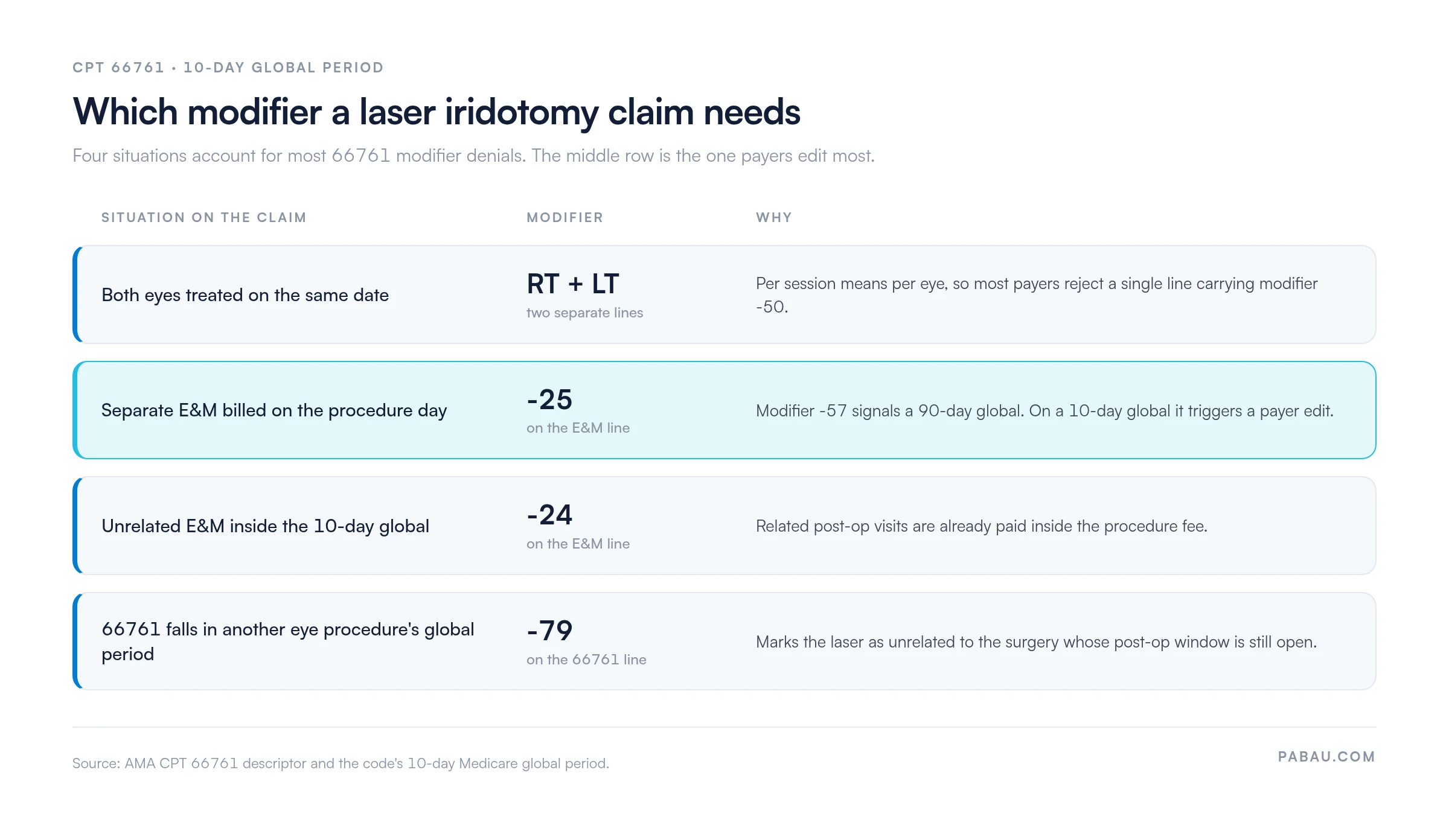
Each eye is billed as a separate session with modifier RT or LT, because most payers reject a single bilateral line.
The code carries a 10-day global period, so a same-day E&M takes modifier -25 rather than modifier -57.
Medicare’s 2026 national average pays about $299 in an office setting and about $202 in a facility.
Pabau captures the procedure code inside the clinical note and submits through the Claim.MD clearinghouse, which cuts re-entry errors.
CPT code 66761 is the procedure code for iridotomy or iridectomy performed by laser surgery, for example for glaucoma, billed per session.
Ophthalmology practices use it to report laser peripheral iridotomy, the standard treatment for angle-closure glaucoma and narrow-angle prevention.
Each eye treated is its own session, the code carries a 10-day global period, and Medicare pays roughly $299 in an office setting. Those three facts decide almost every 66761 claim.
The code sits in the Procedures on the Iris and Ciliary Body section of the AMA’s CPT code set. Its 10-day global period also governs how post-operative visits interact with same-day evaluation and management charges.
This guide covers the full descriptor, clinical indications, billing guidelines, applicable modifiers, 2026 Medicare reimbursement data, documentation requirements, and related ophthalmology codes.
CPT code 66761 describes iridotomy or iridectomy by laser surgery, for example for glaucoma, billed per session. The full AMA descriptor reads: Iridotomy/iridectomy by laser surgery (eg, for glaucoma) per session. The slash between “iridotomy” and “iridectomy” means either procedure may be reported under this code when performed with laser energy.
A laser iridotomy creates a small opening in the peripheral iris. Aqueous humor can then bypass a blocked pupillary pathway and drain freely. An iridectomy removes a small section of iris tissue instead. Both relieve elevated intraocular pressure (IOP) in angle-closure presentations.
Nd:YAG laser is the modern standard. Argon laser is sometimes used first, as a preparatory step to thin the iris before YAG delivery.
Laser iridotomy is indicated for angle-closure glaucoma, narrow-angle glaucoma, and prophylactic treatment of the fellow eye after an acute episode. Payer coverage policies generally require a documented ICD-10 diagnosis code confirming medical necessity. The diagnosis alone is not enough. The chart must also show the clinical findings that justify the procedure, including gonioscopy results, IOP readings, and symptoms.
Coverage criteria vary by payer and MAC region. Always verify against the applicable Local Coverage Determination (LCD) before submitting, especially for prophylactic procedures billed before an acute episode occurs.
Record the gonioscopy angle grade in every note for CPT code 66761. Payers reviewing for medical necessity want to see the angle documented, not just a diagnosis code. A note that carries the ICD-10 code without angle-closure findings is a straightforward audit target.
The most consequential billing rule for CPT code 66761 is the per-session unit. Each treatment session, meaning one eye, is one billable unit. Bilateral procedures on the same date are reported on two separate lines, each with the appropriate anatomical modifier (RT for right, LT for left).
Modifier -50 (bilateral) is not standard for this code. Most commercial payers and Medicare want separate line items with RT and LT instead of one line flagged bilateral. Verify with individual payer contracts before defaulting to -50.
The 10-day global surgical period is the second rule billers most often misapply. Because the global period is 10 days and not 90, a separately identifiable E&M billed on the same day takes modifier -25. Modifier -57 signals a decision for major surgery with a 90-day global period, so it triggers a payer edit on a 66761 claim. Submitting a clean claim means getting that modifier right before the charge leaves the practice.
Other procedures on the same eye do carry that 90-day window. A revision of a failed filtering bleb is billed under CPT code 66250, which carries a 90-day global period. Match the modifier to the procedure performed, not to the diagnosis on the claim.
Four situations cover almost every modifier decision on this code, and the chart below sets out which one applies when.
Post-operative visits within the 10-day global period are included in the 66761 payment. They cannot be billed separately unless a new, unrelated problem is the reason for the visit. Document that unrelated reason clearly to support a separate claim.
Denials on this code cluster around three triggers:
Build a pre-submission checklist that catches all three before the claim reaches the clearinghouse.
Applying the wrong modifier to CPT code 66761 is one of the fastest routes to a denial. The table below maps each applicable modifier to its use case and the billing context where it applies.
Modifier -79 depends on the global period of the earlier procedure. An intraocular lens exchange, billed as CPT code 66986, carries a 90-day global on that eye. A 66761 session inside that window for an unrelated indication takes -79.
The billing denial codes returned most often on rejected 66761 claims are CO-4 (inconsistent modifier), CO-16 (missing information), and CO-97 (included in global). Each one maps back to a preventable documentation or modifier error.
Medicare reimburses CPT code 66761 under the CMS Physician Fee Schedule. Rates differ between facility settings (hospital outpatient, ASC) and non-facility settings (office-based). Non-facility rates are higher because the practice absorbs overhead that no facility fee covers. All figures below are national averages, and payment varies by geographic practice cost index (GPCI) and MAC locality.
Practice expense carries the whole difference between the two settings. Work and malpractice RVUs do not move, so an office-based session pays roughly $97 more than the same laser performed in a facility. Run your own MAC locality through the CMS fee schedule lookup above before you quote a figure to a patient.
Medicare covers laser iridotomy when medical necessity is documented for treatment or prevention of angle-closure glaucoma. Prior authorization is generally not required under traditional Medicare Part B, though Medicare Advantage plans may set their own authorization rules. ASC-based procedures receive the facility rate, while the physician’s professional component is paid separately under the fee schedule.
Practices routing claims through a clearinghouse get an eligibility answer before the procedure date. Practice management software like Pabau connects to the Claim.MD clearinghouse and runs real-time eligibility checks across more than 400 US payers. Confirming coverage before the laser is scheduled removes the most common reason a 66761 charge is written off.
Incomplete documentation is the leading reason CPT code 66761 claims fail a post-payment audit. The chart must support both the diagnosis and the laser procedure itself. Capturing every required element at the point of care prevents retroactive corrections and protects the practice during a MAC review.
Required chart elements for CPT code 66761:
Any E&M service billed on the same day needs its own history, examination, and medical decision-making, documented separately from the laser procedure note. Pasting the procedure note into the E&M and adding one paragraph does not satisfy the separately identifiable standard.
Audit 10 randomly selected CPT code 66761 charts from the past 90 days. Check specifically for gonioscopy documentation, laser settings, and post-procedure IOP. If more than 2 of the 10 miss any of these elements, standardize the note template before the next MAC review cycle.
Coding the wrong laser procedure is a common error in ophthalmology billing. The table below compares CPT code 66761 with the codes most frequently confused with it or billed alongside it. Clearinghouse edits flag mismatched code and diagnosis pairs, but catching them before submission is faster and cheaper than working the denial afterwards.
SLT (65855) and laser iridotomy (66761) treat glaucoma through different anatomical targets. SLT acts on the trabecular meshwork to improve aqueous outflow in open-angle presentations. CPT code 66761 opens the iris to relieve pupillary block in angle-closure presentations. Confusing the two produces a code and diagnosis mismatch that payers catch automatically.
Ophthalmology billing staff work inside a narrow documentation window. The laser procedure is fast and the patient is often anxious. Before the claim can move, the biller needs laser settings, laterality, IOP readings, and ICD-10 codes in one complete note.
Pabau’s claims management software captures CPT codes inside the clinical documentation workflow, so nobody re-keys them into a billing system later. When the clinician records a laser iridotomy against the procedure, the code is pulled forward into the claim. Submissions route through the Claim.MD clearinghouse for validation against payer rules before they reach Medicare or a commercial plan.
For glaucoma practices treating both eyes in one visit, Pabau raises separate RT and LT line items from a single clinical encounter. That removes the manual duplication step. Procedure-level reporting tracks 66761 claim volumes, denial rates by modifier, and reimbursement trends over rolling periods.

Pabau captures procedure codes within the clinical documentation flow and submits claims through our clearinghouse integration. Ophthalmology billers then spend less time correcting errors and more time getting paid.

Most denied 66761 claims fail on something the practice already knew. The angle grade was measured but never written into the note, or the same-day visit went out carrying modifier -57. Both are documentation habits, and a note template fixes both.
Standardize that template once, and the modifier decision stops being a judgment call at the end of a busy laser day. Your billers can then spend their time on the coverage questions that genuinely need an argument.
Pabau ties clinical documentation to claim submission, so ophthalmology practices spend less of the week reworking rejected charges. Book a demo to see how a 66761 charge moves from the laser note to a submitted claim.

Need to understand the denial codes that come back on laser procedure claims? Denial codes in medical billing explains the most common CARC and RARC codes and how to action each one.
Want to reduce claim rejections at the clearinghouse level? What makes a clean claim covers the pre-submission elements that prevent the most common billing errors.
Looking to connect your billing workflow to a clearinghouse? How a medical claims clearinghouse works explains payer routing, eligibility checks, and ERA reconciliation in plain language.
Reconciling Medicare payments against what you expected? Electronic remittance advice shows how to read an ERA and spot short payments on procedure codes.
Building the charge capture step that feeds the claim? What a superbill includes sets out the fields a procedure charge needs before it reaches billing.
CPT code 66761 is the billing code for laser iridotomy or iridectomy. The procedure creates a small opening in the peripheral iris to relieve intraocular pressure in angle-closure glaucoma and anatomically narrow-angle patients. It is billed per session, so each eye treated on the same date is a separate billable unit reported with modifier RT or LT.
RT (right eye) and LT (left eye) are the primary anatomical modifiers required on every claim. When a separately identifiable evaluation and management service is billed on the same day, modifier -25 goes on the E&M code. Modifier -79 applies when 66761 is performed during the global period of an unrelated procedure on the same eye. Modifier -50 (bilateral) is generally avoided, because most payers require separate RT and LT line items instead.
CPT 66761 is billed per session, and each eye counts as a separate session. A bilateral procedure on the same date is submitted as two line items: one with modifier RT and one with modifier LT. The AMA descriptor states “per session” because laterality is controlled through the modifier, rather than by billing two units on a single line.
Medicare pays approximately $299 in non-facility settings (office-based) and approximately $202 in facility settings such as a hospital outpatient department or an ASC. Both are 2026 MPFS national averages. The code carries 8.96 total RVUs in the office and 6.05 in a facility. Actual payment varies by locality through the GPCI adjustment, so verify current rates using the CMS Physician Fee Schedule lookup for your MAC region.
Both procedures bill under CPT 66761 when performed by laser. Iridotomy creates a small hole in the iris, while iridectomy removes a small section of iris tissue. The AMA descriptor uses a slash (“iridotomy/iridectomy”) because either approach is covered by the same code when the laser is the surgical instrument. No modifier distinguishes the two techniques, and neither is billed at a different rate.
Yes, provided the evaluation and management service is separately identifiable and documented independently of the laser procedure note. Place modifier -25 on the E&M code, not -57, which applies to major surgery with a 90-day global. The E&M must carry its own history, examination, and medical decision-making. Without modifier -25 and separate documentation, the payer bundles the E&M into the procedure payment and denies it.
CPT code 66761 carries a 10-day global surgical period. Post-operative visits related to the laser iridotomy within those 10 days are included in the procedure payment and cannot be billed separately. Visits for unrelated problems inside the global period may be billed with modifier -24 on the E&M code. The documentation must establish the unrelated reason for that visit.
The most important distinction is between CPT 66761 (iris procedure, angle-closure glaucoma) and CPT 65855 (trabeculoplasty by laser, open-angle glaucoma). SLT is reported under 65855, not 66761. CPT 66821 covers YAG posterior capsulotomy after cataract surgery and has no glaucoma indication. CPT 92012 is the established-patient ophthalmology E&M code most often billed alongside 66761 on the same date.