



HCPCS code E0198: Water pressure pad billing guide
HCPCS code E0198 is a water pad for a standard mattress HCPCS code E0198 is the ...

Last Updated: Oct 13, 2026

CPT Code 20985 describes computer-assisted surgical navigation for musculoskeletal procedures. It is an add-on code, so it cannot be billed without a valid primary procedure code.
Medicare pays the code through the Physician Fee Schedule. Geographic locality affects the final amount, so verify rates with the CMS lookup tool.
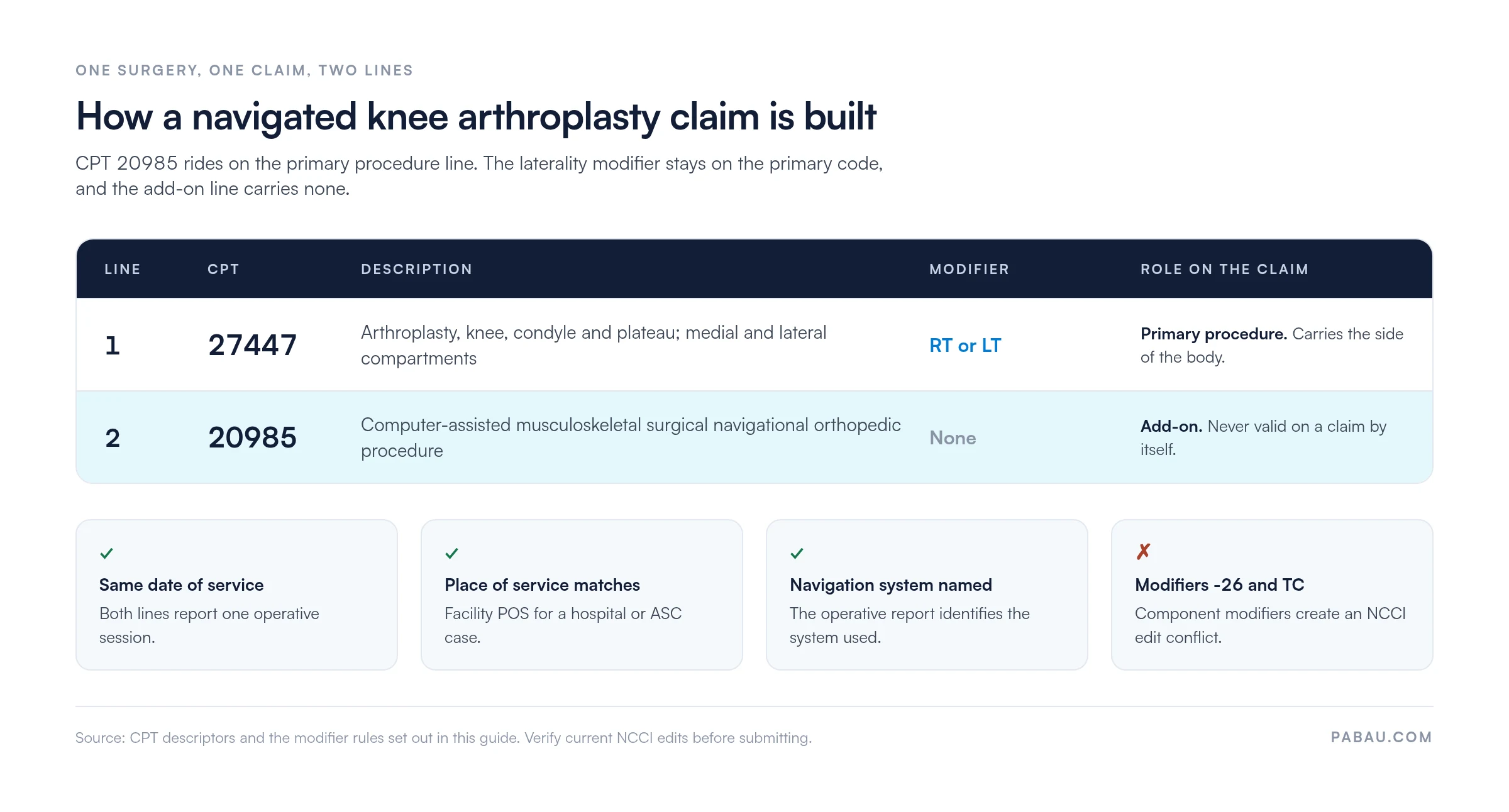
Modifiers -26 and TC are generally not valid with CPT 20985. Laterality modifiers belong on the primary orthopedic code instead.
UnitedHealthcare and Aetna classify computer-assisted navigation as unproven or investigational, so commercial claims for 20985 are frequently denied.
Practice management software like Pabau checks the code pairing, the modifiers and the place of service before a claim leaves the practice.
CPT Code 20985 is the add-on code for computer-assisted musculoskeletal surgical navigation.
It is reported alongside a primary orthopedic procedure, such as a total knee or hip replacement. It has an established Medicare fee, it is never billed on its own, and no component modifier belongs on it.
Coverage is what decides whether the line earns anything. Medicare pays the code through the Physician Fee Schedule. UnitedHealthcare and Aetna both classify computer-assisted navigation as unproven or investigational, so commercial claims are routinely denied. This guide covers the 2026 fee schedule, the valid modifiers, payer-by-payer coverage, and the documentation that survives an audit.
CPT Code 20985 is a Category I add-on code describing computer-assisted musculoskeletal surgical navigation for orthopedic procedures. It is maintained by the American Medical Association (AMA) as part of the CPT code set. It sits under the “Other Procedures on the Musculoskeletal System” section of the CPT manual.
The code reports the use of navigation during surgery to guide implant placement or bone resection. That covers optical and electromagnetic tracking systems, along with robotic navigation platforms that use live imaging data to direct the instruments.
Add-on codes report supplemental work performed during the same surgical session as the primary procedure. CPT 20985 follows that pattern. It cannot be submitted on a claim by itself, and it needs no separate modifier to mark it as secondary.
Orthopedic coders see the code most often paired with total joint arthroplasty. The table below lists the primary CPT codes most commonly reported alongside 20985.
Billers should confirm from the operative report that the surgeon used computer-assisted navigation during the session. Appending CPT 20985 without a note naming the navigation system is the fastest route to a denial or a compliance audit.
The code’s add-on status decides which modifiers belong on the claim and which ones create an edit conflict.
The guidance above reflects common coding practice. Confirm it against the current CMS National Correct Coding Initiative (NCCI) edits and each payer’s own policy before you finalize a claim. Requirements shift with the annual updates.
Laid out as a claim, the split is easy to see. The primary line carries the laterality modifier, and the add-on line carries no modifier at all.
Run CPT 20985 through your clearinghouse’s pre-submission claim scrubber before sending. Payer-specific NCCI edits and bundling logic catch modifier errors that manual review misses, saving the appeal cycle entirely.
Medicare pays for CPT 20985 through the Medicare Physician Fee Schedule (MPFS). The schedule sets a facility rate for procedures performed in a hospital or ambulatory surgery center. Office procedures draw a non-facility rate instead. Rates are adjusted by locality using the Geographic Practice Cost Index (GPCI), so national figures are averages.
Because joint arthroplasty almost always takes place in a facility setting, most claims for CPT 20985 draw the facility rate. Pull the current national and locality-adjusted amounts for your ZIP code from the CMS Physician Fee Schedule lookup tool. Rates are set annually, and the 2026 figures took effect on January 1, 2026.
The facility rate applies when the physician bills for professional services in a hospital, ASC, or skilled nursing facility. The facility then bills separately for its own overhead. The non-facility rate carries a higher practice expense component, because the office absorbs those costs directly.
For CPT 20985, almost every claim falls under the facility rate, since navigation systems are rarely available in office settings. Submitting a non-facility place of service for a hospital case is a red flag for auditors and a common source of overpayment demands.
Place of service is worth checking before the claim transmits rather than after a post-payment review flags it. A clearinghouse validation step catches the mismatch while the claim can still be edited.
Commercial coverage decides whether this line earns anything at all. Policies differ by payer and often by individual plan. Some plans pay the navigation charge separately. Others fold it into the primary arthroplasty code and deny 20985 outright.
Two of the largest commercial payers in the country treat navigation as investigational. That leaves Medicare as the main source of separate payment for 20985. A plan-by-plan check belongs in the coding step, not the appeal step.
Before submitting CPT 20985 to any commercial payer, pull the current medical policy document for that plan. Citing the policy number and coverage date in an appeal letter improves the success rate when a payer denies the code as bundled. Good denial management for orthopedic add-on codes means tracking the reason code, spotting which payers issue it consistently, and keeping clinical evidence ready to attach.
CMS has an established fee for CPT 20985 in the MPFS, and its coverage guidance is clearest in the context of total joint arthroplasty. CMS article A60399, Response to Comments: Total Joint Arthroplasty, set out Medicare’s position on computer-assisted navigation for total knee and hip replacement.
Confirm that any indication you bill under 20985 lines up with the covered clinical criteria. Extending the code to musculoskeletal procedures that CMS guidance does not address invites extra scrutiny. Audits routinely flag add-on codes with no documented clinical necessity in the operative report.
Getting CPT 20985 paid starts with clean documentation, before the claim is even built. These are the errors that generate the most denials for this code.
Practices that run submissions through claims management software with real-time clearinghouse validation catch most of these errors before the claim leaves the building. Add-on codes clear faster when NCCI edit checks run at the point of claim creation, rather than after a denial comes back.

Robotic-assisted orthopedic platforms use live navigational data to position implants, which overlaps with what CPT 20985 describes. Coding guidance has not fully settled how the two relate, so payer policy carries more weight here than usual.
Most coding professionals accept that CPT 20985 can apply to robotic-assisted navigation when the operative report documents the navigation component of the system. Payer policies are not uniform, though. Some commercial plans separate robotic navigation from computer-assisted navigation and reach different coverage determinations for each.
Check the operative report language against that payer’s current policy before submitting. The AAPC Codify CPT lookup and the coding forums carry useful community guidance, but the payer’s own policy document decides the claim.
Practices running a robotic orthopedic program usually need a billing workflow that tracks the navigation add-on separately from the primary procedure queue. Without one, 20985 gets missed at claim generation.
Coders working with CPT 20985 regularly meet the following codes in the same claim context, or as alternatives for specific clinical scenarios.
The codes above are the ones that turn up in the same claim context as 20985. Our CPT procedure codes library covers the rest of the orthopedic and specialty code set, including the descriptors and modifier rules for each one.
When a payer denies CPT 20985 as bundled, request the specific edit reference in writing: the NCCI edit number or the medical policy number. Appeals that cite the exact policy applied, with a counter-citation from the CMS MPFS, resolve faster.
In most orthopedic practices the navigation charge is captured by hand. The surgeon documents it in the operative report, the coder works from the primary procedure, and the 20985 line gets added late or missed altogether.
Practice management software like Pabau holds the clinical note and the claim on the same client record. The coder can see whether the operative report names the navigation system before the claim is built. The add-on line then attaches to the primary procedure instead of living on a spreadsheet.
Pabau also connects to the Claim.MD clearinghouse, so place of service, modifier, and code-pairing checks run before the claim transmits. A denial that would otherwise land three weeks later gets caught while the claim can still be edited.

Pabau’s claims management software supports accurate add-on code submission, tracks payer-specific bundling rules, and integrates with Claim.MD to catch errors before claims leave your practice.

CPT 20985 is well defined and unevenly paid. The descriptor is clear, the Medicare fee exists, and the modifier rules are settled. Coverage is where the money is decided, and two of the largest commercial payers have already decided against it.
So the work that pays is front-loaded. Check the plan’s policy before the case is coded. Make sure the operative report names the navigation system, and keep the appeal evidence where a biller can reach it. Chasing the denial afterwards rarely recovers the line.
That preparation is easier when the note, the code, and the clearinghouse check sit in one system. Book a demo to see how Pabau builds an orthopedic claim without the add-on line going missing.

Need to understand denial codes before an appeal? Denial codes in medical billing explains the most common CARC and RARC codes that affect orthopedic and add-on code claims.
Want to streamline the entire claim lifecycle? Pabau’s Claim.MD clearinghouse guide covers how the integration handles 837P submissions, real-time eligibility, and ERA processing for US practices.
Looking for a broader billing framework? Superbill documentation explains how to structure encounter data so add-on codes like 20985 are captured consistently at the point of care.
CPT Code 20985 reports computer-assisted surgical navigation used during musculoskeletal orthopedic procedures. Examples include total knee arthroplasty (27447) and total hip arthroplasty (27130). It is an add-on code billed alongside the primary procedure code. It captures the extra work of using navigation technology during surgery to guide implant placement or bone resection.
Yes, CPT 20985 is classified as an add-on code, meaning it cannot be reported on a claim by itself. It must always appear with a valid primary orthopedic procedure code on the same date of service. Submitting 20985 alone results in an automatic rejection at the clearinghouse or payer level.
Medicare covers CPT 20985 and has an established fee for it in the Medicare Physician Fee Schedule. Coverage is most clearly defined in the context of total joint arthroplasty (CMS article A60399). Some local coverage determinations may restrict coverage by indication, so verify the current LCD for your MAC jurisdiction before submitting.
No modifier is required on CPT 20985 itself in most billing scenarios. Laterality modifiers (RT or LT) go on the primary procedure code, not on the add-on code. Modifiers -26 and TC are generally not valid for this code, and applying them typically creates an NCCI edit conflict. Verify against the current CMS NCCI edits and individual payer policies annually.
The 2026 Medicare reimbursement rate for CPT 20985 varies by geographic locality and place of service. Because most navigation-assisted arthroplasty occurs in a facility setting, the facility rate applies to the majority of claims. Use the CMS Physician Fee Schedule lookup tool to retrieve the current national and locality-adjusted amounts for your ZIP code. Rates are set annually and change each January 1.
Coverage varies by payer and plan. Medicare pays CPT 20985 separately through the Physician Fee Schedule. UnitedHealthcare and Aetna classify computer-assisted navigation as unproven or investigational, so they generally do not pay it. Some BCBS plans bundle the navigation cost into the primary arthroplasty package. Pull the current medical policy for each plan before submitting, and track denial reason codes by payer.



