HCPCS code T2043: Hospice continuous home care billing guide
HCPCS code T2043 pays for hospice crisis care by the hour HCPCS code T2043 is th...

Last Updated: Oct 7, 2026

CPT Code 73140 covers radiologic examination of the finger(s) only, not the hand or thumb, requiring a minimum of 2 radiographic views per encounter.
Modifier 26 (professional component) and TC (technical component) are the most commonly applied modifiers, used when the reading physician and imaging facility bill separately.
A global claim pays roughly $35 to $40 under the Medicare fee schedule, varying by MAC locality and by setting.
The technical component carries about 83% of the code’s value, so the imaging facility collects far more than the reading physician.
Practice management software like Pabau handles CPT entry, modifier selection, and ICD-10 pairing inside one billing workflow.
CPT Code 73140 is the billing code for radiologic examination of the finger(s), minimum of 2 views.
The AMA CPT code set lists it under Diagnostic Radiology. It covers X-ray imaging of one or more digits, and it does not cover the hand or the wrist. Mixing those two up is the most common billing error on this code.
A global claim pays roughly $35 to $40 under the Medicare Physician Fee Schedule, before geographic adjustment. Most of that sits in the technical component, so a facility and a reading physician who bill separately collect very different amounts. This guide covers the official descriptor, the clinical indications, and the modifiers. It also covers the RVU split, the ICD-10 crosswalk, and the errors that trigger denials.
CPT Code 73140 is the AMA procedure code for “Radiologic examination, finger(s), minimum of 2 views.” It covers X-ray imaging of one or more fingers when at least two radiographic projections are obtained. The code sits in the Diagnostic Radiology section of the CPT code book, under musculoskeletal imaging of the upper extremity.
This code applies to the fingers, not the hand or the wrist. Imaging of the hand uses separate codes, CPT 73120 or CPT 73130. The thumb is less settled. Some payers treat it as a separate digit and expect a hand code instead. Check current AMA guidance and your payer’s policy before coding a thumb study.
Ordering providers must establish medical necessity before billing CPT Code 73140. These are the indications that turn up most often on finger X-ray orders.
Each of these indications maps to one or more ICD-10-CM diagnosis codes. Selecting the most specific ICD-10 code available, rather than a catch-all unspecified code, reduces the risk of a medical necessity denial.
Payers reviewing claims for CPT Code 73140 expect the medical record to demonstrate both medical necessity and technical completeness. A missing item on the list below is enough to lose the claim on review.
Checking the patient’s coverage before the encounter also heads off rejections. Some plans require prior authorization for outpatient radiology, and that requirement is far easier to satisfy before the X-ray than after it.
Modifiers alter how CPT Code 73140 is billed and reimbursed. Applying the wrong modifier, or omitting a required one, frequently triggers automatic claim denials. The table below covers the modifiers most relevant to finger X-ray billing.
Modifier 26 and TC can appear on the same date of service. Their combined amounts should not exceed the global, no-modifier rate. Payers flag anything above it as an overbilling error.
Payment for CPT Code 73140 comes from the Medicare Physician Fee Schedule (MPFS). The schedule turns relative value units (RVUs) into dollars using an annual conversion factor. Rates update every January and vary by geographic location, so verify the current figure with the CMS MPFS lookup tool before you quote one.
Medicare payment for CPT 73140 is built from three RVU components: work, practice expense, and malpractice. Each is multiplied by a geographic practice cost index (GPCI) and then by the conversion factor. The values below follow CMS fee schedule data for the non-facility setting. Confirm the current-year split for your locality in the CMS MPFS lookup tool.
The split matters more than the total. About 83% of the code’s value sits in the technical component, which is what the imaging facility bills. The reading physician’s professional component is the remaining 17%.
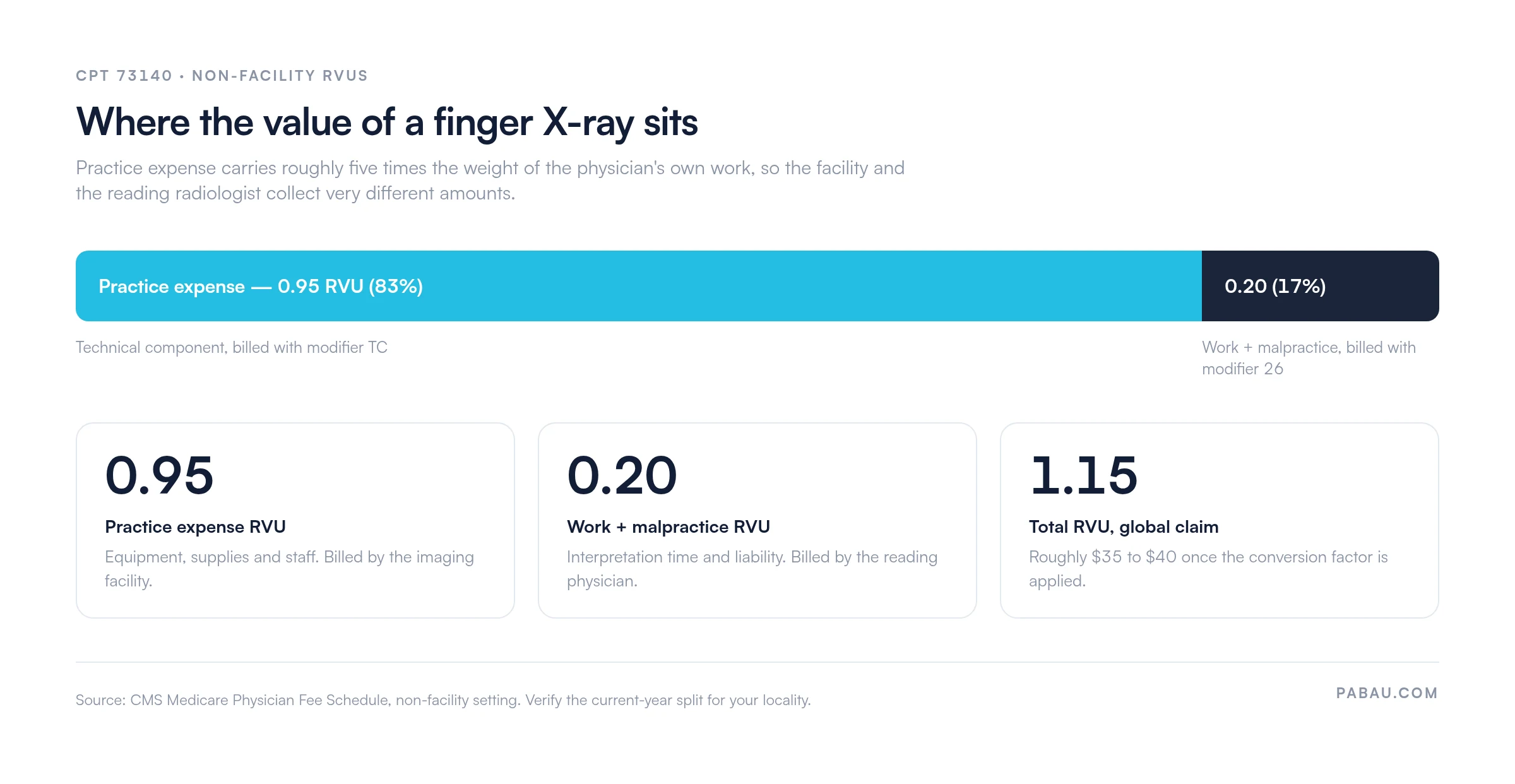
Applying the conversion factor to the total RVU produces a national average Medicare payment of roughly $35 to $40 for a global, no-modifier claim. Non-facility rates in an office setting run higher than facility rates, because practice expense RVUs differ between the two. GPCI adjustments then move the locality rate above or below the national average by a few dollars.
Run a quarterly comparison of your contracted payer rates for CPT 73140 against the current Medicare fee schedule. Private payer contracts often set rates as a percentage of Medicare. If the contract language hasn’t been updated, your reimbursement will lag behind the annual MPFS adjustment.
Every CPT Code 73140 claim needs at least one supporting ICD-10-CM diagnosis code. Use the most specific code the documentation supports, and match it to the clinical indication. Unspecified codes raise denial risk. Check the current ICD-10-CM code set when the chart describes something the table below doesn’t cover.
When fracture codes from the S62 category apply, include the seventh-character extension: A for initial encounter, D for subsequent encounter, or S for sequela. The extension must match the visit type documented in the chart.
CPT Code 73140 sits within a family of upper-extremity radiology codes. Picking the wrong one, usually by reaching for a hand code when only digits were imaged, is the most common coding error in this group. Use the comparison below to confirm the right code for each scenario.
CPT 73130 is the code most often confused with 73140. The distinction comes down to anatomy. If the radiograph captures the metacarpals as part of the study, it is a hand exam. If it isolates one or more digits without the metacarpals, the finger code applies.
Finger X-ray claims fail for a short list of predictable reasons. Each one has a correction that belongs in the ordering or coding step, well before an appeal.
Track which of these five drives the most rejections on your own remittances. The fix usually belongs upstream, in the documentation workflow or in coder training, rather than in the appeal.
The finger X-ray billing workflow has four decision points where errors enter: code selection, modifier assignment, ICD-10 pairing, and claim submission. In most practices each step means a separate lookup in a separate reference tool. Practice management software like Pabau closes those handoffs with claims management without re-keying. The code, the modifier, and the diagnosis stay on one record from the order through to submission.

Pabau connects to the Claim.MD clearinghouse for electronic submission to thousands of US payers. For a radiology practice billing 73140 at volume, that means eligibility checks before the imaging. It also means automated 837P claim files, with electronic remittance advice posted back against the claim.
The difference shows up at submission. Reference tools like AAPC Codify or FindACode carry accurate code data, but a coder still re-enters it into a separate billing system. Every re-entry is a chance to transpose a digit. The electronic claim file Pabau generates carries the CPT code, the modifier, and the diagnosis as one structured package. Payer-specific edits run before it leaves the practice.
Build a 73140 checklist into your billing screen. Confirm the study is finger, not hand. Confirm that 2 views are documented. Apply the laterality modifier. Check that the interpretation is signed and dated. Take the ICD-10 code to its seventh character.
A superbill template that pre-loads the most common diagnosis pairings for 73140 saves coder time and keeps the team consistent. Pabau supports custom superbill templates, so fracture, dislocation, and arthritis codes sit ready on the form.

See how Pabau handles CPT code entry, modifier selection, and ICD-10 pairing in one billing workflow. Fewer manual steps mean fewer claim errors.

Finger X-rays are cheap to perform and easy to misbill. The money is lost in the difference between a hand code and a finger code. Decide the anatomical scope from the radiograph rather than from the order, and most of the denial risk goes with it.
The trade-off worth remembering is the size of the claim. At under $40 a global claim, 73140 rarely justifies an appeal cycle, so an error usually becomes a write-off. Getting the scope, the view count, and the laterality right at the point of order is what protects the line item.
Pabau’s billing tools give radiology and orthopedic practices one path from code selection to a paid claim. Book a demo to see how that workflow handles a code like 73140 end to end.

Need help navigating claim denials on radiology codes? Denial codes in medical billing breaks down the most common CARC denial reason codes and how to resolve them efficiently.
Want to understand how clearinghouse claims processing works end to end? Medical claims clearinghouse guide explains how electronic claims travel from the practice to the payer and what happens at each step.
Looking for a structured approach to billing compliance audits? Credentialing with insurance companies walks through the payer enrollment process that underpins clean claim submission.
CPT code 73140 covers radiologic examination of the finger(s) with a minimum of 2 views, classified under Diagnostic Radiology in the musculoskeletal system section. It applies to X-ray imaging of isolated digits, not the hand as a whole. Common uses include fracture evaluation, dislocation assessment, arthritis workup, and foreign body detection.
A global CPT 73140 claim pays roughly $35 to $40 under the Medicare Physician Fee Schedule. Non-facility rates run higher than facility rates. Locality rates move with the geographic practice cost index (GPCI), so check the exact figure for your MAC in the CMS MPFS lookup tool.
Modifier 26 covers the professional component, for the interpreting physician billing separately. TC covers the technical component, for the facility billing separately. LT and RT record laterality. Modifier 52 applies when fewer than 2 views were obtained. Modifier 59 applies when a separate and distinct study is billed on the same date.
A minimum of 2 radiographic views are required to bill CPT 73140 as written. If only 1 view was obtained due to clinical or patient limitations, apply modifier 52 (reduced services). Document the clinical reason in the medical record. Submitting the full code without at least 2 views is a billing error.
CPT 73140 applies to imaging of isolated finger(s), while CPT 73130 applies to radiologic examination of the hand with a minimum of 3 views. The distinction is anatomical scope. If the radiograph captures the metacarpal bones as part of the study, it is a hand exam and 73130 applies. If the study isolates one or more digits without the metacarpals, use the finger code. Billing 73130 for an isolated finger study is an overcoding error.
Yes, Medicare covers CPT 73140 when the claim is supported by documented medical necessity. The ordering provider must document a clinical indication, such as a suspected fracture or an arthritis workup. The radiologist must provide a signed interpretation report. Coverage is subject to applicable MAC local coverage determinations (LCDs), which may impose additional requirements for specific diagnoses.
Common ICD-10-CM codes paired with CPT 73140 include S62.xx (fracture of finger) and S63.xx (dislocation of finger joint). Others are M19.04x (primary osteoarthritis of finger joints), S60.45X (superficial foreign body of fingers), and M79.644 (pain in right hand finger(s)). Select the most specific code the chart supports. Fracture codes need the correct seventh character: A for initial, D for subsequent, S for sequela.