

CCSD code G5100: Bypass of duodenum billing guide
CCSD code G5100 bills a bypass that leaves the duodenum in place CCSD code G5100...

Last Updated: Oct 16, 2026
J7507 is the HCPCS Level II code for tacrolimus, immediate release, oral, 1 mg.
Let Pabau's smart automation suggest the right codes, reduce claim denials, and keep your practice compliant—effortlessly.
Automate repetitive tasks and focus on what matters most—your patients.
Reduce coding errors and ensure compliance with the latest regulations.
Clean claims, fewer denials, and faster reimbursements.
Powerful insights and reporting to help your practice thrive.
HIPAA compliant SOC 2 certified GDPR-compliant Trusted by 4,000+ clinics worldwide

HCPCS Code J7507 describes tacrolimus immediate release, oral, per 1 mg, used only for post-transplant immunosuppressive therapy
Bill one unit per 1 mg dispensed, so a patient taking 3 mg twice daily needs 6 units for each day’s supply
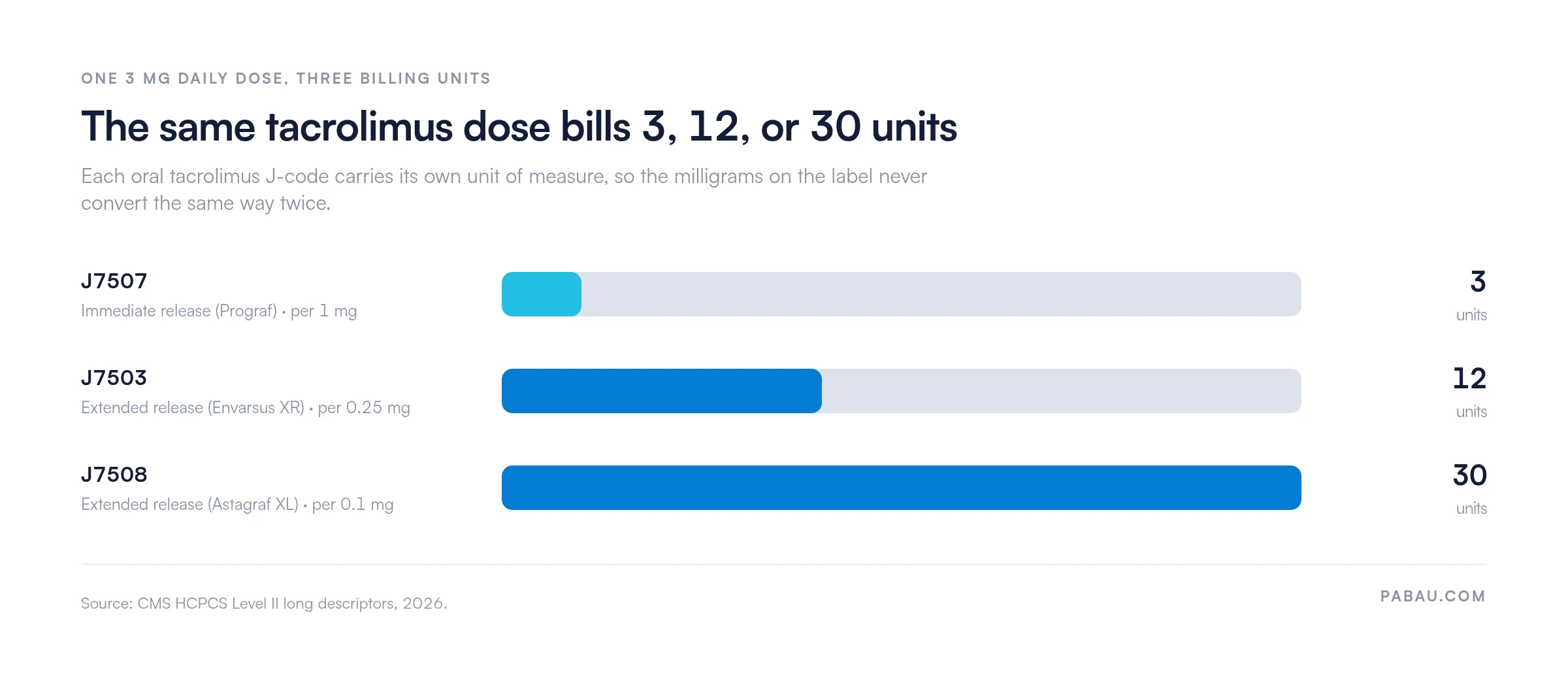
Tacrolimus extended release bills under J7503 or J7508, each with its own unit of measure, so the same dose converts differently
Medicare covers J7507 under LCD L33824 when paired with the correct transplant status Z-code and underlying condition ICD-10-CM codes
Pabau’s claims management software automates HCPCS J-code entry and unit calculation to reduce denial rates on immunosuppressive drug claims
HCPCS Code J7507 is a Level II HCPCS drug code maintained by the Centers for Medicare and Medicaid Services (CMS). It covers one unit of tacrolimus, immediate release formulation, administered orally, billed per 1 mg. Tacrolimus (brand name Prograf, manufactured by Astellas Pharma) is a calcineurin inhibitor. It is used as first-line immunosuppression after solid organ transplantation to prevent rejection.
Most J-codes cover drugs given by a route other than oral, and the immunosuppressive J-codes are the exception to that convention. J7507 is active and valid for the 2025 and 2026 billing years. Billers must keep it apart from the extended-release tacrolimus codes, J7503 and J7508, which carry different units of measure. Conflating them is the most common coding error on transplant immunosuppressant claims.
Medicare Part B covers J7507 under Local Coverage Determination L33824, which governs immunosuppressive drugs for post-transplant patients. Coverage requires a Medicare-covered organ transplant and a continuing need for immunosuppression to prevent rejection. Check the patient’s Part B status before each dispense, because eligibility that lapses mid-cycle produces retroactive denials.
The Consolidated Appropriations Act, 2021 extended Medicare Part B immunosuppressive drug coverage for kidney transplant recipients who would otherwise lose Part A eligibility. Its Comprehensive Immunosuppressive Drug Coverage for Kidney Transplant Patients Act provision created a lifetime benefit limited to immunosuppressive drugs. Coverage for this group used to end 36 months after the transplant. Practices billing long-term tacrolimus patients should confirm enrollment in that benefit before dispensing.
Covered transplant types under LCD L33824 include kidney, liver, heart, lung, pancreas, small intestine, and bone marrow or stem cell transplants. Confirming the transplant type against the LCD is part of the pre-billing review.
J7507 bills per 1 mg. Units billed must equal the total milligrams dispensed for the claim period. There is no rounding up to the nearest capsule strength. If a patient’s prescription is 2 mg twice daily for 30 days, the total dispensed is 120 mg, so the claim reports 120 units.
A common billing error is submitting units that match the number of capsules rather than the milligrams. Tacrolimus immediate release capsules come in 0.5 mg, 1 mg, and 5 mg strengths. If a patient takes four 0.5 mg capsules per day, that is 2 mg, so the correct count is 2 units. Billing by capsule count triggers automated edits and denials from Medicare Administrative Contractors (MACs).
Every J7507 claim requires at least one transplant status Z-code paired with an underlying condition code for the organ’s original disease. ICD-10-CM sequencing places the transplant complication or status code first, with the underlying condition as secondary. Missing the Z-code is the most frequent documentation error on tacrolimus claims.
When the record documents rejection rather than routine maintenance, the T86 rejection code leads the claim. For a kidney recipient that code is T86.11. T86.10 is the unspecified complication code, so it belongs on the claim only when the documentation names no specific complication. Match the organ to the right Z94 or T86 subcategory every time.
For a lung recipient whose graft has failed, report T86.811 and leave Z94.2 off the claim, because Z94 excludes transplant complications.
LCD L33824 requires the medical record to support every element of the claim at the time of billing. Incomplete documentation is the second-most common reason J7507 claims are denied, after unit errors. Submitting a clean claim means the documentation package is complete before the claim leaves your practice.
For long-term patients, the transplant operative report does not need to accompany every claim. It must be on file and available if an auditor asks for it. Annual physician notes confirming the ongoing indication are enough for maintenance billing cycles. Keep a dispensing record that ties the NDC to the HCPCS code, so an audit response takes minutes.
Medicare reimburses J7507 at the Average Sales Price (ASP) plus 6%, updated quarterly by CMS. Because ASP moves with manufacturer price reporting, the per-unit rate changes four times a year. Check the current quarter’s ASP drug pricing file before estimating reimbursement. Any rate quoted in a static reference can be wrong within 90 days.
The Physician Fee Schedule lookup tool prices physician services, not Part B drugs, so it is the wrong reference for J7507. MAC-specific pricing applies in some jurisdictions and can differ from the national ASP rate. Payment runs per unit of 1 mg, so a 30-day supply of 2 mg twice daily bills 120 units. Reconcile the remittance against the quarter’s file whenever a recurring claim pays differently than expected.
Set a quarterly calendar reminder to download the updated CMS ASP drug pricing file. Cross-reference your J7507 unit rate against the new file before submitting the first claim of each quarter. Catching a rate change before billing prevents write-offs and patient balance confusion on immunosuppressant maintenance claims.
J7507 is one of several immunosuppressive drug J-codes on the LCD L33824 drug list. Coders must select the code that matches the drug and formulation on the dispensing record. Using J7507 for an extended-release tacrolimus prescription is a coding error, and it invites a denial or a recoupment audit. The AAPC HCPCS code lookup confirms individual code descriptors when formulation details are unclear.
The distinction that costs the most money sits between J7507 and the two extended-release codes. A 3 mg immediate-release dose bills 3 units of J7507. The same 3 mg of Envarsus XR bills 12 units of J7503, because that code counts in 0.25 mg increments. Astagraf XL counts in 0.1 mg increments, so 3 mg of it bills 30 units of J7508. Applying one code’s unit structure to another produces systematic over- or underpayment.
J7507 denials cluster around five predictable causes, and each has a specific resolution path. Working the pattern up front costs less than appealing one claim at a time. Compare the list below against your current pre-submission workflow to find the highest-risk step.
For a systematic error across many claims, submit a corrected claim batch rather than appeal each one. Reading the denial codes your MAC returns tells you which cause above applies. CO-4 flags a procedure code inconsistent with the modifier used, and CO-97 flags a service already paid within another claim.
Build a pre-submission checklist specific to J7507: (1) Confirm formulation is IR, not ER. (2) Calculate units from total mg, not capsule count. (3) Verify Z94-series transplant status code is present. (4) Confirm NDC matches the Rx label. Running this check takes 90 seconds per claim and eliminates the four most common denial triggers.
Manual unit calculation for HCPCS drug claims stops being reliable at volume. A transplant pharmacy or nephrology practice dispensing tacrolimus to dozens of patients a day cannot hold per-mg math together by hand. Practice management software like Pabau takes the arithmetic off the biller. It applies the unit rule stored against each drug, and flags a missing ICD-10 code before submission.
Practices can attach HCPCS codes to service lines, set drug-specific unit rules, and check ICD-10 codes against coverage policy while the claim is being built. That moves the quality check upstream, so an error surfaces before the claim reaches the payer. Our automated claims management tools cover the J-code entry and unit steps where most write-offs start.
For post-transplant patients, feeding the dispensing record straight into claim creation removes the transcription step where unit errors begin. When the dispensed milligrams flow into the HCPCS unit field, the per-capsule confusion cannot happen. The biller reviews an exception list instead of recalculating each refill by hand.

Pabau’s claims management tools automate HCPCS unit calculation, ICD-10 validation, and documentation attachment. Your team spends less time on denials and more on patient care.

Every denial described in this guide is decided before the claim is built. The formulation, the milligrams, and the transplant status code are all known at the moment the drug is dispensed. A short check at that point costs far less than a 30-day appeal cycle.
The trade-off is that someone has to own the check. When it lives in one biller’s head, it fails the week that person is on leave. When it lives in the billing system, it holds through staff changes and quarterly ASP updates. Book a demo to see how Pabau validates J-code units and diagnosis codes before a claim goes out.

Need a complete overview of the claims process? How medical claims clearinghouses work explains how claims move from practice to payer and where J-code errors get caught.
Unsure how to handle a J7507 denial response? Denial management in healthcare covers CARC/RARC interpretation and corrected claim workflows.
Looking to benchmark your billing performance? What is revenue cycle management outlines the KPIs that reveal where HCPCS drug claim leakage occurs.
Building a record that survives an audit? Medical billing compliance sets out the retention and documentation rules behind an LCD records request.
Chasing an unexpected payment amount? Electronic remittance advice explains how to read the adjustment codes on a paid drug claim.
HCPCS Code J7507 is used to bill for tacrolimus immediate release, administered orally, at a rate of one unit per 1 mg dispensed. It applies only to post-transplant patients receiving immunosuppressive therapy to prevent organ rejection, and it is covered under Medicare Part B LCD L33824.
Bill one unit of J7507 for every 1 mg of tacrolimus immediate release dispensed. For a 30-day supply of 2 mg twice daily, the total dispensed is 120 mg, so bill 120 units. Never bill units by capsule count, because the 0.5 mg, 1 mg, and 5 mg strengths do not equal unit counts.
J7507 claims require a transplant status Z-code as the primary diagnosis, paired with the underlying condition code as secondary. Use Z94.0 for kidney, Z94.4 for liver, Z94.1 for heart, and Z94.2 for lung. When rejection is documented, the T86 rejection code leads instead, which is T86.11 for a kidney transplant.
Prograf is the brand name for tacrolimus immediate release, so claims for Prograf use J7507 under the Medicare Part B benefit. Commercial payers may set different policies, and some require the NDC alongside the HCPCS code. Verify each payer’s formulary and prior authorization rules before dispensing.
LCD L33824 (Immunosuppressive Drugs) governs J7507 Medicare coverage and remains active in 2026. The code itself is valid for the 2025 and 2026 billing years. Confirm the current LCD status with your Medicare Administrative Contractor, as LCDs can be revised or retired without universal advance notice.



