CPT code 52648: Laser ablation of the prostate billing guide
What CPT code 52648 covers, and what it bundles in CPT code 52648 is the code fo...

Last Updated: Oct 21, 2026
J3470 is the HCPCS Level II code for injection, hyaluronidase, up to 150 units.
Provider-administered drugs work differently from the rest of medical billing. The practice buys the vial, administers it, and then bills the payer for both the drug and the administration.
Two details decide whether the claim pays. The first is how you count units when a session runs past 150. The second is whether modifier JW appears when drug was discarded from the vial.
Let Pabau's smart automation suggest the right codes, reduce claim denials, and keep your practice compliant—effortlessly.
Automate repetitive tasks and focus on what matters most—your patients.
Reduce coding errors and ensure compliance with the latest regulations.
Clean claims, fewer denials, and faster reimbursements.
Powerful insights and reporting to help your practice thrive.
HIPAA compliant SOC 2 certified GDPR-compliant Trusted by 4,000+ clinics worldwide

HCPCS code J3470 covers injection of hyaluronidase, up to 150 units, and applies only to the bovine products Amphadase and Hydase.
Extra units on the same date go on one claim line with the count raised, not on a second J3470 line.
Modifier JW belongs on a separate line whenever drug is discarded from a single-use vial, and payers audit for its absence.
Ovine Vitrase bills under J3471 and recombinant Hylenex under J3473, so neither belongs on a J3470 claim line.
Practice management software like Pabau attaches J-codes to the treatment record, so the claim carries the NDC and units the provider documented.
J3470 is a Level II J-code maintained by the Centers for Medicare and Medicaid Services, known as CMS. Its full descriptor reads: Injection, hyaluronidase, up to 150 units. The code covers bovine-derived hyaluronidase as a provider-administered drug, billed under buy-and-bill and mostly by Medicare Part B.
The table below summarizes the code attributes a billing team needs before submitting a J3470 claim.
Hyaluronidase is an enzyme that briefly increases the permeability of connective tissue. It does that by depolymerizing hyaluronic acid in the subcutaneous space. The result is faster dispersion and absorption of whatever drug or fluid is given alongside it. That makes hyaluronidase an adjuvant rather than a treatment in its own right.
Four indications account for almost all hyaluronidase use, and each one changes what the claim has to show.
Filler reversal is the most common aesthetic indication, and skin clinics billing it should name the product being dissolved in the note. Medicare treats that use as non-covered, so those cases land on self-pay or a commercial policy.
IV therapy practices using hyaluronidase for hypodermoclysis should confirm the primary diagnosis before the claim goes out.
J3470 covers bovine-derived hyaluronidase only. Two brands map to the code: Amphadase, from Amphastar Pharmaceuticals, and Hydase. CMS requires the National Drug Code, or NDC, on Medicare Part B outpatient drug claims. Reporting it tells the payer exactly which product was given, in 11-digit format, crosswalked to J3470.
NDC codes for both products are updated in the CMS quarterly NDC-to-HCPCS crosswalk. Verify the current 11-digit NDC against the product label or that crosswalk before you submit. An expired or malformed NDC is one of the most common denial triggers on Part B drug claims.
Hydase is the more complicated of the two. Akorn filed for Chapter 7 bankruptcy in February 2023, closed all of its US sites, and recalled its products. Hydase has had no active manufacturer since.
Treat its continued availability as uncertain, and confirm supply with your wholesaler before building a protocol around it. For most practices that leaves Amphadase as the bovine product they can actually source.
Medicare Part B pays J3470 under the average sales price methodology, known as ASP. The rate is ASP plus 6%. That 6% covers the practice’s acquisition and handling cost under buy-and-bill.
CMS republishes ASP figures every quarter, so the allowable for J3470 changes four times a year. Pull the current quarter’s rate from the CMS fee schedule lookup before finalizing claims. A prior-quarter rate is an easy audit finding.
The spread between WAC and ASP decides whether buy-and-bill makes money. Wholesale acquisition cost, or WAC, is the manufacturer’s list price to wholesalers. ASP reflects average net transaction prices after rebates and chargebacks, and it usually sits below WAC.
So the margin on each administration is the difference between what the practice paid for Amphadase and what Medicare allows at ASP plus 6%. A drug-heavy practice should model that spread by quarter rather than once a year.
Under buy-and-bill the practice purchases Amphadase or Hydase, administers it in the office, and bills the payer for the drug and the administration. Each step needs clean documentation, since a recoupment audit works backward through all of them.
Four variables decide whether a J3470 claim pays: units, modifiers, diagnosis pairing, and NDC accuracy. Getting all four right on the first submission is what keeps the claim out of the denial queue. Medical billing compliance audits target J-code drug claims, because unit miscounts and missing modifiers are easy to find programmatically.
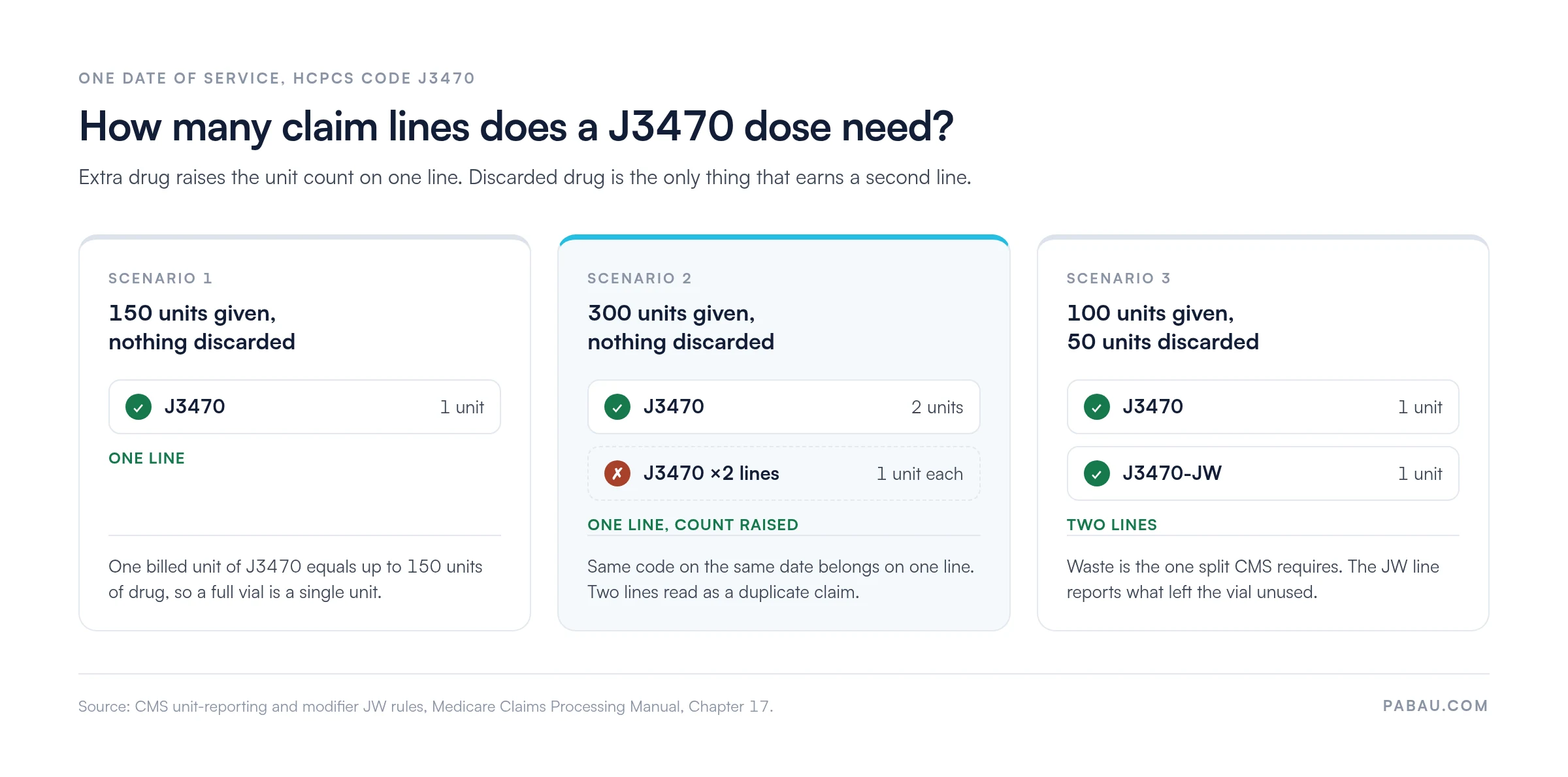
One billed unit of J3470 equals up to 150 units of hyaluronidase. Administer 150 units from a single vial and the claim carries one line with one unit.
When a session needs more than 150 units, the extra units go on the same line. CMS and its Medicare Administrative Contractors have a rule for this. Multiple units of the same HCPCS code on one date of service go on a single line, with the unit count raised.
So 300 units is one line of J3470 at 2 units, not two lines of 1 unit each. Splitting the same code across two lines on one date is what triggers duplicate-claim edits at most payers. The one exception is discarded drug, which CMS requires on its own line with modifier JW.
Between them, the three scenarios below cover nearly every J3470 claim a practice will build.
Modifier JW applies when the provider draws less than the full contents of a single-use vial and discards the rest. CMS wants the administered amount and the discarded amount on separate claim lines. The first line is J3470 with the units given. The second is J3470 with modifier JW for the units wasted.
Managing claim denials on drug waste starts with treating JW as a requirement once waste is documented. The Medicare Claims Processing Manual, Chapter 17, is where CMS sets that out.
Take a provider who draws 100 units from a 150-unit vial and discards 50. Line 1 is J3470 at 1 unit for the 100 units administered. Line 2 is J3470 with modifier JW at 1 unit for the 50 units wasted.
Without the JW line, the claim understates what left the vial. That mismatch between the vial size and the units billed is exactly what auditors screen for.
Every J3470 claim needs a diagnosis code that establishes medical necessity for the hyaluronidase. The code should reflect the primary condition or procedure the drug supported, rather than a standalone hyaluronidase diagnosis.
Payer Local Coverage Determinations, or LCDs, specify which codes are covered, so review the relevant Medicare Administrative Contractor policy first.
Confirm diagnosis coverage against the applicable LCD before you submit. The codes above reflect common clinical contexts, and covered diagnoses vary by payer. Submitting a clean claim for J3470 means the NDC, the units, the modifier and the diagnosis are all verified before the claim leaves the practice.
Run a quarterly audit of J3470 claims before the new ASP rate takes effect. Pull every claim from the prior quarter and confirm the NDC matches the product dispensed. Then check the unit count against the administration record, and look for modifier JW wherever waste was documented. A 30-minute review catches the errors payer auditors find most often.
Hyaluronidase has three commonly used HCPCS codes, and the product in the vial decides which one you bill. J3470 is the bovine code, J3471 the ovine code, and J3473 the recombinant human code.
Payers cross-reference the NDC against the HCPCS code on the claim. A J3471 line submitted with an Amphadase NDC denies on mismatch before a human reads it.
There is a fourth code worth knowing. J3472 covers the same ovine, preservative-free hyaluronidase as J3471, but per 1,000 USP units, so larger Vitrase doses report there instead.
Code selection is product-driven from start to finish. Read the NDC on the label, check it against the AAPC HCPCS code lookup, and bill the code that matches. Institutional memory is a poor source here, because NDC-to-HCPCS assignments shift with reformulations and new packaging.
Medicare Part B generally does not require prior authorization for J3470, provided a covered diagnosis supports the indication and the record documents it. Prior authorization is one of the most payer-specific parts of drug billing, and commercial plans differ widely.
The table below sets out what to expect by payer type. Verify with the specific plan before you administer, since individual policies deviate from these category norms.
A commercial PA submission needs the clinical indication, the product selected, the units planned, and the rationale for hyaluronidase as an adjuvant. Keep the approval number in the patient record and reference it on the claim.
Six errors account for most J3470 denials, and every one of them is visible before the claim goes out. Catching them at submission costs far less than chasing a remittance afterward.
Every error on that list is catchable by a rule rather than by a coder’s memory. Most medical billing software can enforce the NDC format, the unit count and the JW line as checks at submission. That turns a memory problem into a configuration one.
A code lookup tells you which code to bill. The work that follows is where J-code claims usually come apart:
Pabau records drug administrations inside the patient’s treatment record, with the J-code and NDC attached, then exports the claim data from there. The clinical note and the billing record live in the same system. So the NDC on the claim is the one the provider documented during administration.
Approval letters, wholesaler invoices and consent forms attach to the same record. An audit request then becomes a search rather than a hunt through three systems.
Practices using Pabau’s claims management software can also pull every J3470 claim by patient and by quarter. That turns the quarterly ASP audit into a filter instead of a spreadsheet rebuild.

Pabau attaches HCPCS codes like J3470 to the treatment record and carries the NDC and unit count onto the claim. It also tracks what the payer sent back. Your coding and your clinical notes stop drifting apart.

J3470 is a small line on a claim with an outsized denial rate. Almost all of that comes down to process rather than knowledge. Wire the unit rule, the JW rule and the NDC format into how claims get built, and the code stops generating work.
The harder question is supply. Hydase’s status is unresolved after Akorn’s shutdown, which leaves Amphadase as the practical bovine option. A practice planning around one manufacturer should know that before the vial runs out.
Pabau keeps the drug administration, the J-code, the NDC and the claim in one record. The claim then reflects what the provider documented at the point of care. Book a demo to walk a drug administration billing workflow through with our team.

Coding another HCPCS Level II service? HCPCS code H0037 walks through per-diem billing and how units are counted on a service code.
Billing the administration as well as the drug? CPT code 20611 covers image-guided joint injection, including the documentation payers expect.
Coding a focal brain injury case? Focal brain injury coding guide covers S06.309A for a focal brain injury where loss of consciousness was never timed.
HCPCS code J3470 bills the injection of hyaluronidase, up to 150 units, given as an adjuvant to speed drug dispersion or fluid absorption. It covers the bovine products Amphadase and Hydase, and Medicare Part B reimburses it under buy-and-bill at ASP plus 6%.
One billed unit of J3470 covers up to 150 units of hyaluronidase. When a session needs more than 150 units on the same date, raise the unit count on that single line. Do not add a second J3470 line. So 300 units is one line at 2 units.
J3470 covers bovine hyaluronidase, meaning Amphadase and Hydase, and one billed unit equals up to 150 units. J3471 covers ovine, preservative-free hyaluronidase, which is Vitrase, and it bills per 1 USP unit up to 999 units. Hylenex is recombinant and bills under J3473, not J3471. The NDC on the vial decides which code is correct.
Modifier JW goes on a separate J3470 line whenever unused drug from a single-use vial is discarded. The administered units sit on the first line and the wasted units on the second line with JW. Omitting JW when waste occurred is a CMS compliance problem and an audit target.
Hydase’s availability is uncertain. Akorn, which marketed it, filed for Chapter 7 bankruptcy in February 2023, closed its US sites and recalled products. Amphadase is the bovine product to plan around, and any Hydase supply should be confirmed with your wholesaler first.
Medicare Part B generally does not require prior authorization for J3470. Medicare Advantage plans and commercial payers often do require it for J-code biologics. Verify each plan’s policy before administering, especially since the practice has already purchased the drug under buy-and-bill.
There is no CPT code specific to hyaluronidase. The drug is reported with a HCPCS Level II code: J3470 for bovine, J3471 or J3472 for ovine, and J3473 for recombinant. The administration itself may carry an injection administration CPT code, depending on the clinical setting.