CPT code 38571: Laparoscopic pelvic lymphadenectomy
CPT code 38571 covers a full pelvic node dissection on both sides CPT code 38571...

Last Updated: Oct 20, 2026
J2210 is the HCPCS Level II code for injection, methylergonovine maleate, up to 0.2 mg. It covers the injectable drug only, billed at one unit per 0.2 mg vial.
Most J2210 denials come from how the code is billed. The unit count is strict, and JZ became required for Medicare Part B on July 1, 2023 (JW has been required since 2017). Medicaid also requires the NDC on every claim line. A missing modifier or mismatched unit count is the fastest route to a denial on J2210 claims.
Let Pabau's smart automation suggest the right codes, reduce claim denials, and keep your practice compliant—effortlessly.
Automate repetitive tasks and focus on what matters most—your patients.
Reduce coding errors and ensure compliance with the latest regulations.
Clean claims, fewer denials, and faster reimbursements.
Powerful insights and reporting to help your practice thrive.
HIPAA compliant SOC 2 certified GDPR-compliant Trusted by 4,000+ clinics worldwide

HCPCS code J2210 covers methylergonovine maleate injection at up to 0.2 mg per billing unit, and the oral tablet is not covered.
Each 1 mL vial contains 0.2 mg, so a single-vial dose equals exactly one billable unit. Doses spanning multiple vials are billed in proportional units.
Medicare Part B has required JZ on fully used single-dose vials since July 1, 2023. Discarded drug goes on its own line with JW, required since 2017, and other payers vary.
Pabau’s claims management software tracks J-code units, modifier rules, and NDC fields in one workflow, reducing denials before claims leave the practice.
HCPCS code J2210 is the CMS-assigned Level II code for “injection, methylergonovine maleate, up to 0.2 mg.” The descriptor defines a single billing unit as up to 0.2 mg of the drug administered by injection. Oral formulations of methylergonovine are excluded from J2210 entirely.
Methylergonovine maleate is a semi-synthetic ergot alkaloid used as a uterotonic. It produces sustained contraction of the uterus. The drug is sold under the brand name Methergine and also appears in coding literature as methylergometrine.
Methylergonovine maleate is indicated for routine management after delivery of the placenta, postpartum atony and hemorrhage, and subinvolution. These are the FDA-approved indications that support medical necessity when billing J2210.
Billers should know one clinical boundary. The drug is contraindicated in patients with hypertension, per FDA DailyMed prescribing information. A documented blood pressure check before administration strengthens a J2210 claim and shows appropriate patient selection.
Pair J2210 with a covered diagnosis, which you can confirm in our ICD-10-CM lookup for coders. The O72.x code family covers postpartum hemorrhage. O72.1 (other immediate postpartum hemorrhage) and O72.2 (delayed and secondary postpartum hemorrhage) are the most commonly linked diagnoses. Without a covered diagnosis code, payers treating J2210 as elective will deny it on medical necessity grounds.
The standard methylergonovine maleate vial is 1 mL containing 0.2 mg. Because J2210 is billed “up to 0.2 mg” per unit, one vial equals one billable unit. That sounds simple, but it causes steady over-billing when the dose is recorded in micrograms rather than milligrams.
Common calculation error: A nurse documents “200 mcg IM given.” The biller reads “200” and bills 200 units. The correct reading is 200 micrograms = 0.2 mg = 1 unit. Always confirm whether the clinical note records the dose in mg or mcg before entering the unit count.
J2210 is a drug code, not a procedure code. It always appears on the claim alongside a CPT administration code that describes how the injection was given. Submitting J2210 without an administration code is a structural claim error.
The administration code follows the route. Methergine’s standard route is intramuscular, so CPT 96372 is the usual companion code. It covers a therapeutic subcutaneous or intramuscular injection. For an IV push, which is not routine, bill CPT 96374 for the single or initial push. Use CPT 96375 for each additional sequential IV push of a new drug.
On the CMS-1500 form, J2210 and its modifiers go in Box 24D, and the units go in Box 24G. The administration CPT code sits on its own claim line. On a UB-04 for hospital outpatient settings, revenue code 0636 (drugs requiring specific identification) goes in Form Locator 42. The HCPCS code and its modifiers go in Form Locator 44.
CMS has required the JW modifier for discarded drug from single-dose containers since January 1, 2017. The JZ modifier, which reports zero waste, became required for Medicare Part B on July 1, 2023. Since October 1, 2023, Medicare can return claims missing the right modifier as unprocessable.
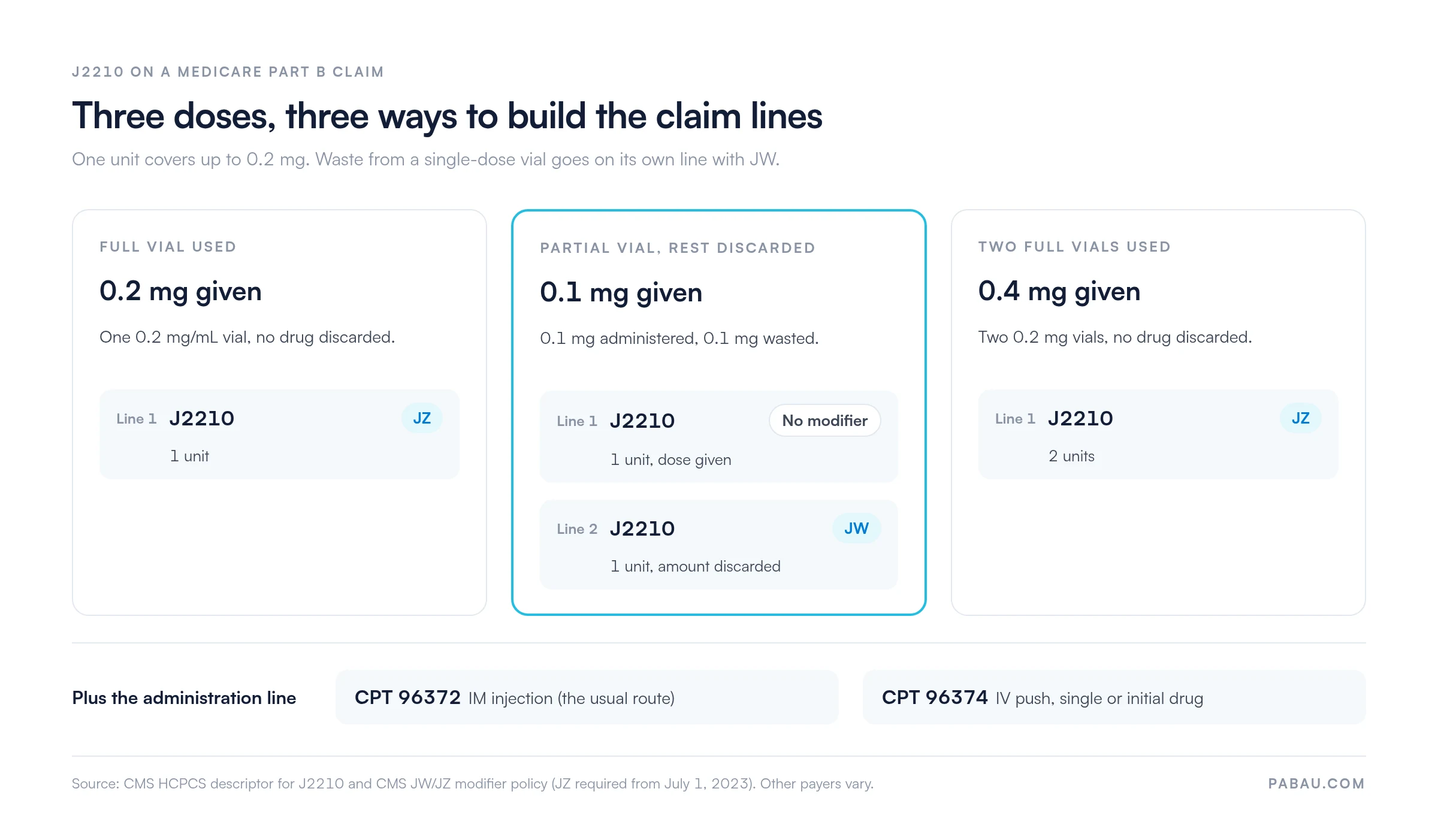
Every Medicare Part B claim line for a single-dose vial must carry JZ (no waste) or JW (on the waste line). The administered-dose line has no modifier when waste is reported. JW and JZ never appear together on one claim. Other payers set their own rules, so check each commercial and Medicaid policy.
Put together, the drug lines and the administration line look like this for the three doses in the unit table above.
Medicaid requires the National Drug Code (NDC) on every J2210 claim line, and some commercial payers have adopted the same rule. The NDC follows the 5-4-2 format (labeler-product-package). It goes in the claim’s drug identification loop, which is Loop 2410 on the 837P electronic claim, or as a narrative qualifier on paper claims.
The NDC qualifier for Medicaid submission is N4, placed immediately before the 11-digit NDC. The unit qualifier is UN (unit) or ML (milliliter), depending on the payer’s instructions. Confirm the format with each state Medicaid plan, because requirements vary. The NLM DailyMed database lists current NDCs for methylergonovine maleate injection products by manufacturer.
Pull the NDC from the vial label on the day of administration, not from a saved template. Manufacturers occasionally change package sizes, which changes the package segment of the NDC. A stale NDC on a Medicaid claim is a fast denial.
Medicare Part B reimburses J2210 using the Average Sales Price (ASP) methodology. The payment rate equals ASP plus 6% in a physician office setting. Dollar amounts change quarterly when CMS publishes updated ASP files. Check the current rate in the CMS Physician Fee Schedule lookup tool or the quarterly ASP pricing file before quoting a figure.
Hospital outpatient settings bill under the Outpatient Prospective Payment System (OPPS). OPPS rates differ from physician office rates because they include a facility component. A hospital-based outpatient department billing J2210 should use the OPPS Addendum B rate rather than the physician fee schedule allowable.
Medicaid coverage for J2210 varies by state. Most state plans cover methylergonovine maleate as a covered outpatient drug. Reimbursement rates, prior authorization thresholds, and NDC reporting rules still differ significantly. Review your state Medicaid agency’s drug fee schedule directly.
Medicare Part B does not generally require prior authorization for J2210 when billed for covered postpartum hemorrhage indications. The drug falls within Part B’s coverage of injectable drugs administered incident-to a physician’s service.
Commercial payers vary. High-deductible plans and managed care organizations may require precertification for methylergonovine given electively or outside an acute hospital setting. For urgent postpartum hemorrhage cases, most commercial payers allow retrospective authorization. Document the clinical urgency in the medical record to support that request.
Three codes turn up repeatedly in coder forums as mistaken substitutes for J2210. Each one is either a different drug or a deleted code that can no longer be submitted.
Strong J2210 documentation does two jobs. It establishes medical necessity, and it supports the billed unit count. Auditors look for consistency between the drug order, the administration note, and the units on the claim line. The medical record needs all of the following to pass a payer audit.
Pabau, the practice management platform we build, ties drug administration records to claim lines in its claims management software. The biller sees the documented dose before entering the unit count.
J2210 denials cluster around four root causes. They are missing modifiers, a wrong unit count, an absent NDC on Medicaid claims, and unsupported diagnosis codes. Each has a direct corrective path.
Recurring J2210 denials usually trace back to charge entry, where a missing modifier could have been flagged before the claim left the practice. Our guide to denial management covers how to route flagged remittances to the right person for correction.
Run a monthly J2210 denial report filtered by CARC code. CARC 4 means the procedure code is inconsistent with the modifier used, or a required modifier is missing, which is the typical JW/JZ denial. CARC 16 (missing information) and CARC 18 (duplicate claim) point to different workflow failures, and late filing shows up as CARC 29. Grouping denials by CARC code shows which step of your process needs fixing.
In many OB-GYN and women’s health practices, J2210 lines are still checked by hand. Someone reads the nursing note, converts mcg to mg, decides between JZ and a JW waste line, and copies the NDC from the vial.
Pabau moves those checks to the point of charge entry. Claims pass through its Claim.MD clearinghouse integration, which runs pre-submission edits against payer rules. A missing waste modifier or an absent NDC is flagged before the payer ever sees the claim.
The result is fewer returned Medicare claims and fewer Medicaid NDC denials. Your billers fix a modifier in minutes at submission instead of working an appeal weeks later.

Pabau’s claims management software tracks HCPCS units, modifiers, and NDC fields in one workflow. Modifier and unit errors are caught before the claim leaves the practice.

J2210 denials rarely come from the drug itself. They come from three small decisions on the claim line, namely the unit count, the waste modifier, and the administration code.
Settle those decisions in the chart, not at the billing desk. When the note records the dose in mg, any discarded amount, the route, and the NDC, the biller is copying facts instead of guessing. Treat J2210 as a test of your wider medical billing workflow, because the same charting habits decide every single-dose vial you bill.
Book a demo to see how Pabau checks J2210 units, waste modifiers and NDCs before your OB-GYN claims go out.

Want to reduce claim rejections before they reach the payer? Clean claim best practices explains the pre-submission checks that cut denial rates across J-code billing.
Looking for guidance on electronic remittance and denial codes? Understanding electronic remittance advice (ERA) walks through how to read CARC and RARC codes from payer 835 files.
Choosing how your drug claims reach the payer? Medical claims clearinghouses explained covers how pre-submission edits catch modifier and NDC errors before a claim is filed.
HCPCS code J2210 covers the injectable form of methylergonovine maleate, billed in units of up to 0.2 mg. It does not cover the oral tablet formulation of the same drug.
One unit equals up to 0.2 mg of methylergonovine maleate. A standard 1 mL vial containing 0.2 mg is one billable unit. If 0.4 mg is administered from two vials, bill two units.
No. Medicare Part B does not require prior authorization for J2210 when billed for covered postpartum hemorrhage indications administered incident-to a physician’s service. Commercial and Medicaid plans vary by state and plan.
The NDC is specific to the vial manufacturer and must be pulled from the product label on the day of administration. Look up current NDCs for methylergonovine maleate injection products in the NLM DailyMed database. For Medicaid claims, report the NDC using the N4 qualifier in 5-4-2 format.
For Medicare Part B, JZ (zero drug waste) has been required since July 1, 2023 when the full single-dose vial is used. When part of the vial is discarded, bill the dose given with no modifier and the waste on a separate line with JW. JW has been required since January 1, 2017, and other payers set their own rules.
CPT 96372 (therapeutic injection, subcutaneous or intramuscular) is the usual companion code, because methylergonovine is normally given IM. For an IV push, bill CPT 96374 for the single or initial push and CPT 96375 for each additional sequential push. The administration CPT and J2210 appear on separate claim lines.