CCSD Code D1010: Radical mastoidectomy including meatoplasty
CCSD Code D1010: Definition and clinical scope CCSD Code D1010 is the UK private...

Last Updated: Nov 25, 2026
J2590 is the HCPCS Level II code for injection, oxytocin, up to 10 units. It covers Pitocin and generic oxytocin given by injection or IV infusion, billed in whole units of up to 10 units each.
A 1 mL single-dose vial holds 10 units, so one vial is one billing unit. Medicare lines from single-dose vials also carry the JW or JZ modifier.
Let Pabau's smart automation suggest the right codes, reduce claim denials, and keep your practice compliant—effortlessly.
Automate repetitive tasks and focus on what matters most—your patients.
Reduce coding errors and ensure compliance with the latest regulations.
Clean claims, fewer denials, and faster reimbursements.
Powerful insights and reporting to help your practice thrive.
HIPAA compliant SOC 2 certified GDPR-compliant Trusted by 4,000+ clinics worldwide

HCPCS Code J2590 reports injected or infused oxytocin, and each billing unit covers up to 10 units of the drug.
A 1 mL oxytocin vial holds 10 units, so one single-dose vial equals one J2590 billing unit.
Medicare requires JW or JZ on J2590 lines from single-dose vials, while multi-dose vials are excluded from the policy.
J2590 has no national payment limit in the October 2026 CMS ASP file, so your Medicare contractor prices it.
Pabau’s claims management scrubs each claim for missing or invalid details before it goes out through the Claim.MD clearinghouse.
HCPCS Code J2590 is the Level II code for injection, oxytocin, up to 10 units. CMS maintains the HCPCS Level II code set, and J2590 sits in its J-series of drugs administered other than by mouth. The code covers the drug itself, and the injection or infusion service is billed on its own line.
Oxytocin is a uterotonic hormone used to induce or augment labor and to prevent or treat postpartum hemorrhage. Pitocin is the branded product, labeled by Par Health USA, LLC, an Endo USA company. Pitocin and generic oxytocin both bill under J2590, and a Pitocin 1 mL single-dose vial holds exactly 10 units.
J2590 covers parenteral oxytocin given by a physician or qualified healthcare professional, billed in units of up to 10 units each. The established indications are labor induction, labor augmentation, and prevention or treatment of postpartum hemorrhage from uterine atony.
Several related scenarios fall outside J2590 or change how it is billed:
Every J2590 claim requires a supporting ICD-10-CM diagnosis code that documents medical necessity. Payers audit drug claims for diagnosis-to-drug appropriateness, and a mismatch between the ICD-10 code and the indication for oxytocin is a common denial trigger.
When labor stalls, the pairing depends on timing. Use O62.0 when contractions were inadequate from the start, and O62.1 when adequate contractions later slowed.
The diagnosis code must reflect the clinical situation documented in the medical record. A code that does not match the chart note is an audit risk. When hemorrhage is the indication, an O72 code documents urgency and medical necessity clearly.
Run a diagnosis-to-drug check before submitting J2590 claims. Payers reject oxytocin claims when the paired ICD-10 code is missing from their medical necessity policy for the drug. Keep the five most common pairings for your caseload at the billing station.
J2590 has no national Medicare payment limit. It does not appear in the October 2026 CMS Part B payment-limit file, where most physician-administered drugs are priced at ASP plus 6%.
Without a national limit, your Medicare Administrative Contractor (MAC) sets the allowance for J2590. Check its drug fee schedule for the current quarter before you quote a figure.
Place of service matters too. In a hospital outpatient department, the facility usually reports the drug under its outpatient payment system. A separate professional J2590 claim may then go unpaid.
In a physician office, the drug and its administration bill on separate lines. J2590 covers the drug, and an injection or infusion administration code covers the service.
Medicaid requires an 11-digit National Drug Code (NDC) on claims for physician-administered drugs such as J2590, because states use it to collect drug rebates. Medicare does not require the NDC on its own Part B claims. It does need one when a dual-eligible patient’s claim crosses over to Medicaid. Many commercial payers require it as well.
The NDC identifies the oxytocin product, its labeler, and the package size. Payers use it to check that the billed drug matches the HCPCS code and the units on the claim.
NDCs are printed as 10 digits in a 4-4-2, 5-3-2 or 5-4-1 pattern, and claims need them padded to 11 digits in 5-4-2 form. Pitocin’s 25-vial carton, NDC 42023-116-25, becomes 42023-0116-25 on a claim. Take the NDC from the vial or carton you used, since each package size carries its own code. Record it next to J2590 on the superbill at the point of administration.
Medicare requires a JW or JZ modifier on J2590 lines when the oxytocin came from a single-dose vial. JW reports an amount discarded, and JZ attests that none was discarded. Multi-dose vials are excluded from the requirement.
MLN Matters article MM13056 (CR 13056) introduced the JZ modifier, effective January 1, 2023, and made it mandatory from July 1, 2023. Since October 1, 2023, Medicare can return a claim that leaves the modifier off as unprocessable.
Because one 1 mL vial is exactly one billing unit, a partly used vial never produces a JW line. If 8 units of a 10-unit single-dose vial are given and 2 are discarded, bill 1 unit of J2590 with JZ. CMS’s JW and JZ FAQs explain that fractional units are not billed, so the full unit goes on the claim.
A JW line appears only when a whole vial is discarded. A second vial drawn up for a repeat dose that wasn’t needed bills as 1 unit administered plus 1 unit with JW. The chart below walks through four common scenarios.
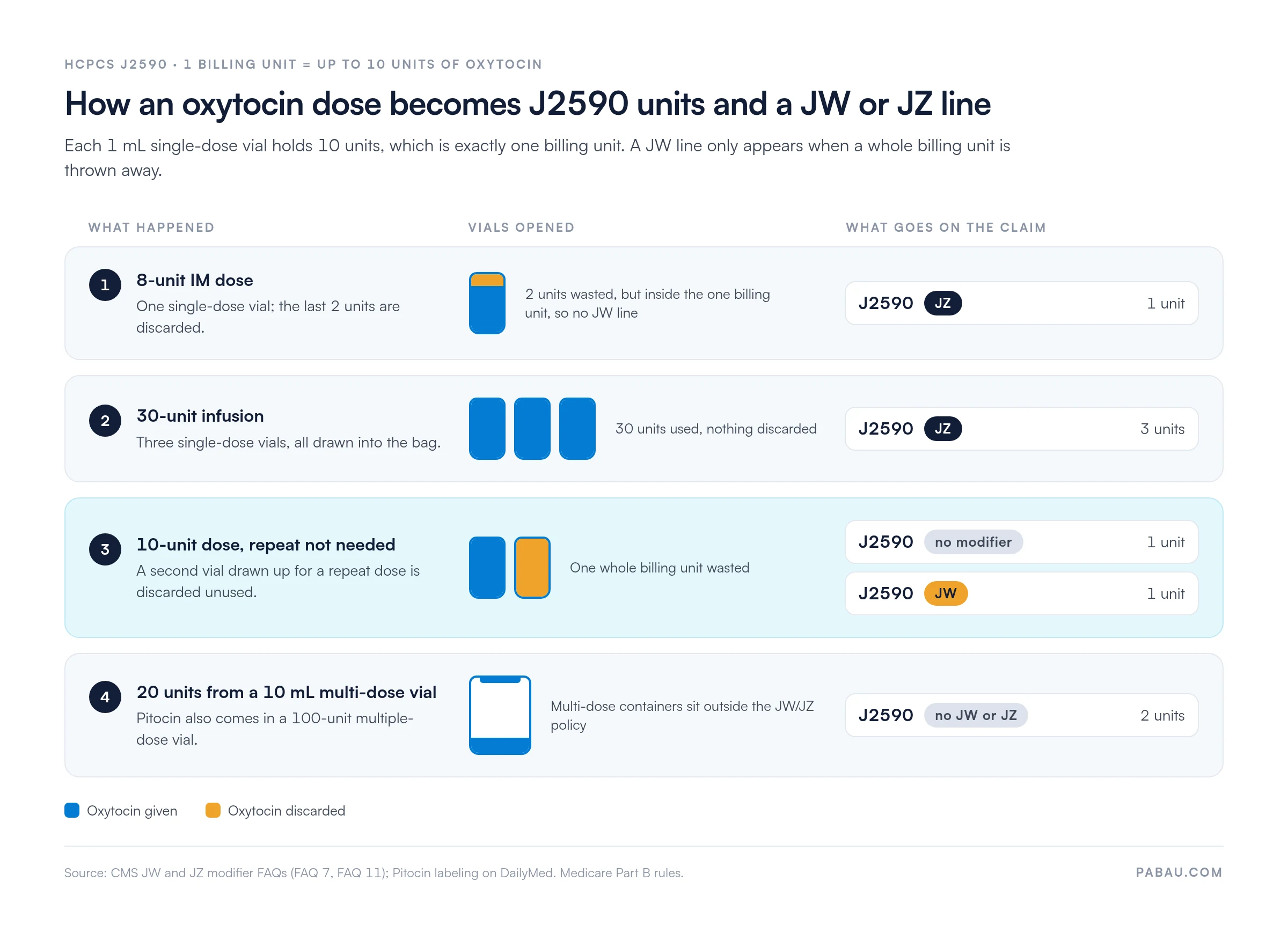
The medical record must show the dose ordered, the dose given, and any amount discarded. Wastage reporting that does not match the record is an audit risk.
Clean J2590 claims rest on documentation that ties the drug to medical necessity. A consistent documentation standard across the practice is the most reliable form of denial management. Review your billing compliance requirements regularly so the standard keeps pace with payer expectations.
Most J2590 denials trace back to a handful of data-entry errors. The table below maps each one to its root cause and fix. Building these checks into a structured medical billing workflow improves first-pass acceptance. When a denial does come back, the claim denial codes on the remittance name the reason.
Run five checks before you submit a J2590 claim. Confirm the NDC is present and formatted, and that JW or JZ sits on every single-dose vial line. Then check the ICD-10 code against the chart, the units against the administration note, and the place-of-service code.
Medicare generally does not require prior authorization for J2590 in an inpatient obstetric setting. Labor induction and hemorrhage management are medically established indications. The picture changes with commercial payers and Medicaid.
Many commercial health plans require prior authorization for oxytocin given in an outpatient or elective setting. Elective induction before 39 weeks draws the most scrutiny. Medicaid PA rules vary by state.
Payer policies on this point change often, so check the payer’s current PA requirements for J2590 before the encounter. Record the authorization number in the patient record and on the claim. A denial for missing PA can only be recovered on appeal, which adds cost and delays payment.
Most J2590 denials start at data entry, not at the bedside. The dose, the vial count, the NDC and the modifier live in the clinical note, and someone retypes them into a claim. Each retyped field is a chance to drop an NDC or a modifier.
Pabau, the practice management platform we build, keeps the administration record and the claim in one system. Its claims management software scrubs each claim for missing or invalid details before it leaves Pabau. US claims then go out through the Claim.MD clearinghouse, with eligibility checks run before the visit.
When a claim comes back rejected, Pabau flags it as Needs action and shows the payer’s reason. Your team corrects the J2590 line and resubmits it. Electronic remittance advice then posts the payment against the same patient record.

Pabau’s claims management scrubs each claim for missing or invalid details before submission and flags rejections with the payer’s reason. Your J2590 claims go out cleaner, and fixes happen faster.

J2590 itself rarely causes a denial. Claims fail on three details around it. Units are counted against 10-unit vials, single-dose lines need JW or JZ, and Medicaid expects an NDC.
Settle those three at the point of administration, and the billing team has no dose to reconstruct later. Treat partial vial waste as JZ, and check your MAC’s price instead of an ASP figure that doesn’t exist for this code. Book a demo to see how Pabau carries the administration record straight into a scrubbed claim for your obstetric billing team.

Billing another injection given after delivery? HCPCS code J2790 covers Rho(D) immune globulin, including units, modifiers and documentation.
Coding the stalled labor behind an oxytocin order? ICD-10 code O62.0 explains primary inadequate contractions and when the code applies.
HCPCS Code J2590 is the Level II HCPCS code for injection of oxytocin, including Pitocin, with each billing unit covering up to 10 units. CMS maintains it among the J-series codes for physician-administered drugs. The injection or infusion service is billed separately with its own administration code.
Medicare generally does not require prior authorization for J2590 in inpatient obstetric settings. Many commercial payers and state Medicaid programs do require it, particularly for elective outpatient induction. Always verify the specific payer’s current PA policy before administering oxytocin in a non-emergent context.
It depends on the payer. Medicaid requires the 11-digit NDC on J2590 claims, and Medicare asks for it on crossover claims for dual-eligible patients. Medicare doesn’t require it on its own Part B claims. Many commercial payers do, so check each plan’s policy.
Yes. Pitocin is the brand name for synthetic oxytocin injection, labeled by Par Health USA, LLC, an Endo USA company. Pitocin and generic oxytocin both bill under J2590. The NDC on the claim identifies the product used.
No. One 10-unit vial is one J2590 billing unit, and CMS doesn’t pay fractional units, so bill the full unit with JZ. JW applies only when a whole billing unit is discarded, such as an unused second vial.
The most common reasons are a missing NDC, a missing JW or JZ modifier, and a diagnosis that doesn’t support medical necessity for oxytocin. Units that don’t match the administered dose and a drug bundled into a facility payment complete the list.
J2590 has no national Medicare payment limit. It is absent from the October 2026 CMS Part B payment-limit file, so each Medicare Administrative Contractor prices it. Check your MAC’s drug fee schedule for the current quarter rather than relying on a static figure.