

HCPCS code E0198: Water pressure pad billing guide
HCPCS code E0198 is a water pad for a standard mattress HCPCS code E0198 is the ...

Last Updated: Oct 13, 2026
J1840 is the HCPCS Level II code for injection, kanamycin sulfate, up to 500 mg. CMS deleted it with a termination date of March 31, 2024, so it is not payable for dates of service from April 1, 2024.
CMS assigned no replacement code. Kanamycin injection given after that date is usually billed under J3490, the unclassified drug code, once the payer's policy confirms it.
Let Pabau's smart automation suggest the right codes, reduce claim denials, and keep your practice compliant—effortlessly.
Automate repetitive tasks and focus on what matters most—your patients.
Reduce coding errors and ensure compliance with the latest regulations.
Clean claims, fewer denials, and faster reimbursements.
Powerful insights and reporting to help your practice thrive.
HIPAA compliant SOC 2 certified GDPR-compliant Trusted by 4,000+ clinics worldwide

HCPCS Code J1840 described injection, kanamycin sulfate, up to 500 mg, an aminoglycoside antibiotic given by intramuscular or intravenous injection.
CMS deleted J1840 with a termination date of March 31, 2024, so it is not payable for dates of service from April 1, 2024.
CMS named no replacement code, so kanamycin injection now goes on J3490 with the drug name, dose and NDC, once the payer’s policy confirms it.
Kanamycin injection supply in the US is very limited, so check availability and the payer’s coverage before you schedule the dose.
Billing the deleted code returns a denial for an invalid code, so update your charge master and any J1840 entries in your fee schedule.
HCPCS Code J1840 is the deleted Level II code for injection, kanamycin sulfate, up to 500 mg. CMS terminated it with effect from March 31, 2024.
A claim that carries J1840 for a date of service on or after April 1, 2024 is not payable. CMS assigned no replacement code, and J1850 (kanamycin, up to 75 mg) was terminated on the same date.
For kanamycin given now, most payers expect J3490, the unclassified drug code. That route needs more detail on the claim, so confirm the payer’s policy before the dose is given.
The table below sets out the code’s official attributes and its status, so you can check a legacy claim or a charge master entry quickly.
Kanamycin sulfate is an aminoglycoside antibiotic for serious infections caused by susceptible gram-negative bacteria. These include certain strains of Escherichia coli, Klebsiella pneumoniae and Serratia marcescens.
It has also been used in regimens for drug-resistant tuberculosis. The World Health Organization no longer recommends kanamycin in those regimens and favors all-oral combinations instead.
Supply of kanamycin injection in the US is very limited. Before you plan a course, confirm that the pharmacy or wholesaler can source the product. Then record which product and NDC was given.
No. J1840 was removed in the April 2024 quarterly HCPCS update, with a termination date of March 31, 2024. It stays valid only for dates of service up to that day.
The CGS Medicare April 2024 HCPCS update lists J1840 and J1850 as discontinued. No crosswalk to a new kanamycin code appears in the CMS update.
The date of service decides which code the drug line carries, and each route needs different detail on the claim.
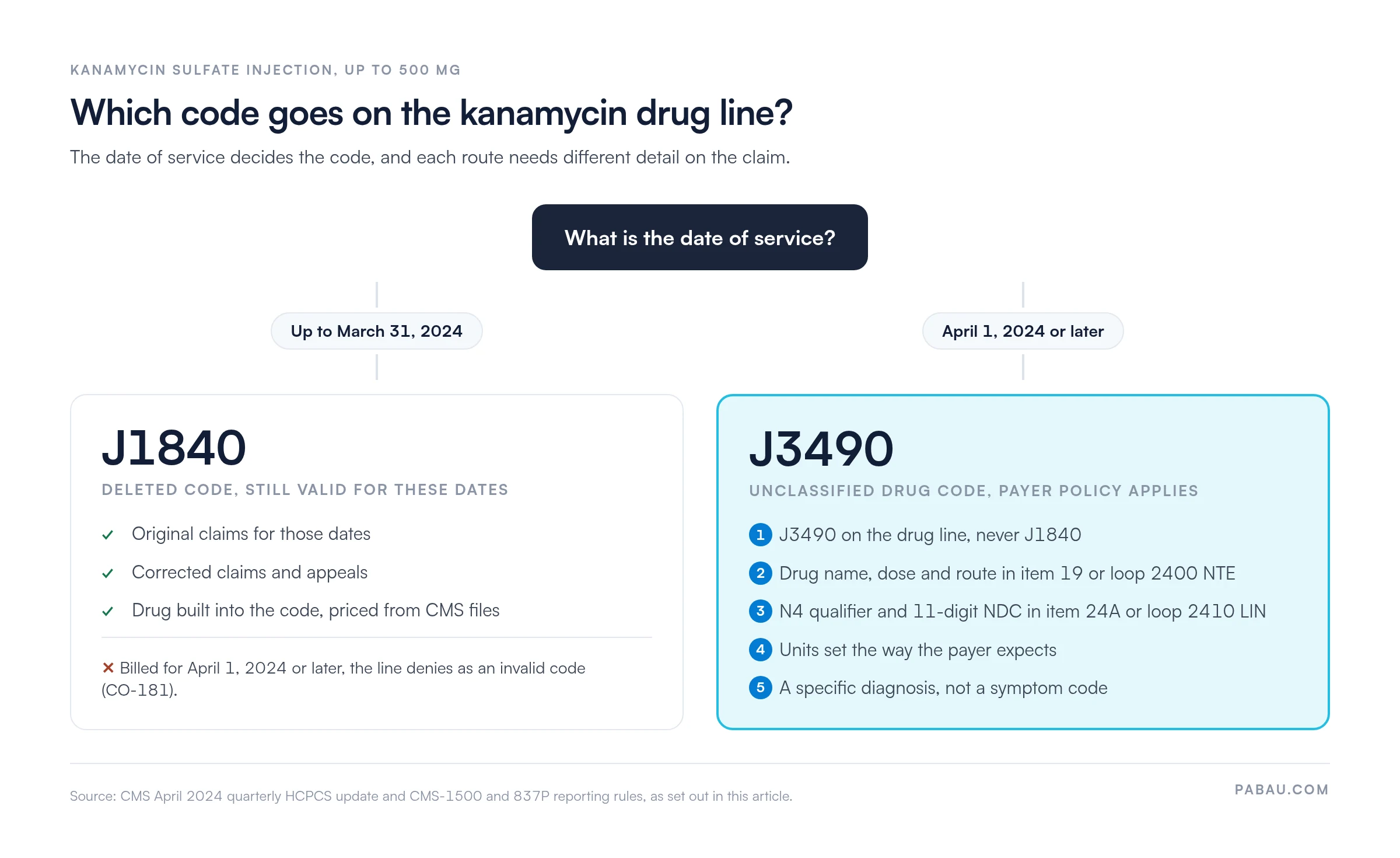
With no replacement code, kanamycin injection now goes on J3490. That code covers drugs without a code of their own, and some payers publish their own instructions for it. Check the policy before you submit.
Unclassified drug lines draw more scrutiny in audits. A complete narrative and a matching NDC keep the line consistent with the record.
A clean claim for kanamycin given from April 1, 2024 needs five elements to line up with each other.
Add the administration code on its own line, and record any prior authorization number the payer issued.
The drug code covers the drug only. A separate CPT administration code describes how it was given. An IM dose usually goes on 96372, while an IV infusion starts with 96365.
Check the National Correct Coding Initiative (NCCI) edits before you submit. A pairing that the edits bundle returns a CO-97 denial.
Medicare has no current J1840 payment rate, because the code is not payable for dates of service from April 1, 2024. A J1840 figure in an older pricing file does not apply to current claims.
Your Medicare Administrative Contractor (MAC) prices an unclassified drug line individually. Expect a request for the invoice or other pricing support. The CMS ASP pricing files still help you check rates for any other drug on the claim.
In hospital outpatient departments, unclassified drug lines are generally packaged into the related procedure payment rather than paid separately.
Keep the invoice for each kanamycin vial with the patient record. When the MAC asks for pricing support on a J3490 line, you can send it the same day.
Traditional Medicare does not usually require prior authorization for an injectable antibiotic like kanamycin. Medicare Advantage plans and commercial payers often do, and policies vary by plan.
When a payer requires authorization, the record must show why kanamycin fits. That usually means a culture result naming a susceptible gram-negative organism. It also means a note on why other antibiotics were unsuitable, plus the prescribed dose.
Link at least one ICD-10-CM code to the drug line to show medical necessity. The code should name a condition that kanamycin treats.
Payers often question drug lines that rest on a symptom code such as R50.9 or R05.9 (cough, unspecified). Code the confirmed organism or infection site instead.
If culture results are pending when the dose is given, document the suspected infection. Then update the diagnosis once the results arrive.
Most kanamycin denials now trace back to the code deletion or to a thin J3490 narrative. Understanding the denial codes payers use helps you fix each one on the first resubmission.
Effective denial management strategies for drug lines start before submission. Check the code’s status for the date of service, the narrative and the NDC every time.
A complete record protects the claim against medical necessity denials and pricing queries. Good medical billing compliance treats the clinical record as the first line of audit defense.
A structured superbill with fields for the NDC, dose and administration method keeps these details together for the biller.
Today, the dose, the vial’s NDC and the invoice often sit in three different places. The biller then rebuilds the J3490 narrative from memory or from scanned paper.
Pabau’s practice software keeps the treatment note, digital forms and invoicing in the same patient record. The clinician records the drug, dose, route and NDC in the note. The biller reads the same record when building the claim.
Pabau’s claims software for practices works from that same record, so the narrative matches the chart. When a payer asks for supporting documents, they are already on file.

Pabau keeps the treatment note, NDC details and invoice in one patient record, so your J3490 narratives match the chart.

Treat J1840 as a historical code. Use it only for dates of service up to March 31, 2024, and retire it from your charge master today.
For current kanamycin claims, the work moves to J3490. That means checking supply and payer policy first, then a narrative, NDC and diagnosis that agree with the chart.
The trade-off is slower, manual pricing, which a complete record makes predictable. Book a demo to see how Pabau keeps drug documentation and invoices in one patient record.

Need to understand how drug claim denials are categorized? Denial codes in medical billing explains the full CO/PR/OA reason code framework and how to match corrective actions to each code type.
Looking to streamline how your practice tracks claim submissions? Medical billing workflows explained walks through the end-to-end process from encounter to remittance.
Want a cleaner first-pass acceptance rate on drug claims? Clean claim submission covers the data elements payers validate automatically and how to prevent common formatting failures.
Billing another drug that has no code of its own? HCPCS code J3490 explains how the unclassified drug code works and what payers expect on the claim line.
No. CMS deleted J1840 with a termination date of March 31, 2024. It is not payable for dates of service on or after April 1, 2024, and CMS assigned no replacement code.
CMS named no replacement. Kanamycin injection given from April 1, 2024 is usually billed under J3490, the unclassified drug code, with the drug name, dose and NDC. Confirm the payer’s policy first.
Yes. J1840 stays valid for dates of service up to March 31, 2024, including corrected claims and appeals for those dates.
On the CMS-1500, enter the N4 qualifier, the 11-digit NDC, the unit qualifier and the quantity in the shaded area of item 24A. On the 837P, the NDC goes in the LIN segment of loop 2410.
There is no current J1840 rate. Your MAC prices a J3490 line individually and may ask for the invoice. Hospital outpatient departments generally see unclassified drugs packaged into the procedure payment.
Supply of kanamycin injection in the US is very limited. Confirm the product is available before you schedule a course, and record the NDC of the vial used.
CO-181 when J1840 is billed after the deletion, and CO-16 when a J3490 line lacks its narrative or NDC. CO-4 follows a missing modifier, CO-97 a bundled administration code, and CO-50 a vague diagnosis.



